
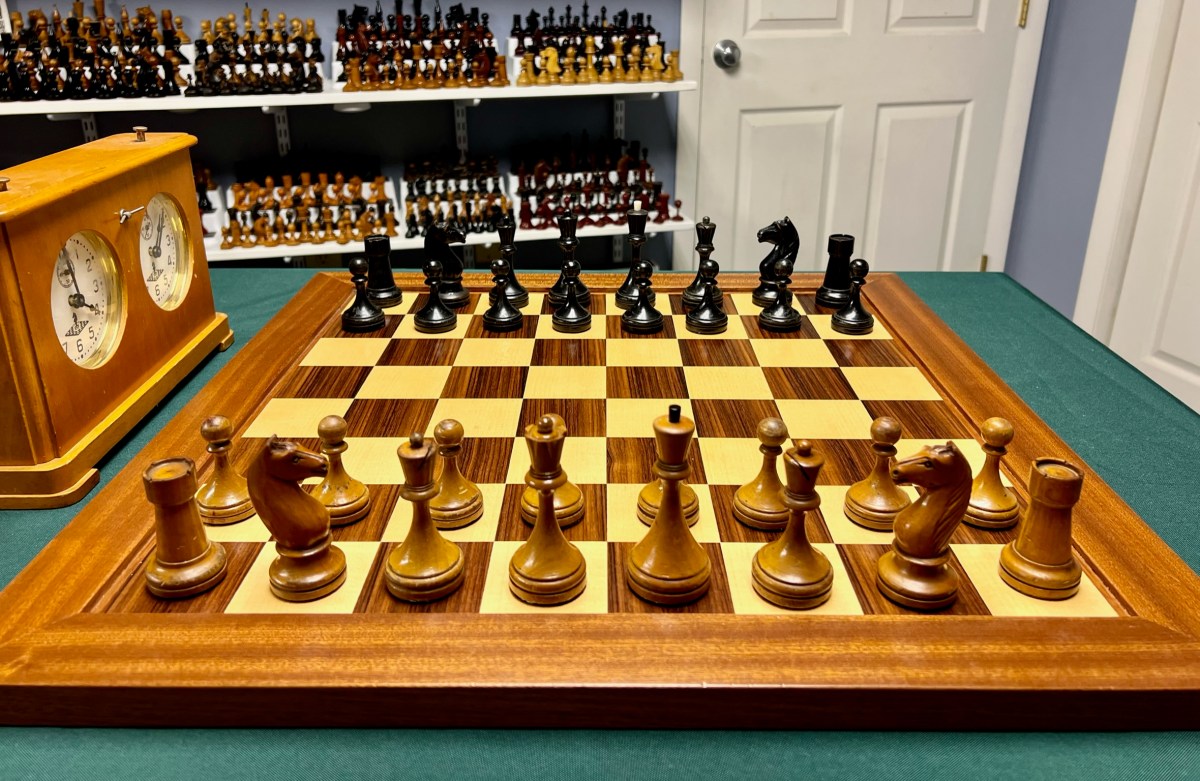
The Second and Third Moscow International Tournaments of 1935 and 1936 were the second and third major Soviet events to use the iconic Botvinnik-Flohr II design, the history of which we have chronicled here. The first event in which pieces of this design were used was the 1934 Leningrad Masters Tournament. The significance of the 1935 event is discussed here.
At least two different styles of knights are evident in photos from the 1935 event. Most well-known is the knight shown in this famous photo of Capablanca.
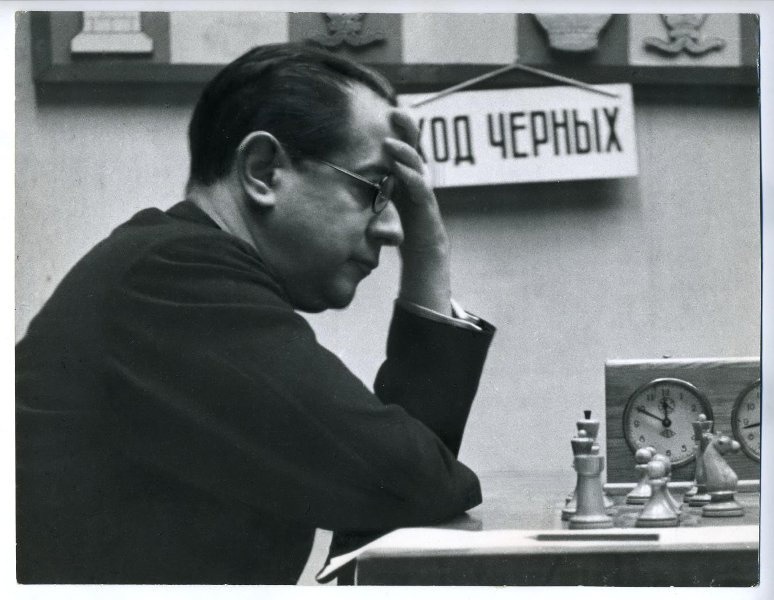
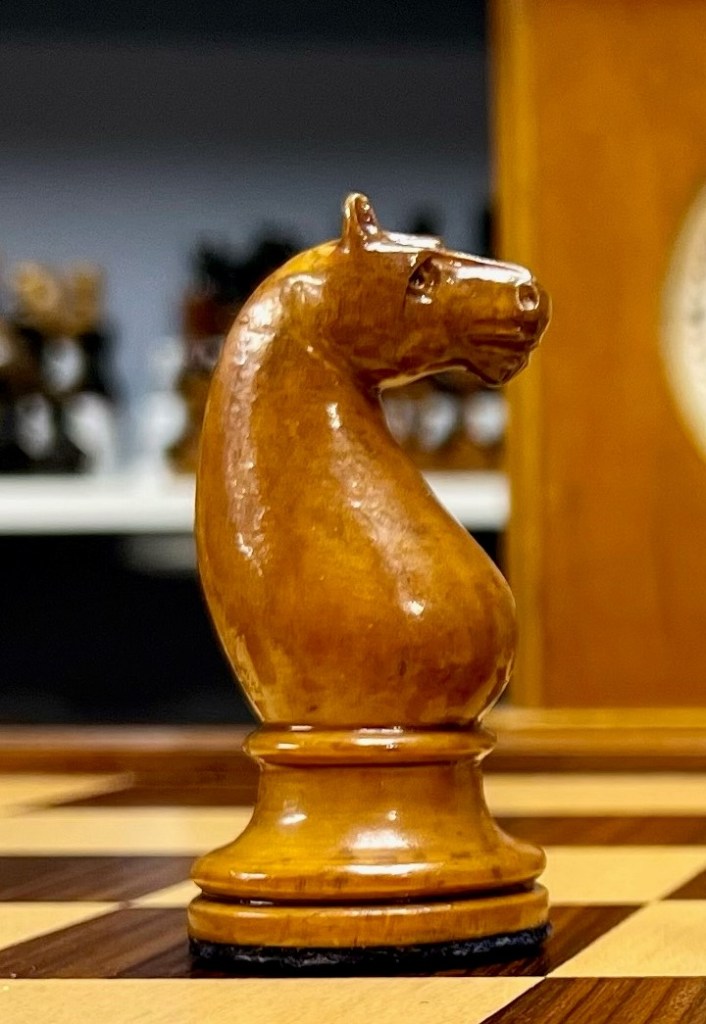
Here is a close-up of Capablanca’s knight. For the sake of discussion, I’ll refer to it as the Capablanca Knight.

The Capablanca’s knight is turned slightly to the left of the line of the file, allowing us to glimpse both of the horse’s ears. The most evident distinguishing feature of the Capablanca Knight is the ear placement rising vertically from the arc of the back. It also has protruding eye sockets, forward-facing eyes, and a relatively short snout. St. Petersburg collector and artisan Sergey Kovalenko has described its face as a “bear.” Here is an example from my collection.
But a second type of knight appears in photos of Vera Menchick from the 1935 event.
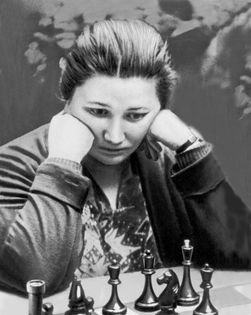
Two knights appear in this photo: Menchick’s King Knight is on d7, and her Queen knight is on b8. The d7 knight exhibits a very different ear configuration and the Capablanca Knight. Whereas Capablanca’s knight’s ears protrude from the arc of the back, the ears of Menchick’s d7 knight organically continue the arc of the back. Menchick’s d7 knight appears to have the same large eye sockets and forward-facing eyes as Capablanca’s knight, but a longer snout; the knight on b8 appears to have a different facial configuration, with eyes more to the sides of the head. The ear configuration of Menchick’s d7 knight is not visible, though it is clear that the ears point forward, rather than to the sides, as they do in the 1950s Olympic versions of the BFII. For the sake of discussion, I am going to refer to two types of c. 1935 BFII knights: The “Capablanca Knight,” with the protruding ears; and the “Menchick Knight,” with the organic ears.
Here is a set I recently acquired. The kings, queens, bishops, rooks, and pawns have all the characteristics of the 1935 Moscow sets. I characterize the steeds as Menchick Knights because of the organic placement of the ears continuing the arc of the horse’s back.

Here are the set’s knights.

According to Moscow collector Alexander Chelnokov, some Russian and Ukrainian collectors refer to knights of this type as “Mongolian,” but inasmuch as this usage apparently does not derive from the set’s Mongolian ancestry or the historical occupation of Kievan Rus by the Mongols, I decline to adopt it because of its pejorative connotations in English and other languages.
That said, there may be a connection between the Mongols and the general form of the BFII and Baku knights, which according to Linder’s The Art of Chess Pieces (1994) first appeared in early 15th Century Novgorod. The Novgorodian artisan who carved Novgorod Knight no doubt was aware of the extent of Mongol control over Kievan Rus, and of tribute, trade and other dealings between Novgorod and the Mongols. It is plausible that the artisan’s knowledge of the Mongols, their horsemanship, and their horses somehow influenced the form he carved, but that remains little more than a hypothesis in want of further evidence.
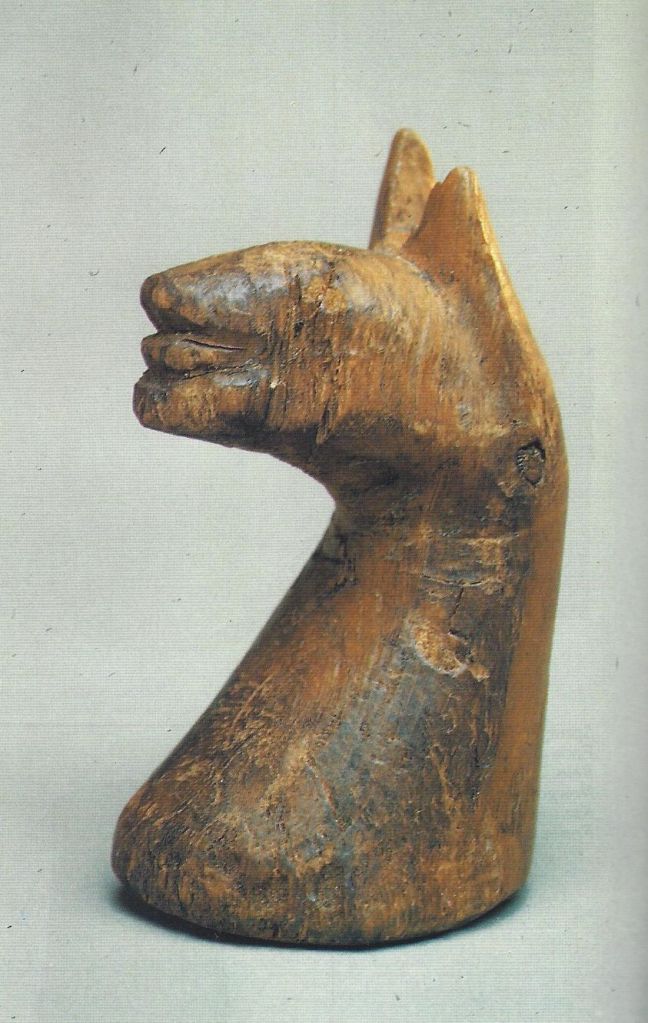
A set similar to mine, but with the White pieces in red, resides in the collection of American collector Mike Ladzinski.

The Menchick Knights appear to have been used in the 1935 game between Botvinnik and Flohr. Inasmuch as the design takes its name from these two giants of the chessboard and their first place tie at this historic event, perhaps they are the ultimate expression of the set used in that tournament.
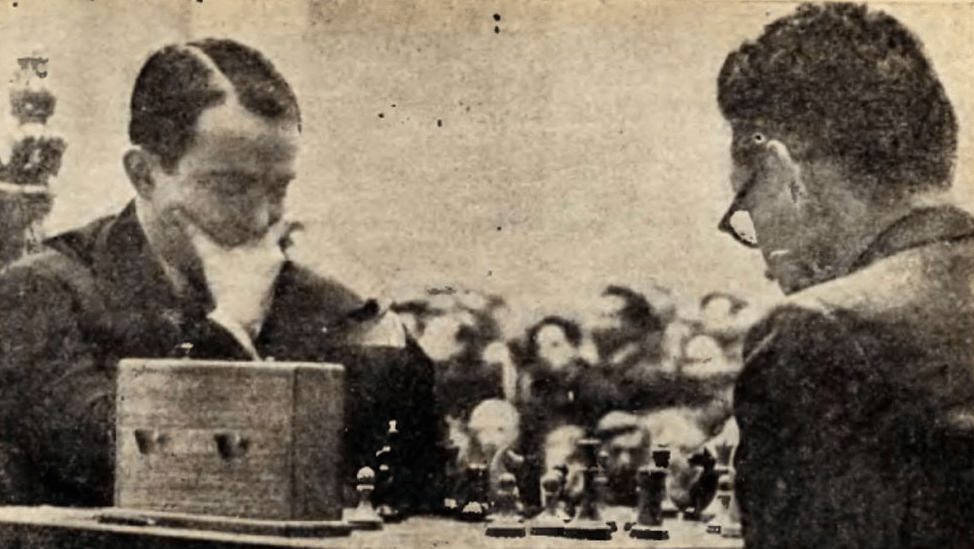
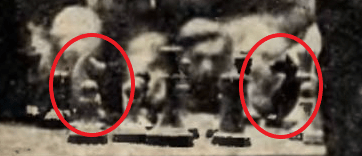
In a future article, we will explore the different variations of the BFII sets of the 1930s.

 Soviet and Late Tsarist Chess Sets
Great articles, as always! And congratulations on the column in the American chess magazine! Best regards, Terje
LikeLiked by 1 person
Many thanks, Terje! I appreciate the kind words!
LikeLike