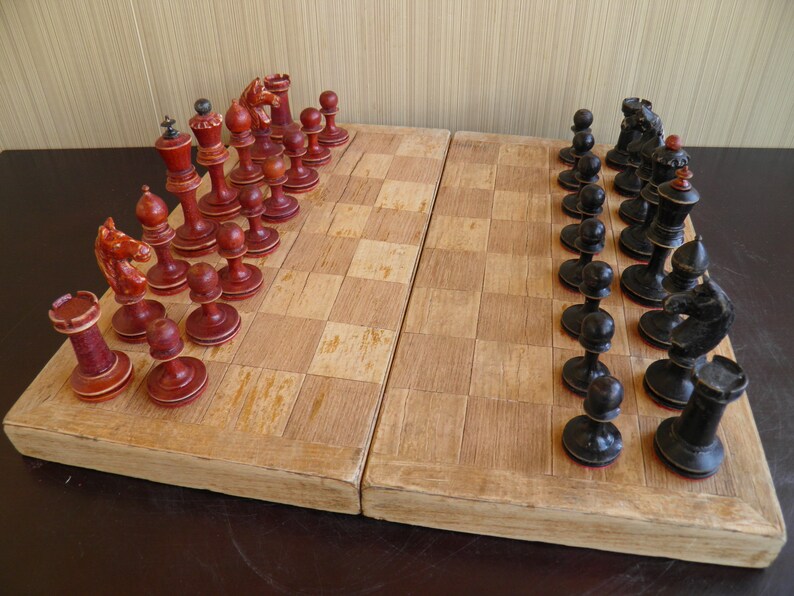
Perhaps our favorite way to date Soviet chess sets is to find them in photos that can be reliably dated, a methodology that gives us a “no later than” date to the pictured set. Sometimes, however, sets come with information on accompanying boxes that allows us to reasonably estimate their age. So it is with a fascinating set that was offered for sale by Ukrainian vendor Igor Grechyshki on EBay and Etsy. (It was sold shortly after I posted this article.) The set gives us a rare glimpse of pieces of the 1920s, a period for which there is a relatively sparse photographic record.
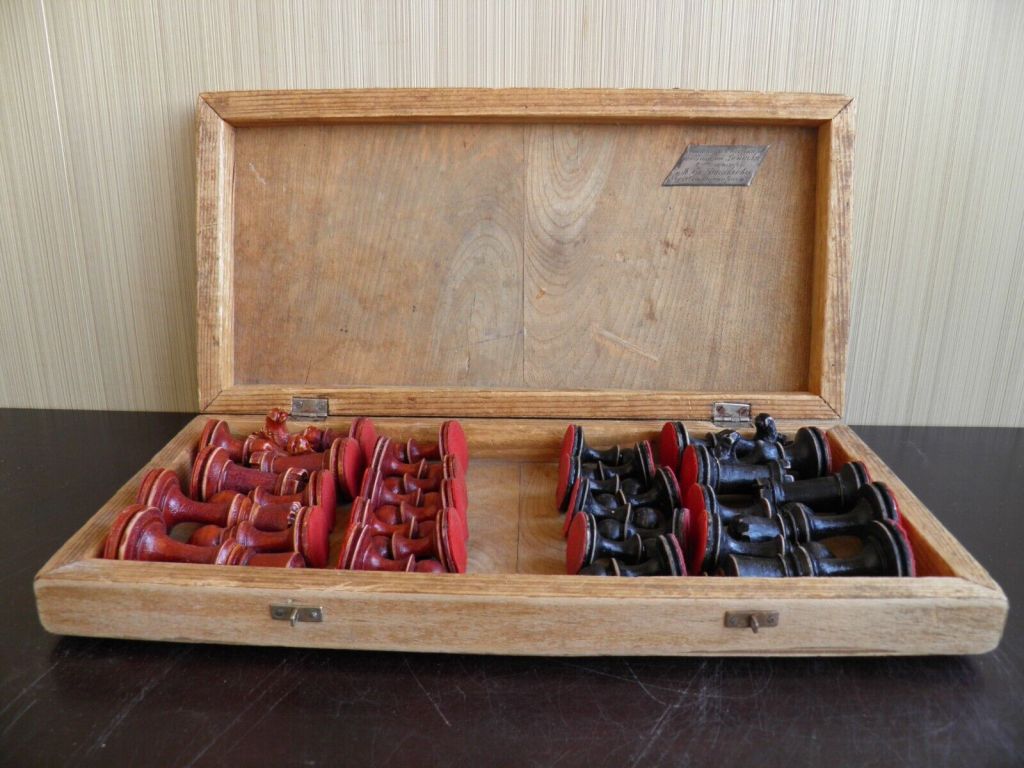
The set comprises 32 weighted wooden pieces in red and black armies, with kings 95mm tall. The pieces are housed in a typical Soviet board/box, which bears an engraved plaque.
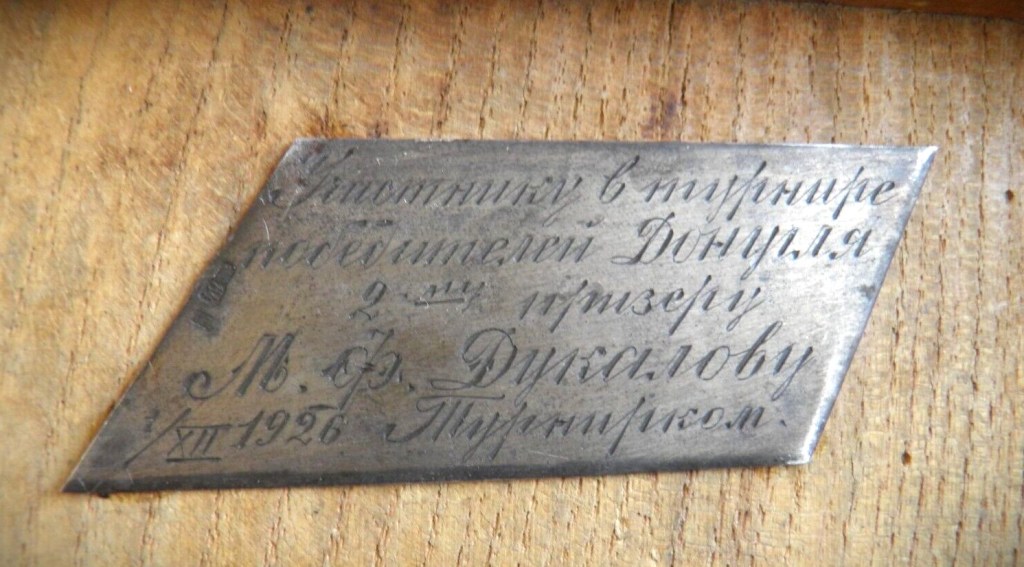
As translated by Igor, the plaque reads as follows: To the participant in the tournament of winners the second prize-winner M.F. Dukalov 1.12.26. Tournament Committee. The maker of the set is unknown, and the style is as yet unnamed. I’ll refer to it as Dukalov’s Set, in homage to the player who took second place in the tournament. Its significance lies in that it’s one of only a handful of Soviet sets we can reasonably date to the 1920s.
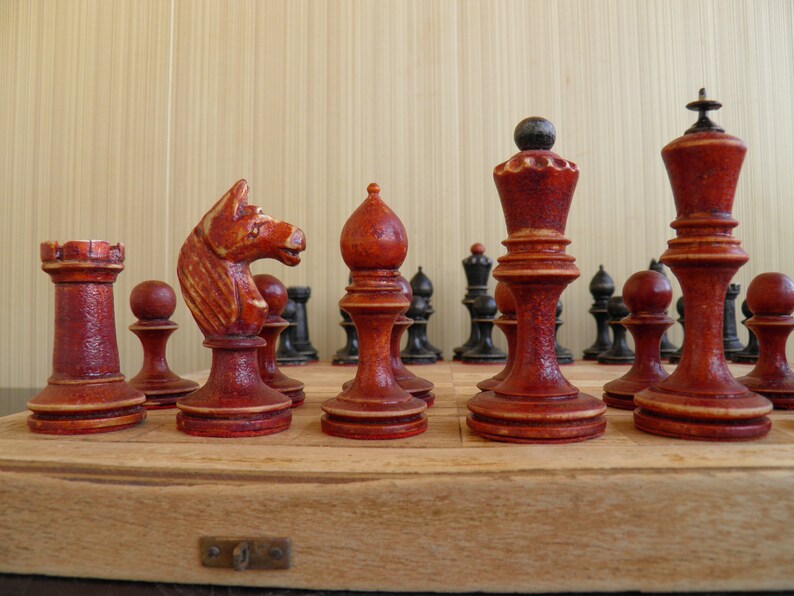
Weighted with lead and of good size, the pieces are of tournament quality. Stylistically, they exhibit Staunton, Soviet, and Modernist elements. The relative sizes of the pieces, proportions of height to base diameter, piece signifiers, “triple collar” structure, step-up base, and proportion of piece signifier to set signifier (base and stem) comport with Staunton norms.
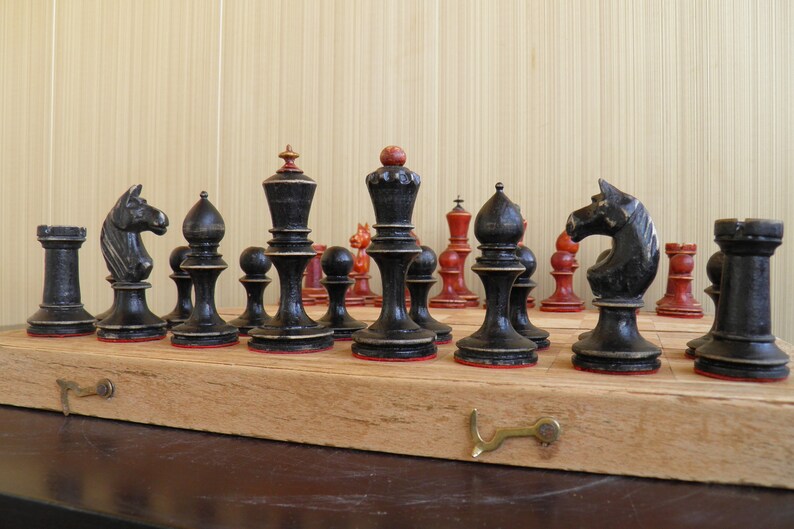
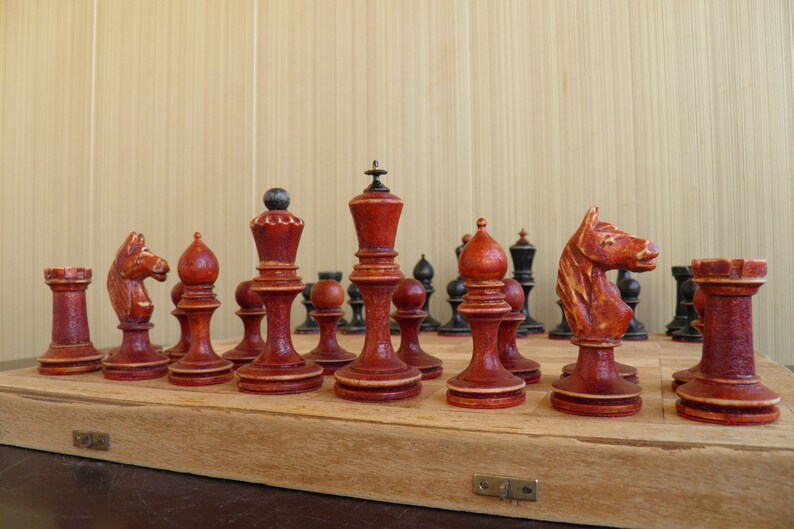
The CV shape of the knight is typically Soviet. The secularized, cut-less bishop miters and cross-less king finials are characteristically Soviet while also reflecting the abstract Muslim influences Linder has documented on the pieces of Ancient Rus. These influences persisted centuries longer than they did in the West, as the modernized game did not reach Russia until the rule of Peter the Great, c. 1760. The mildly dendriformic shapes of the stems reflects Modernist influences we’ve discussed earlier with respect to the Smyslov design, which also appeared in the 1920s. The continuous flow of the stem into the pedestal that supports the piece signifiers of the royals, clerics, and pawns is another Modernist influence that we’ve explored in relation to the Botvinnik-Flohr II design, which first appeared in 1934.
According to Igor, a native of Kharkov:
The tournament was held in the building of the State Trust for Coal Mining and Sales, located in Kharkov (former Ukrainian SSR, now Ukraine). In October 1929, the reorganization of the trust began, culminating in its liquidation in January 1930. The building, built for the trust in 1925, combines the features of Art Nouveau and constructivism, which were so popular in Kharkov in the 20-30s. last century. The facade is decorated with two figures of miners by the famous Ukrainian, Soviet sculptor, film and theater director, playwright, screenwriter I. Kavaleridze.
The building is pictured below.

While I could find nothing m0re on M.F. Dukalov the chess player, a Google search revealed an M. F. Dukalov to have co-authored several works on mining and related to a mining and timbering institute located in Kharkov in a set of scientific abstracts compiled by the American Central Intelligence Agency and declassified in 2000.
Many thanks to Igor for bringing this wonderful set of the 1920s to our attention, for his research, and for his permission to cite it and to re-post his photographs.

 Soviet and Late Tsarist Chess Sets
The colors (red and black) of the “Dulalov” set seem to be consistent with sets made in the 1920’s during Stalin’s reign which began in 1924.
LikeLiked by 1 person
Yes, they do.
LikeLike