I'm a chess collector, chess player, and retired attorney. I've been collecting Soviet and Russian chess sets since 2014. I'm interested in their history, design, and the people who made and played with them. I have published articles on Soviet sets in the magazines of Chess Collectors International and CCI-USA, and author a column on chess collecting for American Chess Magazine. I consult with House of Staunton on the reproduction of historic chess sets. I have collaborated with NOJ Slovenia on the very first reproduction of the popular “Tal” set and with Official Staunton on the reproduction of the set of the 1966 Havana Olympiad.
The 1930s saw an explosion in the production of Soviet chess sets and in the creativity of their designs. While very simplified designs began to be produced in Gulag workshops worked by largely unskilled prisoners to meet the demands of the Soviet State’s program of bringing chess and culture to the masses, smaller cooperatives of skilled artisans known as Artels threw off the yoke of the Staunton design and began incorporating Modernist and Constructivist elements into their designs.
Artel Kultsport
Artels were collectives of handicraft-producing artisans, originating in Tsarist times yet expressly recognized by Soviet law, which produced consumer goods and handicrafts. These artisans labored in a commonly owned workshop with commonly owned tools, and their products belonged to the cooperative. They organized their own production efforts and shared costs and revenues.
Artels saw a dramatic expansion during the late twenties and thirties, but an equally dramatic reduction in numbers during World War II. By 1960, all the remaining Artels had been converted to state factories. G. Phillips, Handicrafts in the Soviet Union, 14 JOURNAL OF THE INTERNATIONAL AFRICAN INSTITUTE NO. 4 209 (Oct. 1943); F. Leedy, Producers’ Cooperatives in the Soviet Union, 80 MONTHLY LABOR REVIEW 1064 (No. 9, Sept. 1957).
Foremost among the chess-producing cooperatives was Artel Kultsport, located in Moscow. Artel Kultsport produced chess pieces, chess boards, chess tables, checker sets, and other sports-related items. This “advertisement” from the 1930s lists the artel’s product line and lists its Moscow address. Ironically, the graphic designer does not appear to have been a chess player!
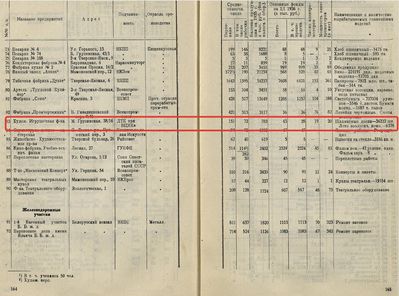
Here are two pages from the 1936 Moscow Directory recoding the production of 34,359 chess boards by Kultsport, uncovered by the excellent research of St. Petersburg collector Sergey Kovalenko into the history of Soviet chess-manufacturing entities.
Source: Sergey Kovalenko
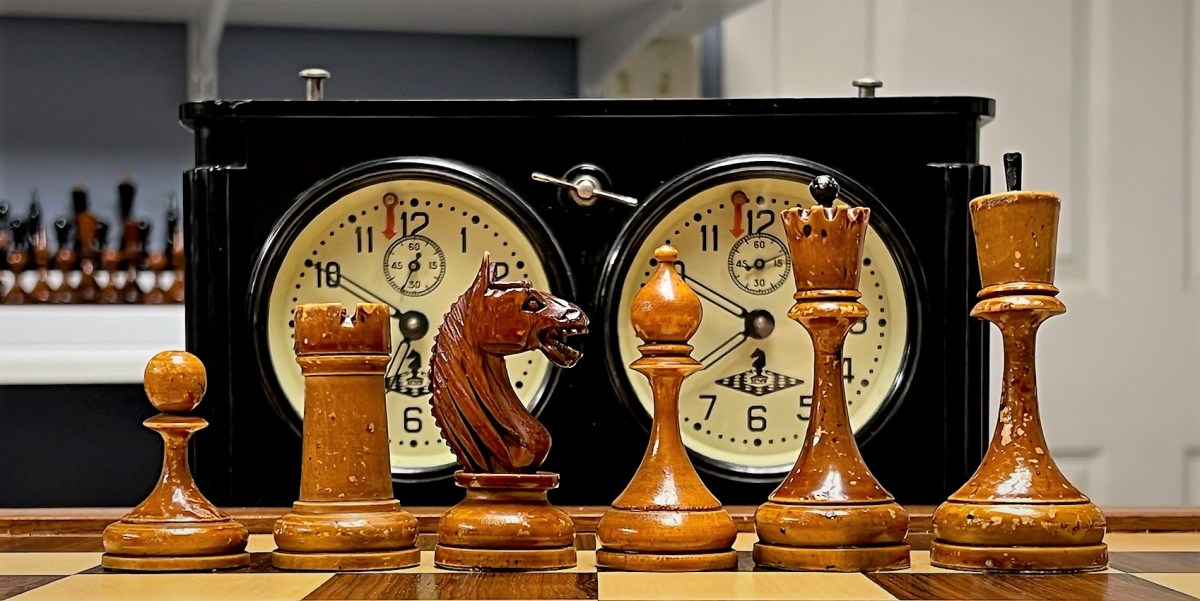
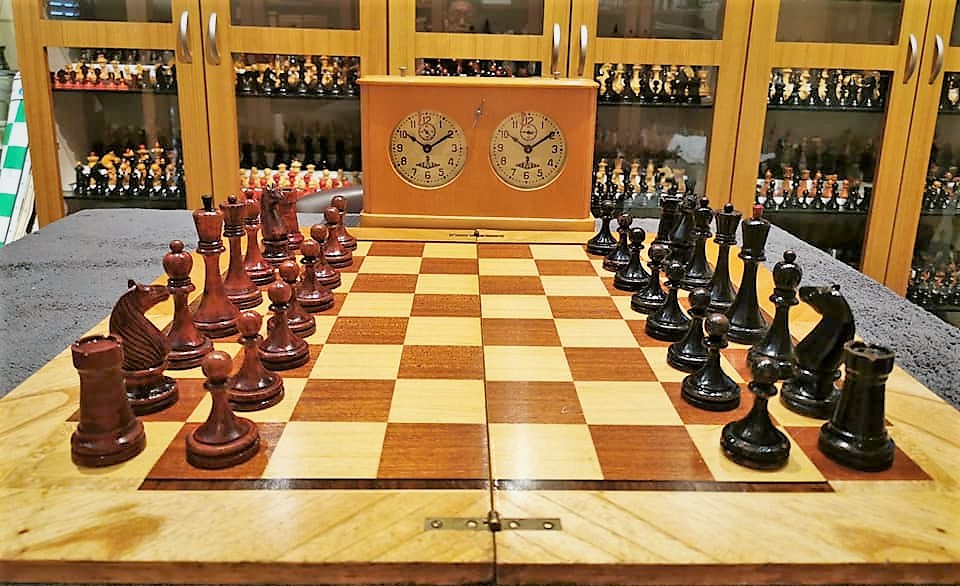
The Ferocious Knight Set
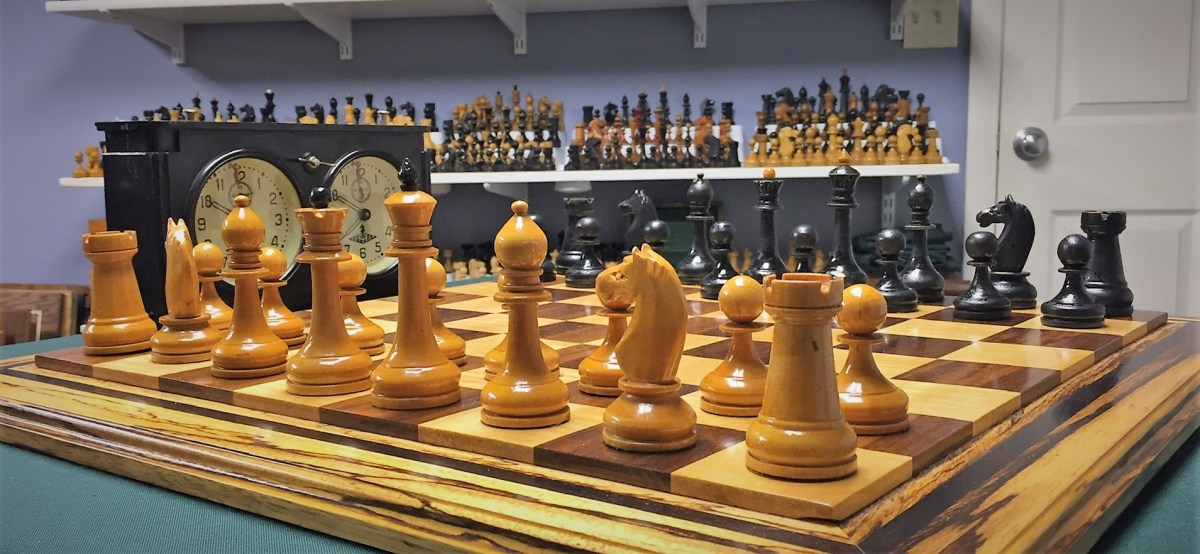
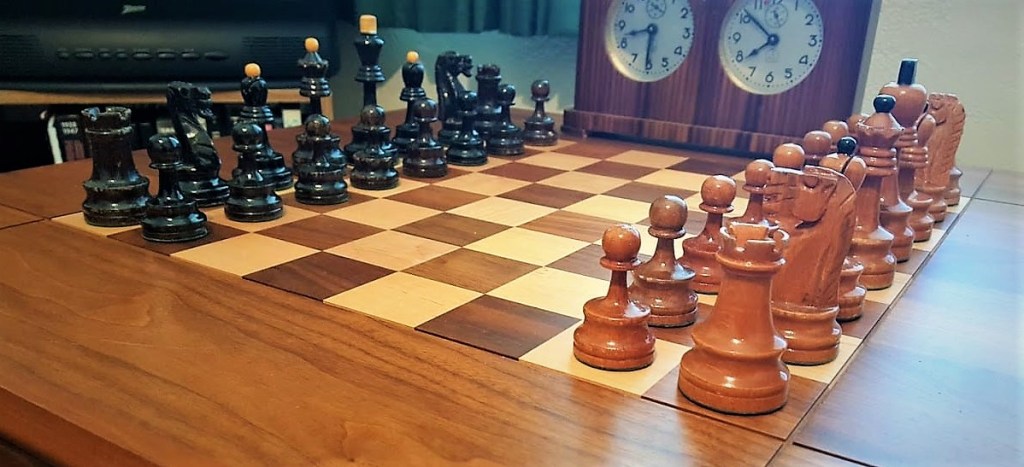
Among the most beautiful of the sets Artel Kultsport produced was this tournament set, whose pieces are weighted and whose kings are 100 mm tall.
Chuck Grau Collection, photo.
The beautiful red-toned box/board contains a partial paper label linking the set to Artel Kultsport.
Chuck Grau Collection, photo.
The set is finished with the caramel-colored varnish typical of the 1930s, and is well-scarred by cigarette ash. Some of the pieces, even a rook, exhibit warping, a very uncommon affliction in Soviet sets.
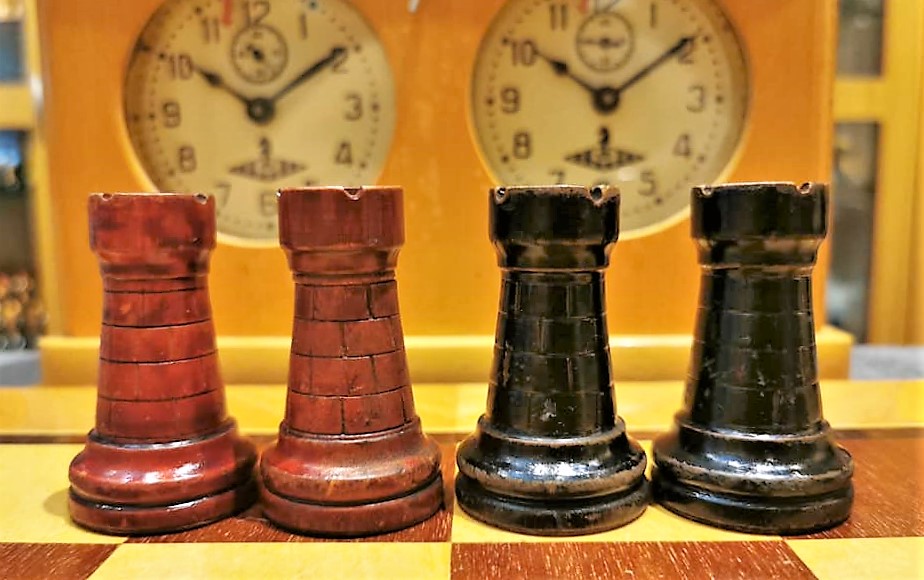
The pieces of the set retain some Staunton elements. The pieces’ relative proportions reproduce the column and pediment structure analyzed by architect and chess set designer Dan Weil. The Queen wears a coronet and the rooks turret bears merlons.
Chuck Grau Collection, photo.
At the same time, the set dispenses with the Staunton’s “triple collar.” It also replaces the King’s cross with a spiked finial, a practice that Isaak Linder documented goes back to ancient Rus. Linder, The Art of Chess Pieces (Eng. ed. 2002). The Bishop’s miter resembles the onion tops of Orthodox churches. In addition to the traditionally Russian elements, the set-identifying elements of the pieces–their bases, stems, and pedestals–form a continuous geometric curve that reflects Modernist and Constructivist influences and resides at the core of Soviet design. The rooks tubular appearance presages the barrel-rooks of sets of the early 1940s.
Chuck Grau Collection, photo.
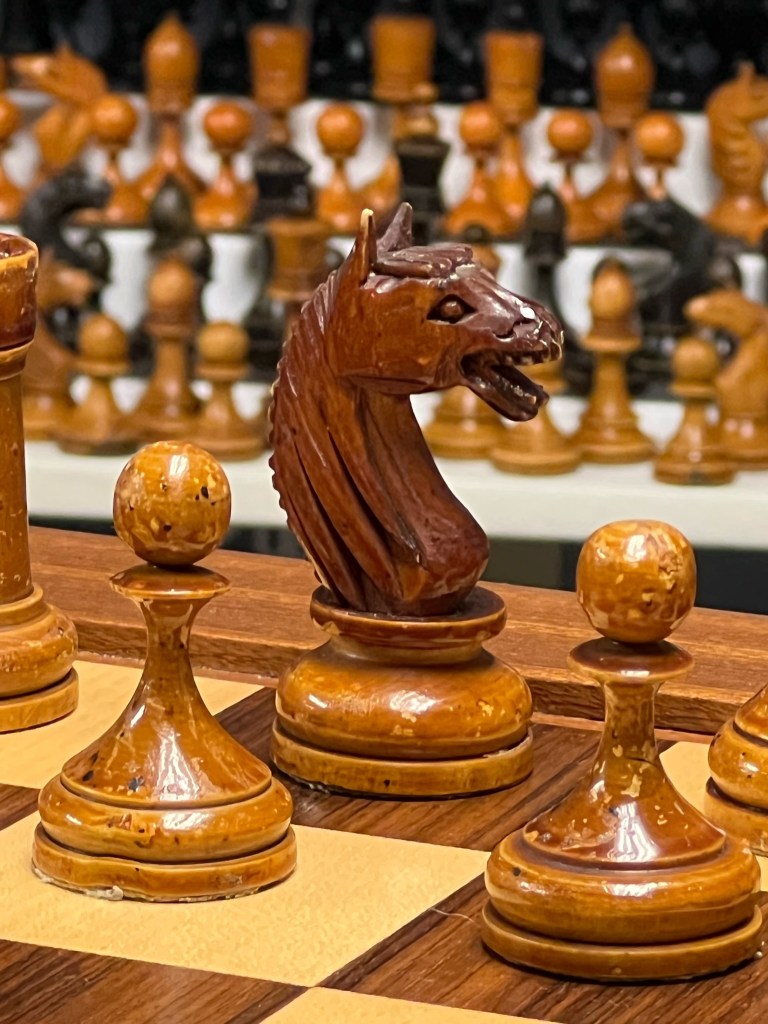
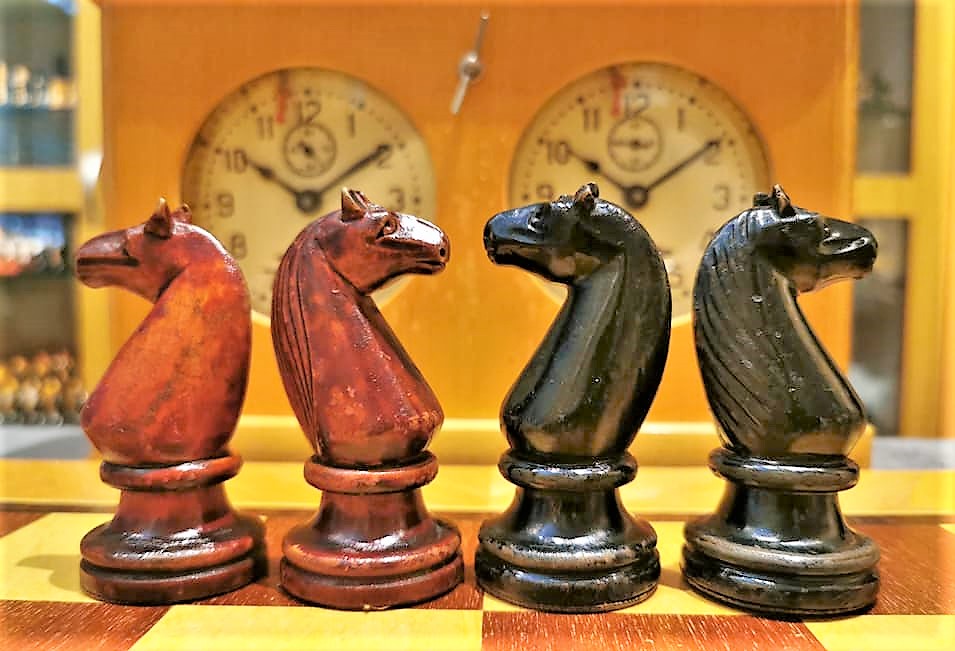
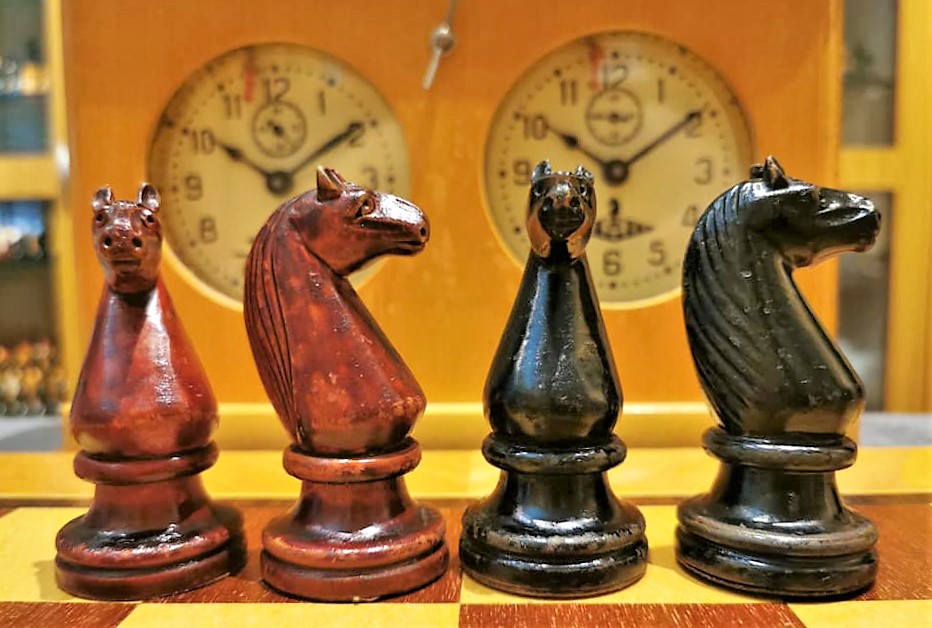
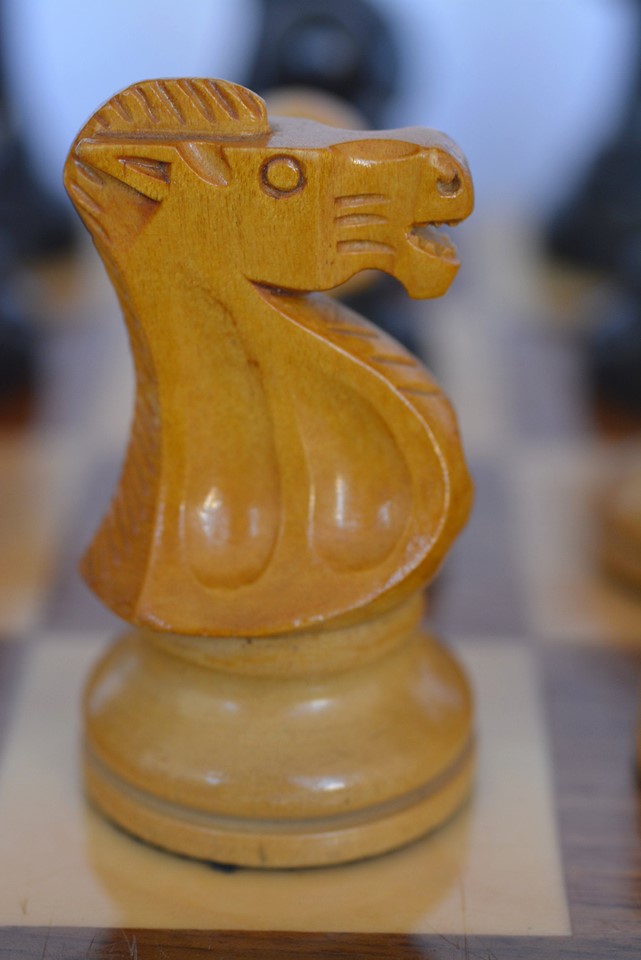
The knights of this set are magnificent. The standard Staunton S-shaped spine has been eschewed in favor of the Soviet C-shaped spine and V-shaped chest. While the carving is detailed, it depicts not the horse of the Elgin Marbles, but a highly expressive stylized horse with exaggerated eyes and over-sized mouth gaping open to bite its foe with its large and finely detailed teeth. Its forward-perked ears tell us the horse is at heightened alert, focused on the enemy to its front. By contrast, the ears of the Staunton’s Elgin Marble knight are pinned back. The sweeping side mane is beautifully carved, and the mane carvings along the spine foretell those found on the knights of the early 1940 Barrel Rook set.
The 1930s Artel Kultsport Ferocious Knight Set embodies the high production standards, creativity in design, and Modernist elements of Soviet artel sets of the era. Its fierce knight perhaps symbolizes the spirit to attack the future, the past, and enemies of the State both foreign and domestic.
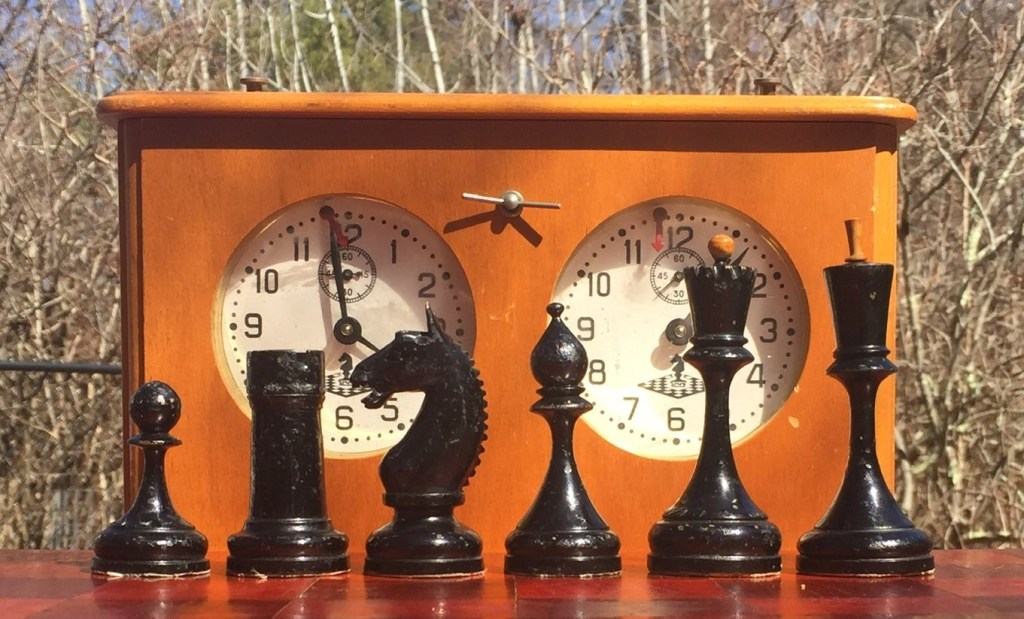
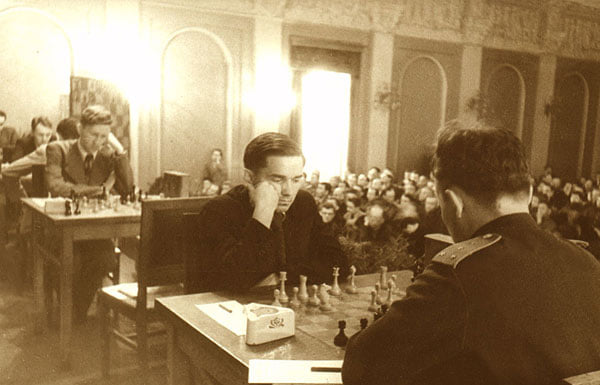
An interesting set that adopts a good number of Staunton design elements. I call it the “Proto-Tal” set because it is so similar to the Tal set in a pre-Annexation photo of Keres and Mikenas playing in an Estonia-Lithuania Friendship Match in Tallinn in Spring 1940 that the two must be related. We already have examined the development of the Tal chessmen here in From Tallinn to Tbilisi: the Evolution of the Tal Chess Pieces.
Tal chess pieces of the 1940 Keres-Mikenas game in Tallinn, Estonia. Photographer unknown.
The Prot0-Tal set is tournament-sized but unweighted. My specimen retains its original black cloth bottoms. The king’s cross is decidedly non-Soviet, evidence of its origin in Estonia or another Baltic state prior to their Annexation by the Soviet Union late in 1940. Here are the proto-Tal pieces:
For comparison sake, here are the 1940 Tal pieces in Mike Ladzinski’s collection. The knight is better developed and carved. The bishop’s miter is cut. The pieces are weighted and are covered with red rather than black cloth.
1940 Tal chess pieces. Mike Ladzinski Collection, photo.
I believe the Proto-Tal set preceded the 1940 Tal set because the knight of the Keres-Mikenas photo is a mature Tal knight, very similar to those appearing in photos of events from 1940 to 1979, whereas the Proto-Tal knight is barely pubescent. I also believe it to be of Baltic, possibly of Estonian origin. We know that Tal sets appeared in the Baltic region as early as 1940 from the Keres-Mikenas photo. We also know that Mike Ladzinski’s c. 1940 Tal set came to him from Lithuania, and that Ron Harrison’s Proto-Tal set like this one came to him from Estonia. These facts support an inference of the set’s Baltic origins.
Proto-Tal chess pieces. Mike Ladzinski Collection, photo.Proto-Tal chess pieces. Ron Harrison Collection, photo.
Alternatively, it is also possible that rather than being the source of the Tal set, the Proto-Tal set is a simplified version of the early Tal set manufactured for popular rather than tournament use. This would explain the greatly simplified knights, the lack of weighting, and the absence of a miter cuts on the bishops.
The Proto-Tal set appears to have originated in the Baltic region prior to its annexation by the Soviet Union, and to be the progenitor of the widely loved Tal chess pieces.
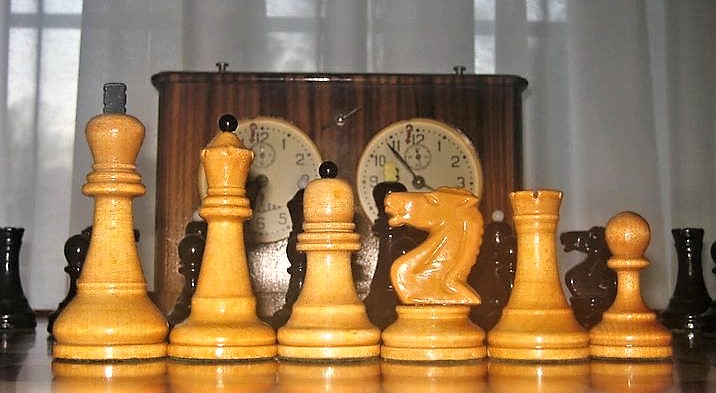
This photo of young Kamsky came across my Facebook feed recently. The set he and his father are using reminds me very much of the set used in the 1941 Leningrad Championship, a variation of the venerable Botvinnik-Flohr II pieces first introduced at the 1934 Leningrad Masters Tournament.
Gata Kamsky and his father Rustam, c. 1987. N. Adamovich /TASS photo. Source: Douglas Griffin.
According to Wikipedia, “The [1941 Leningrad] championship continued to be played, in spite of tremendous difficulties, during the siege of Leningrad in the Second World War, though the tournament of 1941 could not be finished…”
Here is a discussion of chess in besieged Leningrad by Dmitry Oleinikov, Director of the Moscow Chess Museum, who begins by referring to chessmen printed on paper cubes for the city’s beleaguered citizens:
The spirit, enclosed in weak flesh-this is what these lightest, hollow inside, cardboard cubes, painted with red and black ink, remind of. This is the chess of besieged Leningrad.
Instead of the boards and figures that burned down in the stoves of the insatiable bourgeoisie in the terrible winter of 1941-1942, the Leningrad Industrial Complex launched the production of the most simple and cheap chess. And all because in the besieged city thousands of people played and wanted to play chess.
Besieged Leningrad Set. Moscow Chess Museum Photo.
Just as the citizens of Leningrad continued to play chess through the siege, the city championship went on. Writes Oleinikov:
Already in November 1941, the strongest chess players of Leningrad (among those who were not evacuated or drafted into the active army) announced: “Today, in a difficult and tense situation in the city of Leningrad, we are opening the next chess championship. <…> We are in good spirits, and no blockade, no hardships can hinder us.”
The newspapers of December 1941 became smaller, appeared less frequently, and nevertheless found space for messages: “The unfinished games were played out in the chess championship of Leningrad. Before the fifth round, Novotelnov is ahead … Today the next round will take place in the N hospital “. In the hospital – because the chess players came to their spectators and fans, and the further, the more the chess proved its healing effect.
The siege lasted almost three years, and up to a million and a half Soviets died from it. Among them were many chess organizers and highly ranked players. Oleinikov continues:
The organizer of the tournament was Samuel Weinstein, an active figure in the Soviet chess movement from its very first years. The 1941 championship will be Weinstein’s last chess brainchild: he will die in that terrible winter. The blockade will take away many famous and not famous chess players from Leningrad. Among them are Vsevolod Rauser, a renowned theorist who proclaimed: “e2 – e4, and White wins!” composers brothers Kubbeli … On the way to evacuation, Alexander Ilyin-Zhenevsky will die under bombing; having already reached Perm, the master and author of popular books Ilya Rabinovich will die of exhaustion. Many young chess players of Leningrad, who were predicted to have great achievements before the war, will die at the front, and remain as candidates for the master… having already reached Perm, the master and author of popular books I.L. Rabinovich.
Alexander Ilyin-Zhenevsky, father of Political Chess, died during the Siege of Leningrad. Public domain photo.
But despite the hunger and the cold, the hard labor and the death, organized competition went on. Oleinikov writes:
And yet, … participants [in the Leningrad Championship] recalled that even getting to the site of the tournament was not easy: they had to reckon not only with enemy shells, but also with police squads and military patrols that directed pedestrians to bomb shelters during shelling. 16-year-old Aron Reshko, the future foreman, and then the youngest participant in the 1943 and 1944 championships, was sent out of town for agricultural work and walked tens of kilometers every day to participate in the championship. One of the tournament participants, Vasily Sokov, spent the whole night on the eve of the next round on duty, extinguished seven incendiary bombs, and the next day he was offered to postpone the game. He replied: “At the front, they are fighting day and night, and there is no need to arrange a resort for me here!”
The conditions were abysmal:
They played to the accompaniment of exploding shells, bomb explosions and antiaircraft artillery shots; frozen over a difficult position, they forgot about the bomb shelter – even when one day the blast wave knocked out all the glass in the room! To maintain the strength of the participants – and to fight scurvy – they were given nettle soup and pine compote…
1941 Leningrad Championship BFII pieces. Steven Kong Collection, photo.
Surviving specimens of the set used in the 1941 Leningrad City Championship are exceedingly rare, but one is held in the collection of Steven Kong of Singapore.
1941 Leningrad BFII Pieces. Steven Kong Collection, photo.
The pieces incorporate the architecture and detail of the original mid-1930s BFII pieces, but for three aspects. Instead of the angular miter of the earliest versions, the miter of the 1941 Bishop is ovoid. Unlike the earliest miters, the 1941 miters lack cuts. And, finally, the 1941 Rook towers are carved with mortar work not found in the earlier versions.
1941 Leningrad Championship BFII Rooks, showing mortar work detail. Steven Kong Collection, photo.
The knights are exceptionally beautiful, and bear a striking resemblance to the Novgorod Knight of the 15th Century.
1941 Leningrad Championship Knights. Steven Kong Collection, photo.1941 Leningrad Championship Knights. Steven Kong Collection, photo.Novgorod Knight. 15th Century. I. Linder, Schachfiguren im Wandel der Zeit photo.
The set of the 1941 Leningrad Championship, held under the horrendous conditions of the Siege of Leningrad, was a fascinating evolution of the venerable Botvinnik-Flohr II design. Surviving examples of this beautiful and historic set are extremely rare.
The set used in the 1944 Soviet Championship continued to steer chess set design away from the Modernist elements of earlier Soviet sets and towards the incorporation of more traditionally Staunton elements. The source of production for the set remains a mystery despite an unusually large amount of relevant evidence.
The 13th USSR Championship was held in Moscow in May and June 1944 by which time tide of the Great Patriotic War had turned against the Nazi invaders. Mikhail Botvinnik won the tournament over a field of seventeen players. It was the first Championship played since 1941. Breaking from the practice of using Botvinnik-Flohr II pieces, which were heavily influenced by Modernist design concepts, the 1944 Championship pieces were much more traditionally Staunton in their design, an evolution of the Barrel Rook set we previously have examined.
Here are several photos of the 1944 event.
Kotov v. Versov, 1944 USSR Championship, 1-0. Photographer unknown.Closeup of the pieces in the Kotov-Veresov.Smyslov v. Botvinnik, 1944 USSR Championship, 0-1. Photographer unknown.
The pieces are very similar in structure to those of the Barrel Rook set, except for the angled walls of the Rooks, which are straight in the Barrel Rook set, and the smooth spine of the knight, which bears a toothed mane upon its spine. In addition, there is a faintly discernible shadow pattern on the side of the 1944 knight, which I believe to be the product of mane carvings on the side of the horse’s neck.
The following pieces are like those in the photographs from the 1944 Championship.
Chuck Grau Collection, photo.
The pieces reject the concave and dendriformic stems so typical of sets of the late 1920s and the 1930s, and instead employ the long, narrow stems resembling neoclassical columns and in proportions like those found in Staunton pieces. As with Staunton pieces, the joint between the stems and the pedestals of the royals, clerics, and pawns are perpendicular; and the crowns and miters of the royals and clerics are connected by cylinders bordered top and bottom with distinct rings, which together with the pedestals comprise the “three collars” common to Staunton sets.
Chuck Grau Collection, photo.
The design abstracts away the step-up base of Staunton sets, replacing the step with a carved ring which defines the boundary between base and stem, but, as in Soviet designs of the earlier two decades, maintains the curved flow from base to stem. The set also retains the Soviet CV structure of the knight’s torso, and the use of finials rather than crosses atop the kings, a practice that hearkens back to ancient Rus.
Although the bishop miters lack the typical Staunton cut, like Staunton pieces, the rook turrets bear clearly carved merlons and the queen’s coronet contains crenel cuts. The royals follow the Eastern European practice of opposite-colored finials.
The pieces came housed in a customary veneered Soviet board/box that is of better than average quality and larger than average 50 mm squares. Still, the pieces, with 100 mm kings, are more appropriate for at board with at least 55 mm squares.
1944 Championship Pieces on original 50 mm board. Chuck Grau Collection, photo.
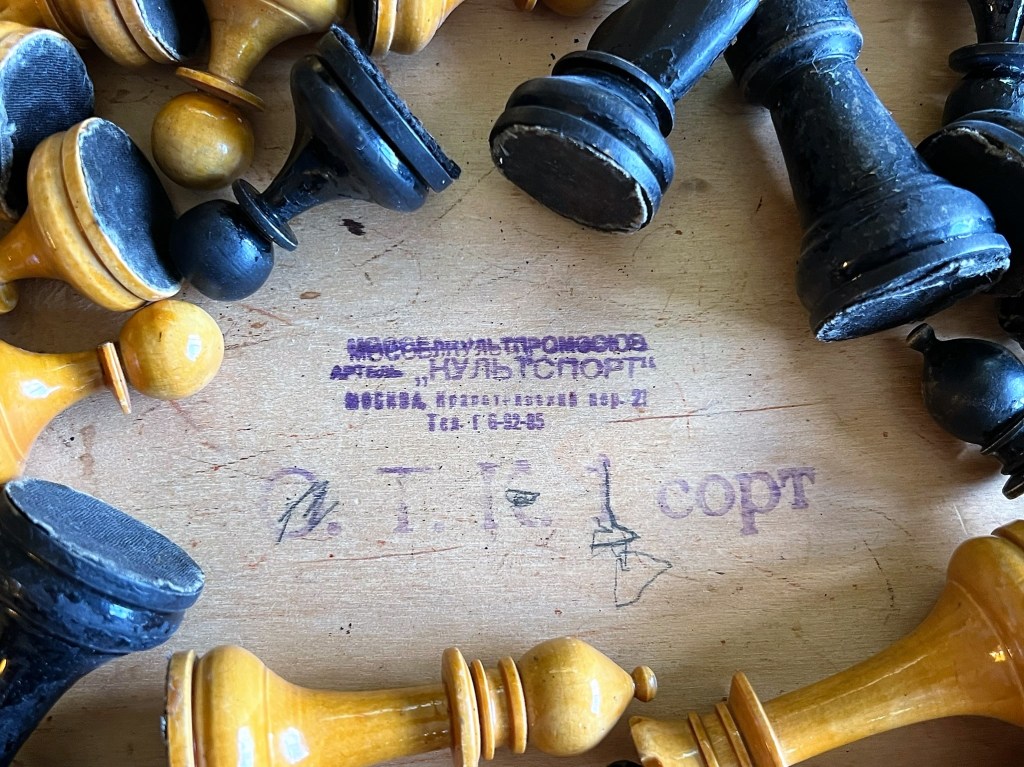
The board bears a stamp indicating the manufacturer to be Artel Kultsport, with a Moscow address, and that the item is 1st Sort, or highest quality.
1944 Championship Set Artel Kultsport stamp. Chuck Grau Collection, photo.
Unlike the Ladzinski and Adamski Kultsport stamps we examined in our review of the Barrel Rook set, this box does not contain a separate stamp indicating the item to be a chess board, or what type of chess board the item is. I interpret this as evidence that the stamp applies to the pieces as well as the board. At the same time, there is extrinsic evidence suggesting that the pieces were made by an entity other than Artel Kultsport.
Moscow collector Alexander Chelnokov believes this line of sets was produced by the Red Combine, located near Zvenigorod, roughly 65 km west of Moscow, whereas Artel Kultsport was located in central Moscow. Chelnokov administers a Facebook group titled Russian Chess Sets (Tsarist, Soviet, and Modern) that features his magnificent collection of Tsarist and Soviet sets, and which I heartily commend to your viewing. It is ironic that this rare instance of a relative abundance of information about the production of a set provides us conflicting data, but such is the enigma of Soviet chess sets.
Conclusion
The set used in the 1944 Soviet Championship continued to steer chess set design away from the Modernist elements of earlier Soviet sets and towards the incorporation of more traditionally Staunton elements. The source of production for the set remains a mystery despite an unusually large amount of relevant evidence.
The looming world war had its impact on Soviet Chess design. Sets began to appear without metal weights, as metals were reallocated to the production of instruments of war. And from a visual perspective, designs began to retreat from the Constructivist and Modernist influences of the late 1920s and 1930s, adopting more traditional Staunton elements, following a trend towards Neoclassicism we already have noted in Soviet architecture.
c. 1940 Barrel Rook Tournament Chessmen. Chuck Grau Collection, photo.
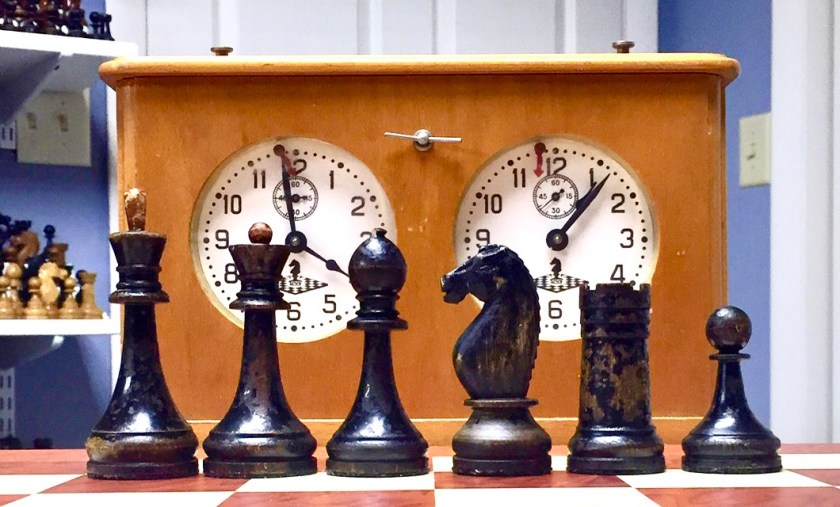
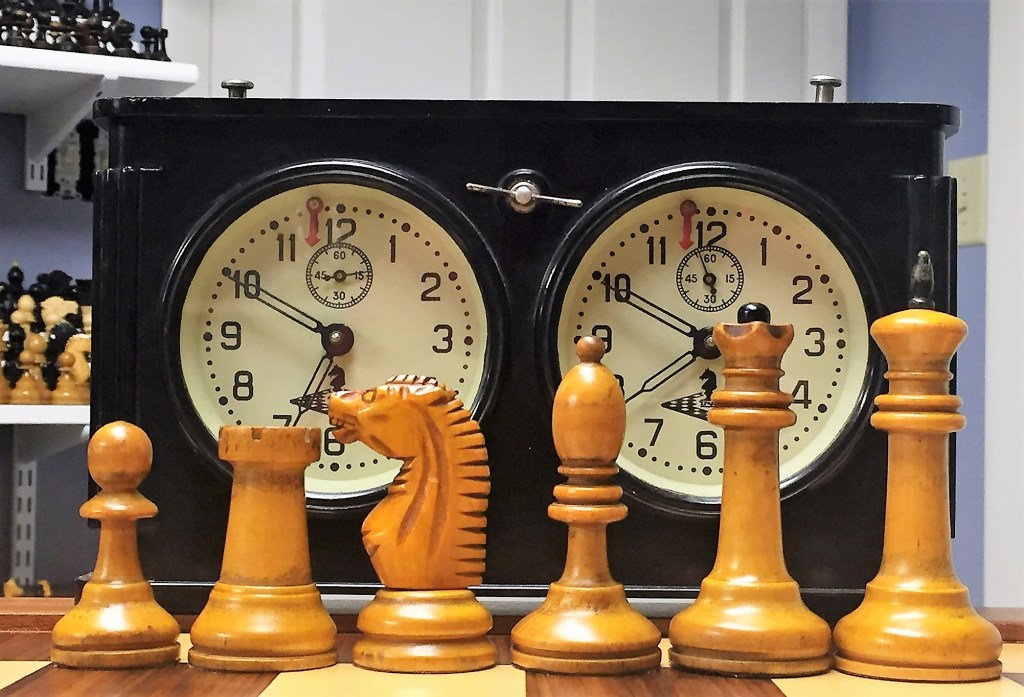
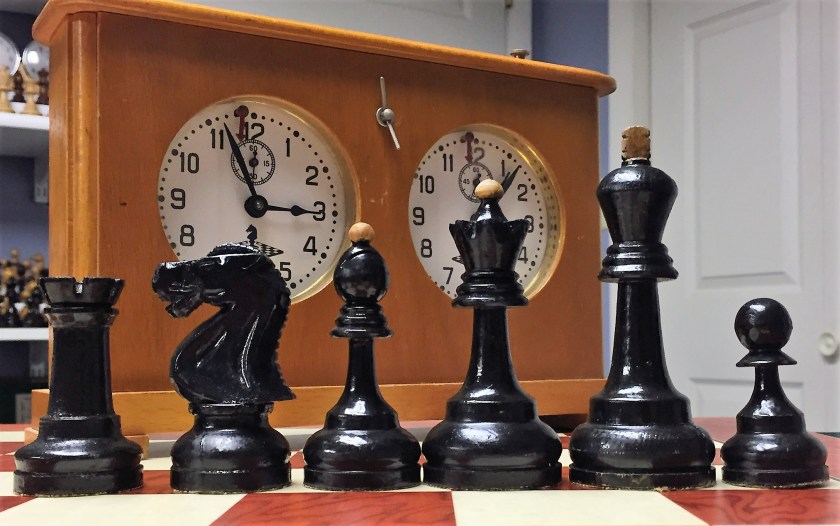
I use the term “Barrel Rook” to describe this set because of the barrel-like shape of its rooks, perhaps the set’s most notable visual attribute. The kings are 98 mm tall, a typical size for a tournament set, and the pieces are unweighted. Nevertheless, the pieces remain fairly stable because of the solid bases and conical bottom of the stems.
c. 1940 Barrel Rook Tournament Chessmen. Chuck Grau Collection, photo.
Gone are the sweeping concave stem curves of the Voronezh Pattern. But at the same time, so is the stepped up base characteristic of the Staunton design and found in the Late 1930s Grandmaster and the phenol resin Soviet Stauntons of the same period. Instead, the stem flows organically from the base in accordance with Soviet design precepts, the only demarcation a shallow turned ring.
c. 1940 Barrel Rook Tournament Chessmen. Chuck Grau Collection, photo.
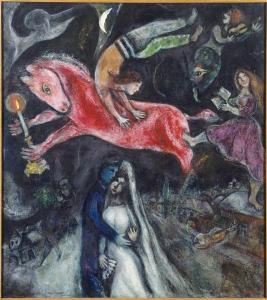
The beautiful knights incorporate the typically Soviet CV structure of the back (C-shaped) and chest (V-shaped) and are nicely carved. Perhaps their most prominent feature are what Berlin collector and artist Porat Jacobson Chagall eyes, because they whimsically resemble those seen in so many of the Belarussian’s images of horses and other paintings.
c. 1940 Barrel Rook Tournament Set Knight. Marc Chagall, A Red Horse (1938).
The photographic record shows the set in use at high levels in what appears to be some time in the 1940s, but the date, location, and name of the event have as yet not been established.
Salo Flohr, Alexander Konstantinopolsky, Barrel Rook chessmen. Event, date, photographer unknown. Source: S. Voronkov, 2 Masterpieces and Dramas of the Soviet Championships 375 (2021).
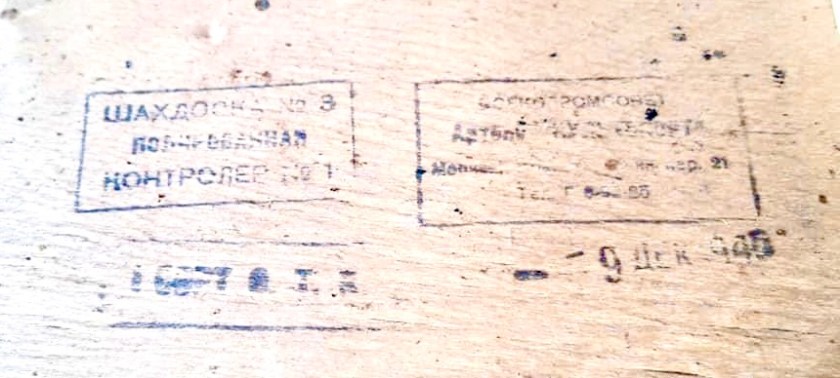
The set probably was made by Artel Kultsport, though Moscow collector Alexander Chelnokov suggests Artel Sila may have been the maker. I infer the date and manufacturer from stamps included in the boxes of similar sets in the collections of Mike Ladzinski and Tom Adamski.
Mike Ladzinski Collection, photo.
The top stamp from the Ladzinski set tells us that Artel Kultsport is the maker, with an address in Moscow. The next stamp identifies the item as Chess Board no 4-a, which according to Kyiv collector and dealer Mykhailo Kovalenko, may indicate squares of 4 cm. The second stamp also tells us that the item was inspected by Controller No. 1, who in the third stamp has indicated it to be of “1 Sort,” or first quality. The final stamp provides the year of manufacture to be 1941.
c. 1941 Barrel Rook Set. Mike Ladzinski Collection, photo.
Tom Adamski’s set provides similar information. His set also originated at Artel Kultsport, and comprised or included Chess Board No. 3. Like Ladzinski’s it is of first quality and was produced in 1945. Many thanks to Mykhailo Kovalenko and Eduardo Bauza for their help in translating the stamps.
Tom Adamski Collection, photo.
Even if the stamps apply only to the boards but not to the pieces found inside them, they are evidence as to when and where the pieces were produced, absent any evidence that they were not. This inference is strengthened by the fact that the pieces in the boxes are very similar, suggesting that both sets of pieces are of similar origin. If the pieces were placed in these boxes randomly, it is far more likely that these two examples would be different than as similar as they are.
Conclusion
The c. 1940 Barrel Rook set, characterized by its stout rooks and Chagall-eyed knights, was used at high levels of Soviet chess. Incorporating more elements of Staunton design than most Soviet sets of the late 1920s and 1930s, it was part of the general repudiation of the Constructivist and Modernist ideas that had helped shape them.
This beautiful set is named and dated by Kyiv collector and dealer Nikolay Filatov. The 110 mm kings, heavy weighting, and superior craftsmanship all mark this as a set used at the very highest levels of Soviet chess and thereby worthy of the Grandmaster name, even though I have not been able to find it in the photographic record. The lead weighting is similar to that of other tournament sets of the 1930s, a practice that ended with the outbreak of war as metal was allocated to military production. And the knight is carved in detail not found in wartime or post-war knights.
Late 1930s Grandmaster Set. Chuck Grau Collection, photo.
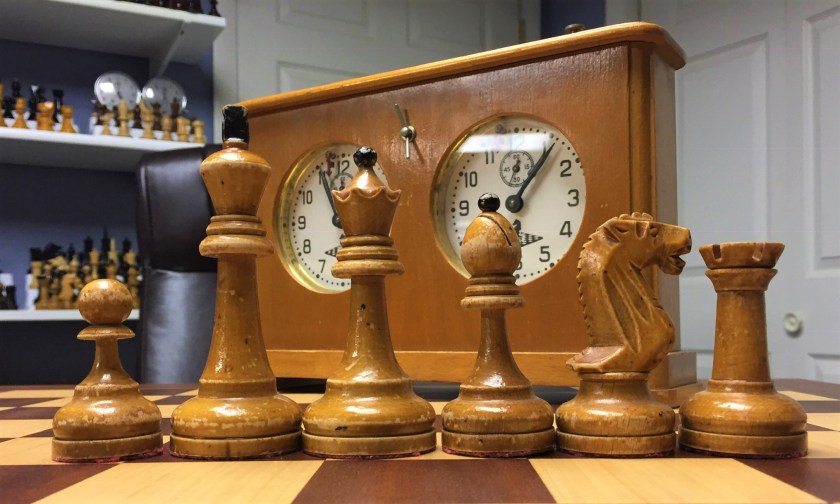
Breaking from the Modernist influences found in other sets of the thirties, these pieces hearken back to the Stauntonesque Karelian Birch sets of the late Tsarist period, notably in the crowns of the royals and the incorporation of more traditional English Staunton elements. These include the triple collars, the stepped up bases, the proportions of the base to stem to piece identifiers, the relative proportions of the pieces to each other, and the columnesque shapes of the stems bases.
Late 1930s Grandmaster Set. Chuck Grau Collection, photo.
The Late 1930s Grandmaster pieces resemble their contemporaries, the 1930s-40s Bakelite and Carbolite pieces made famous in a photo shoot at the 1940 USSR Championship. Interestingly, the rooks of each set find a large hole bored or molded into the top of their turrets.
The Late 1930s Grandmaster pieces are also similar in structure to tournament sets we know to be from the early forties, particularly their collar and crown patterns and proportions.
c. 1900 Karelian Birch, c. 1940 Barrel Rook, and 1944 USSR Championship sets, left to right.
Finally, the Late 1930s Grandmaster pieces foreshadow Soviet Staunton designs that rose to the heights of Soviet Chess in the late forties and the fifties, the Tal sets, the Grandmaster 3 (and “Supreme”) sets, and the last of the Soviet Grandmaster sets, the GM 4.
Tal, GM3, and GM4 sets, left to right.
Conclusion
Although the Late 1930s GM pieces are scarce if even present in the photographic record, they are significant in their high quality, their detailed knights, their rejection of Modernist influences, and their embrace of Staunton architecture, part of the Counterrevolution in Style we already have discussed.
In our examination of the Botvinnik-Flohr II, Smyslov, Cannon Rook, and other Soviet sets of the 1930s, we have seen how the revolutionary precepts of Soviet Constructivism and modernism influenced chess set design in the Soviet Union. We also have examined two designs comprising traditional Staunton elements, the Tal set, which first appeared in Estonia in 1940, and the Grandmaster 3 set, which first appeared in Moscow in 1950. These elements include the straight ascension of the stems; the distinct breaks between base, stem, and pedestals; the step-up from base to stem; the triple collars; the cross atop the king’s crown; the crenels in the queen’s coronet; the bishops’ miter cuts; the merlons of the rooks’ towers; the pieces arrayed mirroring the columns and pediment of classical Greek architecture; and the S-shaped backs of the knights. We have called the latter two sets Soviet Stauntons. The sets’ Soviet identity is largely cosmetic, consisting of opposite-colored finials and the vestigial nature of the king’s cross.
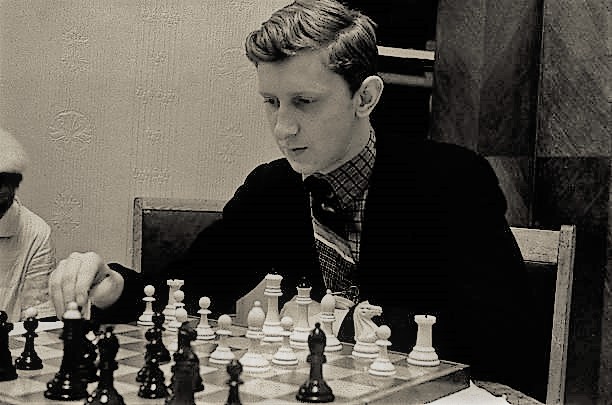
V. Smyslov, Moscow 1940. A. Yegorov, Sovfoto photograph.
Socialist Realism and Stalinist Empire Architecture
Even as Soviet chess set design saw an explosion of creative expression during the 1930s, heavily influenced by modernist concepts, a major counterrevolution in design took seed. Asserting control over art was one component of Stalin’s brutal consolidation of power from the death of Lenin to the beginning of the Great Patriotic War against Nazi Germany. Key to this was the official disbanding of all existing literary and arts organizations in 1932, their replacement with state-sanctioned and -controlled artist unions, and the formal adoption of Socialist Realism as the only acceptable theory of art by Communist Party Central Committee and the Congress of Soviet Writers in 1934. In his address to that Congress, Maxim Gorky declared that Socialist Realist art must be proletarian; it must be typical, addressing the everyday lives of the Soviet people; it must be Realist in style; and it must be partisan, actively promoting the aims of the Soviet state. For Stalin, Socialist Realism meant that art must offer unambiguously positive images of life in the Soviet Union, in a ‘true-to-life’ visual style that the masses could readily digest. The Art Story, accessed 18 May 2022.
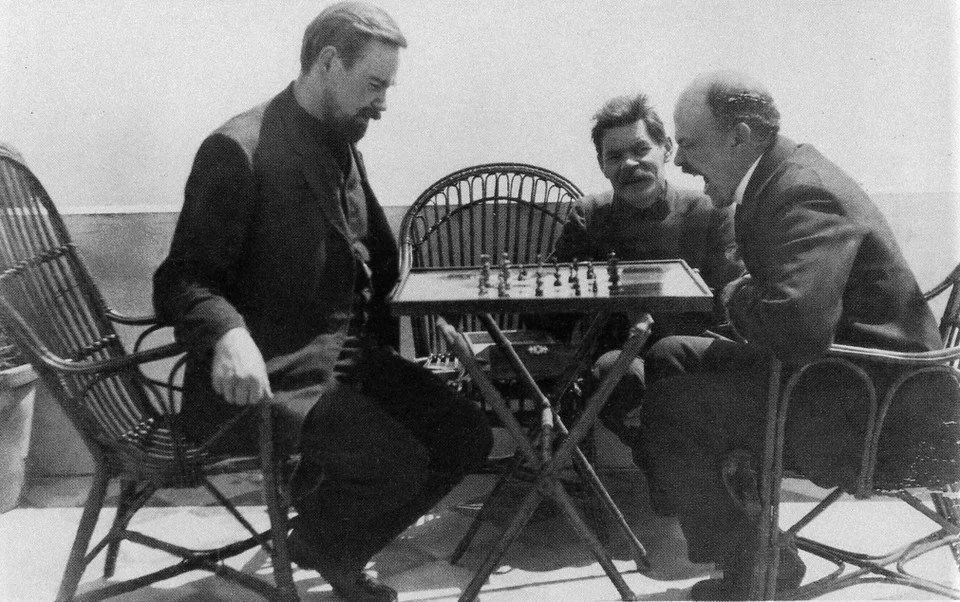
Maxim Gorky watching Lenin and Alexander Bogdanov play chess. Photographer unknown.
Socialist Realism turned Soviet architecture away from the Constructivist influences of Vladimir Tatlin and El Lissitzky and others and towards the Neoclassical influences of the likes of Ivan Fomin, Ilya Golosov, and Vladimir Vladimirov. Id. According to Russian art historians Kristina Krasnyanskaya and Alexander Semenov, the 1930s to mid-1940s saw a shift in architecture and furniture design to Art Deco and Soviet Neoclassicism, often described as Stalinsky Ampir or Stalinist Empire Style, which embraced a return to decor and classical forms. Soviet Design, From Constructivism to Modernism 1920-1980 194 (2020). In the words of Christina Lodder, “During the Stalinist era and particularly in the years just before and after the Second World War, Soviet architects and designers tended to turn their backs on avant-garde approaches and produce furniture and buildings that sought to evoke an immutable classical elegance and a timeless quality in the solidity of their materials, their historical allusions and their ornate forms.” Id. at 11-12. The purpose of this approach, Latvian lawyer Augustinas Žemaitis explains, is that “Stalin sought to make Soviet cities look grander than those of the empires gone-by and perhaps comparable to the US cities. The details inspired by previous styles (columns, towers, etc.) returned even on simple buildings such as apartment blocks.”
A good example of Stalinist Empire Style, in which the Neoclassical influences are evident, are the structures VDNKh, or the Exhibition of Achievements of the National Economy, located in Moscow and dating back to 1939. The entire VDNKh complex includes columned porticos, pediments, domes and lavish sculptural adornments “reminiscent of ancient temples and palaces.” Nataliya Kuznetsova, Stalinist Empire Style in Moscow, accessed 19 May 2022.
Bolshevik Constructivism had sought new forms to forge a new Socialist Society. Stalin’s Socialist Realism sought to prove that his brand of statism met or exceeded the West by adopting the West’s own forms. With Stalin forcibly eliminating his domestic enemies, real and imagined, it should come as no surprise that Soviet chess set designers from the mid-thirties to the rise of Nikita Khrushchev would begin to embrace Staunton chess set designs, which embodied the same Neoclassical design elements that Stalinist Empire Style employed to symbolize the success of the Soviet Union. It likely also offered them a very real form of personal and employment security.
Bakelite Version
The late 1930s saw the introduction of a Soviet tournament chess set unique in three respects. First, it was unabashedly Staunton in its design. Second, its knights copied the Elgin Marble design of the British Jaques knights. Third, it was made of Bakelite, an early phenol-formaldehyde plastic that was moldable.
This Soviet Staunton is a large set, with kings 110 mm tall. It is also heavy despite being unweighted owing to the density of the Bakelite. Its beauty, size and weight mark it as intended for high level tournament play, and the photographic record of later Carbolite versions of the design confirm this.
The moldable nature of Bakelite promised to provide a set that could be easily reproduced and did not involve the labor required to hand carve each and every knight, particularly one so handsome and detailed as this one. Bakelite was hard but brittle, and therefore relied on fillers to give it structural strength. The need to hide the filler led to it appearing primarily in dark colors, typically black and dark maroon in chess sets and other consumer products.
1940 Carbolite Version
The design was made famous by a photo shoot taken at the 1940 Soviet Championship, which was held in Moscow, and therefore is often referred to as the “1940 Championship Club” set. The Smyslov photo as the top of this post is one of those photos. Here are several others.
V. A. Makogonov. 1940 Moscow. A. Yegorov, Sovfoto photograph. Paul Keres. Moscow 1940. A. Yegorov, Sovfoto photograph.
The pieces actually used in the championship, however, were BFIIs, as photographs of the tournament itself establish.
Isaac Boleslavsky. 1940 USSR Championship. The set is clearly a Botvinnik-Flohr IIdesign. Russian Chess Federation photo.
The black and white version of this Soviet Staunton was molded of a different plastic that the Soviets called Carbolite. Like Bakelite, Carbolite is also a moldable phenol formaldehyde resin, developed to transcend the brittleness of Bakelite and obviate the need for fillers and dark colors to mask them. It differs chemically from Bakelite in that it is made from an acidic solution, whereas Bakelite is made from a basic solution. Carbolite was initially developed by the Karpov Scientific and Research Institute of Physical Chemistry in Moscow. J. Crowther, Science in Soviet Russia 67 (1930). The sets likely were made at Karbolit Zavod (Carbolite Plant) in Orekhovo-Zuyev outside Moscow. I believe the Bakelite version of this Staunton design came first because Bakelite preceded Carbolite, but there is also reason to believe that Bakelite versions continued to be made even after the introduction of the Carbolite version.
Here is a beautiful specimen of a Carbolite 1940 Soviet Staunton from the collection of Ron Harrison.
c. 1940 Carbolite Soviet Staunton. Ron Harrison Collection, photo.
Legend has it that the Carbolite chessmen of the 1940 photos were used in the Moscow Chess Club, but I am unaware of any firm evidence supporting that. The legend has the benefit of at least being consistent with known facts in that it first appeared in Moscow and was considered to be an important design. Perhaps the photo shoot was intended to showcase a practical and beautiful application of the Karpov Institute’s research.
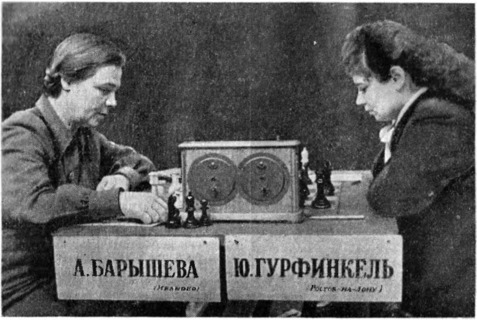
The Carbolite set appears to have been used in the 1946 US-USSR Match, the 1947 USSR Championship Semifinals, the 1948 USSR Men’s and Women’s Championship, and other events.
Keres (R) vs. Fine, 1946 US-USSR Match, held in Moscow. 1-0. Max Euwe, chief arbiter. Photographer unknown.Mikhail Botvinnik, 1946 US-USSR Match, Moscow. Photographer unknown.Simagin vs. Kholmov 1947 USSR Championship Semifinals, Moscow. 1-0. Photo courtesy of Jorge Njegovic Drndak. Photographer unknown.Furman vs. Averbakh (1-0), 1948 USSR Championship, Moscow. Photograph courtesy of Eduardo Bauza. Photographer unknown.Anna Barysheva vs. Yuzefa Gurfinkel. 1948 USSR Women’s Championship, Moscow. Photograph courtesy of Jorge Njegovic Drndak. Photographer unknown.
1950s Carbolite Version
The Carbolite version of this Soviet Staunton continued to be produced in the 1950s. Here are pieces from the set in my collection.
I believe these pieces to be from the fifties, owing to the yellowish cast of the white Carbolite, the red plastic finials of the Black royals, and the obvious casting seams, which suggest the decline in attention to detail that began to creep into post-war production. The castings of my Bakelite specimen and this Carbolite version are virtually identical, though great care was taken to file down the casting seams of the Bakelite pieces. The most noticeable structural difference between the two versions is there is an additional beveled level at the bottom of the Bakelite pieces, giving them a slight height “advantage” over these Carbolite pieces. These Carbolite kings are 108mm. As with their Bakelite comrades, these pieces are heavy despite being unweighted.
Miniature Versions
Both plastics were used to manufacture miniature versions of this Soviet Staunton design.
Late 1930s-1950s Miniature Bakelite Soviet Staunton Pieces. Nikolay Filatov photo.
These pieces were manufactured by Artel Plastmass (артель “Пластмасс”) in Leningrad. According to Russian collector Sergey Kovalenko, one of the plants of the artel “Mineral” was reorganized into the Artel Plastmass around 1937. Sergey tells us that the most famous products of these artels were gramophone records and dominoes. The kings are approximately 70 mm and the pieces are not weighted.
Possibly 1950s Miniature Carbolite Soviet Staunton Pieces. Nikolay Filatov photo.
Conclusion
By incorporating the Neoclassical architecture of the traditional Staunton design, the Bakelite and Carbolite Soviet Staunton sets of the late 1930s, 40s, and 50s rejected the Constructivist and Modernist design influences of the 1920s and 30s, instead embracing Socialist Realism, the Soviet state’s official theory of art as of 1934. In doing so the sets symbolized the arrival of Soviet Chess to the pinnacle of the sport, much as Stalinist Empire architecture signaled the Soviet Union’s arrival as a great empire.
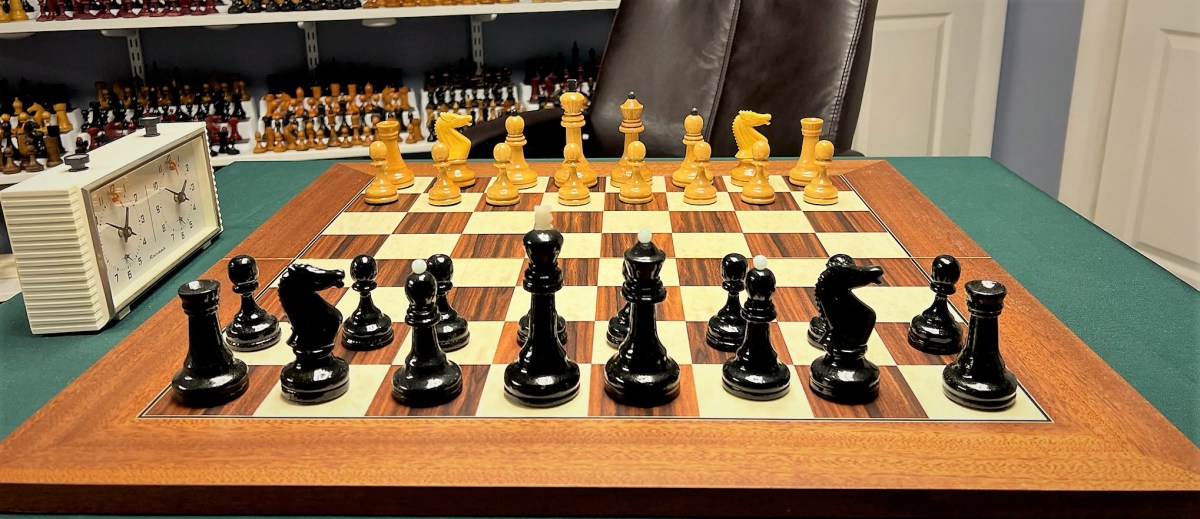
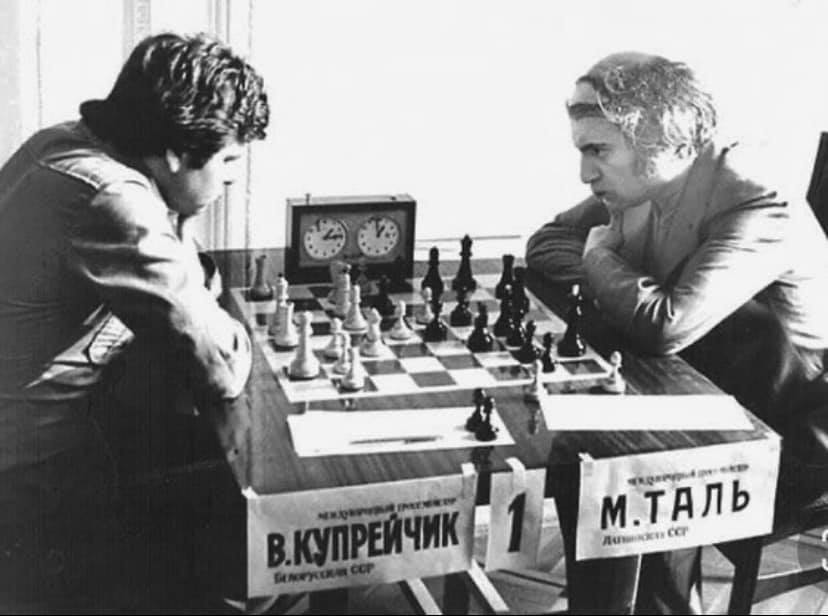
Grandmaster 4 chessmen are the final evolution of the GM3 sets that first appeared around 1950, the end of the line for an august design. Recognizing them to be descendants of the GM3 design, Arlindo Vieira wrote that the GM4 pieces were “the last version of this competitive set.” They represent the further simplification of the GM3 design in the interest of increasing production and reducing cost through factory production and the substitution of plastic parts for carved ones.
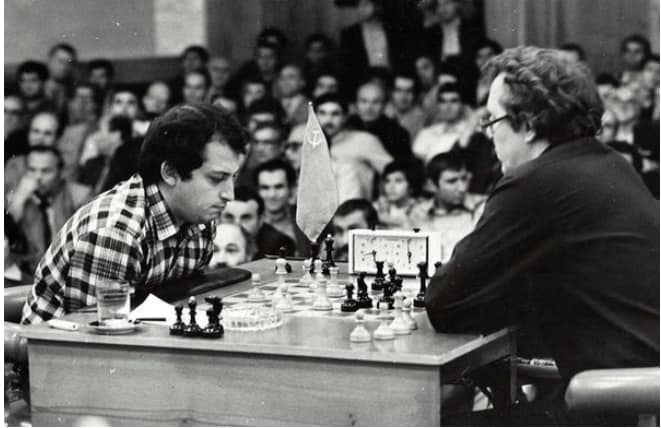
Tal glaring at Viktor Kupreichik over GM4 pieces, 1981 Soviet Team Championship. 0-1. Photographer unknown.Arshak Petrosian-Vitaly Tseshkovsky, Yerevan 1984. GM4 Pieces. Photographer unknown.
GM4 sets were produced from the 1970s to the 1990s. They appeared in a number of variants, perhaps, as Moscow collector Alexander Chelnokov has suggested, because they were made in multiple factories which each had a slightly different take on the stylistic details. Some retained vestigial rook merlons, queen crenels, and miter cuts. All had plastic knight heads and finials. All retained the basic Staunton architecture of the GM3 design while discarding some or most of its details.
Alexander Beliavsky with GM4 pieces. Date and photographer unknown.
Here are three GM4 variants that retained vestigial cuts, crenels, and merlons. The first eliminated the miter cuts; the second and third variants retained crude ones.
Mike Ladzinski Collection, photo.Alexander Chelnokov Collection, photo.
The next variant was known to Soviets as the Champion set, according to St. Petersburg collector Sergey Kovalenko. Sergey tells us that the Champion set was produced by Voenohot Factory No. 2, as were the GM4 set below, Yunost, Voronezh, and other GM3 sets. I include it within the GM4 category because it retains the general Staunton architecture of the GM3 sets, but with the plastic knight heads and diminished detail and quality of the GM4 sets.
The kings in this set are 104 mm tall. The pieces are unweighted, and the finish crude and badly in need of sanding. The finials are all plastic. The king’s crown is topped with a peg, rather than the vestigial cross found in other GM3 and GM4 sets.
From a design perspective, the pieces are Soviet Stauntons within the broad GM3/GM4 family, but with Soviet-styled, CV-shaped knights more like those found in the Yunost, Voronezh, and some sets of the forties and fifties, than the Stauntonesque, S-shaped knights of the GM3 and other GM4 sets. Like other GM4 sets, the knights have plastic heads and torsos. Like GM3 sets, the rooks have merlon cuts, the bishops miter cuts, and the queens shallow, scalloped cuts on their coronets. The miter cuts are asymmetrical like those in late model, mass-produced GM3 sets. Unlike GM3 sets, the merlon and coronet cuts are vestigial. The collars are irregular and unevenly and nondescriptly turned.
Below are GM4 pieces from my collection that were produced by Voenohot Factory No. 2 near Moscow, as revealed by their original cardboard box.
Gone from this set are the queen’s crenels, the bishop’s miter cut, and the rook’s merlons found in the GM3 design. All the crosses, finials, and knight heads are plastic. The set’s kings are 108 mm tall. The pieces are nicely weighted. The bottoms are covered with leatherette pads, some of which on this specimen have slightly buckled. Arlindo Vieira described the GM4 as “elegant and playable.” I quite agree, despite their simplifications.
GM4 sets were used in the 1994 Moscow Olympiad. Vieira rightly criticizes the organizers for providing boards that cramped the pieces and garish tablecloths on the playing tables “made players crazy.” Here is a screenshot of a wonderful YouTube video of the game Korchnoi-Yusupov from that event.
Korchnoi-Yusopov, Moscow 1994, with GM4 pieces, likely the Voenohot version.
The mass production of GM4s meant there were plenty of them with which to play simultaneous exhibitions with them. Here are Kasparov and Smyslov doing just that.
The GM4 sets were the culmination of the evolution–or devolution–of the venerable Grandmaster 3 line. While the GM3 design was simplified and cheapened by the GM4’s elimination of details and its replacement of wooden parts with plastic ones, the Grandmaster 4 retained much of the original design’s basic elegance and remained a very playable set.
Around 1950, a new Soviet Staunton design appeared. In its highest forms, it was used in multiple Soviet Championships and several intra Soviet World Championships over the next four decades. It was also used in lower tournaments, and in its most simplified forms mass-produced. Arlindo Vieira called these Grandmaster 3 sets, and one of the last versions the Grandmaster 4 pieces.
K. Isakov and E. Strelkov dated 1950, but unconfirmed. Event and photographer unknown.
GM3s are a markedly different design from that of the GM1s and GM2s, both of which are typically Soviet designs. Like the Tal pieces, GM3 pieces are much more traditionally Staunton, down to the straight ascension of the stems, the distinct breaks between base, stem, and pedestals, the triple collars, the vestigial cross atop the king’s crown, the crenels in the queen’s coronet, the bishops’ miter cuts, the merlons of the rooks’ towers, and the S-shaped backs characteristic of Staunton knights.
Here are GM3 pieces that I believe perhaps to be the earliest version, circa 1950, and similar to those in the Isakov photo.
This set is well-made, the knight’s chest has three dimples, and the rook’s tower and merlons are thin. The knight leans forward, with its snout protruding past its belly. The original finish (shown) was a detestably sticky water-based varnish that Alan Power of the Chess Schach has replaced while maintaining the set’s patina and wear. Kyiv collector and dealer Nikolay Filatov has called this variant the “Super GM” set, and I’ve adopted his usage. The kings are 120 mm and the pieces are weighted.
The pieces used in Soviet and intra-Soviet World Championships typically were of noticeably higher quality turning, carving, and finishing than the versions usually available to collectors. Some collectors began calling these Championship versions of the GM3 design Grandmaster Supremes to reflect their superior quality. Tal and Botvinnik played their 1960 and 1961 World Championship matches with GM Supreme pieces.
Botvinnik and Tal, 1961 World Championship match. Tass photo.
Botvinnik and Petrosian also played their 1963 World Championship match with GM Supreme chessmen.
Botvinnik and Petrosian, 1963 World Championship match. I. Novosti Press photo.
GM Supreme pieces were used regularly in Soviet Chess Championships after 1950, displacing the Botvinnik-Flohr II pieces that previously had served as the preeminent pieces of Soviet Championships. Whereas the BFII was predominantly a Soviet design, the GM Supreme set, like the Tal set, was a predominantly Staunton design dressed up in Soviet lipstick, namely the vestigial nature of the king’s cross and the opposite colored finials. For this reason I use the term Soviet Staunton to describe them. This displacement ironically reflects the triumph of Stalin’sSocialist Realism over the Bolshevik Constructivism and modernism in the design of tournament chess pieces, a matter I will examine in a future article. Here is a photo of GM Supreme pieces in use at the 1973 Soviet Championship.
Polugavesky and Karpov, 1973 USSR Championship. Novosti Press photo.
These magnificent sets were few in number, and are exceedingly rare. I know of only one complete set in the possession of a collector, and another partial set owned by a Ukrainian chess artisan and vendor. Here is a photo of the complete set.
Antonio Fabiano Collection, Nick Filatov photo.
While they exhibit variations over the many years they served in Soviet Championships, Grandmaster Supreme sets are distinguished from regular GM3 sets by a number of characteristics. They are better made and finished. Their knights appear Lardyesque, squarish in shape, with the nose never protruding beyond the belly, and with three dimples carved in the belly. The rooks have generally thinner towers and thinner merlons.
Side profile of GM Supreme knight. Antonio Fabiano Collection, photo.
Regular GM3 Sets of the 1950s and Early 1960s
GM3 sets of the 1950s and early 1960s saw minor variations in knight carvings, the shape of the bishops’ miters, finishes, and felting, but which variations occurred when or where are largely unknown. Here are several specimens of that period from my collection.
1950s Grandmaster 3 Pieces. 112 mm kings. Heavily weighted. Original sand-colored cloth bottoms. Chuck Grau Collection, photo.1950s-60s Grandmaster 3 Pieces. 112 mm kings. Heavily weighted. Original blue felt-like cloth bottoms. Chuck Grau Collection, photo.1950s-60s Grandmaster 3 Pieces. 112 mm kings. Heavily weighted. Original blue felt-like cloth bottoms. Chuck Grau Collection, photo.
Here are GM3 chess pieces being used in the 1952 Ukrainian Championship, held in Kyiv.
Kiev 1952. Photo courtesy of Jorge Njegovic Drndak. Photographer unknown.
Regional Variations: Estonian and Georgian Sets
The photographic record reveals unique variations of the GM3 design in use in Estonia and Georgia SSRs. American collector Ron Harrison has specimens of each in his collection. Here is a photo of Ron’s Estonian Super GM3.
c. 1970 Estonian “Super” Grandmaster 3 Pieces. Ron Harrison Collection, photo.
My basis for dating Ron’s set is the photographic record that he has compiled and posted in Shakhmatnyye Kollektsionery. I refer to it as a Estonian because it appears prominently in photos of events there, not because of any direct evidence that it was produced there. I think it’s worthy of a specific designation because of the unique drop-jaw, “goateed” knight, which distinguishes it from other GM3s.
Estonian great Paul Keres with the Estonian GM3.
I refrain from classifying this set as a GM Supreme because it lacks two of the criteria used to categorize sets with that designation. First, the knight’s snout cannot extend over the front of the belly. Second, the front bottom of the the knight’s belly must have three dimples, as in Jaques knights. Nevertheless, I am comfortable using Nikolay Filatov’s term “Super GM” to describe Ron’s set because it embodies some of the special characteristics of “GM Supreme” sets, notably its very high production quality.
Ron’s research also has brought us another beautiful GM3 variant used in the former Georgia SSR. This design was used in the 1978 USSR Championship held in Tbilisi, Georgia SSR.
Tamaz Vasilievich Georgadze, playing Black against Gennadij Timoscenko in the 46th USSR Championship, Tbilisi 1978. Their game can be foundhere. Photographer unknown.
This GM3 variant is distinguished by its tall, sharply tiered bases; deep, squared knight jaws; L-shaped knight spines; rimmed rook turrets; and narrow rook merlons. Here is a specimen from Ron Harrison’s collection.
Georgian GM3 chess pieces. Ron Harrison Collection, photo.
Khrushchyovka of the Chessboard: GM3 Pieces of the Late 1960s and Beyond
Khrushchyovka, literally Khru-slum, is a derogatory term for low-cost, concrete or brick apartment buildings constructed during the premiership of Nikita Khrushchev. To meet intense demand for chess sets, the GM3 design was simplified and incorporated molded finials, crosses, and knight heads to decrease production costs.
In Xadrez Memoria, Arlindo Vieira observed that the quality of the Grandmaster pieces degraded over time: “[T]he pieces lost quality from the oldest to the most recent ones, and when I say so, the photos prove it in the very simple question of manufacture: they lost detail, care in the details: look at the Towers, the Horses, in the Bishops and what I said ends up coming to the fore.”
Here is a set from my collection that dates from around 1970, which illustrates Arlindo’s points.
It is apparent that plastic finials and black knight heads have replaced wooden ones, with a degradation in attention to detail and quality in general, as seen in the asymmetrical miter cuts and inconsistent collar structures. American collector John Lawson describes the miter cut as a smirk. Still, the pieces are hefty, reasonably attractive, and comfortable to play with. The kings stand 112 mm tall. The pieces are nicely weighted and their bases are covered with original tan, felt-like cloth. They possibly were manufactured by Voenohot Factory No. 2 outside Moscow.
The degradation of the quality of GM3 sets continued through the end of production. We can get a sense of it by comparing three knights from GM3 sets in my collection, each more simplified and cruder than the one preceding it.
Conclusion
If Botvinnik-Flohr II sets were the workhorse of Soviet Chess before 1950, Grandmaster 3 sets pulled the plow thereafter. Grandmaster Supreme sets served in Soviet Championships and intra-Soviet World Championships, while other events used regular versions that varied across time and region. Over time, the quality of the sets generally degraded as they were simplified for mass production and cheapened for mass consumption. Ironically, the workhorse of Soviet chess for the last forty years of the Union’s life was not a true Soviet design at all, but a traditional Staunton design adorned with opposite-colored finials to give it a pinch of Soviet seasoning.
Next: GM4 Pieces–The End of the Line for the GM3 Design
Originally classified “Grandmaster 2” as one of four “Grandmaster” sets by Portuguese collector and historian Arlindo Vieira, the “Bronstein” name was added by American collector Mike John Ladzinski based on a 1968 photo of Bronstein and Tal playing with such pieces.
The GM2 sets were mass produced to meet an immense demand for sets among the vast chess-playing Soviet public.Shakhmaty v SSSR, 9/1962, at 278-279. Their design is quintessentially Soviet. It incorporates large, bulbous bases, curving up to concave stems, which trumpet into the pedestals upon which the crowns and miters perch. The bulbous bases are echoed in the large, rounded bases of the king’s crown and bishop’s onion-shaped miter, which itself reflects the shape of orthodox church domes. Large proletarian pawns reflect the importance of the working class to socialist ideology. CV-shaped Knights are carved in the distinct manner of the sixties. The following 1950s-early 1960s version has 105 mm kings and original dark blue cloth bottoms.
c. 1960 GM2 Pieces. Note the large wooden knights and the wooden finials. Chuck Grau Collection, photo.c. 1960 GM2 Pieces. Note the large wooden knights and the wooden finials. Chuck Grau Collection, photo.
By 1967, the GM2 sets, manufactured in the Perkhushkovaya Factory of Cultural Goods in Moscow, began to sport plastic finials. Here is a set made in 1967 from the collection of Eduardo Bauza, together with its original cardboard box and sales receipt. Consistent with Soviet practice, the set lacks a distinct name, and is described by the box and receipt only as “Tournament Chess,” that is, a set suitable for tournament play.
1967 GM2 set. Eduardo Bauza Collection, photo.
By 1967 the set also saw some variation in the finials atop the kings. GM2 pieces with plastic, spike-shaped finials were used in the 1967 USSR Championship in Kharkiv, as shown by a photo of Uri Sakharov playing Lev Alburt in that event.
Uri Sakharov, Kharkiv, 1967. 0-1. Club Avangard photo.
Here are pieces similar to those in the Sakharov photo.
Here is a set from the seventies. It is slathered in uneven, taffy apple varnish. The knights are all wooden but the wooden finials have been replaced with plastic ones.
c. 1970s GM2 Pieces. Chuck Grau Collection, photo.
Some subtle changes to the design are evident. For example, the king of the 1970s set is taller, but with a narrower and less bulbous base. Its stem is shorter, but its crown is taller.
c. 1960 GM2 (left) vs. c. 1970 GM2 (R). Chuck Grau Collection, photo.c. 1960 GM2 (left) vs. c. 1970 GM2 (R). Chuck Grau Collection, photo.
The c. 1970s knight, however, is shorter and slimmer, its carving lacking details like the mane and the bit-hole found in the mouth of the c. 1960 knight. The curves of the c. 1970s knight are cruder, less smooth than those of the earlier knight.
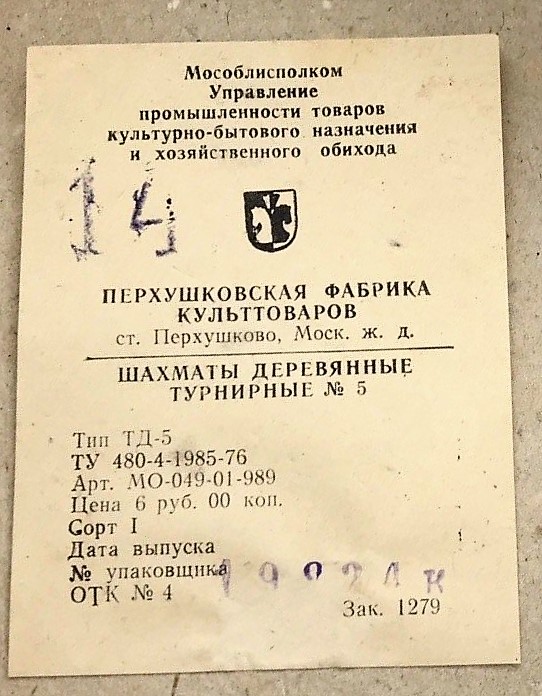
By the 1980s, this “Tournament Chess” had been given a numerical designation “No. 5” to distinguish it from other sets also generically described as tournament sets. The label from the inside of a box of a 1985 set refers to it as “Wooden Tournament No. 5.”
As we will see with other mass-produced sets, production eventually was simplified with the use of less expensive plastic knights. Here is an example from the collection of collector John Moyes illustrating the plastic knight.
GM2 Plastic Knights. John Moyes Collection, photo.
The Grandmaster 2 Bronstein chess set served Soviet chess for decades. It was mass produced for a chess-playing public in need of thousands and thousands of sets. Its curvaceous design was quintessentially Soviet, even as it evolved to incorporate plastic parts and discard some detail in an effort to economize its production and make it more accessible to a Soviet public hungry for playing sets.




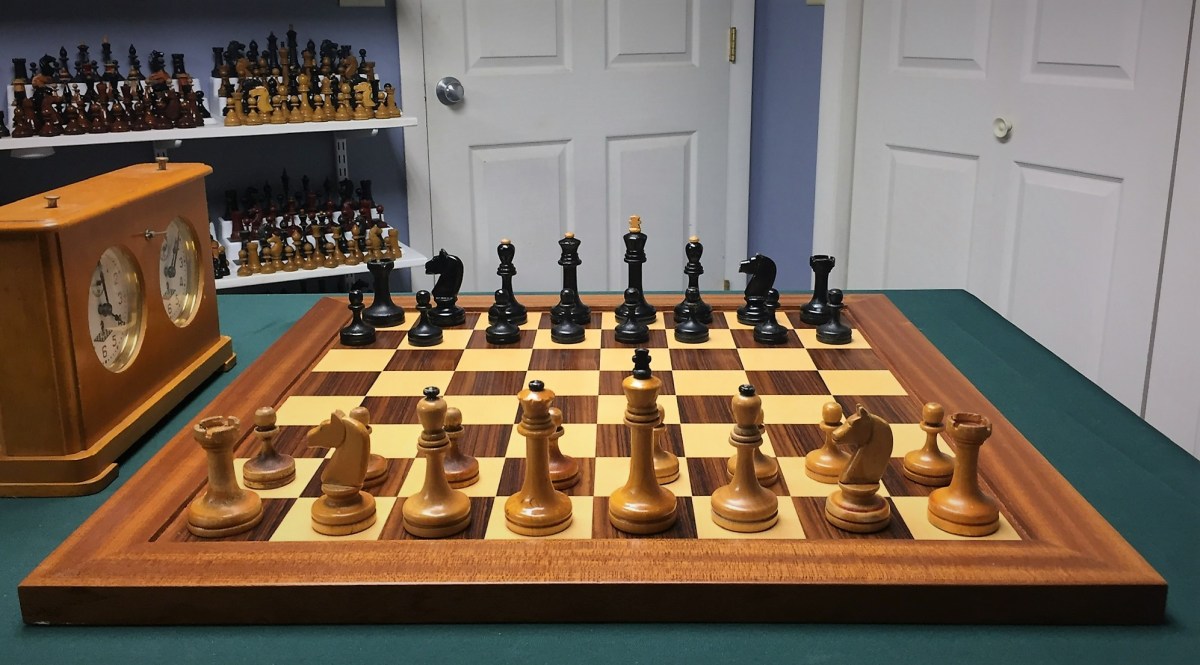

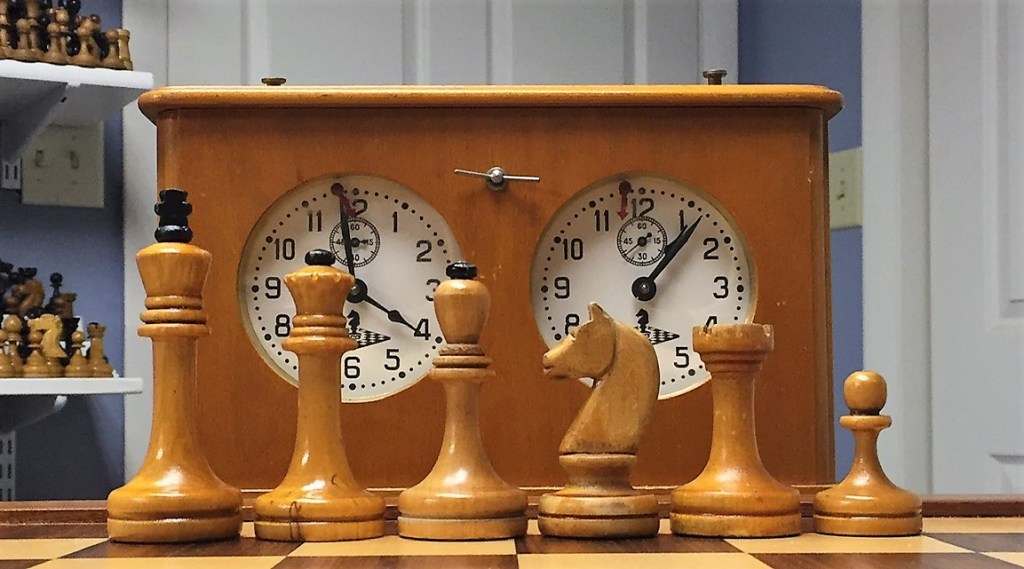
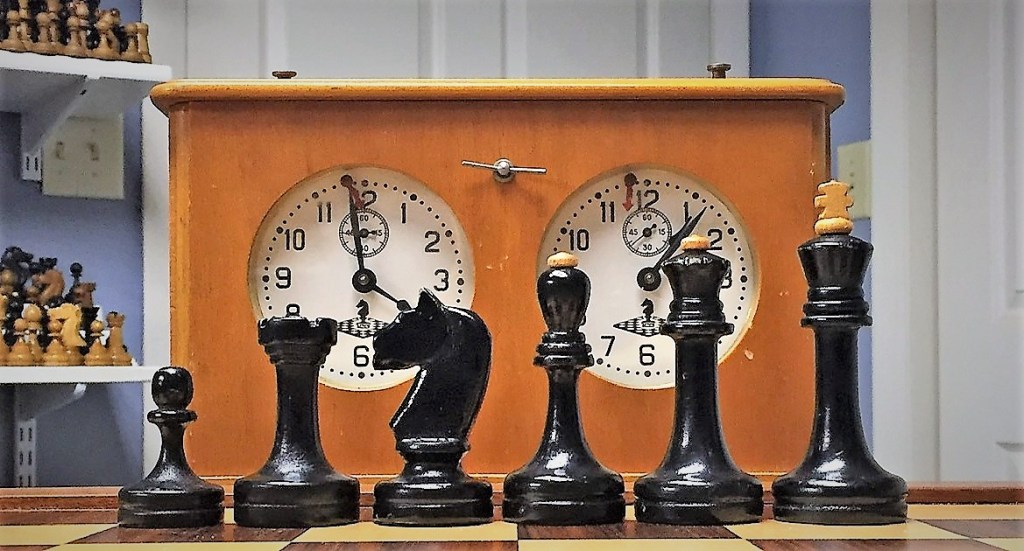
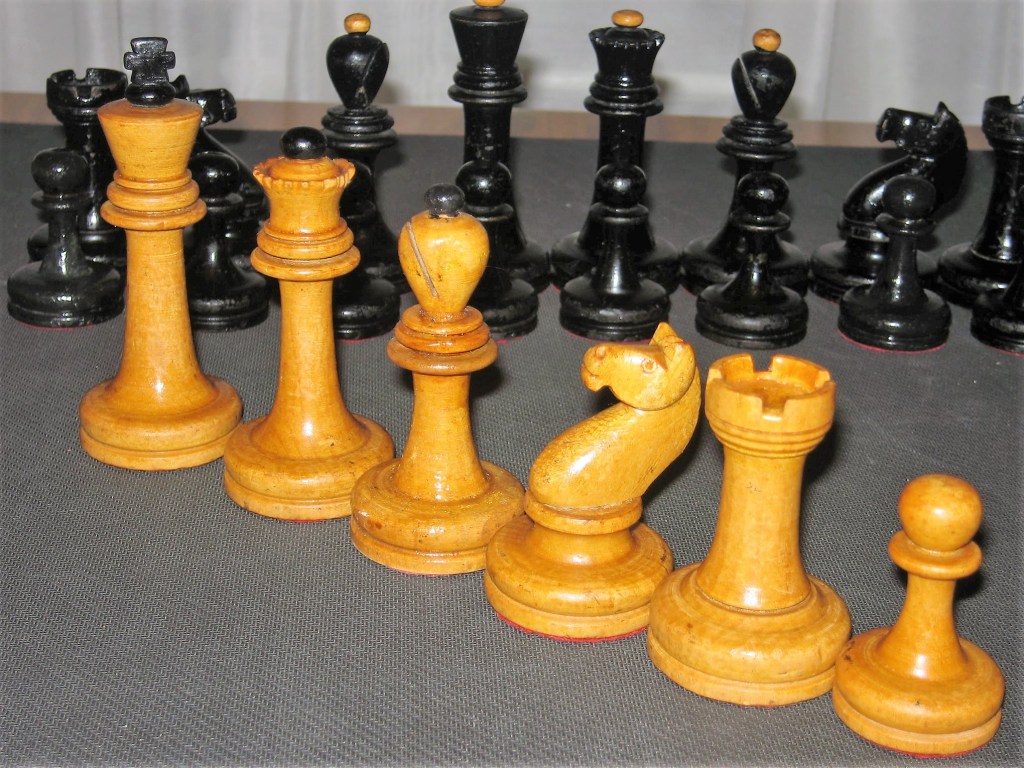


































 Soviet and Late Tsarist Chess Sets