Four Styles of Soviet Grandmaster Chess Sets: The GM1 Chess Pieces

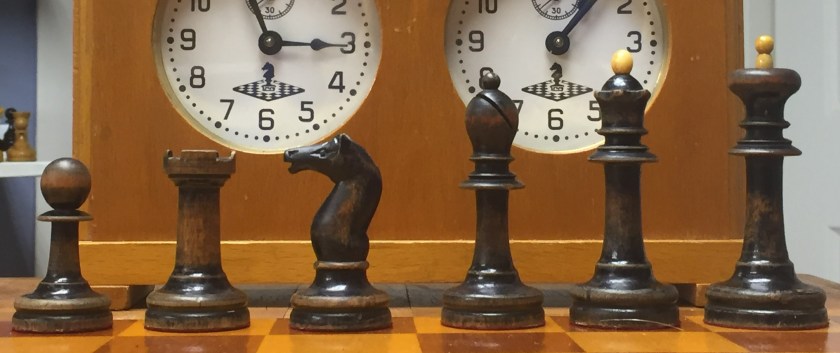
Today, I want to focus on one narrow topic raised by a contributor to Shakmatnyye Kollektsionery: what is a Grandmaster set and what are the differences between the different types of Grandmaster sets mentioned by collectors?

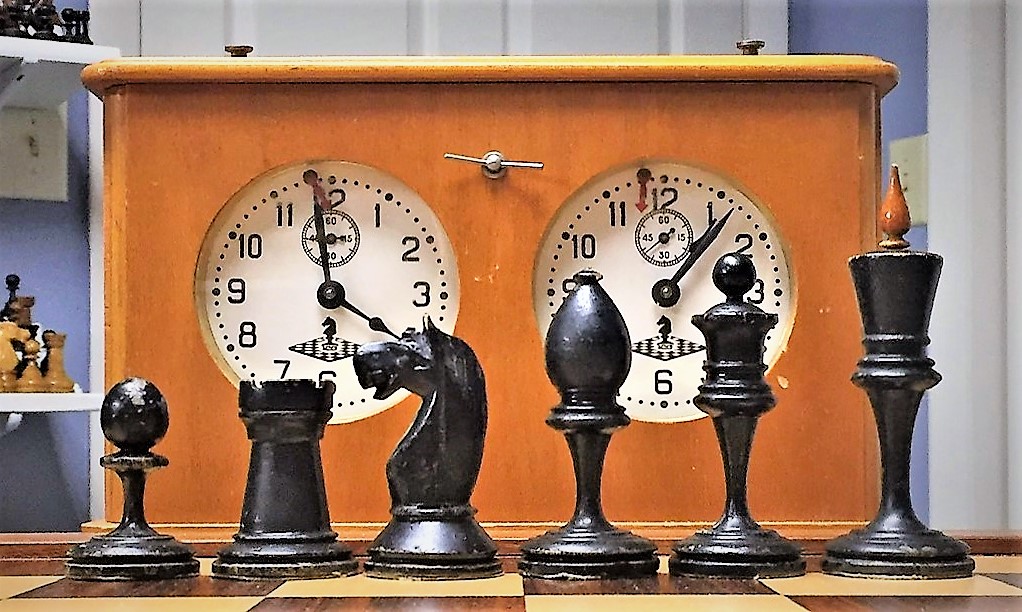
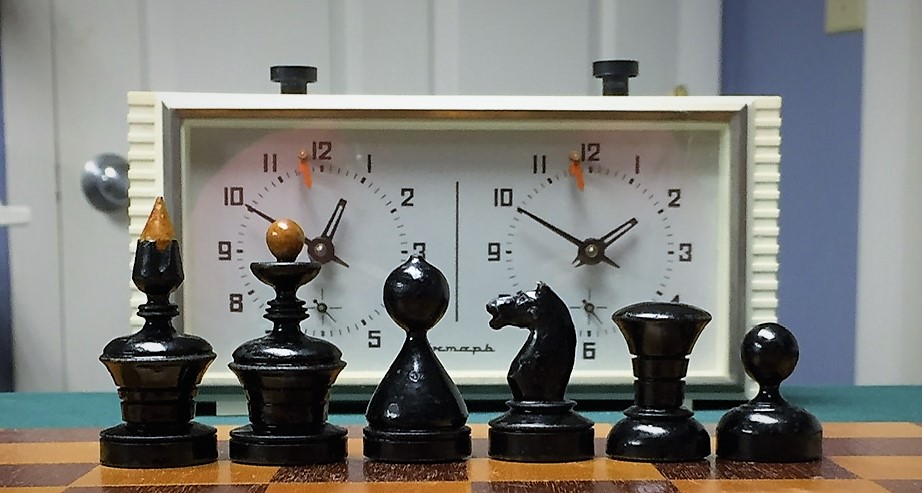
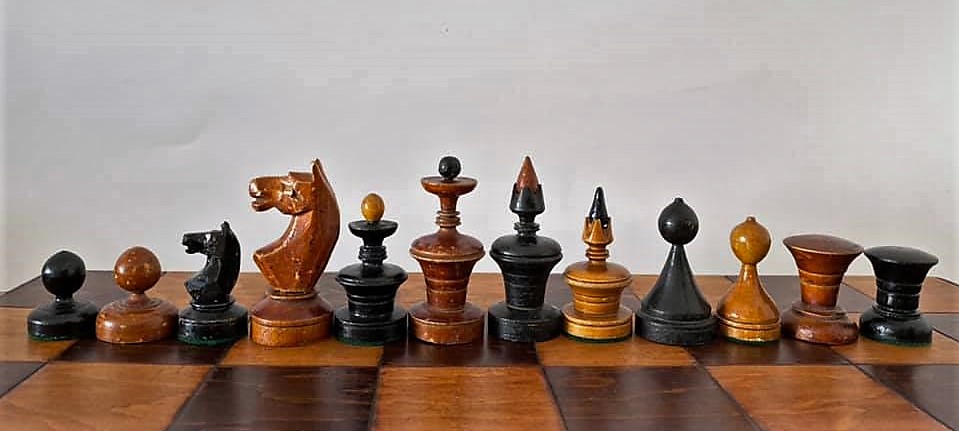
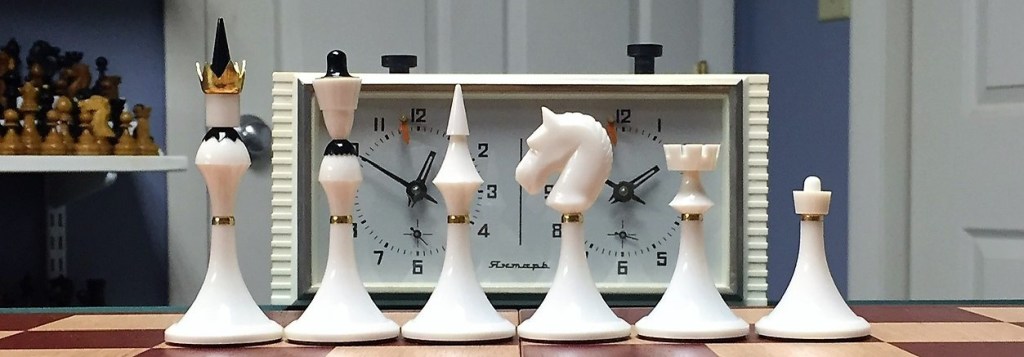
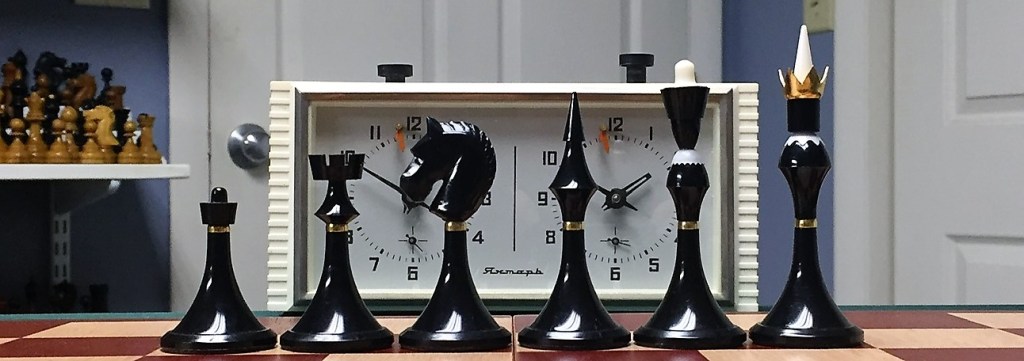
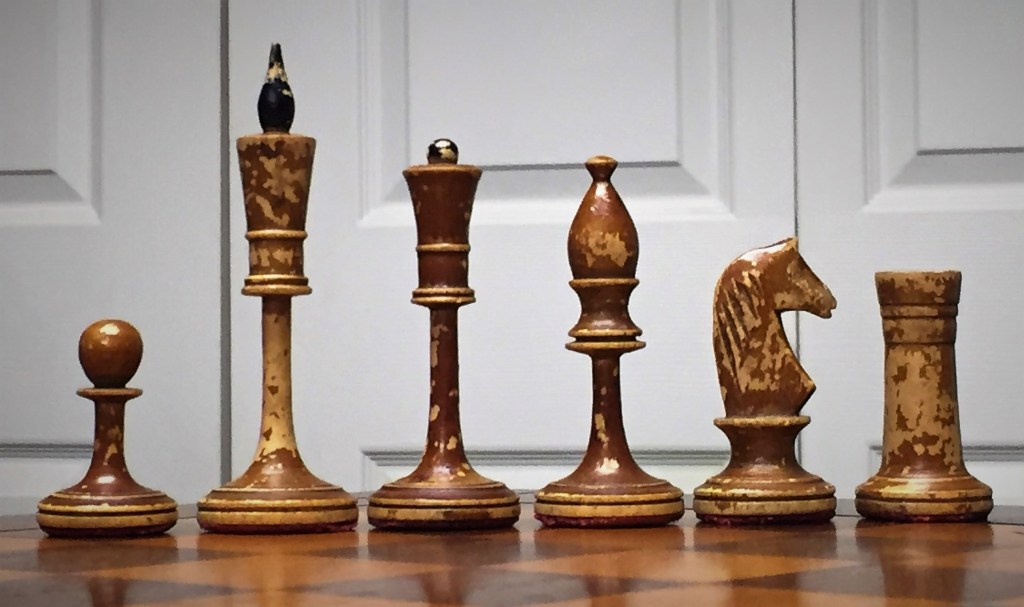
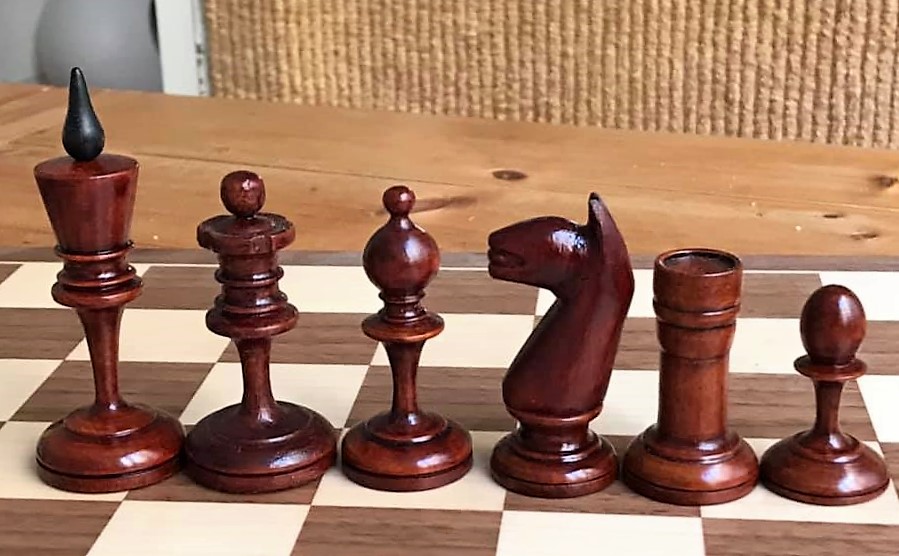
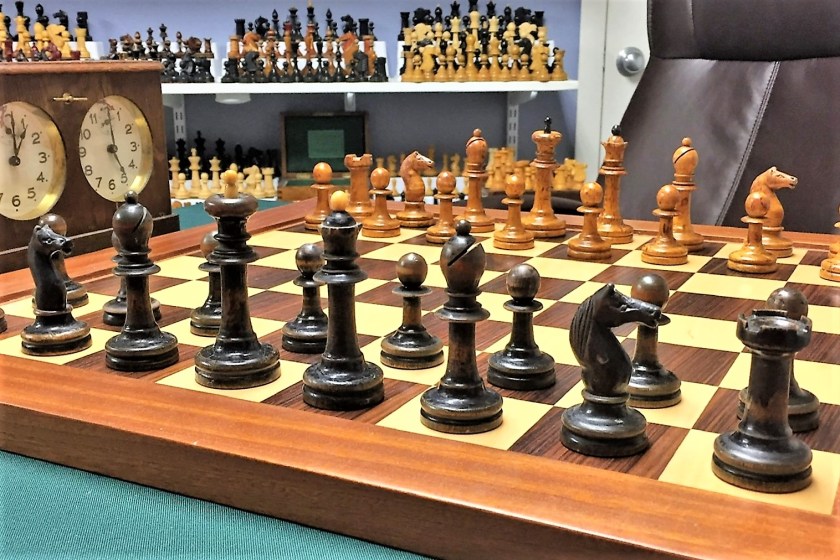
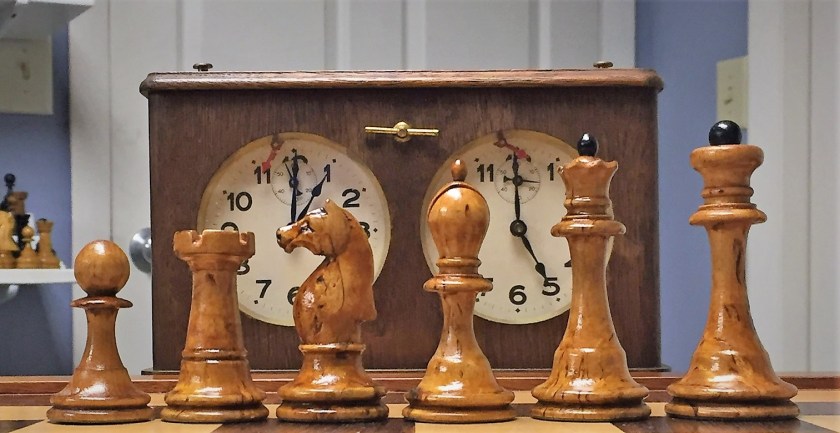
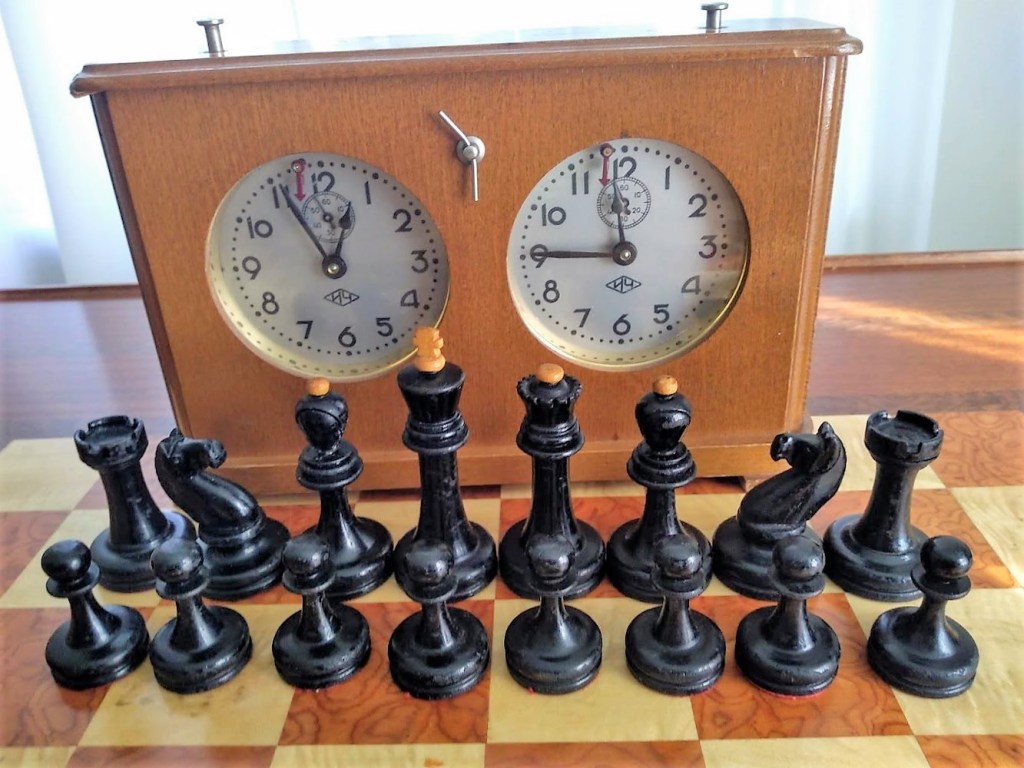
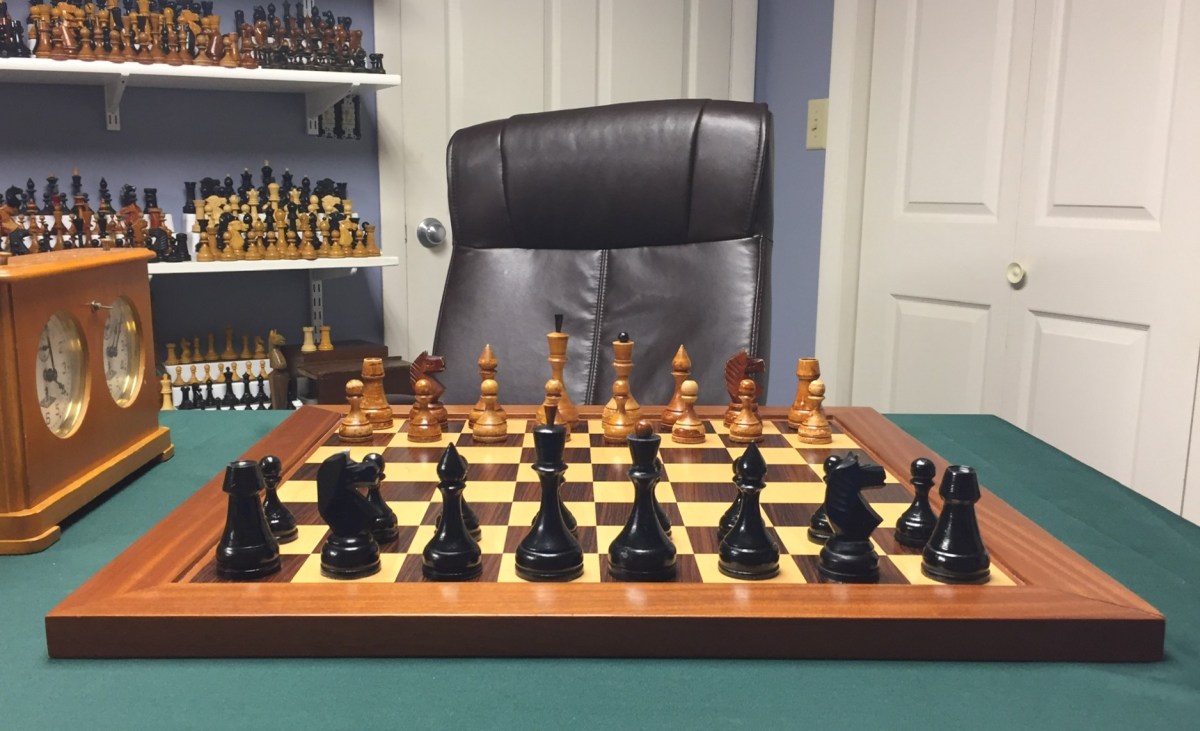
c. 1960 Grandmaster 1 Pieces. Chuck Grau Collection, photo.

A Grandmaster, or Grossmeister set is most generally a set that was used at the highest levels of Soviet chess, that is, by Grandmasters. Soviet sets typically did not have names, just as most Soviet consumer products did not have brand names. Instead, chess sets were described by functional categories.

Grandmaster sets were used by grandmasters. Tournament sets were for use generally in tournaments. Yunost sets were for students and youth. In Xadrez Memoria, Arlindo describes these GM, or Grandmaster, sets as:

Soviet pieces characteristic of many Clubs, competitions and even simple chess lovers that in a park, or Garden, anywhere in the former Soviet Union used to use them. Almost always these pieces were made with the respective folding board that also served as a box where they were kept (such “anemic” trays of 4.5 – 5cm square for pieces with a King base with 3.5-4 cm!… All of these pieces are very reasonable in size, with the KINGS walking 10-11 cm high… [T]hey are very different sets from each other and have been used in different times… .

Xadrez Memoria, 4 December 2012.

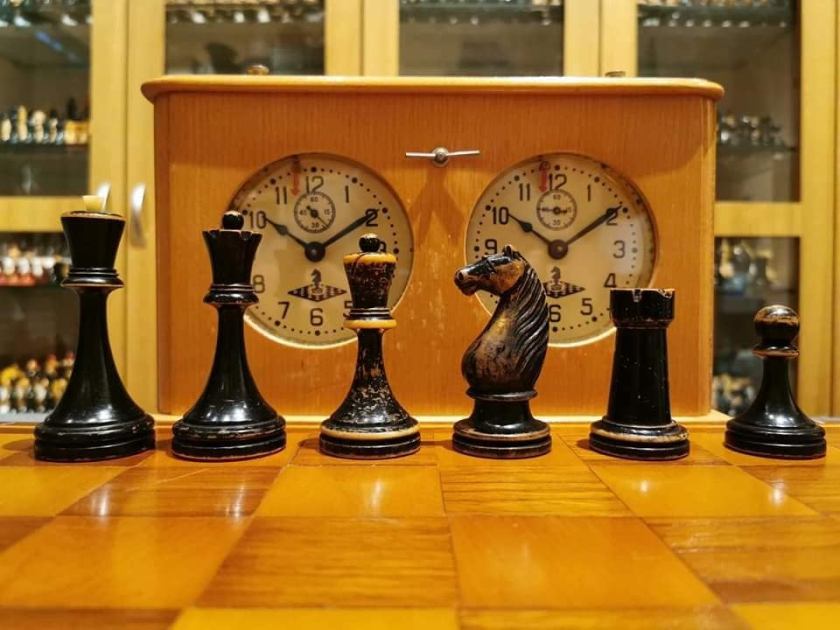
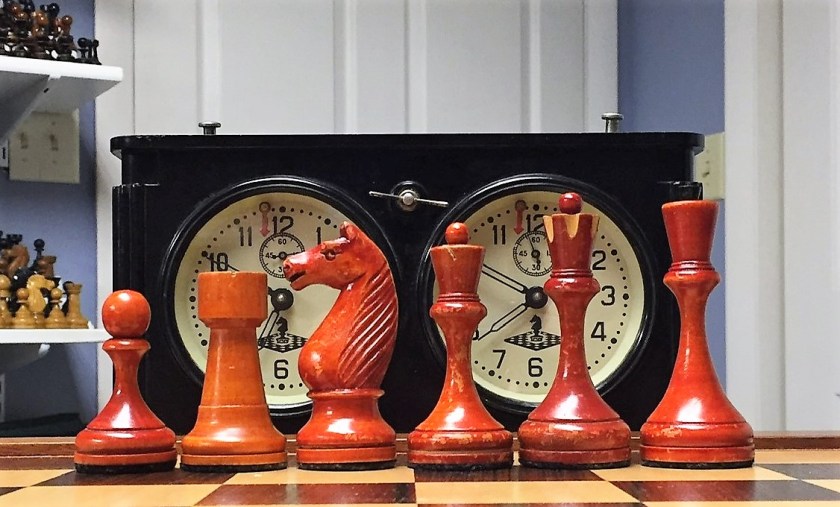
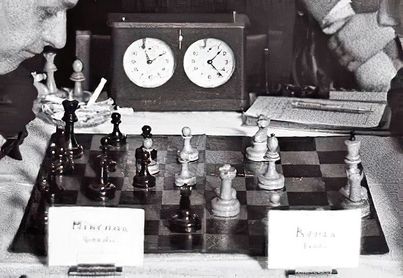
Vieira designates each type of Grandmaster set with a number, 1-4, and dedicates one sub-section of his video to each GM type. He dates the GM1 in the seventies and eighties; the GM2 in the sixties through the eighties; the GM3 goes undated in both the video and the blog; The GM4 is undated, but he describes it as “the last version of this competitive set,” and shows it in use in the mid-eighties. The photographic record provides evidence that each of the four types indeed were used at the highest levels of Soviet Chess.

Within each GM category, there were a number of different sets sharing the same basic style. Some of the differences can be attributed to when or where they were produced, others by the intended audience. Thus each style had better made and finished types that were used at the high levels, and simplified versions that were mass marketed to the millions who played chess. Over the course of four articles, we will examine each of Arlindo’s four types.

Grandmaster 1 Pieces
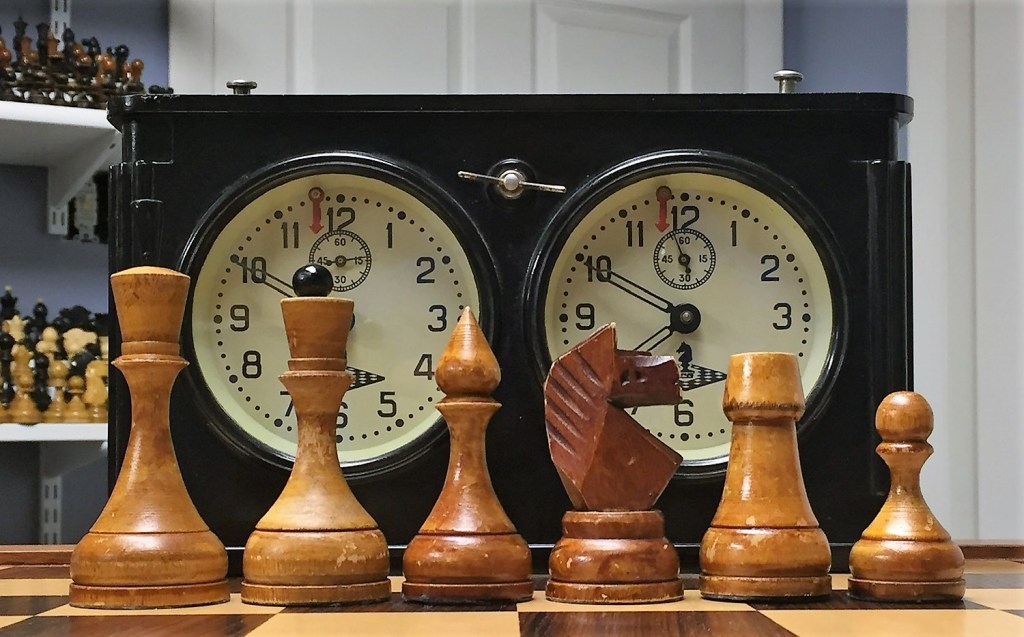
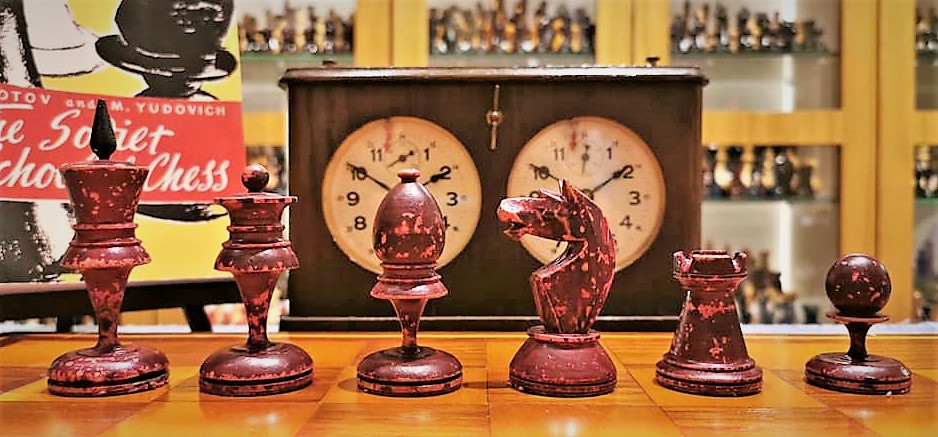
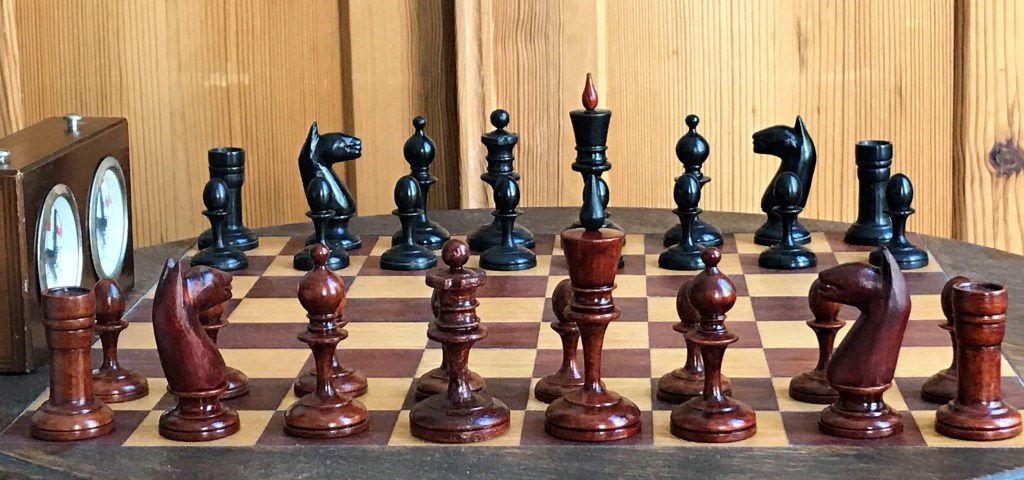
Figure 1. 1960s Grandmaster 1, or GM1 Pieces, with reddish alcohol-based varnish finish.
Chuck Grau Collection, photo.

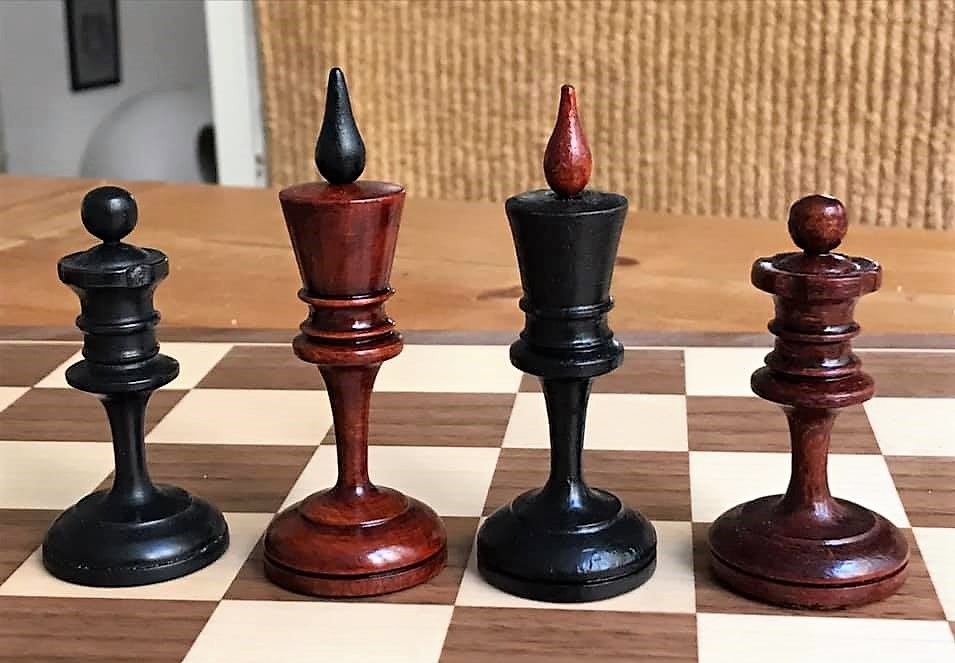
Figures 1 and 2 present an example of a GM1 set from the 1960s. They are obviously well-used, not surprising insofar as Vieira describes the GM1 to have been “very popular in chess clubs.” In some ways, this set represents the end product of Soviet design. Reminiscent of a simplified BFII design, the GM1 incorporated what I call the Voronezh Curve, extending up from the base, forming a stem concave in shape, which blossoms out to form the pedestal upon which the piece signifiers rest.

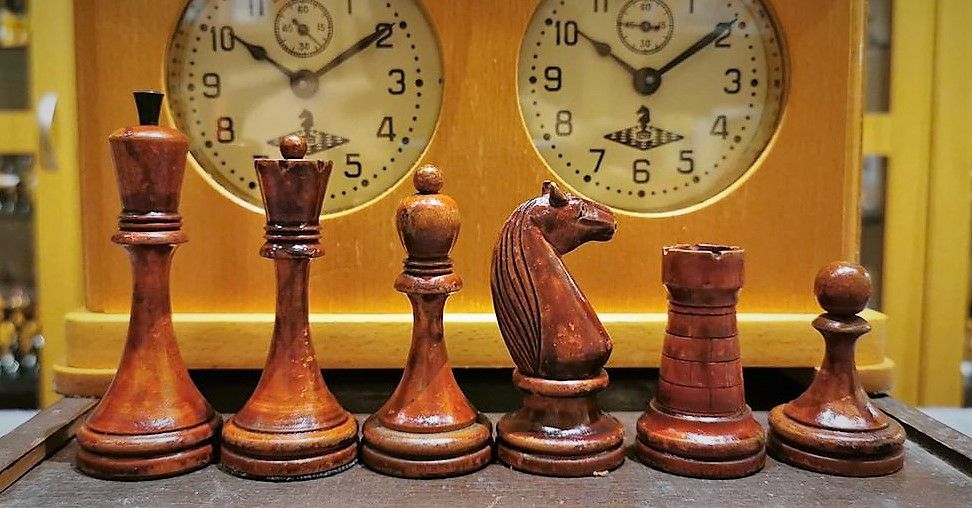
Figure 2. 1960s GM1. Note the wooden finials. Chuck Grau Collection, photo.

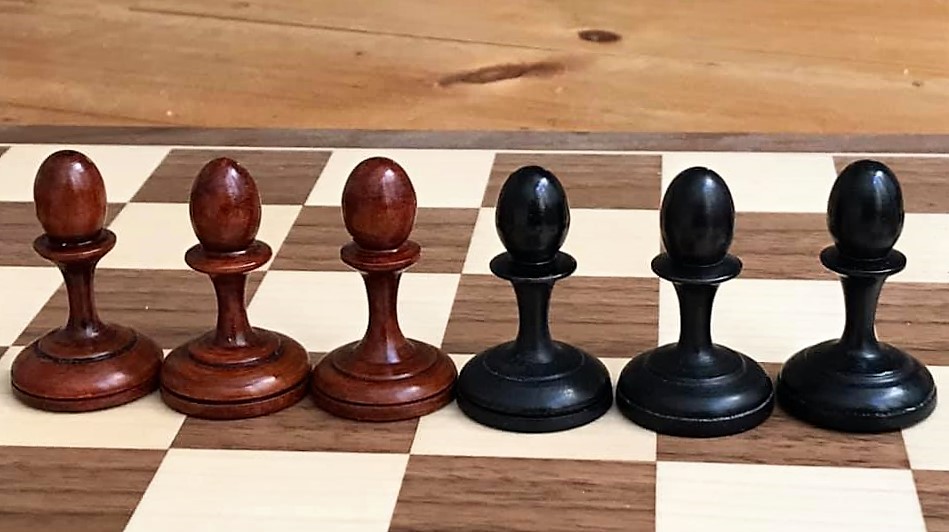
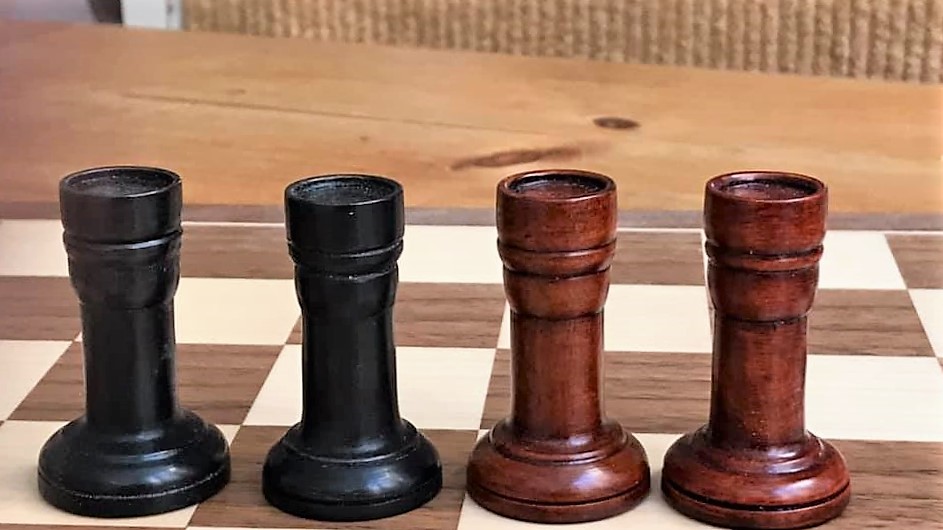
The Royals’ crowns are bounded by a simple band, rather than the three-piece (two collars and a connecting area), with a simple trapezoidal shape, slightly domed at the top of the king. The coronets, miters, and turrets all lack details. The bishop’s miter has simplified the common Soviet onion dome to the shape of a tear. The knight is basically a slab with cuts across the vertical plane, and carvings cut into the wood. Its shape is an almost an exaggeration of the standard Soviet CV shape. All of the simplifications retain their Soviet character while facilitating mass production of the pieces. It is a simple design, perfect for mass production. The stem rises almost seamlessly from the base, forming a concave curve that trumpets out to serve as a pedestal, upon which the piece signifier–crown, coronet, miter, or ball–rests. The finials atop the king and queen are made of wood. In later versions, they are made of plastic. The queen’s coronet bears no crenellations. The knights are quite simple, comprising a slab with two angular cuts signifying the mane. The knight’s back forms a simple C-Curve, whereas the chest is cut to an angular V. The back of the ears continue the upward line of the back. The bishop’s miter is a simple tear-shape without a cut. The rook’s turret lacks merlons.

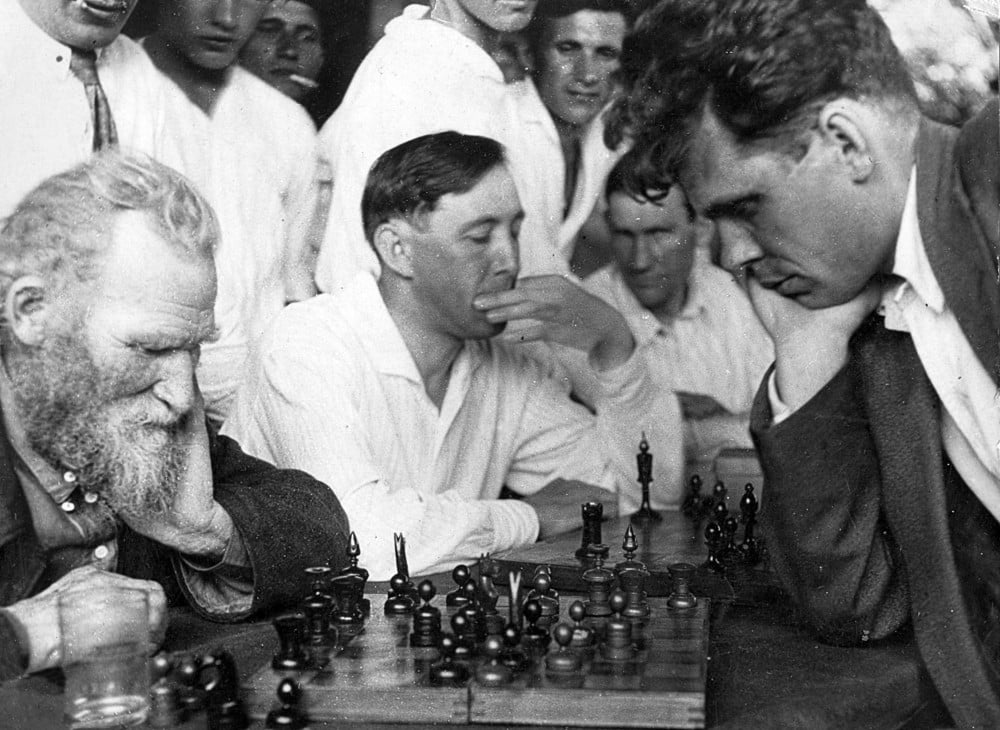
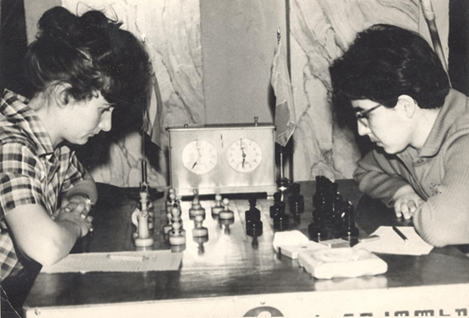
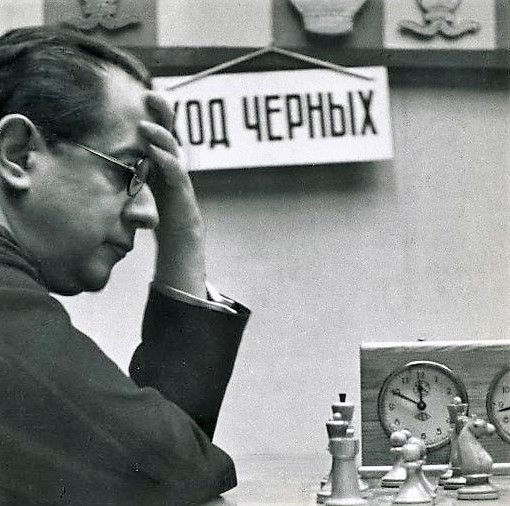
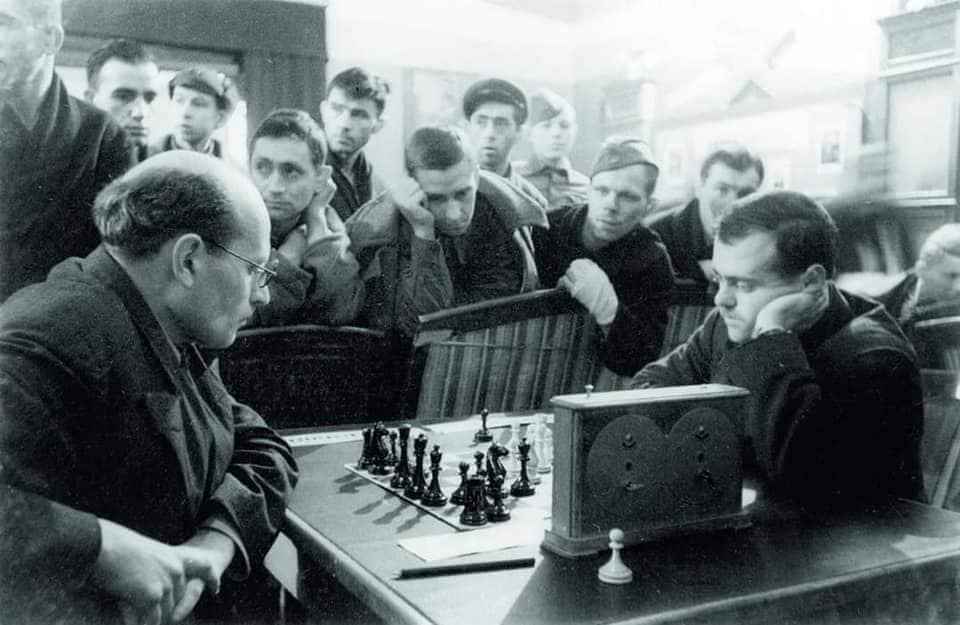
Figure 3. Analysis room, USSR Championship, Tbilisi 1966/67. Photographer unknown.

According to St. Petersburg Collector Sergey Kovalenko, many of these sets were made in Oredezh settlement, Luga district, Leningrad region.

Sergey has compiled a history of chess set production in Oredezh/Luga:

GM1 chessmen. Oredezhsky DOZ. Oredezh settlement, Luga district, Leningrad region.

The factory produced chess sets (board and pieces), as well as chess boards and tables separately. Boards of at least four sizes – 20×20 cm, 30×30 cm, 40×40 cm, 45 x45 cm.

“GM1″ was produced in at least three sizes– for a board of 30cm, 40cm and 45cm.

From about 1960 to 1966, white figures and boards were covered with a red-brown varnish (most likely based on alcohol), from about 1967 they switched to a colorless nitrocellulose varnish.

In the 1970s, the finals began to be made plastic. In the “best” years, in the mid-70s, [the] factory produced up to 13,000 thousand sets per month.

Chain of renaming.

The artel “УтильПром/Utilprom” (in some sources “Утиль/Util”) was established in 1948.

In 1953 it was renamed “Промвторсырье/Promvtorsyrye” (in some sources “Промвторспрос/Promvtorspros”).

In 1957, it was renamed the
“Ореджская промыслово кооперативная артель/Oredezh Promislovo-Kooperativny Artel”…

In 1960 was reorganized into the “Оредежский ДОЗ/ Oredezhsky DOZ.

The Oredezhsky DOZ existed with this name until April 1970, when the Oredezh and Luga plants were merged into “Лужский ДОК/Luzhsky DOK”.

In 1982, it was renamed “Лужский ЛДОК/Luzhsky LDOK.”

“Лужский ДОЗ/Luzhsky LDOK” Luga city, Leningrad region, has its own history.

In 1946, the “Лужский Мебельщик/ Luzhsky mebelschik” artel was established.

In 1956 it was renamed the “Лужская Мебельная фабрика / Luga Furniture Factory.”

In 1962 it was renamed the “Лужский ДОЗ/Luzhsky DOZ.” …

Source: Shakhmatnyee Kollektsionery 12 November 2021.

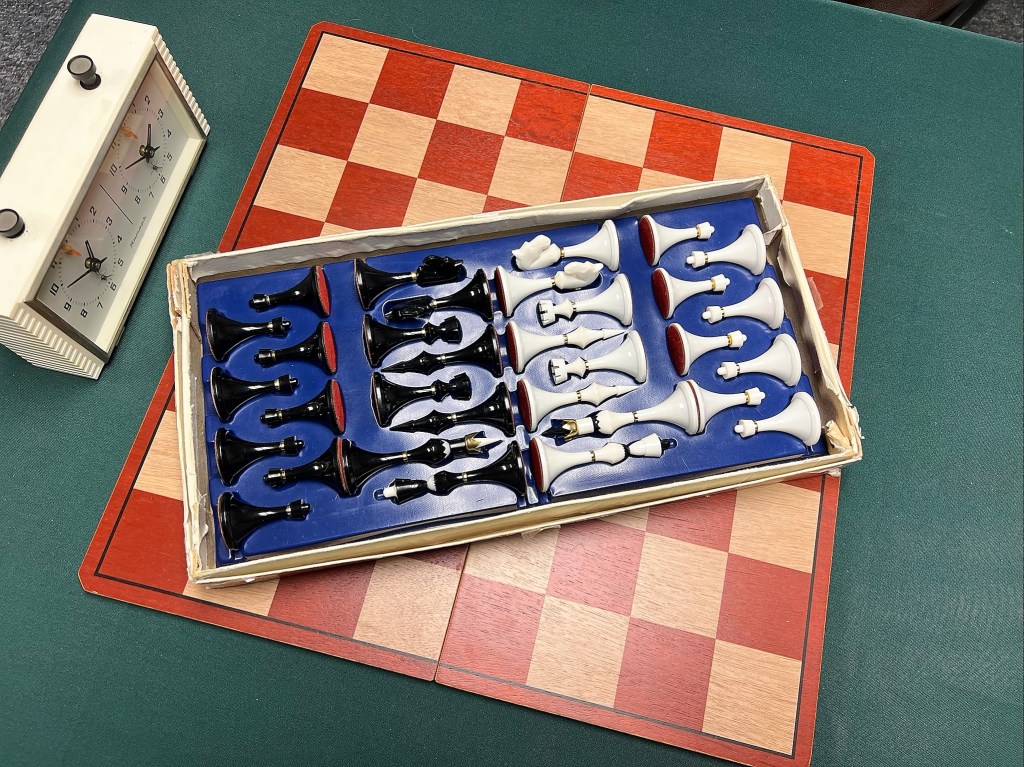
Figure 4 below shows a stamp found inside the board of a first quality set produced in 1968 in the Oredezh Wood Processing Factory, 11 Lenin Street, in Leningrad Oblast. The set included both the pieces and Board No. 4, as both are described and their product numbers given. The finials are all wood. The board’s squares are 4mm x 45mm.
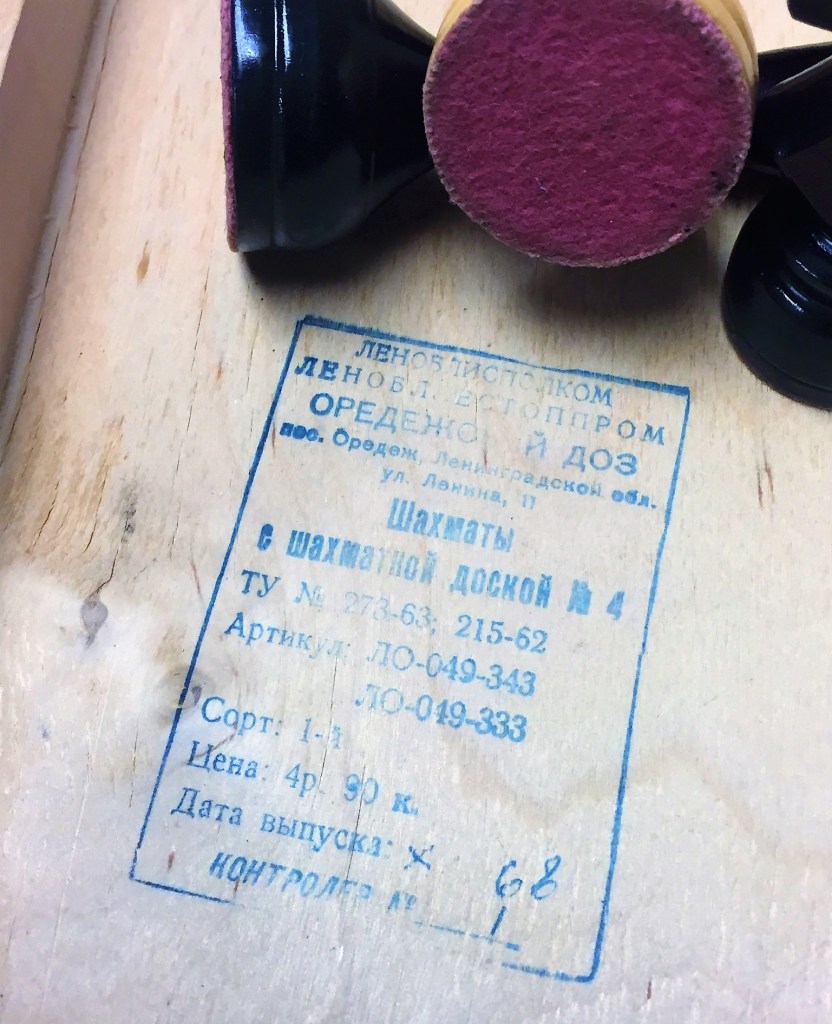
Figure 4. Stamp inside board/box for GM1 produced in Oredezh. Chuck Grau Collection, photo.

The next photo, Figure 5, gives us a rare look inside a Soviet chess factory. It depicts a chess assembler foreman inspecting GM1 pieces in the Oredezh Wood Processing Factory.

Figure 5. Nina Yanovna Doroseva, Foreman of chess sets assemblers with GM1 pieces. Oredezh, 6 August 1979. Consistent with Sergey’s chronology, the pieces are finished in a clear varnish and should have plastic finials. Source: Sergey Kovalenko.

As Sergey described, the Orodezh Factory changed merged into to Luga, and began branding its sets with Luga’s distinctive round trademark, seen on the box in Figure 6. It is a late model set with all plastic finials.

Figure 6. Late Model GM1 pieces produced in Luga District, Leningrad Oblast. Source: Alexander Chelnikov.

Figure 7 depicts the GM1 design in an analysis-sized set with kings of 76 mm. The finials are wooden, and the knights of an early pattern. They are consistent with those Sergey described as being for a 30 mm No. 3 board.

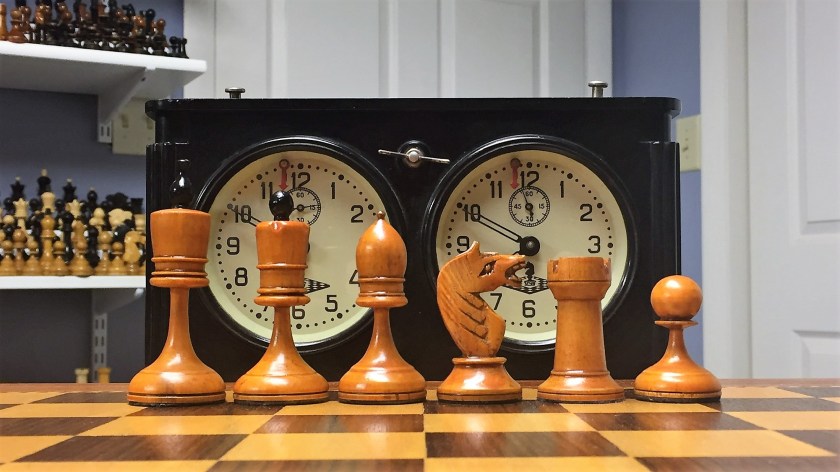
Figure 7. 1960s Analysis GM1 with 7.6 cm kings. Chuck Grau Collection, photo.

According to Arlindo Vieira, smaller sets like these were “very popular in schools and clubs, amateur tournaments.” It is perhaps a stretch to use a classification he coined to denote sets used by grandmasters in high level tournaments to describe a miniature set, but I use it to reference the design of the pieces rather than who used them.
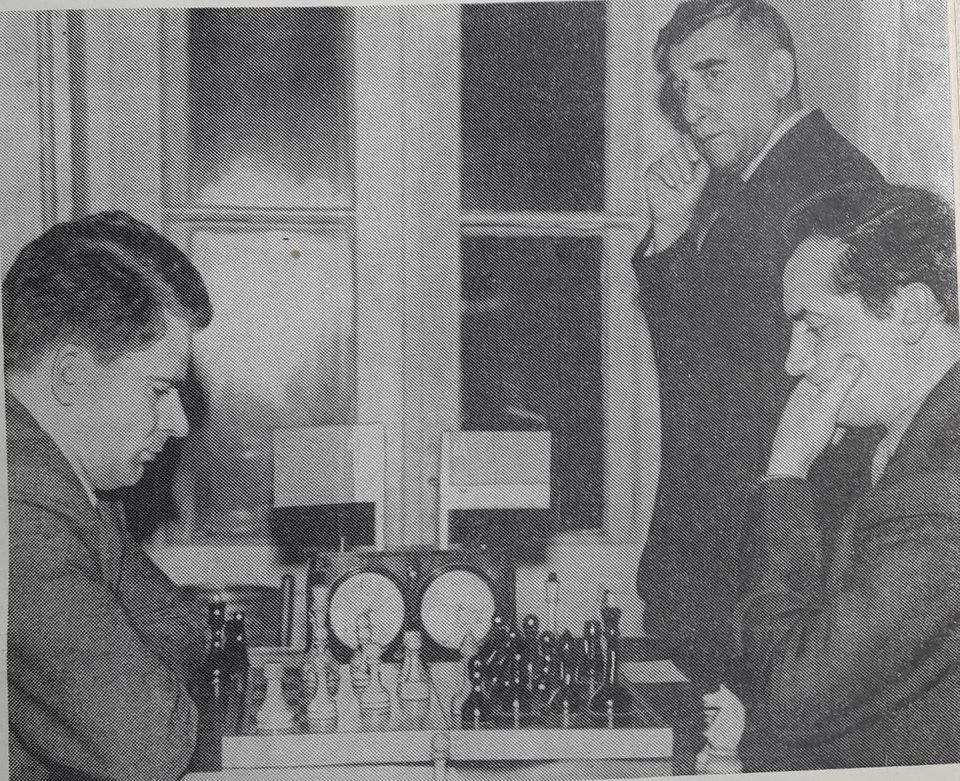
Figure 8. Spassky, Stein, and Bondarevsky with GM1 pieces (1966). Clear varnish, likely wooden finials. Photographer unknown.

As Sergey noted, the plant moved from red/brown varnish to a clear coat in 1967. Here are the pieces from the 1968 set shown in Figure 4.
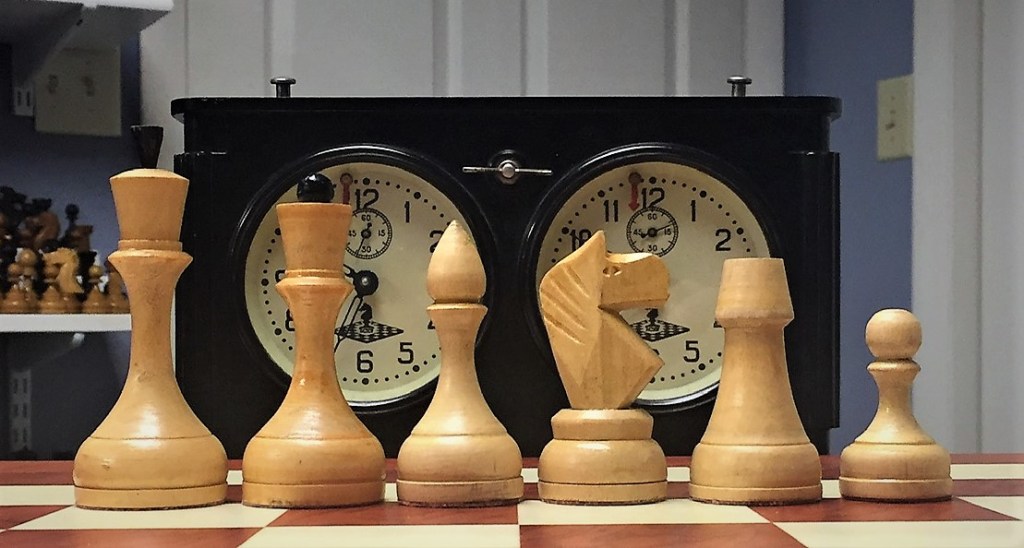
Figure 9. Late 1960s GM1 Pieces with colorless nitrocellulose varnish. Chuck Grau Collection, photo.
Figure 10 . Late 1960s GM1 Pieces. Note the wooden finials. Chuck Grau Collection, photo.

As of this update, collector and graphic designer Eva Silvertant is working on a typology of GM1 knights. She has identified two other styles of GM1 knights. The first is similar to those shown in Figures 1, 2, 7, 9, and 10 from the Orodezh/Luga factory.
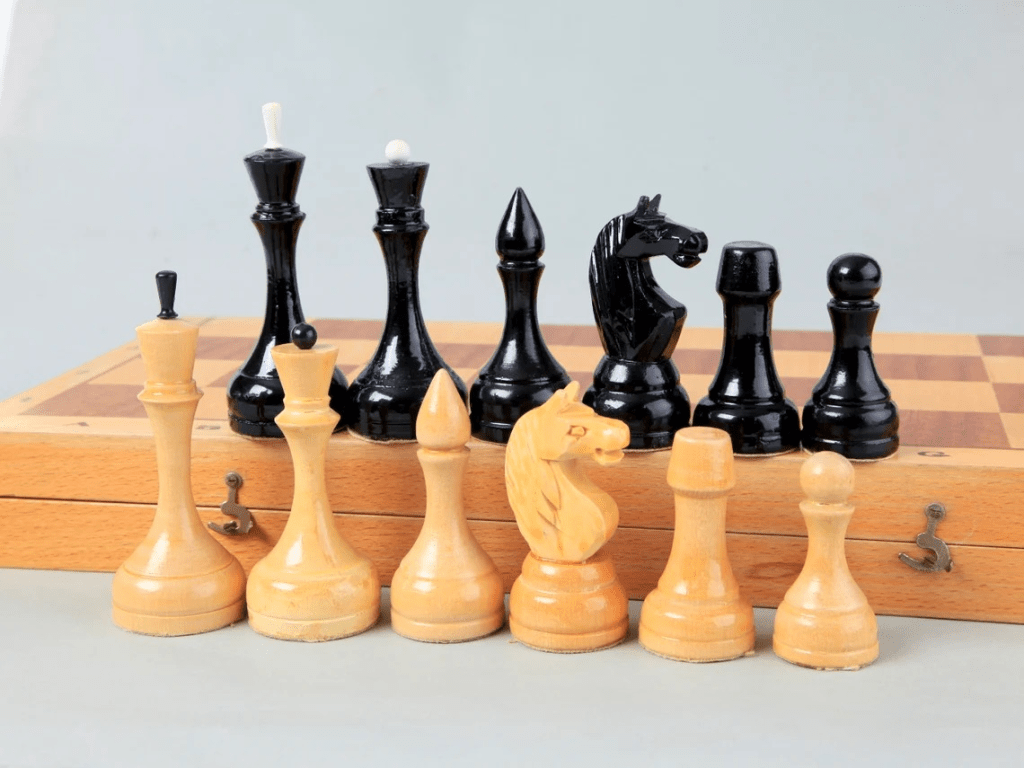
Figure 11. Source: GM1 Variant with Perkhushkovskaya Factory knights. Eva Silvertant.

The knights in this set appear to be very similar to those found in GM2 sets manufactured by the Perkhushkovskaya Factory of Cultural Goods, which suggests that these GM1 variants were produced there. More research is needed.

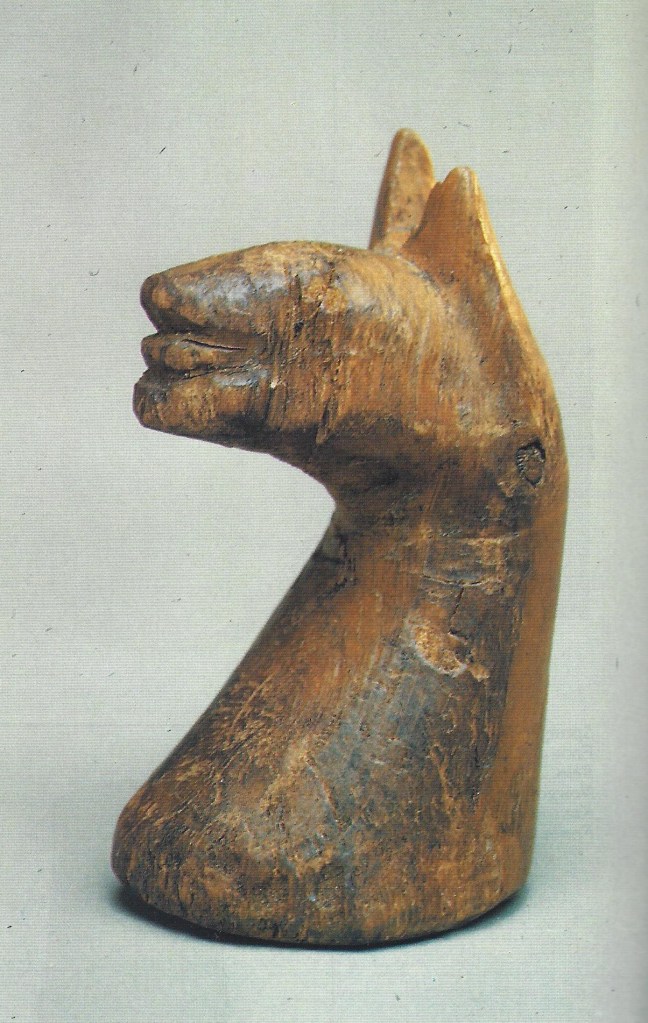
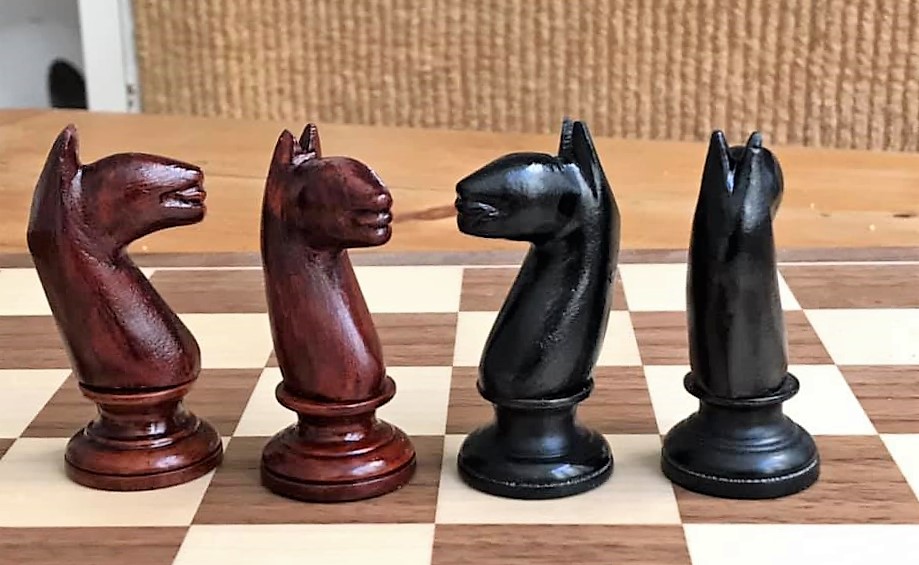
A second variant Eva has brought to our attention is what she aptly dubs the “Fox Head” Knights. She states that they were made by Luzsky Woodworking Enterprise, which Sergey had identified as the 1972 successor to Oredezhsky DOZ, renamed to essentially Eva’s form in 1982. Interestingly, these Fox Head knights appear similar to those Arlindo Vieira first posted in 2012. At this point, I am unaware of any cardboard boxes with identifying information relating to this variant.

Figure 12. Fox Head Knight GM1. Source: Eva Silvertant.

GM1 Wolf-Ear Variant

One interesting variation of the basic GM1 design, seen in Figures 8 and 9 below, has been called the “Wolf Ear” or “Dropjaw” set in reference to its unique knights with their dropped jaws and their wolf-like ears. The knight’s wolf-like ears echo the sharp peak of the cleric’s tear-shaped miter. The rook’s lines also have been exaggerated over those of the standard GM1.

Figure 13. GM1 Wolf Ear Pieces. Chuck Grau Collection, photo.
Figure 14. GM1 Wolf Ear Pieces. Note the wooden finials. Chuck Grau Collection, photo.

The king stands 103 mm tall with a good-sized base of 45 mm. Lightly weighted. Like other GM1 sets, the Wolf Eared ones came in a variety of sizes. Steven Kong’s collection includes one with 112 mm kings. Ribnar Mazumdar’s collection also includes a specimen with 112 mm kings.

The Wolf-Ear set retains the general shape of the standard GM1, but is heightened and widened, the severity of the stem’s curve is reduced, the knight’s ears and mouth have been exaggerated, the king’s crown has been given a larger bulge on top, the king’s and queen’s pedestals have been heightened, the connection between pedestal and crown has been increased on the royals, the king’s and queen’s finials have been shortened and reduced in diameter respectively, and the sides of the rook’s turret have been given a curve.

Figure 15. A young Lev Aronian plays with a GM1 Dropjaw set c. 1991. Photographer unknown.

One significant problem with the Wolf-Ear set is that the kings and queens are difficult to distinguish. In fact, the Wolf-Ear queen looks very much like the king in other Soviet sets as well, compounding the problem. Another confusing design element is that the stem of the queen is longer than that of the king, connoting that she, not her liege, is the most important piece. Moreover, the unusual length of her stem results in her pedestal being above the kings, destroying the descending line of the pedestals that harmonizes the sight of the pieces on their initial squares and further confuses the connotation of value.

According to Sergey Kovalenko, the Wolf-Ear sets were manufactured in a correctional colony, Institution OI 92/9 in Makhachkala, DASSR (Dagestan). The colony later received the designation IK-2. The sets accompanied by the following labels were made in the 1980s.

Figure 16. GM1 Wolf-Ear set labels. Source: Sergey Kovalenko

Perhaps the unique profile of the Wolf-Ear knights derives from the Silver Wolf in the flag of the Avar Khanate of Dagestan.

Figure 17. Avar Khanate flag. Photo source: Creative Commons.

GM1 Conclusion

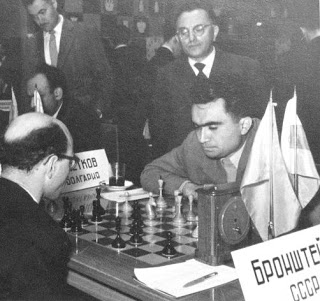
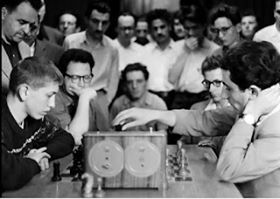
This concludes our survey of Grandmaster 1 chess pieces. Next we will turn to another very Soviet design, the Grandmaster 2 pieces, sometimes called the Bronstein pieces owing to a photo of Bronstein and Tal playing with them.

Updated 9 June 2022, 7 July 2022, 7 March 2025.
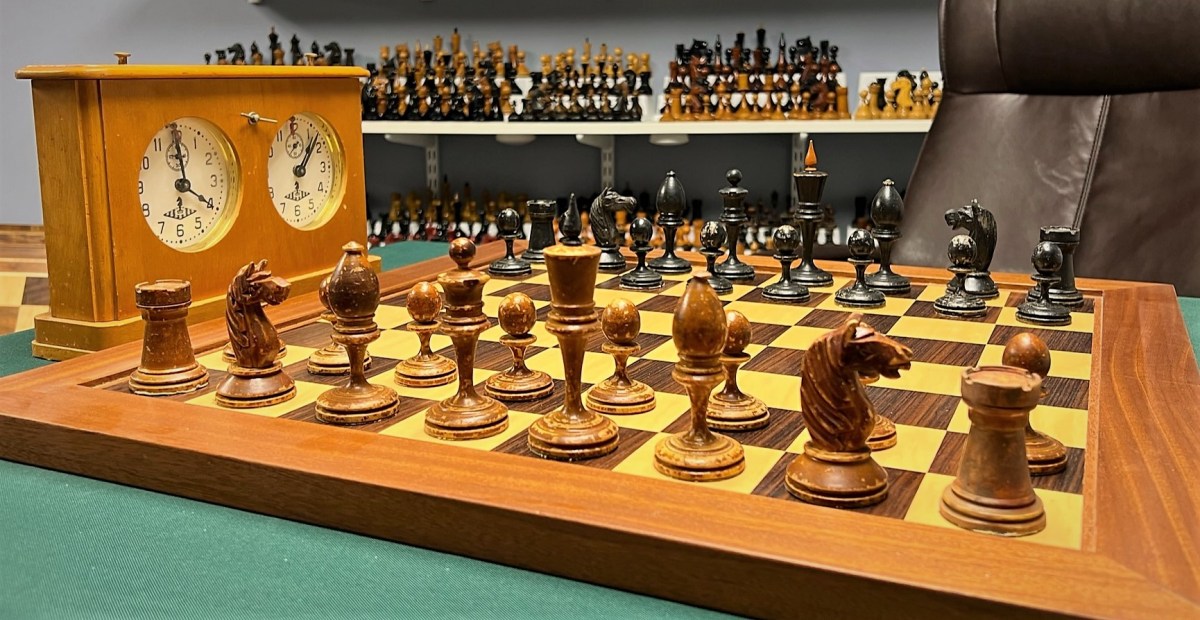
“Revolutionary” Smyslov Chessmen

These impressive chess pieces are named after World Champion Vasily Smyslov (1921-2010), who is seen as a young man in a rare photo playing with a set of this design and size. Berlin artist and collector Porat Jacobson calls these pieces “revolutionary” because they reject the neoclassical column structure of Staunton and late Tsarist stems, replacing them with a trumpeted, dendriformic stem echoing modernist column designs.

Vasily Smyslov with pieces named after him. Dated 1937 according to Soviet chess historian Jorge Njegovic Drndak. Photographer unknown.

Porat Jacobson and I also believe Smyslov pieces appear in a 1927 photo of a game between Botvinnik and Panchenko.

Mikhail Botvinnik and Nil Panchenko, Leningrad 1927. See their game here.
Photographer unknown.

What really sets these pieces apart are their trumpeted stems, which begin narrow at the base and widen as they rise, flaring at the top where they meet the pedestals upon which the King, Queen, Bishop, and Pawn signifiers rest. Unlike the Botvinnik-Flohr II and Voronezh designs, where the pedestals are a seamless continuation of the top of the stem’s concave curve, here they are distinct structural parts, delineated by a discernable seam.

Chuck Grau Collection, photo.

Visually, the royals and cleric signifiers rest within inverted isosceles triangles whose tips rest on the wide bases. Somehow the set still manages to convey an appearance of stability, perhaps due to the wide bases. The queen wears a unique, large globe-shaped finial perched on a stem above her coronet.

Chuck Grau Collection, photo.

The bishops wear massive miters topped with discs, perhaps a truncated form of globus cruciger as seen in the Laughing Knight pieces. Similar discs or spheroids sit atop the Baku clerics as well. The kings of my set are 11 cm tall with a base of 4 cm, and the pieces are reasonably well-weighted.

The design appears in other sizes and finishes. Here is a set from the Steven Kong collection with 9.5 cm kings. The “White” pieces are finished in red.

9.5 cm version in red. Steven Kong Collection, photo.

Here is an undated photograph of what appears to be the 9.5 cm. version in action.

Source: Steven Kong in Shakhmatnyye Kollektsionery. Photographer unknown.

The set’s counterintuitive stems remind me of the “dendriform” columns of the S.C. Johnson Administration Building in Racine, Wisconsin designed by Frank Lloyd Wright and opened in 1939. Those columns are only 9 inches in diameter at their base, but blossom to 18.5 feet in diameter at the top, and support ten times the structural load requirement.

Dendriform columns Frank Lloyd Wright designed for the S.C. Johnson Administration Building in Racine, Wisconsin. S.C. Johnson photo.

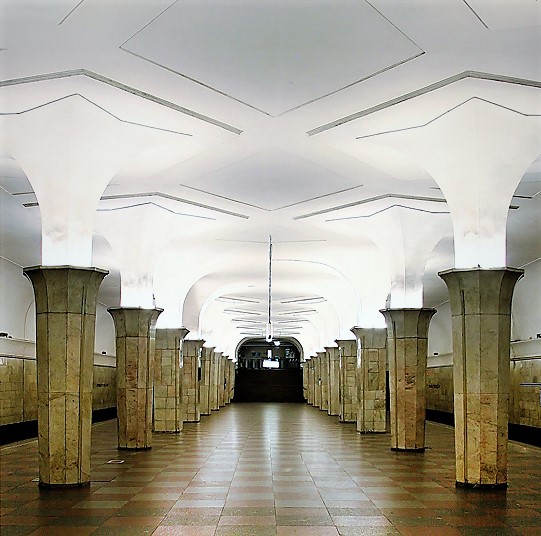
Dendriform columns were no stranger to Soviet design of the 1930s. They can be found in the Kropotkinskaya metro station in Moscow, completed in 1935 and designed by Alexey Dushkin and Ya. Likhtenberg. The station received international recognition and received the Stalin Prize for architecture and construction.

Dendriform Columns of the Kropotkinskaya Metro Station, Moscow.
<a href=”http://NVO, CC BY-SA 3.0 Wiki Commons photo.

The Smyslov’s trumpeted, dendriformic stem seems to have appeared by at least 1927, seven years before the the convex stem/pedestal structure appeared in the Botvinnik Flohr II design. It’s not a stretch to think these pieces were a major step towards the structure that represents a major element of Soviet chess piece design.

The Smyslov’s dendriformic stem seems to appear in photos of the set used in the 1949 Moscow Championship, acquiring the name “Averbakh Set” by virtue of a photo of Yuri Averbakh playing with them in that event, and sets of the 1950s that seem to evolve or derive from the 1949 set. In this way the revolutionary elements of the Smyslov design have enjoyed a long and impactful life.

1920s-1930s Constructivist-Influenced Soviet Chess Pieces

The state-sanctioned program of Political Chess begun by Alexander Ilyin-Genevsky and elaborated by Nikolai Krylenko was but one of several parallel projects aimed to promote socialism in the fledgling Soviet Union. Another such effort was Soviet Constructivism and its VKhUTEMAS Institute, an acronym for Vysshie Khudozhestvenno-Tekhnicheskie Masterskie (Higher State Artistic and Technical Studios), founded in 1920 by the merger of the Moscow School of Painting, Sculpture and Architecture and the Stroganov School of Applied Arts. Like the Bauhaus, it combined industry, architecture, design, and art under one roof. Among its famous faculty were Konstantin Melnikov (architect), Aleksandra Ekser (“color in space”), Alexander Rodchenko (construction), Nadezhda Udaltsova (“volume in space”), Varvara Stepanova (textiles), and Alexei Gan (graphic design). In Stepanova’s words, the Institute’s goal was to devise “methods for a conscious awareness of the demands imposed on us by new social conditions.” “Art is dead!” proclaimed Gan, “There is no room for it in the human work apparatus. Work, technique and organization!” J. Willette, Constructivism and the Avant Garde (2020).

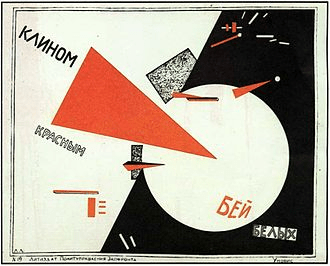
According to art historian Laura Hillegas, “The Constructivists sought to influence architecture, design, fashion, and all mass-produced objects. In place of painterly concerns with composition, Constructivists were interested in construction. Rather than emerging from an expressive impulse or an academic tradition, art was to be built.” Constructivism Brought the Russian Revolution to the Art World. Constructivist design employed pure geometric forms, linearity, symmetry, repetition, simple, sans-serif fonts, the dominance of red and black, and photomontage. FINSA, What is Russian Constructivism?

Many of these elements can be seen in El Lissitzky’s famous poster, Reds into Whites (1919):

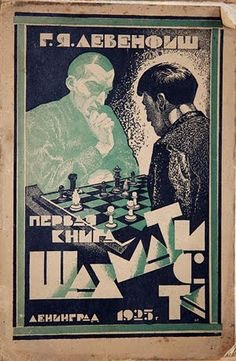
Constructivist elements abound in graphic art associated with Soviet chess of the 1920s and 1930s. Here is the cover of a popular chess book from 1925.
Grigory Levenfish, Book of a Beginner Chess Player (1925).

There are no known examples of a purely Constructivist Soviet chess set, but Rodchenko designed a chess table in 1925 for a Worker’s Club:

Rodchenko’s Constructivist Chess Table reproduction. He did not design the chess pieces.
Wiki Commons photo.

It then should come as no surprise to find Constructivist elements appearing in Soviet chess set design. The constructivist influence is heavy in these small, unweighted pieces likely of the 1930s, whose kings stand a mere 63 mm tall.

Chuck Grau Collection, photo.

The bishops combine a sphere and a cone. The pawn is a sphere resting upon a stem that flows organically from the disc-shaped base unobstructed by a collar. The royals share a thick, hyperbolic, dendraformic stem, noticeably narrower at the bottom than at the top in defiance of neoclassical notions of “common sense,” where the bottoms of columns are “naturally” wider than their tops. The geometry of the royals’ stems is echoed in the dendraformic structure of the rook. “Common sense” is literally stood upon its head.

Chuck Grau Collection, photo.

The royals’ pedestals echo the form of the pawn’s base, their crowns attached by a double-collared connector. The king’s crown is composed of triangles and topped with a bullet-shaped finial. The queen’s crown inverts and repeats the pawn base structure, and is topped by a sphere. The only Staunton elements evident are the collared royal connectors and the relative sizes of the pieces.

Chuck Grau Collection, photo.

Pieces in this Constructivist-influenced design were made in at least two sizes. Here is the 65 mm king version compared side-by-side with a larger 85 mm version.

Alex Chelnokov Collection, photo.

The pieces of this set bear a remarkable resemblance to those found in a Constructivist flyer for the well-known 1925 Soviet film Chess Fever, starring World Champion Jose Raul Capablanca and other participants of the 1925 First Moscow International Chess Tournament, itself a manifestation of the Soviets’ program of Political Chess. The film, with English subtitles, can be viewed in its entirety here.

Chess Fever (1925) Poster. Source: @dgriffinchess.

The pieces also appear in the photographic record from the 1930s. Here is a photo found by collector Sergey Kovalenko of Grandmaster Emeritus Vladimir Alatortsev (1909-1987) playing in a simultaneous exhibition with what seems to be the larger version of the set in the foreground.

Grandmaster Emeritus Vladimir Alatortsev. Source: Sergey Kovalenko.

My specimen of this design came inside a small wooden board/box similar to that appearing in the Alatortsev photo. The coordinates were added by a prior owner.

Constructivist-influenced pieces with board. Nikolay Filatov photo.

The inside of the box bears a stamp indicating that it was manufactured by the Moscow State Toy Factory, with a Moscow street address.

Chuck Grau Collection, photo. Alexander Chelnokov translation.

It’s from the Chess Fever flyer and Alatortsev photo that I date the set.

Many other Soviet sets bore Constructivist influences. I’ve already discussed the impact of modernism on the Botvinnik-Flohr II design here. It is a theme to which we will return.

Rocket City Molodets Set

Rocket City Molodets Set. Chuck Grau Collection, photo.

A beautiful, cleverly simple plastic set.

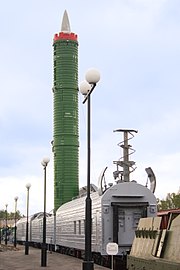
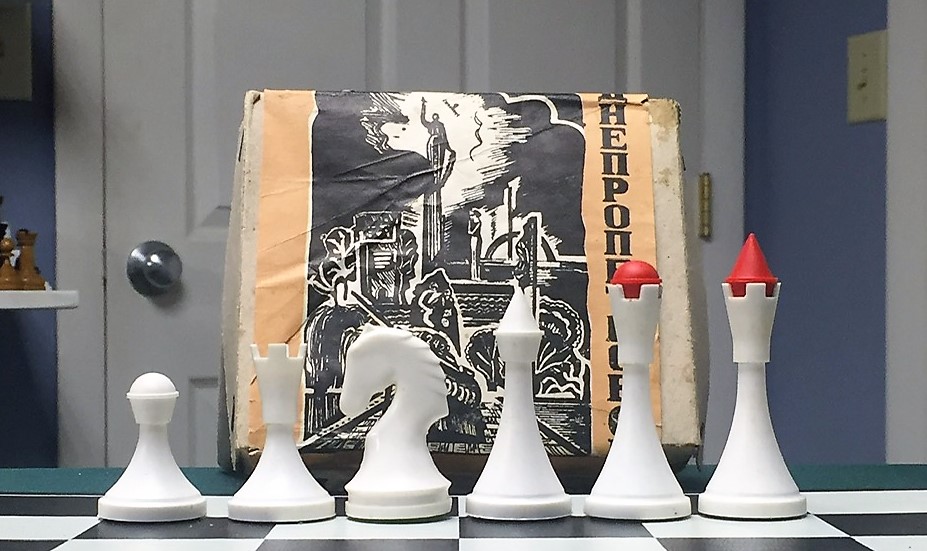
The set’s original box indicates that it was manufactured in Dnepropetrovsk (since 2016 simply Dnipro), the fourth largest city in Ukraine, with about one million inhabitants, located in east central Ukraine, about 400 km southeast of Kyiv. I use the term Rocket City because Dnepropetrovsk was the center of Soviet strategic rocket development and manufacture. I use the term Molodets in reference to Toronto-based artist and collector Alan Power’s description of the king’s similarity to a particular Soviet ICBM, the RT-23 Molodets, which translates to Brave Man or Fine Fellow. Its NATO designation was the SS-24 Scalpel. Alan owns and operates The Chess Schach, where he artistically restores vintage sets, many of them Soviet, and provides both set specific commentary and related essays.

RT-23 Molodets ICBM at the Varshavsky Rail Terminal, St.Petersburg, Home of the Central Museum of Railway Transport, Russian Federation

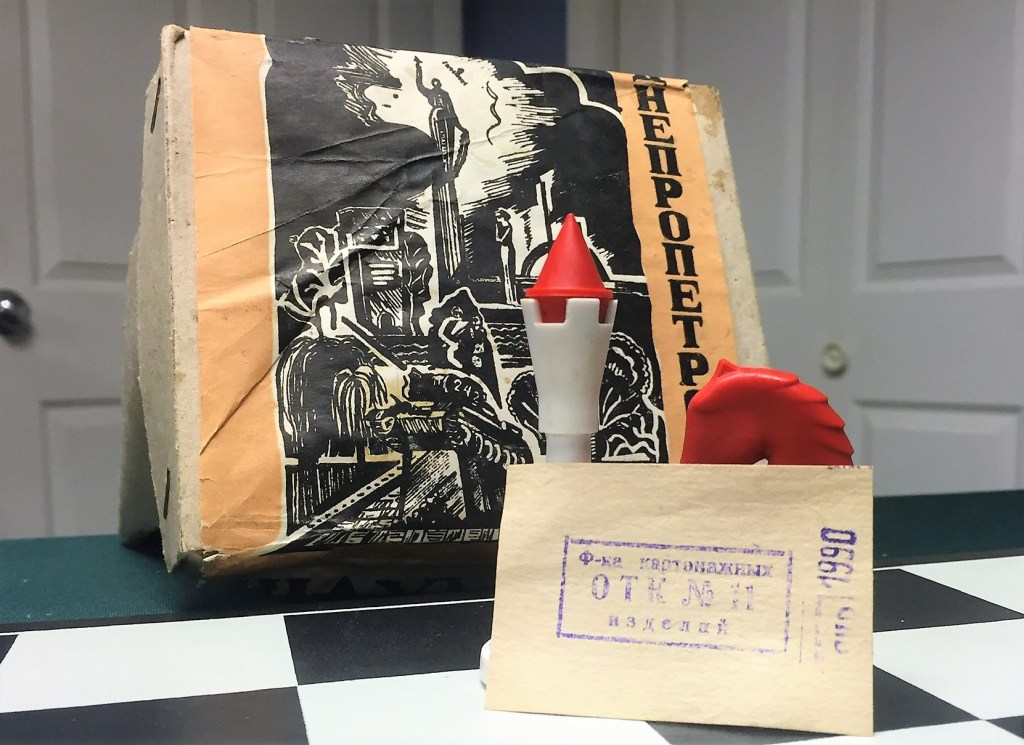
I date my specimen from an inspection stamp found inside the set’s box.

Molodets Set with original box and inspection certificate. Chuck Grau Collection, photo.

Original boxes accompanying sets are important sources of data on the sets’ dating and manufacturer. They more frequently are found with plastic sets than with wooden ones, which typically are paired with wooden box/boards that may or may not be original to the sets they accompany.

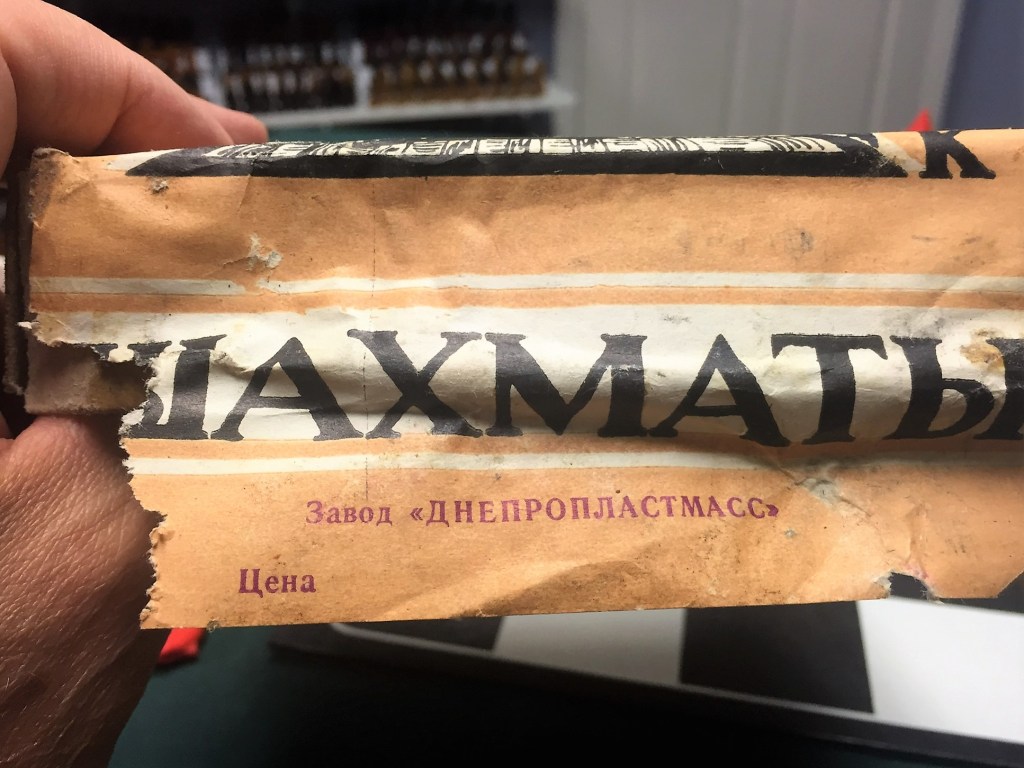
Alan Power describes the graphic on the top of the box as follows: “It has the words ‘CHESS’ at the top and bottom and DNEPROPETROVSK to the right of the illustration, depicting war machines (a tank and a rocket being launched) and a statue of a cosmonaut reaching up into space. The words ‘Plant DNEPROPLASTMASS’ appear at the bottom of the label. Unfortunately, the ‘цена’ (‘price’) is left blank.” Here is the bottom of the label from my set, which extends to the side of the box’s top.

Translation: “Chess/Factory Dneproplastmass/Price” Chuck Grau Collection, photo.

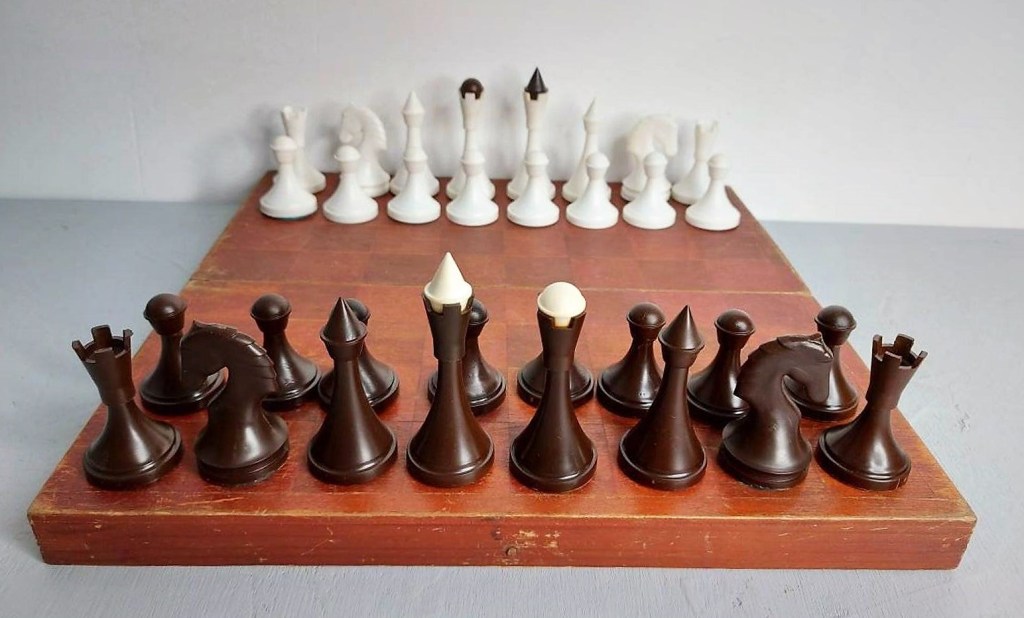
The clever simplicity of the set lies in its redundancy, its repeated use of the same parts to construct different pieces. The bases and stems of the king, queen, and bishops are identical. Only the crowns and miter distinguish them. The bottom portions of the king and queen crowns are identical. The top portions of their respective crowns vary to identify them. The king’s crown bears an opposite-colored conical top, identical in shape to that of the bishop, but of a different color, and set in a crown, whereas the conical piece in the bishop sits directly atop the stem. The shape of the king’s crown echoes the structure of the Molodets ICBM. The top of the queen’s crown is likewise opposite-colored, but is dome-shaped rather than conical.

Rocket City Molodets Set. Chuck Grau Collection, photo.

In similar fashion, the rook and pawn share identical bases. Again, it is their tops which identify and distinguish them. Atop the rook sits a turret that is none other than the same part used for the bottom portions of the royal crowns. Atop the pawn rests the same dome used to distinguish the king from the queen, but of the same color as the pawn’s base, whereas for the queen, the dome is opposite-colored. Alan Power suggests the dome shapes allude to the Soviet Sputnik satellite.

Sputnik I, Cosmos Magazine image.

It is not at all surprising that the Soviets would incorporate stylistic elements reminiscent of icons of Soviet achievements like the Sputnik satellite or the Molodets ICBM, for it was common practice for them to use art to glorify the successes of Soviet socialism, and to name places and things after heroes of the Revolution or Soviet socialism. It is also consistent with the theory and practice of Socialist Realism, the theory of art formally sanctioned by the Soviet State in 1934, which, simply put, mandated the use of “realist styles to create highly optimistic depictions of Soviet life.”

Dnepropetrovsk Proplastymass manufactured the Molodets set in other colors. Here is one in chocolate and white.

Chocolate and White Rocket City Molodets set. Collection and photographer unknown.

This beautiful set from the Soviet Union’s Rocket City is an echo chamber of form and color so clever it could have been designed by a rocket scientist. In the tradition of Socialist Realism, the Molodets set pays homage to the Soviet Union’s military and scientific rocketry by incorporating design elements reminiscent of the RT-23 ICBM and the Sputnik satellite.

From Tallinn to Tbilisi: The Evolution of the Tal Chess Pieces

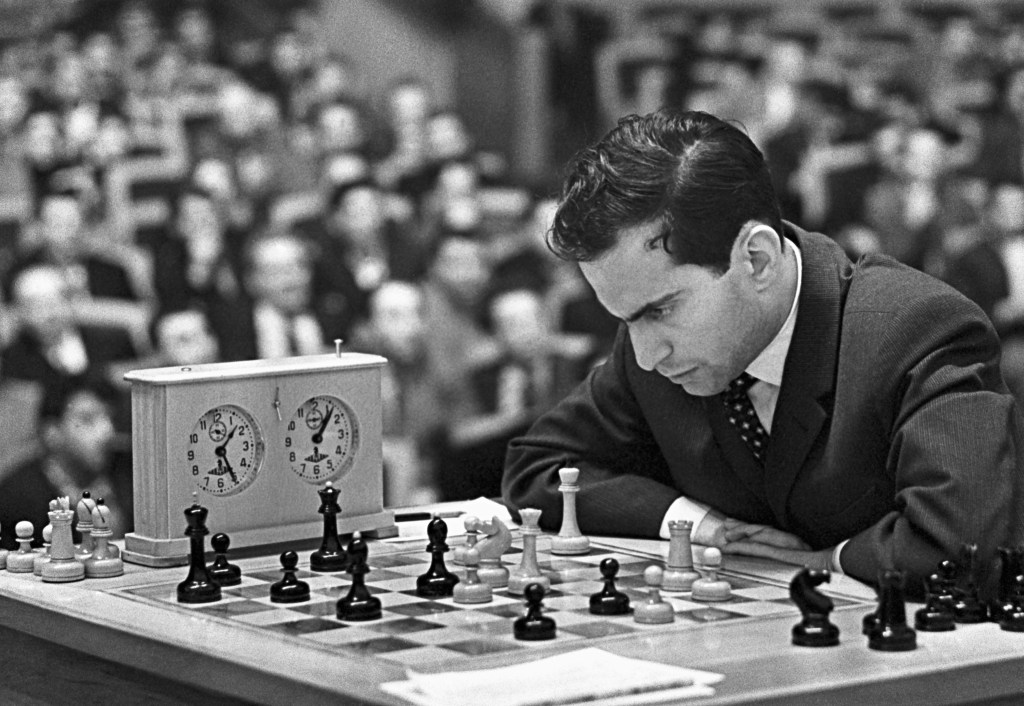
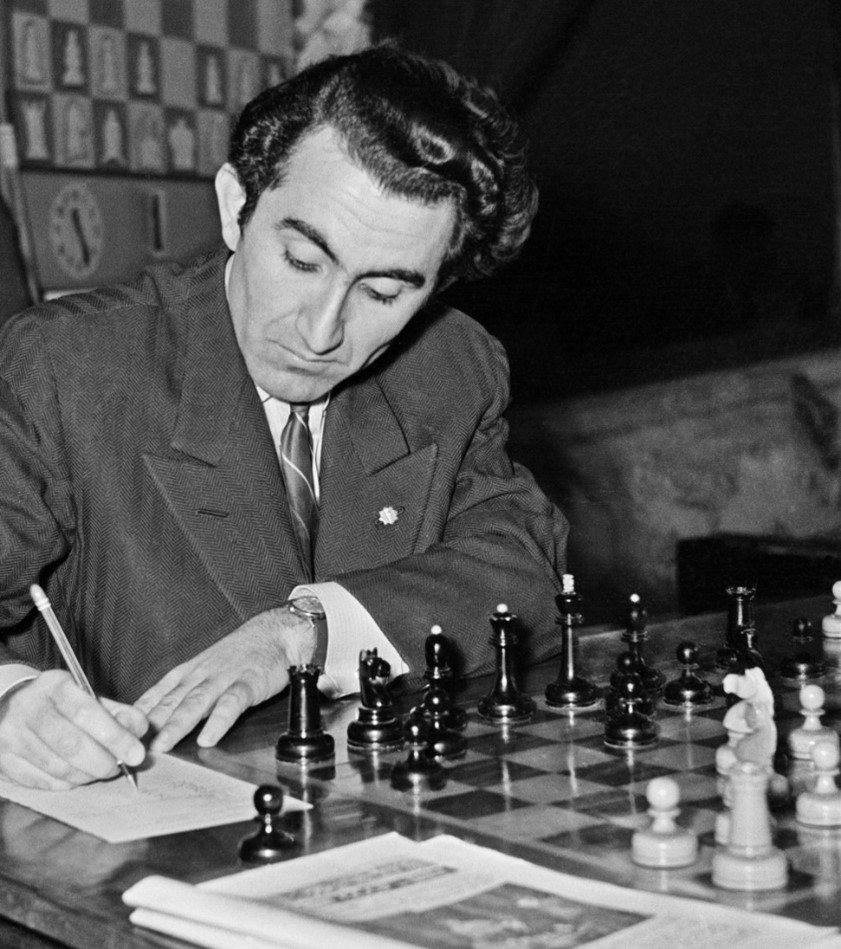
Former world chess champion Mikhail Tal, USSR Ch. Yerevan 1962. Sputnik photo.

Collectors typically study photographs of events to help them determine what type of pieces they have in their collections, when they were used, in which events, and by which players. Sometimes, however, they discover pieces in photographs of which they have not seen surviving examples, launching them on a quest to find them. So it is with the chessmen appearing on the cover of the Cadogan and Everyman paperback editions of former World Champion Mikhail Tal’s autobiography, The Life and Games of Mikhail Tal.

Chuck Grau photo.

The book’s cover bears a photo of Tal contemplating his position after Black’s 32nd move in Tal v. Krogius, played in the 30th Soviet Championship in Yerevan in 1962, a Ruy Lopez won by Tal. These chess pieces comprise one of three sets Portuguese collector Arlindo Vieira described as “Utopia” in his 2012 video on Soviet and Russian chess sets. Collectors of Soviet chessmen have come to call them “Tal Pieces” in homage to the former World Champion’s connection to them in this photo.

The photographic record of the Tal chess pieces strongly suggests that they originated in the pre-Annexation Baltic states around 1940, most probably Estonia, but then evolved stylistically, and migrated to a new home in Georgia SSR in the fifties, where they remained in use until at least 1979.

The pieces largely follow neoclassical Staunton conventions, while also incorporating certain Soviet design elements, the combination of which collectors have come to call Soviet Stauntons. Among the traditional Staunton elements present in Soviet Stauntons are: relatively wide bases that incorporate a step as they rise to meet the stem; vertical stems that rise from the bases’ steps with a bottom diameter appreciably less than that of the base; stems that taper as they ascend to form a largely vertical segment and intersect the pedestal at a distinct, perpendicular or near-perpendicular joint; upon the pedestal rests a piece signifier resembling the symbolic representation of the piece in chess diagrams; which is offset from the circumference of the pedestal and connected by a connecting section defined by two collars resembling the rims of crowns or miters (together with the pedestal the two collars of the connector are often referred to as a “three collar structure”); the king’s signifier often incorporates a cross-like finial; the queen wears a coronet; the bishop’s miter often bears a cut; and the rook’s turret typically contains merlons; when arrayed on their starting squares the pieces resemble a series of columns supporting a triangular pediment. The shape of the knight’s back approximates the S curve characteristic of Staunton knights.

Tal Chess Pieces’ Staunton, Soviet Attributes. NOJ reproduction. Chuck Grau Collection, photo.

Among the typically Soviet design elements of Soviet Stauntons are the opposite colors of the king, queen, and bishop finials; the modification of the king’s cross to one not quite recognized by Christian iconography; and, with one notable exception, a knight not patterned after the Elgin Marbles. Among the features that distinguish the Tal set are the hefty wide and tall bases; the thick rook towers; the crisply carved angled merlons; the squat pawns; and the jaunty knights, which appear to lean backwards with their heads tilted up toward the sky. The traditional and idiosyncratically Soviet elements of Soviet Stauntons are illustrated above.

The origins of the design have been a matter of some interest. Based on his extensive review of photographs from Georgia SSR and elsewhere, American collector Ron Harrison has suggested that the design is Georgian in origin. To be sure most of the photos of the sets in use from the fifties, sixties, and seventies were shot in or nearby Georgia. My own research, however, suggests that the set originated in the Baltic states, where it appears in the photographic record as early as Spring 1940, notwithstanding its later ubiquity in Georgia.

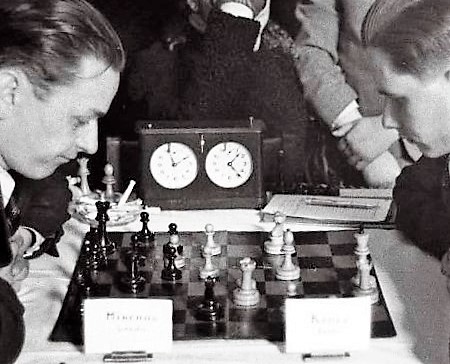
Mikenas and Keres with first generation Tal pieces. Tallinn 1940. Photographer unknown.

The photo above shows Paul Keres and Vladas Mikenas playing in a match between Estonia and Lithuania held in Tallinn prior to the annexation of the Baltic states by the Soviet Union later in 1940.

A specimen of this set from the collection of Mike Ladzinski is shown below. Ladzinski obtained his set from a Lithuanian dealer in 2019. Lacking several elements of the mature Tal design of Yerevan 1962, these chessmen adopt traditional elements of the English Staunton design, most notably the long stems narrower at the top than the bottom; the distinctly jointed pedestals, the three-ring collar system, the cross-crowned king, the bishop miter cuts, the merlons of the rook turrets, and the collective column-pediment. Unlike traditional Stauntons, the crosses and finials are opposite-colored. The unique, jaunty knights do not emulate the Elgin Marbles in realism or detail, but are very close in design to those of the 1959 Tbilisi and 1962 Yerevan sets. The pieces contain the wide, almost squared-off bases characteristic of the mature sets, but not yet as tall. The cross is a true cross, not the quasi-cross of the 1962 set. While the rooks’ turrets incorporate merlons, their towers are noticeably narrower than their successor’s, and concave rather than the straight Tbilisi and Yerevan towers. The pawns’ stems are longer than the late versions, making the pawns less squat.

First generation Tal pieces. Mike Ladzinski Collection, photo.

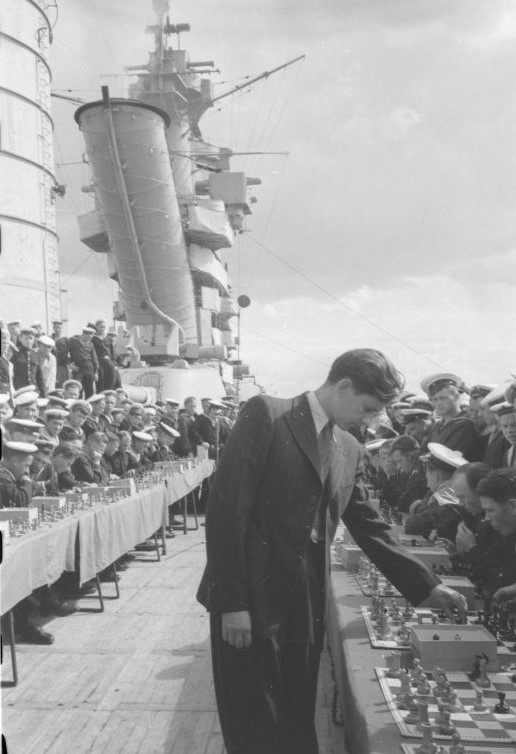
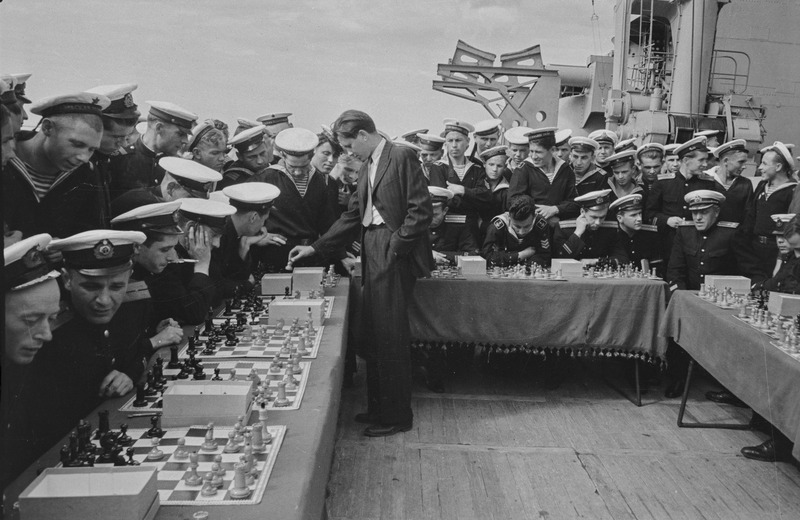
Shortly after the Second World War, Tal sets were used in a simultaneous exhibition that Estonian great Paul Keres played with players from the crew of the Soviet battleship October Revolution when it docked in Tallinn in 1946. The pieces in the following two photos seem to have evolved. The bases appear thicker, the pawns stubbier, and the rook stems thicker and straighter.

Paul Keres Simultaneous Exhibition aboard Soviet Battleship October Revolution, Tallinn, 1946. Grigori Akmolinski photo, AM N 33716:8, Estonian Sports Museum.

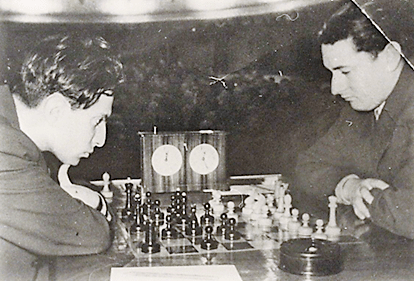
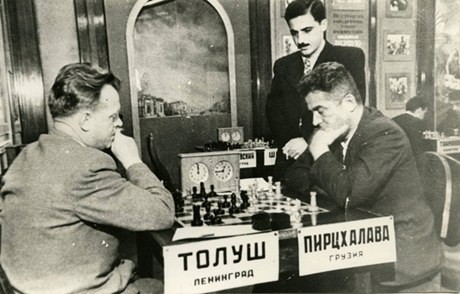
Over the next few years, the pieces continued to be used in the then-annexed Baltic states and in nearby Leningrad, as the following three photos indicate. In these photos, the pieces can be seen evolving towards their 1962 form, with widened, straightened rook towers and stouter pawns. The first photo depicts Akaki Pirtskhalava and Alexander Tolush playing in the match between Leningrad and Georgia in the 1948 USSR Team Championship. The tournament was held in Vilnius, Lithuania.

Pirtsskhalava-Tolush, 1948 USSR Team Ch., Vilnius, Lithuania. Photographer unknown.

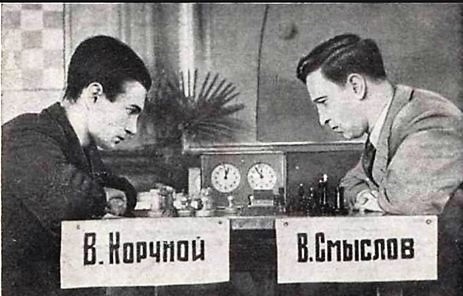
The second photo documents a game between Viktor Korchnoi and Vasily Smyslov playing in the 1951 Mikhail Chigorin Memorial tournament, held in Leningrad.

Korchnoi-Smyslov, 1951 Chigorin Memorial, Leningrad. Photographer unknown.

In the third photo, Vytautas Landsbergis and Tigran Petrosian are seen playing in the 1951 Lithuanian Championship, held in Vilnius, Lithuania.

Landsbergis-Petrosian, 1951 Lithuanian Championship, Vilnius. Photographer unknown.

By the late fifties, use of these pieces migrated to Georgia SSR, where they became very popular, and used in major tournaments there and nearby Yerevan for decades. It was in Georgia that they likely evolved into the form seen on the cover of Tal’s biography, complete with the taller bases and stout pawns with very short stems. The next three photos show the Tal pieces in use in Georgia from 1959 to 1979.

Gufeld-Tal, 1959 USSR Championship, Tbilisi, Georgia SSR.
Alexandra-Gaprindashvili, Tbilisi 1960. History of Romanian Chess. Photographer unknown.
Gurgenidze-Klovan, Tbilisi 1979. Photographer unknown.

The next photo shows in great detail the Tal set used in the 1959 USSR Championship held in Tbilisi, Georgia SSR. The pieces have reached their mature form, with stout bases, extraordinarily squat pawns, and chunkier, less tubular knights than in the original Tallinn version of the set. The photo depicts the pieces at use in Tigran Petrosian’s game against Yuri Averbakh, a Najdorf Sicilian Defense won by Petrosian, who won the game and the championship.

Averbakh-Petrosian, 1959 USSR Championship, Tbilisi, Georgia SSR. T. Archvadze/TASS photo.

The next two photos depict original Tal pieces like those shown in the photos above from the 1959 Soviet Championship in Tbilisi. Whereas the pieces in the photos appear to be natural and black, these originals are natural and a very dark brown. The finials on the dark pieces are painted rather than finished natural wood.

1959 Tal Pieces. Chuck Grau Collection, photo.

Although photos have emerged purporting to show a surviving set of pieces like those used in Yerevan, 1962, there is no evidence corroborating the pieces’ authenticity, and at least one collector and dealer from Kyiv believes the pieces are modern reproductions.

Tal pieces continued in front line service until at least 1979 but were largely displaced as pieces of Soviet Championships by another Soviet Staunton design, the so-called Grandmaster 3 design, after the 1962 Championship in Yerevan. They enjoyed a long and storied existence on the front stages of Soviet chess at the apex of its dominance, beginning with their appearance in Tallinn in 1940 to their popularity in Georgia SSR in the 1950s, 1960s, and 1970s. Tied to the ever-popular World Champion Mikhail Tal by the cover of his autobiography, the Tal pieces remain a favorite to collectors of Soviet chess sets.

A version of this article is appearing in a forthcoming issue of Chess Collector International Magazine.

Aristocratic Olympians: The 1980 Minsk Olympic Set

c. 1980 Minsk Olympic Commemorative Pieces. Chuck Grau Collection, photo.

Much Soviet chess set collecting focuses on wooden tournament sets, and understandably so, as those were the sets with which the giants of Soviet chess played their magnificent chess. But Soviet plastic sets provide many delights of their own. To the program of Political Chess, they provided an opportunity to produce great numbers of sets cheaply. For players, they offered sets better able to stand up to the elements for the inevitable games played on park benches whatever the weather. For designers, they provided ways to express creativity not afforded by wood.

This design is showcased in Arlindo Vieira’s seminal 2012 video on Soviet and Russian chess pieces and in his blog Xadrez Memoria. He describes them as “Unusual Plastic/Metal Chess Pieces,” which he acquired from a friend who knew only that they were Soviet. His video tells us little about the pieces, other than they were made in Minsk in 1984, according to a page from a Christies catalog he displays.

c. 1980 Minsk Olympic Commemorative Pieces. Chuck Grau Collection, photo.

In Xadrez Memoria, Arlindo elaborates his views, describing the pieces as “quite different” from traditional Soviet pieces, “almost say, aristocratic in their design.” Vieira was fascinated with their “Flowery… somewhat complex and turned shapes.” He tells us that his research determined that the pieces had been offered to certain personalities and sold to the public in commemoration of the 1980 Olympic games held in the USSR. He shows the set depicted on the cover of a chess book, from which he concludes the pieces had gained “some popularity.”

c. 1980 Minsk Olympic Commemorative Pieces. Chuck Grau Collection, photo.

What I find fascinating about this design is how it incorporates the principle of redundancy found in other Soviet plastic sets. By this I mean the use of the same plastic part to serve different or like functions in different pieces. In this set, the base/lower stem structure is a single unit, and is identical for all the pieces. It comprises the set signifier. Each piece is then identified by a different piece signifier, which either sits directly upon the base/lower stem section, as with the knights, rooks, and pawns, or together with an upper stem section that increases in height from bishop to queen to king. One wonders whether the subliminal message of the design is that “at base, we are all equal.”

c. 1980 Minsk Olympic Commemorative Pieces. Chuck Grau Collection, photo.

Kiev collector and dealer Михайло Коваленко, from whom I acquired my set, provides the following commentary: “As for this type of chess pieces, I already wrote in Facebook that there are three types of this type of chess. The first is Belarusian. It can be in a separate package (like mine), or in a plastic chessboard. If in a board, the color of the substrates should be identical to color of an upholstery of a board inside. Belarusian pieces in white turn yellow over time, especially in the sun. There are also Ukrainian-made (the city of Severodonetsk) two types of pieces. The first Ukrainian is similar to the Belarusian, but does not turn yellow. The second Ukrainian is reinforced. The stems are thick and all the pieces are coarser. These pieces are more resistant to shocks. Also, Ukrainian pieces come with yellow metal and ‘silver’ metal. Belarusian only yellow metal.”

My pieces in their efficient storage tray. Chuck Grau collection, photo.

The pieces also are packaged in a variety of boxes. Some commemorate the 1980 Olympics; others different events; yet others contain only the pieces without commemoration. Regardless of the designation, the pieces are referred to generally as an “Olympic” set.

Ukrainian 1980 Olympic Commemorative Set. ChessUSSR photo.

One Ukrainian variation in this design is of particular note. Perhaps as a means to reinforce their relatively longer stems, it incorporates a double base for the kings and queens. Basically, the flare at the bottom of the base is repeated before the ascension of the stem. Perhaps this suggests that, to paraphrase Orwell, “All bases are equal, but some bases are more equal than others.”

Pushki on the Chessboard: The Soviet Cannon Rook Set

c. 1935 Cannon Rook Pieces. Chuck Grau Collection, photo.

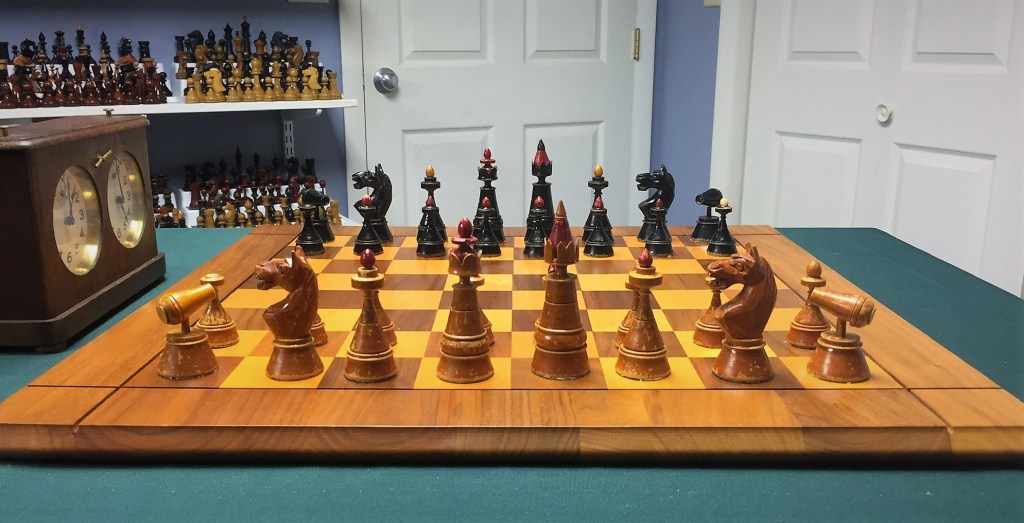
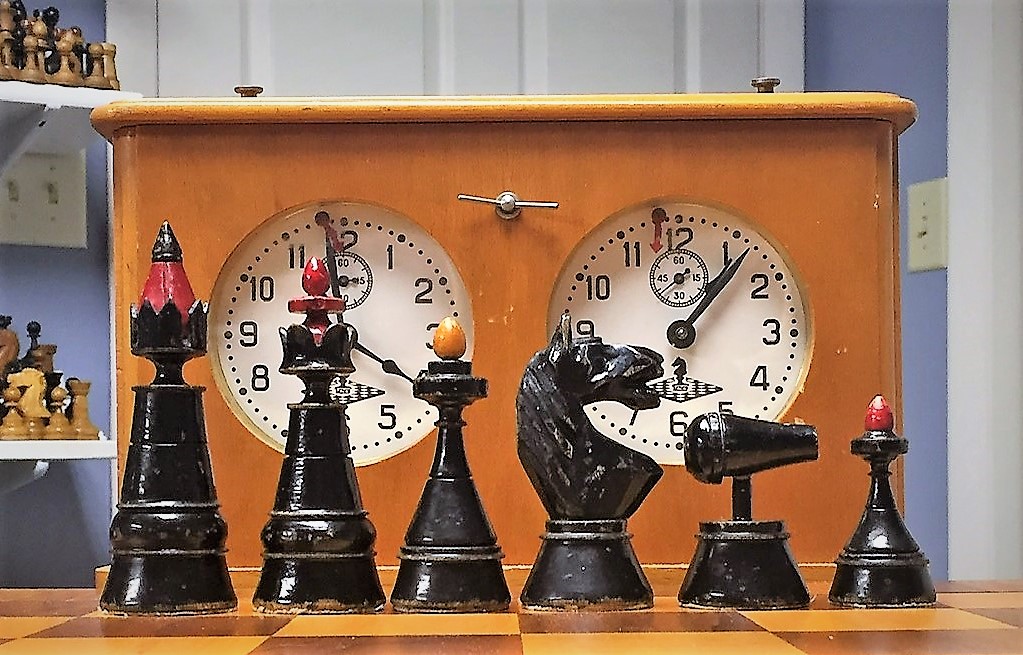
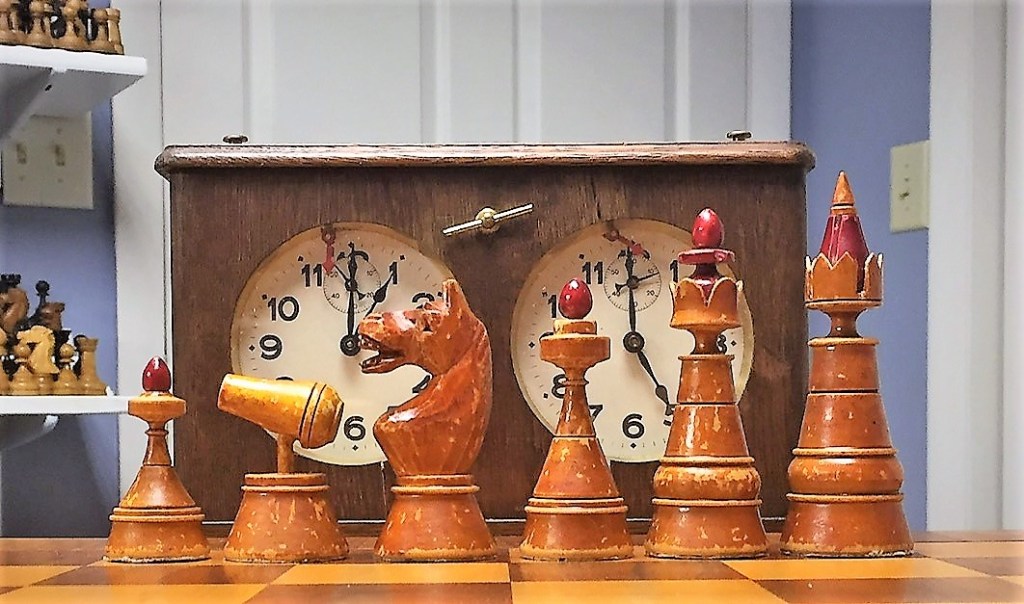
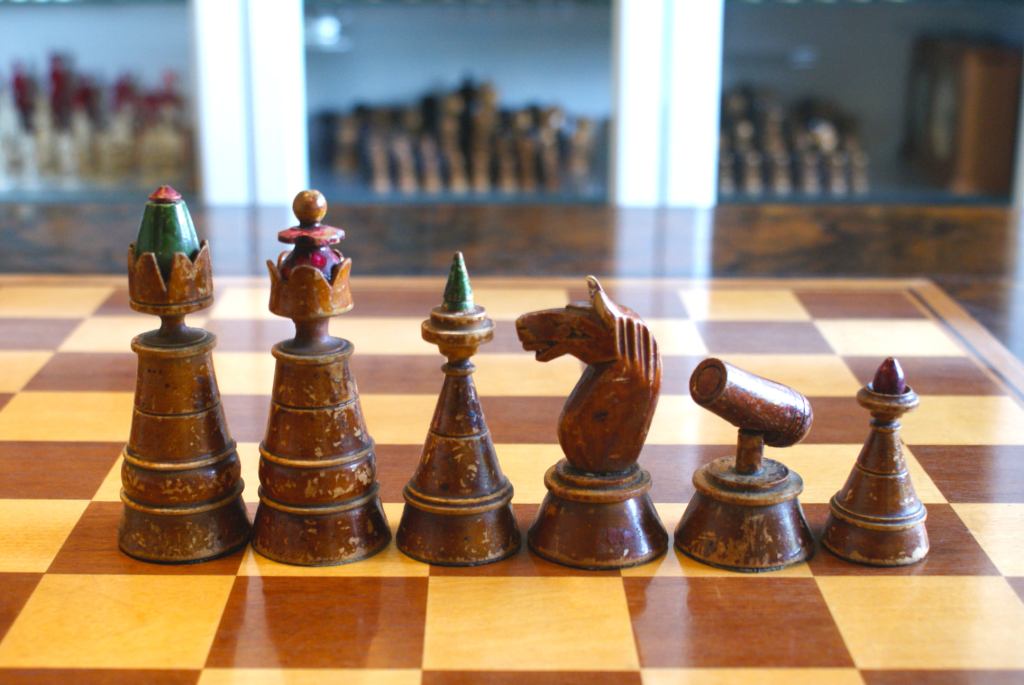
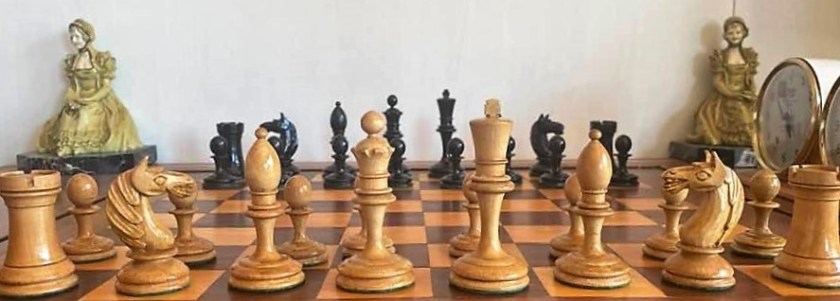
One of the most interesting sets in my Soviet collection comprises what I call the “Cannon Rook” pieces, a non-Staunton design characterized by its unusual rooks, represented not by the traditional towers, but by cannons mounted on stems above bases.

c. 1935 Cannon Rook Pieces. Chuck Grau Collection, photo.

The pieces present an overall conical impression, tapering from bottom to top without distinct base and stem sections. The piece signifiers share a common theme—a bullet-shaped cap, mostly in red for both sides, but with some varnished in natural wood. The king is 107 mm tall with a base of 37 mm. Its crown consists of two parts–a colored cone situated within a ring of saw-toothed points. The queen has a rhyming structure, but instead of a cone her crown inlay consists of a tear-shape atop a disc-shaped pedestal. The tear-shape also appears atop the bishop and the pawn. The knights are nicely carved with large, prominent teeth like those found in other late Tsarist and early Soviet knights, and resemble other well-carved knights thought to be made by Artel Kultsport. The pieces are nicely weighted and felted with patterned cotton cloth.

c. 1935 Cannon Rook pieces. Chuck Grau Collection, photo.

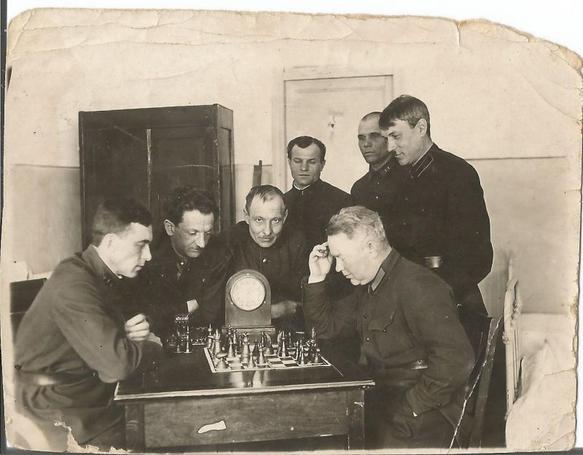
Moscow’s Russia Chess House, from whom I acquired it, dated the set as late 19th century, but I think this is too early. The design appears in the photographic record in 1935, which I think much closer to its time of origin owing to the “Kultsport” knights and the nature and condition of the varnish finish. Here is a photo said by St. Petersburg collector Sergey Kovalenko to be from the Leningrad region in 1935.
CDN Molypolk.ru photo, provided by Sergey Kovalenko.

I know of three sets that share this basic design. Of a somewhat smaller set, noted German collector Holger Langer writes: “An unusual Soviet chess set with unusual rooks, probably made in the 1920’s or 1930’s. The pieces are made of wood and are moderately weighted. King height is 9.85 cm or 3.85″. The white side is covered with the usual reddish-brown varnish often seen in Soviet sets. The black side is covered with a black lacquer. The kings with a very pronounced crown and hat in green color with a red finial, the queens of almost equal height but with a red ball inside the crown with a red disc and a small ball finial on top (the black queen with some damage, unfortunately). The rooks are extremely unusual in that they are shown as cannons mounted on a circular pedestal. The knights as carved horses’ heads of typical Russian or early Soviet shape. The bishops with a long cone shaped corpus and a green colored pointed finial. The pawns also with a smaller cone shaped corpus and a colored drop finial (in red for the white side and in brown for the black side).”

Holger Langer Collecti0n, photo.

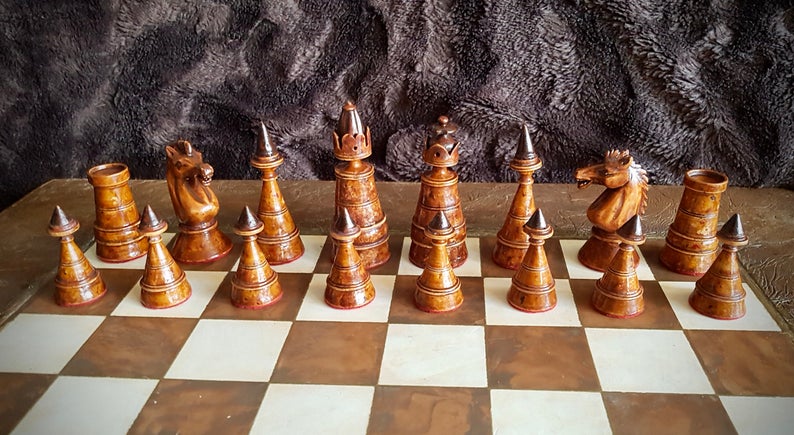
Of the second similar set, artistically restored by The Chess Schach, artist Alan Power writes: “Militibus ex Antiquis Ruthenorum (Old Russian Warriors), 32 heavily-weighted chessmen without board, wood, white v. red, Soviet (post Revolution era), circa 1920 – 1930 Height: King 10cm, weight 55g, base width 3.8cm, Queen 9.2cm, Bishop 9cm, Knights 8/7.5cm, Rook 5.8cm, Pawn 5.8cm. W: red felt bases B: black felt bases.

Militibus ex Antiquis Ruthenorum. The Chess Schach Gallery, Alan Power photo.

“An extremely rare set of Soviet chessmen (most probably hand-turned for personal use or as a gift, perhaps). It came to me in pretty poor condition; two of the Knights muzzles have been repaired and two Bishop mitres and five pawn caps (I’ve lost track of which pawns) have been replaced. There is also a certain amount of ‘head-bowing,’ also called stooping or leaning amongst the pieces, which adds overall character, therefore, it has been left as is. A few ‘battle-scars’ have also been left here and there for the same reason.” Unlike the Langer and Grau specimens, the Chess Schach rooks are traditional towers, not cannons mounted on bases. The knights are more delicately and intricately carved.

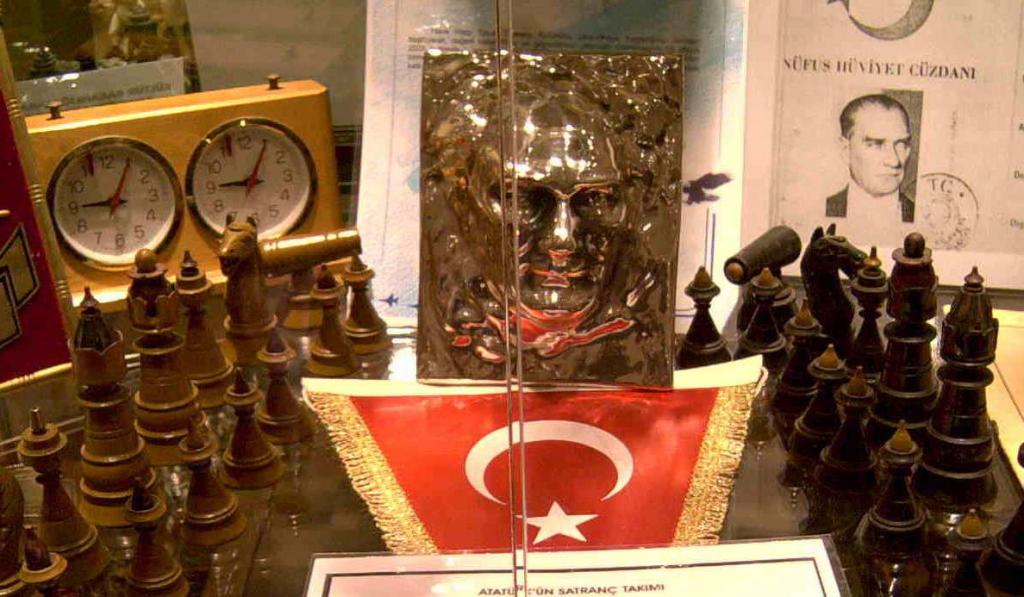
The third specimen is the most intriguing. According to a well-regarded collector who goes by the penname Schachkunst BL on Facebook, Stalin presented Turkish President Mustafa Kemal Atatürk (1881-1938) with it as a gift. The set made its way into the hands of Turkish Master Halil Sertac Dalkiran (b. 1955), who displayed it in a chess museum he opened in Istanbul.

Set gifted to Ataturk by Stalin in Dalkiran’s Istanbul Museum. Photographer unknown. Source: Schachkunst BL on Facebook, accessed 3 April 2022.

Indeed, a photograph of a Soviet Cannon Rook set appears on the cover of Dalkiran’s 1995 book Chess Training Method, as posted on Facebook by Moscow collector Alex Chelnokov.

Source: Goodreads

According to Schachkunst, Dalkiran’s museum closed in 2008. The whereabouts of the Atatürk set are unknown as of this writing.

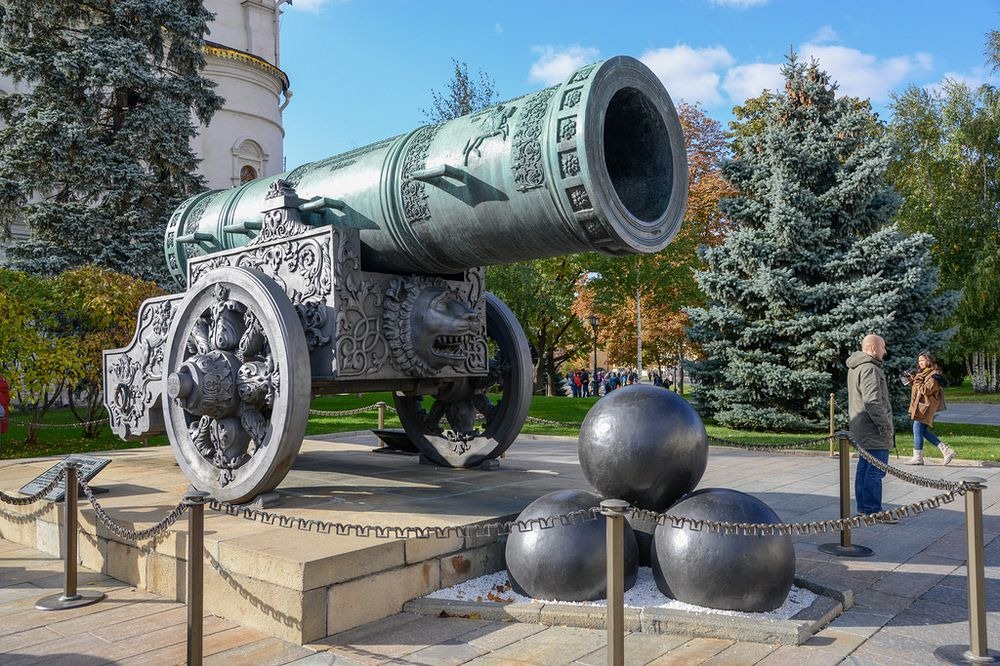
The cannon is an important part of Russian cultural heritage. We are all familiar with Tchaikovsky’s 1812 Overture, commemorating the successful defense of the Motherland from Napoleon’s invading armies, and the rousing cannonade of its finale. Less well-known in the West is the massive Tsar Cannon, cast in bronze in 1586 by the master caster Andrey Chokhov and displayed on the grounds of the Kremlin in Moscow.

Jorge Láscar/Flickr photo.

The set’s likely origin in the early 1930s came at a time of great experimentation in Soviet chess design, much of it challenging central Neoclassical elements of the Victorian Staunton design. Some games sought to displace classical chess. One such game was Victrix, as explained by Moscow Chess Museum Curator Dmitry Oleynikov: “The revolutionary changes in the world of the 1920s gave rise to attempts to ‘revolutionize’ the old war game, and not only by depriving it of its ‘monarchist’ regalia.” Advertisements described Victrix as “An exciting new game of chess pieces on a board of 100 squares. In addition to the usual figures, new figures MACHINE GUN, PLANE AND TANK are participating! Anyone who knows the rules of an ordinary chess game very soon, at once, LEARNS THE MOVES OF NEW FIGURES!” While Victrix did not include a Cannon piece, it does evidence a willingness to experiment with the identity of the playing pieces, and its Machine Gun bears an eerie resemblance to the Cannon Rooks of the c. 1935 set.

1920s Victrix Set. Russian Chess Federation photo.

Elements of the crown structures can be seen echoed in other Soviet sets. The first is from my collection, a diminutive Constructivist-influenced set from the 1920s or thirties, where the king’s crown is reminiscent of that in the Cannon Rook set.

1920s-30s Constructivist-Influenced Pieces. Chuck Grau Collection, photo.

The second set resides in the collection of New York collector Eduardo Bauza. The royals’ crowns in this set beautifully restored by Ron Fromkin echo those of the Cannon Rook set.

Eduardo Bauza Collection, photo.

Finally, the king’s crown of the c. 1980 Minsk Olympic Commemorative set recall those of the much earlier Cannon Rook set.

c. 1980 Minsk Olympic Commemorative Pieces. Chuck Grau Collection, photo.

The fascinating design of the wonderful Cannon Rook pieces well reflects the creativity of Soviet chess design in the 1930s and its challenge to Neoclassical Staunton design. Elements of the Cannon Rook set’s design can be found in other Soviet sets spanning the decades.

Working the Soviet Design Toolbox: Porat Jacobson’s “Smyslova” Set

Porat Jaconbson’s Smyslova Chess Pieces. Porat Jacobson photo.

Berlin Artist Porat Jacobson has designed and produced an original Soviet chess set design melding design concepts spanning six centuries. The pieces are inspired by at least four sets. The knight derives from one found from a Novgorod set of early 15th Century Rus.

Early 15th Century Novgorod Knight. Photo from Isaac Linder, The Art of Chess Pieces (1994).
Porat Jacobson’s Smyslova Knights. Porat Jacobson photo.

The King and Queen are inspired by those of the Smyslov set of the 1920s and 1930s, as are the pawns. Perhaps the most striking feature of the Smyslov design is the dendriform structure of the stems, an Modernist architectural feature found in Frank Lloyd Wright’s dendriformic columns in the S.C. Johnson office building in Racine, Wisconsin USA and in Moscow’s Stalin Award-winning Kropotkinskaya Metro Station.

Smyslova Royals. Porat Jacobson photo.
Original 1930s Smyslov Chessmen. Chuck Grau Collection, photo.

Porat’s pawns echo the Smyslov pawns while exaggerating the ovoid shape of their heads.

Smyslova Pawns. Porat Jacobson

The Smyslova Rook is inspired by those of the Soviet Upright (fka Averbakh II) set of the 1930s and 1940s.

Smyslova Rooks. Porat Jacobson photo.
1930s-40s Soviet Upright Pieces. Chuck Grau Collection, photo.

The bishop is inspired by another undetermined set, but incorporates the Smyslov’s dendriformic stem. Porat melds the ideas borrowed from these disparate Soviet sets with rhyming bases and dendriformic stems (“set identifiers” in Mike Darlow’s parlance).

The Smyslova set manifests Porat’s theory that Soviets had a “toolbox” of ideas from which they drew in different combinations and variations. It also illustrates his corollary that knights in Soviet sets are largely fungible. Different styles of knights can pair equally well with the same set; the same style knight can pair equally well with multiple sets.

Porat Jacobson’s Smyslova Chess Pieces. Porat Jacobson photo.

The Smyslova is the inaugural set of Porat’s new venture, Jacobson Handmade Chess Sets. We can’t wait to see what else he has in store.

Icons of the Soviet Chess Board: Botvinnik-Flohr II Chess Pieces

Mid-1930s Botvinnik-Flohr II Pieces, Chuck Grau Collection, photo.

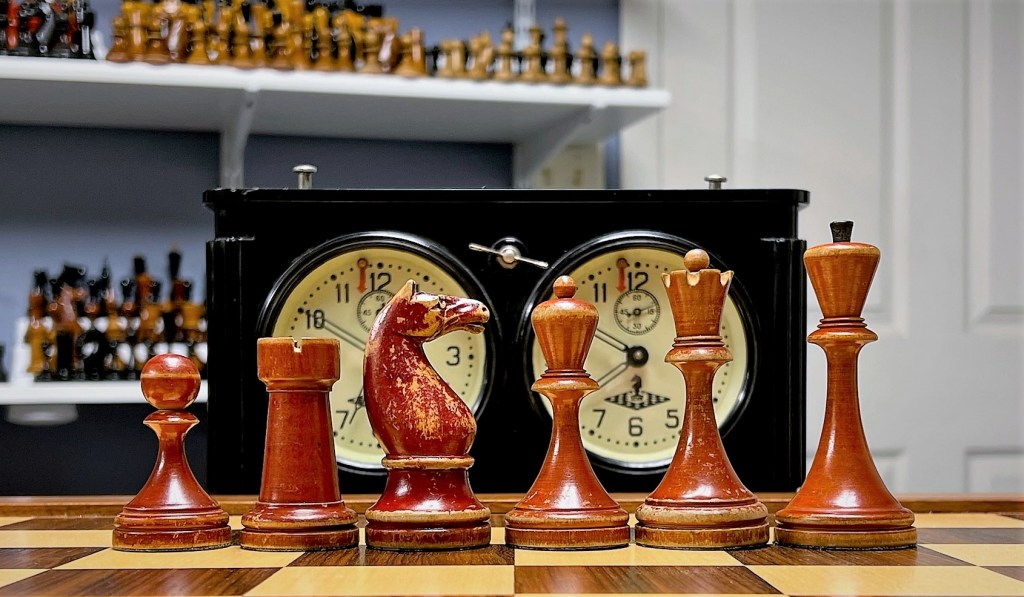
Perhaps the most iconic Soviet chess pieces of all are what we have come to call Botvinnik-Flohr II pieces, BFII for short. In evolving variations, they were used at the highest levels of Soviet chess from the 1930s to the 1960s, including the 1934 Leningrad Masters Tournament, the 1935 Second Moscow International Tournament, the 1936 Third Moscow International Tournament, multiple Soviet Championships, and the 1956 Moscow Olympiad. World Champions Lasker, Capablanca, Euwe, Botvinnik, Smyslov, Tal, Petrosian, Spassky, and Fischer all played with pieces of this style.

For decades, BFII chess pieces served as soldiers in the front lines of the Soviet state’s program of Political Chess first pioneered by Alexander Ilyin-Genevsky in the 1920s and firmly established by Nikolai Krylenko in the thirties.

Alexander Ilyin-Genevsky, photographer unknown. Genevsky died during the Siege of Leningrad.

Genevsky served as a Red Army Commissar during the Revolution and was a master-level player and chess organizer. He believed chess was a way to teach soldiers initiative and strategic thinking. Chess, he wrote, “sometimes to an even greater degree than sport, does develop boldness, inventiveness, willpower, and something more that sport cannot do, develop strategical ability in a person.” Genevsky believed chess could do the same for the working masses, arguing that “In this country where the workers have gained victory, chess cannot be apolitical as in capitalist countries.” Krylenko had served as Commander in Chief of the Red Army during the Revolution, and later became Chief Prosecutor of the Soviet Union as well as Chairman of the All-Union Chess Section of the Supreme Council for Physical Culture. “We must finish once and for all with the neutrality of chess,” wrote Krylenko, “We must condemn once and for all the formula ‘chess for the sake of chess,’ like the formula ‘art for art’s sake.’ We must organize shock-brigades of chess-players, and begin immediate realization of a Five-Year Plan for chess.”

Nikolai Krylenko, photographer unknown. He was shot in 1938, a victim of the Purges and guilt-by-confession trials he had helped perpetrate. Ironically, one of the counts in the indictment against him alleged that he had practiced “Chess for Chess’s sake.”

Political Chess advanced on two fronts. First, it sought to increase the cultural level of the masses by teaching them chess and expanding clubs in workplaces, unions, youth organizations, and the armed forces, thereby drawing them into the political and social life of the Soviet Union. “In our country,” wrote Krylenko, “where the cultural level is comparatively low, where up to now a typical pastime of the masses has been brewing liquor, drunkenness and brawling, chess is a powerful means of raising the general cultural level.” This expansion would also improve the quality of chess play by identifying, nurturing, and advancing talent, which would thereby help the Soviets to compete with and defeat chess in the West, the second front of Political Chess. Political Chess catapulted Botvinnik to the world championship in 1948 and created a cadre of world class players who dominated chess for decades, thereby achieving Stalin’s goal of “meeting and exceeding the West.” This is an introduction to these historic pieces, which were present at every step along the Soviets’ road to world domination.

Pieces of the Mid-1930s

BFII pieces took center stage in the Krylenko’s efforts to gauge the strength of Soviet players against top level international competition, and to carry forward the “struggle at the chess board between the USSR and the capitalist countries.” Introduced at the 1934 Leningrad Tournament where future World Champion Max Euwe and Hans Kmoch, both Dutch, were brought in to compete against top Soviet players, they enjoyed the limelight at the 1935 and 1936 Moscow International Tournaments. The pieces shown as Set 1 are very similar, if not identical, to the sets used in the 1934 , 1935 , and 1936 tournaments.

Set 1. Mid-1930s Botvinnik-Flohr II Pieces, Chuck Grau Collection, photo.

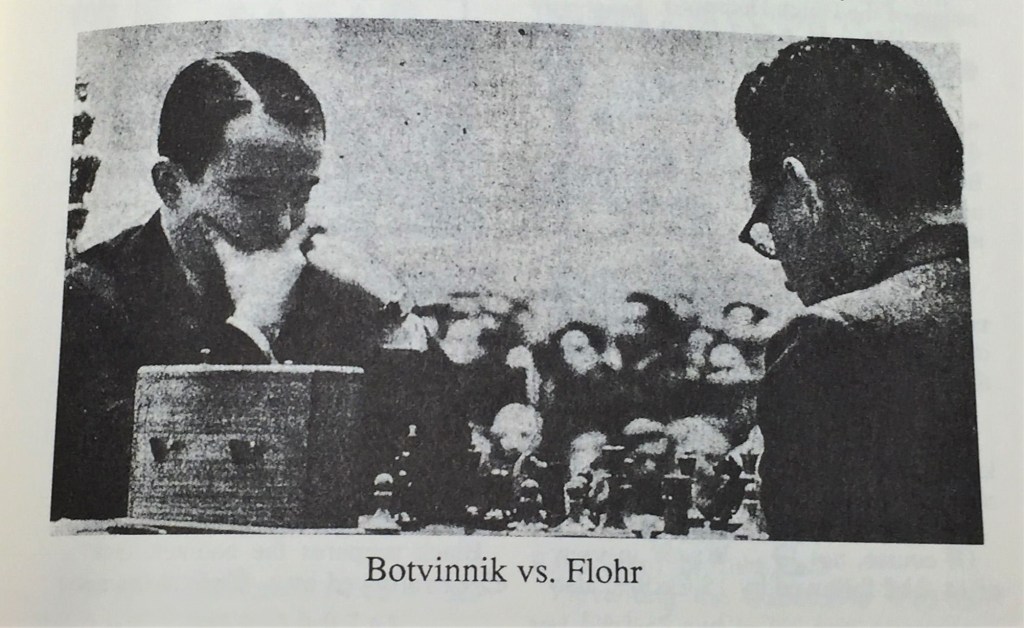
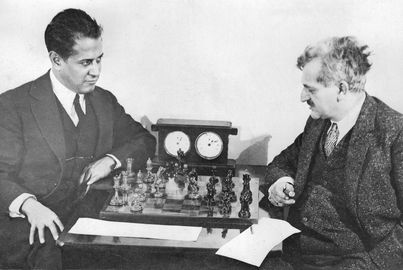
The set acquires its name from the two players who shared first place in the 1935 affair, Mikhail Botvinnik and Salo Flohr, ahead of former world champions Lasker (third) and Capablanca (fourth). It was with pieces like these that the famous Mop the Floor game was played between Botvinnik and Flohr in the 1936 tournament. The II designation distinguishes these pieces from those used in the Botvinnik-Flohr match of 1933 (BFI pieces). Until the differences between the pieces used in the 1933 match and the other events were rediscovered in 2017, collectors and manufacturers of reproductions had confounded them.

Flohr and Botvinnik, Moscow 1935. Source: Moscow 1935 International Chess Tournament 177 (N. Krylenko & I. Rabinovitch eds., Caissa Ed. 1998).
The pieces comprising Set 1 were turned and carved in Leningrad at the Prometheus Cultural Goods factory on Krestovsky Island, according to a stamp in the accompanying red-stained wood box. Given the pieces’ high level of craftsmanship for a Soviet set, the Prometheus Cultural Goods factory may well have been an artel. Artels were collectives of handicraft-producing artisans, recognized by Soviet law, who organized their own production efforts and shared costs and revenues.

Stamp inside box cover. Chuck Grau Collection, photo.

Collectors in Russia and Ukraine might refer to the set colloquially as a Leningrad set, as they report that it is their practice to refer to sets by using the name of the city or town where they were produced. With very few exceptions, Soviet sets went nameless, and like other Soviet consumer goods were referred to by functional designations. Thus, sets intended for tournament play were all called Tournament Chess, those for youth Yunost (Youth) Chess, and so on.

While the pieces used in the 1935 and 1936 International tournaments were clearly black and natural in color, this specimen is bright red. Stalin, our colleagues in the former SSRs tell us, did not like white pieces, as they could be seen to symbolize the White Army that fought against the Bolsheviks in the Russian Civil War. Revolutionary red, often referred to as “Stalin Red,” was to be preferred for sets made for Apparatchiks and the public.

Capablanca, 1935 Moscow. Sergei Korshunov photo.

The style of these pieces differs noticeably from that of traditional English Staunton in several respects. First, the king is not topped with a same-color cross, but a secular, opposite-color finial. While the bishop’s miter at first included a cut, as we shall see it soon disappeared. The knight is simply cut and carved, echoing the lines of the 15th century Novgorod knight displayed in Linder’s works, rather than the Elgin Marbles. They lack the S-shaped back of English Staunton knights, and their ears face forward, rather than backwards, as in the English sets. The crenelations in the queen’s crown and the rook’s turret follow Staunton conventions, but soon disappeared. Unlike traditional Staunton pieces, which have an easily distinguishable base/stem/pedestal structure, these pieces flow up conically from the outside circumference of the base and ascend in a curve, which trumpets out to form the pedestal, upon which the piece signifiers and their connectors rest. This base to stem to pedestal curve was to become a basic element of Soviet style. The royals and clerics retain the double collars of the connector between piece signifier and pedestal familiar to traditional Staunton pieces. The pieces generally conform to the proportions of Staunton pieces.

Pieces of the Mid-1930s to 1940s

No sooner did the BFII design debut than it began to evolve and undergo permutations. Set 2 derives from the mid-to late 1930s. It appears in the black and natural colors characteristic of Soviet tournament sets. The bishops share the shape of the previous specimen, but the miters lack the cuts. Kings sport opposite-color bone finials. There are some variations in the carving of the knights from the previous specimen, most notably the ears, which do not extend the curve of the back but perk forward from the top of the head. Knights with this ear structure appear in many photos from the 1935 and 1936 Internationals, but to my eye the ear structure of the knights in those photos is mixed between those found in these first two specimens.

Set 2. Mid to Late 1930s BF2 Pieces. Chuck Grau Collection, photo.

Set 3 appears in a photo dated 1938 appearing in Igor Botvinnik’s Photo Chronicle (2012) tribute to his uncle. It is very similar to the original design, but the bishop’s miter has grown rounded and lost its cut. The black king’s finial is made of bone, and the set is substantially weighted.

Set 3. c. 1938 BFII Pieces. Chuck Grau Collection, photo.

In Set 4, below, we begin to see significant modifications. The king’s crown and bishop’s miter have been noticeably rounded. The crenelations on the queen’s crown and the rook’s turret have disappeared, while the cut in the bishop’s miter remains absent. The queen’s finial has changed from same-color to opposite-color. The vertical portion of the stem has been shortened, while its conical portion has been commensurately lengthened, presenting an overall conical impression. And the torso of the knight, while retaining its neo-Novgorodian profile, has ballooned in girth, leading some collectors to dub it a Penguin Knight. A very similar set likely was produced by Artel Red Combine.

Set 4. c. 1940 BFII Pieces. Chuck Grau Collection, photo.

The Olympic Version of the 1950s

The final version of this iconic design (Set 5) appeared early in the 1950s, and was made in Valdai, Novgorod Oblast, according to an original box housing a pristine specimen of this version in the collection of Mike Ladzinski. Bobby Fischer played blitz against Tigran Petrosian with this version of the pieces, and they were the pieces used in the 1956 Moscow Olympiad and the 1957 USSR Championship.

Bronstein and Minev, 1956 Moscow Olympiad. Photographer unknown.
Bobby Fischer and Tigran Petrosian, Moscow 1958. Photographer unknown.

The design of this final version of the venerable BFII retreats from the radically conical version of the late thirties. The proportion of the conical lower to the vertical upper portion has diminished to that of the mid-thirties sets. While the tops of the kings and bishops remain rounded, there is a sharp joint demarking the boundary between top and side. The characteristic base/stem/pedestal curve remains. The size and girth of the knights are diminished, and the ears are pointed out to the sides for the first time. Unlike our first three specimens, the neck for the first time is not cut back from the front of the torso to the base. The height of the knight’s base is increased to compensate for the reduction in the height of the figural horse.

Set 5. 1950s Olympic BFII Pieces. Chuck Grau Collection, photo.

Set 5 is finished in natural and black, as were the sets used in the Olympiad and Soviet Championships.

Soviet Design and Political Chess

The simple style of the BFII pieces may be seen to carry forward the program of Political Chess in several ways. It facilitated cheaper mass production of chess equipment for use by the hundreds of thousands of players Political Chess would draw to the game. Beyond that, in relying on simplicity and incorporating industrial and geometric forms akin to Modernism and Constructivism, the Soviet design broke radically with the realism and neoclassical forms associated with the rise of industrial capitalism and “respectable Victorian society” expressed in the Staunton.


The design’s treatment of religious symbolism, a pillar of the Staunton design, merits elaboration. To be sure, the removal of crosses from kings and miter cuts from bishops expressed the Soviets’ underlying antipathy to religion and their efforts to repress it, but two other historical factors reinforced their aversion to the use of religious symbols in chess pieces. One is the Eastern roots of chess in Kievian Russia, where the first chess pieces bore a heavy Muslim influence in name and their geometric, abstract design, reflecting Islam’s prohibitions on the use of human forms. These Eastern influences persisted centuries longer than they did in the West, as the modernized game did not reach Russia until the rule of Peter the Great after 1760. The second is the hostility of Orthodox Christianity towards chess. Even many Tsarist designs avoided crosses and miter cuts, perhaps because more secular designs accommodated the Church and defused its opposition to the game.

Interestingly, however, early BFII pieces retained bishop miter cuts. Perhaps this reflected the pieces’ intended use in international tournaments, and an interest in keeping the pieces sufficiently familiar to foreign players participating in Soviet-sponsored international events. This may have been a factor in the Soviets’ retention of other elements of Staunton design as well, such as the relative proportions of the respective pieces. The BFII pieces—as other Soviet chess pieces we shall examine—ultimately incorporated some elements of the traditional Staunton design, while rejecting others, thereby forming what philosopher Walter Benjamin called a dialectical image in which now (modernist/simplified/geometrical/secular/socialist) confronts then (neoclassical/complex/realistic/religious/capitalist). In this way, these Soviet chess pieces embodied the “struggle at the chess board between the USSR and the capitalist countries” pursued by Krylenko’s program of Political Chess through the international and championship tournaments in which they were used.

Conclusion

The iconic Botvinnik-Flohr II design served the Soviet program of Political Chess as it scaled the ramparts of chess dominance. It is a preeminent example of how the Soviets put their mark not only on the style of chess play, but on the style of chess pieces as well.

An original version of this article appeared in the November 2021 edition of The Chess Collector Magazine, official publication of Chess Collectors International.

Chess Sets of Major Tsarist and Soviet Events, 1909-1941

Karelian Birch Pieces, used in the 1909 & 1914 St. Petersburg Tournaments. Chuck Grau photo.

Having examined Arlindo Vieira’s groundbreaking work, I turn now to a survey of major tournament sets. I begin with an examination of sets used in significant events from 1914 to 1941. My goal is to provide a quick identification guide to the new collector or student of Soviet designs, and a bit of information about them to help further study or appreciation of these sets.

Pieces from the 1909 & 1914 St. Petersburg Tournaments: Late Tsarist Karelian Birch Chessmen

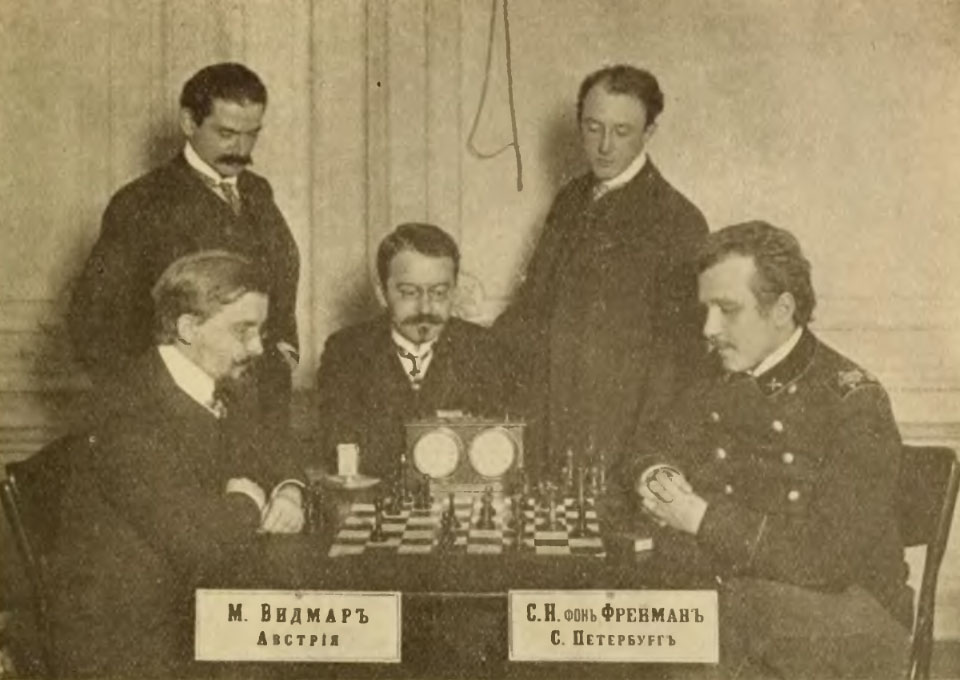
1909 St. Petersburg. Photographer unknown.

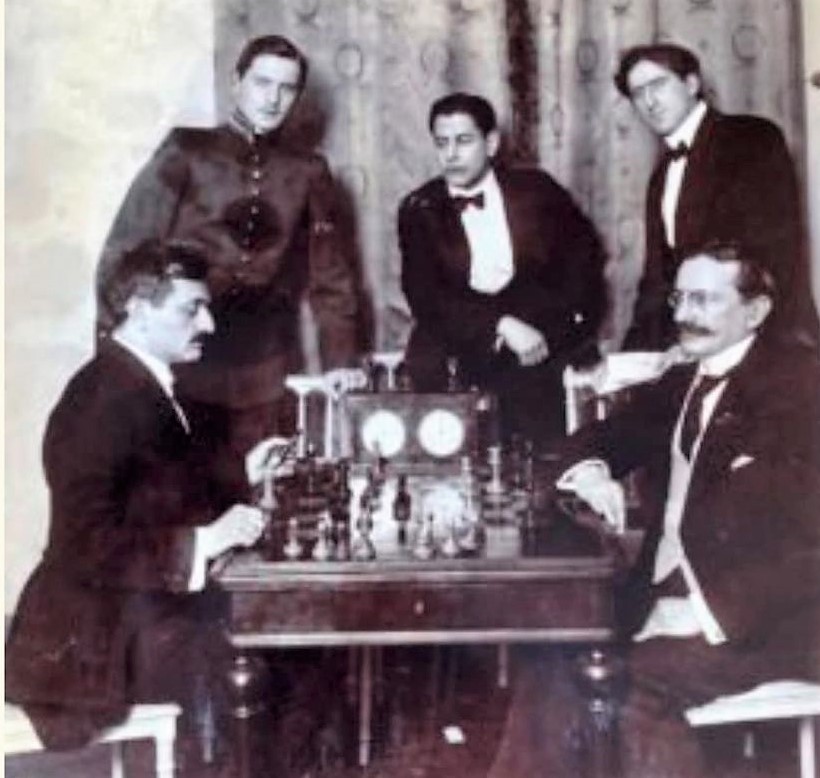
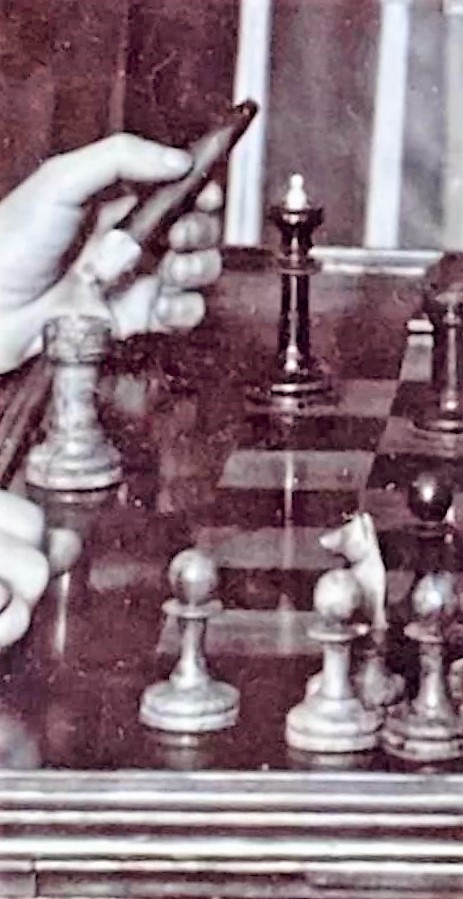
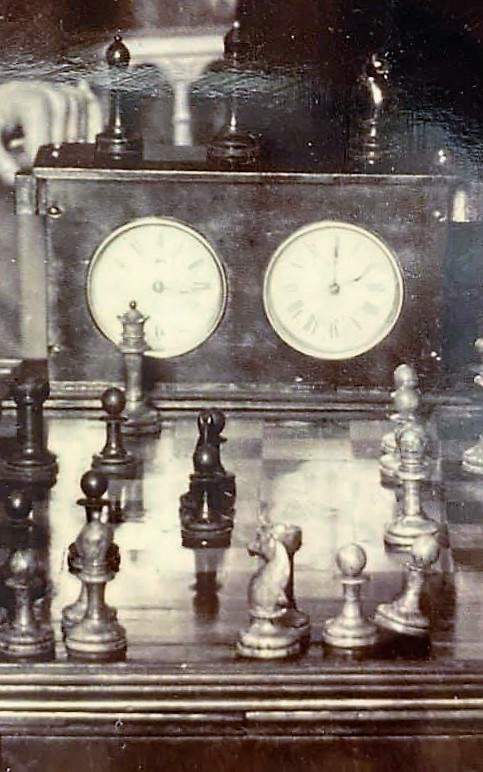
The last major tournament of the Tsarist era was played in St. Petersburg in 1914. Participants included World Champion Lasker, Capablanca (the winner), Alekhine, Tarrasch, Marshall, Nimzovich, Rubenstein, Janowski, Bernstein, Blackburne, and others. Here is a photo of the 1914 Tournament and some of its illustrious participants, together with two magnified and enhanced close-ups of the pieces used.

1914 St. Petersburg Tournament, photographer unknown. L to R: Emanuel Lasker, Alexander Alekhine, J.R. Capablanca, Frank Marshall, Siegbert Tarrasch.
1914 St. Petersburg Pieces.

1915 St. Petersburg Pieces.
C. 1900 Karelian Birch Pieces, Antonio Fabiano Collection, Chuck Grau photo.

The photographic record above establishes that pieces like these were used in the famous 1914 St. Petersburg Tournament. Usually referred to as “Karelian Birch” pieces, the set is named for the wood from which they are turned, characterized by its uniquely bold figure and found only in the Karelian Peninsula north of St. Petersburg. Staunton features predominate, though an opposite colored finial replaces the king’s crown, and the queen’s orb is also changed to the opposite color. In some sets, the king’s finial is made of bone; in others, wood. In some sets the king’s finial is replaced with a demi-orb. The cuts in the bishop’s miter are usually asymmetrical, but those in the pictured set are symmetrical. The unusual crown of the king hearkens to those found in some Austrian sets. The sets came in various sizes. Known specimens include 3.75″, 4.00″, and 4.25″ kings. The pictured set’s kings are 3.75″.

Karrelian Birch Pieces. 3.75″ king. Wooden demi-orb atop king. Asymmetrical miter cuts. Chuck Grau Collection, photo.

Pieces from the 1925 First Moscow International Tournament

Once Soviet authorities decided chess was going to be an instrument of state policy intended both to raise the cultural level of the masses to define an area of cultural competition where they intended to “meet and exceed” the West, they decided to hold an international tournament in Moscow to measure where Soviet players stood in relation to those of the West. Scholar Michael Hudson terms this program “Political Chess.”

While there are a handful of photos, some taken from the film Chess Fever, which starred no less than Jose Raul Capablanca and other participants of the tournament, collectors have not identified a surviving example of the set. The photos themselves are somewhat unclear as to the set. Here is a well-known photo from the event and a close-up of the pieces in it.

Capablanca and Lasker, Source: Archivo General de la Nación, Buenos Aires, inventory #259945.
Close-up of Capablanca-Lasker set by Eduardo Bauza.

The pieces are Staunton in style and proportion, with stepped-up bases, distinct pedestals, “triple collars,” a cross atop the king’s crown, a crenellated coronet, and distinct merlons in the rooks’ turrets. The pieces are probably from the late Tsarist period because during the preceding years, two revolutions and a civil war impeded both the development of Soviet style and the production of new chess sets.

1933 Botvinnik-Flohr I (“BFI”) Chess Pieces

Continuing to pursue their program of meeting and exceeding the West, Soviet chess officials arranged a 1933 match between their most promising player, Mikhail Botvinnik and Salo Flohr, who was then considered to be a world championship contender and perhaps the strongest player in the world. The match was played in Leningrad and Moscow and ended in a draw.

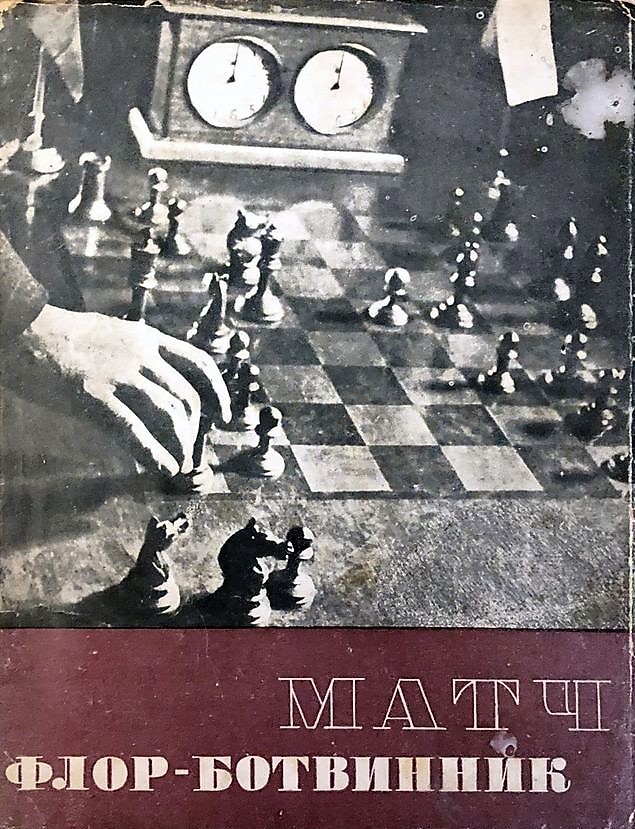
Here is a photo of the pieces used that appeared on the cover of the match book authored by Botvinnik.

Cover of M. Botvinnik’s 1933 Match Book

Although the available photos from the event are few in number, and somewhat ambiguous as to the size and style of the pieces, the pieces in the photo appear to bear many similarities to those in the photos from the 1925 First Moscow International. No surviving examples are known.

Unfortunately, the pieces pictured below were thought to be the same as the match pieces, and are commonly called “BFI” pieces. Ongoing review of the photos of the event have convinced me and other collectors that this name is mistaken for these pieces, even though they share some design features with the set actually used in the 1933 match.

Soviet Upright Pieces Misnamed “BFI” Pieces, Chuck Grau Collection, photo.

However, a set in the collection of Antonio Fabiano is very close in style to that of the 1933 match. Its main deviation from the match set are the concave walls of its rooks’ towers, which appear straight in photos of the match. Here is his set.

Antonio Fabiano Collection, photo.

In these pieces, we begin to see the development of a distinct Soviet style, despite the diminutive cross upon the king. The stepped-up base of the Staunton base has largely disappeared. The stems are noticeably concave, and mirror modernist dendriform columns rather than the neoclassical columns incorporated by Staunton sets. While the queen’s crown retains crenels on her coronet and the rook its merlons, the bishop’s miter has lost its cut. The knights make no attempt to copy the Elgin Marbles as Staunton knights do. Its snout is elongated, its mouth toothy, its eyes oversized, combining to form a very expressive visage.

Soldiers of International Competition 1934-36: Botvinnik-Flohr II (BFII”) Pieces

The next major events held in pursuit of the Soviets’ program of Political Chess were the 1934 Leningrad Masters Tournament, the 1935 Second Moscow International Tournament, and the 1936 Third Moscow International Tournament, all of which pitted the top Soviet players against fields of top Western players, including three then or future world champions Lasker, Capablanca, and Euwe.

A new set design appeared in these tournaments, perhaps the most iconic Soviet chess pieces of all, which we have come to call Botvinnik-Flohr II pieces, BFII for short. In evolving variations, they were used at the highest levels of Soviet chess from the 1930s to the 1960s, including the three mentioned events of 1934, 1935, and 1936, multiple Soviet Championships from 1937 to 1957, and the 1956 Moscow Olympiad. World Champions Lasker, Capablanca, Euwe, Botvinnik, Smyslov, Tal, Petrosian, Spassky, and Fischer all played with pieces of this style.

Flohr and Botvinnik, Tournament Book, Caissa Ed. (1998) at 177.
Close-up of Capablanca’s Pieces, Moscow 1935, photographer unknown.

Pieces like these were used in the 1934 Leningrad and 1935 and 1936 Moscow International tournaments, and a number of USSR Championships in the late 1930s and 1940s. The following specimen is from the collection of Singapore collector Stephen Kong.

Mid-Thirties BFII Pieces, Steven Kong Collection, photo.

The set acquires its name from the two players who shared first place in the 1935 affair, Mikhail Botvinnik and Salo Flohr, ahead of former world champions Lasker (third) and Capablanca (fourth). It was with pieces like these that the famous Mop the Floor game was played between Botvinnik and Flohr in the 1936 tournament. The II designation distinguishes these pieces from those used in the Botvinnik-Flohr match of 1933 (BFI pieces). Until the differences between the pieces used in the 1933 match and the other events were rediscovered in 2017, collectors and manufacturers of reproductions had confounded them.

Mid-Thirties BFII Pieces, Chuck Grau Collection, photo.

The pieces pictured above were turned and carved in Leningrad at the Prometheus Cultural Goods factory on Krestovsky Island, according to a stamp in the accompanying red-stained wood box. An identical set housed in an identical box with the same Prometheus stamp also bears a 1935 or 1936 date stamp, depending on how you interpret the smudged final digit of the stamp. The style of these pieces differs noticeably from that of traditional English Staunton in several respects. First, the king is not topped with a same-color cross, but a secular, opposite-color finial. While the bishop’s miter at first included a cut in the Staunton tradition, it soon disappeared in subsequent versions.

Tal Pieces of the 1940 Estonia-Lithuania Friendship Match

The earliest known example of the so-called Tal set is seen in photo of Paul Keres and Mikenas in a match between Estonia and Lithuania held in Tallinn, Estonia prior to the annexation of the Baltic states by the Soviet Union later in 1940. The set derives its name from a photo of Tal playing at the 1962 USSR Championship in Yerevan with a later version of the set. The photo appears on the cover of Tal’s autobiography, The Life and Games of Mikhail Tal.

Keres-Mikenas, Tallinn 1940, photographer unknown.

A specimen of this set resides in the collection of Mike Ladzinski.

1940 Tal Chessmen, Mike Ladzinski Collection, photo.

These chessmen adopt traditional elements of the English Staunton design, most notably the long stems narrower at the top than the bottom; the distinctly jointed pedestals, the three-ring collar system, the cross-crowned king, the bishop miter cuts, the merlons of the rook turrets, and the collective column-pediment. Unlike traditional Stauntons, the crosses and finials are opposite-colored. The unique, jaunty knights do not emulate the Elgin Marbles but are virtually identical to those of the 1962 Yerevan set. The pieces contain the wide, almost squared-off bases characteristic of the Tal, but not yet as tall as those of the Yerevan set. The cross is a true cross, not the vestigial cross of the 1962 version. While the rooks’ turrets incorporate merlons, their towers are noticeably narrower than their successor’s, and concave rather than straight, like the Yerevan tower. The pawns’ stems are longer than in later versions, making the pawns less squat.

1941 Leningrad Championship Pieces

The BFII design evolved through the late thirties, the forties, and the fifties, with multiple variants existing side-by-side over the years. One notable variant was used in the 1941 Leningrad Championship, which was begun during the Siege of Leningrad but was never completed.

1941 Leningrad Championship, photographer unknown.
1941 Leningrad Championship BFII Pieces, Stephen Kong Collection, photo.

The pieces have retained their general shapes and proportions, as well as the crenellations on queens and rooks. The bishop’s miter, however, had grown rounded and lost its miter cut. This BFII variant is notable for the mortar work carved into the rooks’ walls.

Hopefully, the collector or student of Soviet chess sets now has some basic information to help identify these sets and when, where, and by whom they were used.