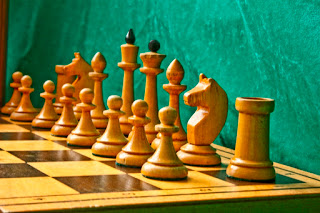
Urban Legend and the Not Very “Latvian” Set

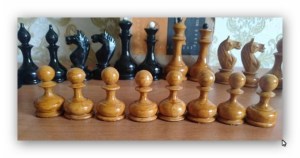
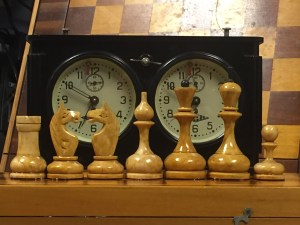
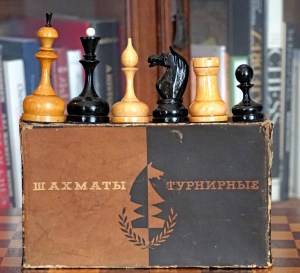
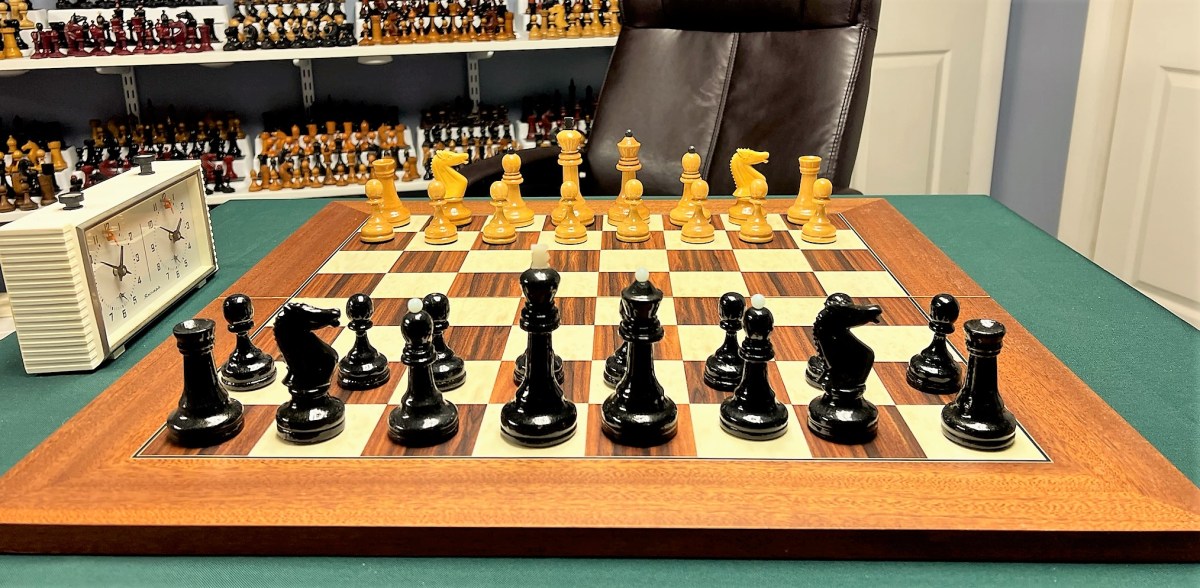
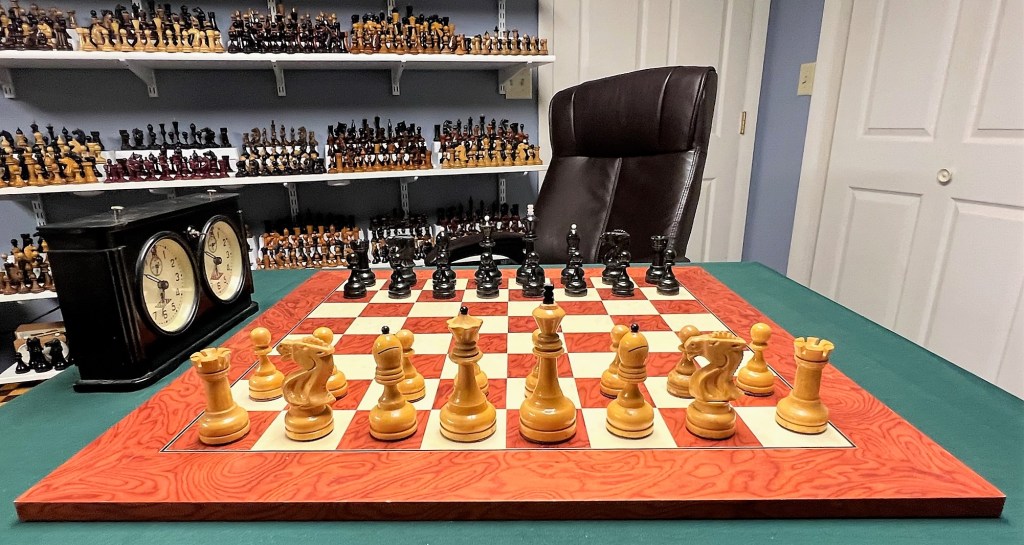
We often see a particular style of Soviet set described as “Latvian” and as “Tal’s favorite.” Although neither claim is supported by the current state of research, both contribute to ongoing misunderstanding of the set’s origin and significance.

According to Merriam-Webster.com, an Urban Legend is an often lurid story or anecdote that is based on hearsay and widely circulated as true. While there no doubt are lurid details about the life and times of Mikhail Tal, none are known to be associated with these pieces.
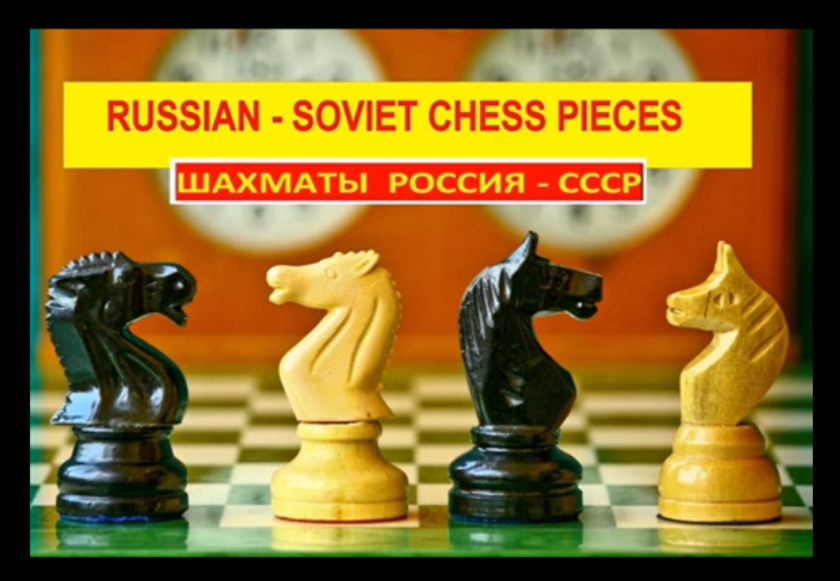
Title Page to Arlindo Vieira, Chess Sets–Russian Soviet (2012).

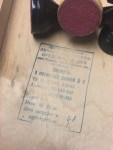
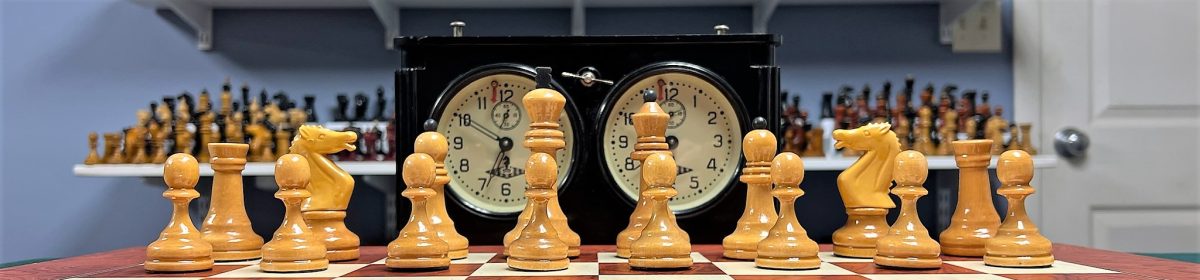
Both claims originate from slides appearing in Arlindo Vieira’s seminal 2012 video on Soviet and Russian chess sets and associated test in his blog Xadrez Memoria. The set appearing in the banner is the one from his collection that he claims to be Latvian. The claim that the set is Latvian arises from a slide in which Arlindo proclaims that “I call this set Latvian” and the other from a slide in which he declares that “He [Tal] loved these pieces!” The first claim rests on a questionable inference; and the basis for collectors repeating either claim is little more than hearsay.

Urban Legend 1: “These Pieces Are Latvian”

Here is the slide that collectors are ultimately relying upon when they claim that sets like Vieira’s are Latvian.

Vieira 2012 Video.

When collectors and dealers claim pieces like these are “Latvian,” they are knowingly or unwittingly referring to this slide, rather than first hand information or research actually linking the sets to Latvia. They are repeating Arlindo’s designation for the truth of the matter asserted–that they’re Latvian– making the statement relied upon hearsay.

A more defensible claim might be: “I believe this set to be Latvian and I am relying on Arlindo’s expert opinion in doing so.” If we consider Arlindo as an expert witness, as I do, we are entitled to inquire into the basis of his opinion. He lays that out in this very slide–the set was popular in Latvia, as evidenced by the many photos he found of like sets being used in Latvian events. His conclusion that the set is Latvian rests on the proposition that a set’s place of origin can be inferred from the frequency with which we find photos of players using it there. As he explains in his blog, Xadrez Memoria:

I have noticed through photos that certain games were used more frequently in the former Baltic Republics, and less, much less in tournaments in the capital or Leningrad, just to give an example. This is the case with these pieces of mine, which curiously appear in dozens and dozens of photos related to Latvian schools, tournaments and players. In fact, curiosity or not, even today at Ebay auctions, when these pieces appear, the sellers are mostly from Latvia, just like the one who sold me the pieces shown here.

On its face, this seems fairly reasonable, but the more we parse it, the less reasonable it becomes. If frequency of appearance in photos and Ebay auctions implies place of origin, what happens when photos of sets used in different venues appear? Or more sets are sold by vendors in Ukraine? The most reasonable response would be to say that the set more likely comes from the place from which the most photos and sales of it arise. We have no idea of how representative his photos and Ebay vendors are. What if, notwithstanding the photos Arlindo examined, more of the sets actually were used in Moscow. Does that make it a Moscow set? Or perhaps there actually are more photos of the set being used in Leningrad, which he missed in his review? Is it now a Leningrad set? My point is that it is not inherently reasonable to definitively infer the origin of the set from a handful of photos without considering how representative the photos are of all photos of Soviet sets in all locations. We just don’t know from the evidence presented in Arlindo’s video and website. But I think it’s fair to say that since 2012, we have examined more photos of Soviet sets in use than Arlindo did or could access back then.

I think the best way to understand Arlindo’s statement “I called this set Latvian!” is as an hypothesis, rather than a firm conclusion. He called it “Latvian” based on photos and Ebay listings he found. It’s reasonable to form an hypothesis based on such limited research. But like every other hypothesis, its validity is subject to being tested by the collection and analysis.

Berezovsky Children’s Penal Colony pieces. Chuck Grau Collection, photo.

Since 2012, a great deal of data has been uncovered that overwhelmingly indicate that sets of this basic design were made in many places, but not one of them is Latvia. We find evidence of them having been made in a children’s penal colony in Siberia, in Gulags in Mordovia, artels in Khalturin and Ivanovo, and in state factories in Ivanovo and Semenov. We owe a debt of gratitude to Vladimir Volkhov for his research into the sources of production, reported in his wonderful blog, Retrorussia. And this evidence consists of much more direct evidence than photos of use. It comprises stamps and labels identifying places of origin on and in the boxes containing the actual pieces. This is hard evidence, allowing far stronger inferences than could be made in 2012 in the absence of such a rich record.

This all, of course, begs the question as to what these sets should be called. Vladimir’s solution is to adopt Russian collectors’ practice of naming sets by where they were made. So sets made in Mordovia would be called Mordovian; those in Khalturin, Khalturiskie; those in Semenov, Semenovskie; those in Ivanovo, Ob’edovskie, for the village in Ivanovo Region where the production facilities were located. I think this is a very important part of the naming solution. It incorporates and honors local practice, and ties sets to locations where they actually originated.

But I have two problems with adopting this convention as a total resolution to the naming issue. The first is that it completely ignores the important issue of style. It cannot be disputed that the “Latvian” sets from Berezovsky, Mordovia, Khalturin, Semenov, and Ivanovo are the same general style. That is an important observation, as it indicates design notions and practices transcended localities and regions, and ignoring it leaves important chapters of the story unwritten.

The second problem is that the location convention creates as much confusion as it eliminates. Take the Khalturin example. Many different styles of chess pieces were manufactured there. Under the location convention all of them would bear the same name, and we never could distinguish one from the other in writing without attaching a picture to clarify which one we were talking about. I find that unacceptable.

Ultimately, we need to accept a naming convention that recognizes both style and place of manufacture. And I would include a date, because pieces made in the same style in the same place could vary over time in some significant details. But, then, what should we call this not very Latvian design? I would be comfortable calling the style Berezovsky, in homage to the children of the Gulag who apparently first made them. I also would be comfortable calling them Everyday, in accordance with the category John Moyes found on the label of a set from Ivanov. I like two things about this option. First, it is homage to the Soviet practice of calling consumer items, including sets, by the category of intended use. Second, sets in this style were ubiquitous, truly the everyday sets of many Soviet households. Until we reach some consensus on this, I probably will continue to call the style Mordovian, as I find it the most beautiful iteration of this venerable style.

Urban Legend 2: “Tal’s Favorite Set!”

This one is a real whopper.

“Tal’s favorite set.” Mein Gott im Himmel, how do you know that?

I’ve never seen a collector or dealer asserting this claim to state his or her basis for making it, myself included. One hypothetically might have first hand knowledge: “I knew Tal, and Tal told me it was his favorite set”; or “I watched Tal play and every time he chose the set he chose this one”; or “I listened to Tal give an interview to a Filipino Grandmaster and he said it was his favorite set and that he was the victim of vast international conspiracies.” Wait, that was Fischer. Or, “I read such and such by Tal and he wrote that it was his favorite set.” Or one might have evidence from which one might infer it was his favorite, like multiple photos of Tal using the set in his residence or hotel rooms, or sitting over his mantle or displayed on a shelf.

But no, “Tal’s favorite!” is the claim, without further evidence, only a wink and a nod as if to say the claimant has some special inside information and insight into the Magician of Riga, or belongs to an exclusive club of those who do. I’ve done it myself. Hogwash.

All these claims of special insight into the predilections of one of the world’s most popular champions arise from a single slide in Arlindo’s 2012 video, which his blog does not elaborate:

Vieira 2012 video.

Arlindo’s slide doesn’t even SAY it was “Tal’s favorite.” We all leapt to that specious conclusion ourselves. I’d now characterize Arlindo’s statement as an excited utterance, expressing joy that the pieces could be connected to the charismatic Tal. But it’s not credible evidence that the set was “Tal’s favorite.” All us cognoscenti who imply we have have inside information about Tal’s preferred set, we need to present our evidence, or we need to stop repeating a baseless claim.

Mass-Produced State Factory Wooden Sets 1950-1991

In recent posts, we’ve been exploring how the means of Soviet chess set production changed in response to a growing army of chess-players and the evolution of Soviet economic policy, structure, and organization. Here are some sets mass-produced by major factories following the Great Patriotic War.

Obyedovskaya Toy Factory, Ivanovo Region

Nikolay Filatov photo.

Such sets were manufactured by Obyedovskaya Toy Factory, Ivanovo Region. They represent last major evolution of this venerable design that appears to have originated in the Berezovsky child labor camp of the late 1930s. By the 1980s it had been significantly simplified to facilitate mass production. This is most evident in the knights, which have become little more than slabs cut by a band saw. The cuts in the rooks’ turrets and the queens’ coronets also have been removed. The fictional Beth Harmon played her ultimate match with pieces like these in the Netflix series Queen’s Gambit. The kings are 100 mm tall and the pieces are unweighted, but remain relatively stable because of their conical stems and bases.

Chuck Grau Collection, photo.


According to Wikipedia, “Ivanovo… is the administrative center and largest city of Ivanovo Oblast, located 254 kilometers (158 mi) northeast of Moscow and approximately 100 kilometers (62 mi) from Yaroslavl, Vladimir and Kostroma. Ivanovo had a population of 408,330 as of the 2010 Census, making it the 49th largest city in Russia… “Ivanovo gained a reputation as the textile capital of Russia during the nineteenth century. .. Also, there is a branch plant of AviraKids, a Russian holding company that occupies 37.5% of the Russian gaming equipment production industry.”

Borodino Factory of Cultural Goods

Mykhailo Kovalennko photo.

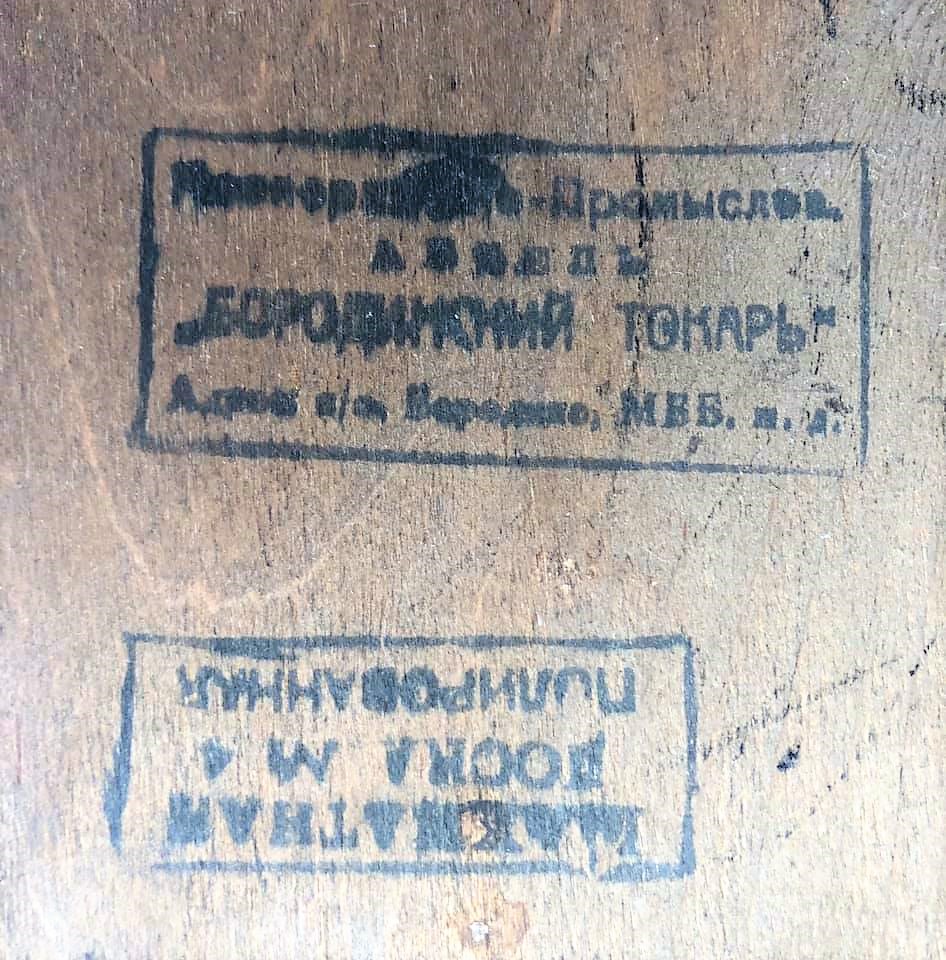
This factory, located near Moscow, bears the name of the famous battle fought near Borodino village in 1812. It may have derived from an artel named Borodino Turner, as seen in this stamp from the 1930s or 1940s.

Alexander Chelnokov Collection, photo.

The pictured pieces have a 10.5 cm. king and are unweighted. They appear to be from the 1970s or perhaps later because of their plastic finials.

Elizarovskaya Factory of Cultural Goods

Elizarovskaya is another factory located near Moscow. The kings of this 1950s set are 93 mm. and the pieces are unweighted.

Eduardo Bauza Collection, photo.

I believe the following set likely was manufactured by Elizarovskaya, though it lacks a cardboard box with identifying information.

Chuck Grau Collection, photo.

These pieces are very similar to those seen in a well-known photo of Yuri Averbakh playing with them in the 1949 Moscow Championship.

Photographer unknown.

Zvenigorod Cultural Goods Factory

Yet another factory from the Moscow region. Here is a set of unweighted tournament pieces manufactured there in the 1950s.

Chuck Grau Collection, photo.

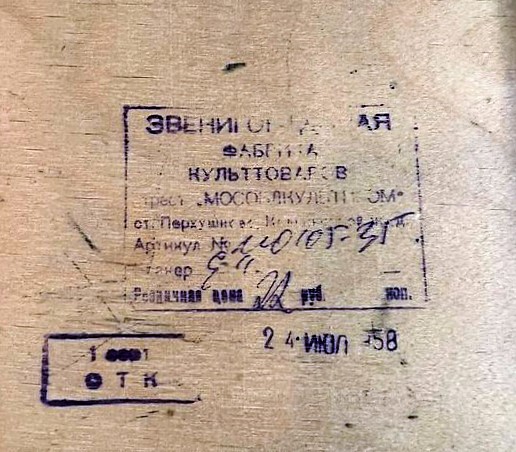
King’s height: 105 mm. Weighted, with blue felts. Here is the stamp from the set’s box.

Chuck Grau Collection, photo.

Petrushkovaya Factory of Cultural Goods

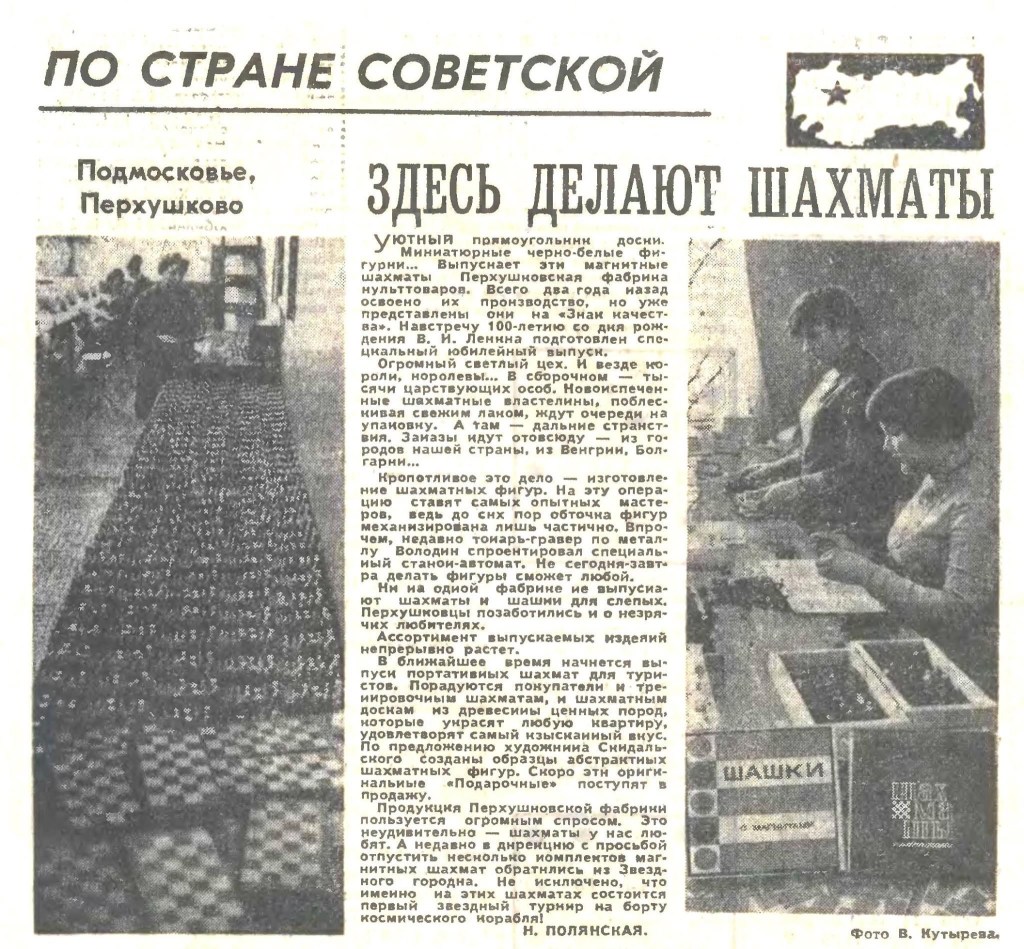
An article on chess set production circa 1970 in the Perkhushkovskaya factory outside Moscow. As translated by Nick Basmanov:

“Chess Are Made Here

“A cosy rectangle of a board. Tiny black and white figures… These magnetic chess sets are manufactured by cultural goods factory named Perkhushkovskaya. The production is mastered only 2 years ago, but it has already got the “Quality sign”. A special anniversary edition is prepared for the centenary of Lenin’s birth.

“A huge bright workshop. And kings and queens are everywhere. Thousands of monarchs are in the workshop. The newly made chess lords gleaming with fresh varnish are waiting in a line for packaging. They are waiting for long journeys. Orders come from everywhere: from cities of our country, from Hungary, Bulgaria…

“Manufacturing of chess pieces is a laborious business. This operation is entrusted to the most experienced craftsmen, cause figures turning is only partially automated. However engraver Volodin designed a special machine and very soon anyone will be able to make chess pieces.

“There is no factories manufacturing chess and checkers sets applicable for blind people. Perkhushkovskaya is the only exception. The range of products is growing continuously.

“The issue of portable chess for tourists to begin soon. Training chess and boards made of precious woods will delight customers and decorate any apartments. Samples of abstract chess pieces are created at the suggestion of craftsman Sindalsky. This original “Gift” set to go on sale soon.

“The Perkhushkovskaya factory production is in great demand. This is not surprising cause we love chess. Recently representatives of Star City asked the management of the Perkhushkovskaya to sell several magnetic chess sets. Perhaps the first spaceship tournament will be played on these chess boards.”


1950s Tournament Set

Nearly identical in design to the Zvenigorod set above.

1980s Grandmaster 2 Pieces

This design originally was classified as one of four “Grandmaster” sets by Portuguese collector and historian Arlindo Vieira.

The design is quintessentially Soviet. Large, bulbous bases, curving up to concave stems, which trumpet into the pedestals upon which the crowns and miters perch. The bulbous bases are echoed in the bulbous bases of the king’s crown and bishop’s onion-shaped miter, which itself reflects the shape of orthodox church domes. Large proletarian pawns. CV-shaped Knights carved in the distinct manner of the sixties.

108 mm. kings and weighted. Sets similar to this one were used in the 1967 USSR Championship.

Like the GM3, the finials of these sets began as all wood, but replaced by plastic ones by the eighties. Similarly, the finish of the early sets were smooth and clear. By the eighties, the pieces were slathered unevenly in taffy apple varnish.

Oredezh Factory, Leningrad

Originally called the Orodezh Factory, this production facility was succeeded by the Luga Factory.

Shown below are 1968 GM 1 Chessmen, Model ЛО-049-343. It’s a beautiful specimen in excellent condition. Wooden finials. Light finish on the White pieces. Beautiful dirty rose felts. The stamp makes it clear that the pieces and board originally came together.

Here is a set in the later Luga Factory box.

Nikolay Filatov photo.

Conclusion

This concludes our brief survey of wooden factory sets of the fifties and later. We will examine factory-made plastic sets in a later article.

Mass-Produced Sets of Voenohot Factory No. 2

Changes in Soviet economic policy and organization in the 1940s left Soviet planners with a problem. While the numbers of chess players continued to dramatically rise, the Artel and Gulag production that had expanded throughout the thirties to meet the growing demand for chess sets were simply unable to keep pace. During the Great Patriotic War, Artels began to decline in economic importance just as many began to adopt techniques of mass production characteristic of factory manufacturing. Stalin died in 1953, and Beria issued a general amnesty for Gulag prisoners, which significantly diminished the Gulag work force. By 1954, most Soviet officials had come to understand that Gulag production was quite inefficient. In 1956 the Central Commitee sounded the death knell for artels. By 1960, neither Artels nor Gulags formally remained.

Some of the Artels and Gulag workshops converted to State-run factories worked by wage laborers. Other factories arose. One of the most prolific of those state factories was Voenohot Factory No. 2, located in the Moscow region. It manufactured some of the most famous mass-produced sets of the Soviet Union: Voronezh pattern, GM3s, GM4s, Champion, and Yunost sets.

Voronezh Pattern Set

I call these sets “Voronezh Pattern” because a very early specimen in my collection reportedly survived the Great Patriotic War in a basement in the war-torn city of Voronezh. I cannot say where that set was made, but later sets in that style were mass-produced by the Voenohot Factory No. 2 in the 1950s and 1960s, and perhaps later. Here is an example of a factory-made set from the 1950s.

Chuck Grau Collection, photo.

The design is quintessentially Soviet. The concave stem rises from the base to form the pedestal upon which the royal, cleric, and foot soldier signifiers rest without connecting sections separating them from their pedestals. The cleric is signified by a tear-shaped miter. The royals sport wooden finials, which were replaced by plastic ones in later versions. 102 mm kings. Unweighted but decently balanced.

Grandmaster 3 Set

This Soviet Staunton design first appeared around 1950. At first it was used only in top Soviet tournaments. Those sets probably were made in very limited numbers by specially commissioned ateliers. By the 1960s, GM3 sets were being mass-produced by Voenohot Factory No. 2 with plastic finials and black plastic knight heads. Here is an example I believe to have been manufactured in the late 1960s or 1970s.

Chuck Grau Collection, photo.

Grandmaster 4 Set

The GM4 design is an evolution of the GM3 design, albeit simplified and cheapened. But what remains is the basic Staunton architecture of the GM3. Recognizing them to be closely related to the GM3 pieces, Arlindo Vieira wrote that the GM4 pieces are “the last version of this competitive set.” He described them as “elegant and playable,” but “made players crazy” when used on boards with squares far too small.

Here is a specimen from my collection with its original box bearing the factory label in its upper right had corner.

Chuck Grau Collection, photo.

In Xadrez Memoria, Vieira observed that the quality of the Grandmaster pieces degraded over time: “[T]he pieces lost quality from the oldest to the most recent ones, and when I say so, the photos prove it in the very simple question of manufacture: they lost detail, care in the details: look at the Towers, the Horses, in the Bishops and what I said ends up coming to the fore.” Indeed, gone from the original GM3 design are the queen’s crenels, the bishop’s miter cut, and the rook’s merlons. All the crosses, finials, and knights are plastic.

GM4 sets were used in the 1994 Moscow Olympiad. Vieira rightly criticizes the organizers for providing boards that cramped the pieces and garish tablecloths on the playing tables that surely distracted players.

Even so, I find it an attractive set easy to play with. 108 mm kings. Nicely weighted. Leatherette pads, some of which on this specimen have slightly buckled.

Champion Chessmen

From a design perspective, the pieces are within the broad GM3 family (which includes both GM Supreme and GM4 sets), but with knights more like those found in Yunost, Voronezh, and some sets of the forties and fifties, than in GM3 sets.

Chuck Grau Collection, photo.

Like GM4 sets, the knights have plastic heads and torsos. Like GM3 sets, the rooks have merlon cuts, the bishops miter cuts, and the queens shallow, scalloped cuts on their coronets. The finials are all plastic. The set is unweighted, and the finish crude and badly in need of sanding. The miter cuts are asymmetrical. 104 mm kings.

Yunost Chessmen

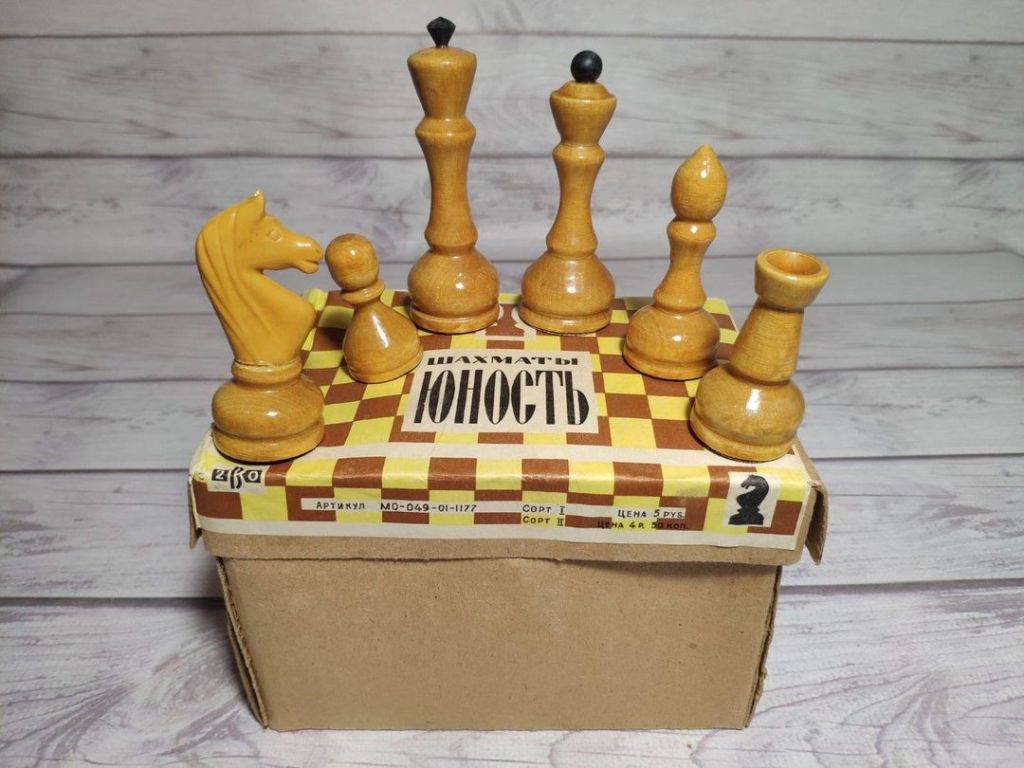
“Yunost” is a category, not a name. It literally means “Youth,” and designates these pieces as suitable for children and students. They were mass-produced for schools and Young Pioneers, with plastic finials and knight heads. Here is an example with the Voenohot Factory No. 2 box and logo.

Nikolay Filatov photo.

The kings are 10 cm. tall, and the pieces are unweighted and with narrow bases, leaving them unstable in play.

Conclusion

With the demise of Artel and Gulag production, state factories began mass-producing sets for the growing millions of Soviet chess players. Perhaps no factory was more prolific than Voenohot Factory No. 2 of Moscow Oblast.