Gulag Knights? A Tale of Two Valdais

Gulag Knights

The reason I have been unwilling to pull the trigger is simple. In his engaging 2019 essay The ‘Gulag’ Knights, Alan claims the Valdai Nobles sets were born in a Gulag in Valdai. Writes Alan:

Needless to say, the hundreds of thousands of prisoners snatched up by the Gulag could produce hundreds of thousands of chess sets, and that’s exactly what Stalin had them do. There were two main factories (or camps) that concern this brief discussion. The first “Village” (a polite Stalinist term for a penal colony) was located halfway between the main artery connecting St. Petersburg and Moscow, namely, The Valdai Regional Industrial Manufactory in Novgorod (450 km north-west of Moscow), a picturesque and densely forested area used today by the rich and famous (including Putin and his entourage) for quick summer getaways. The second ‘village’ is the Yavas Township located in the Central Volga Region of Mordovia (500km south-east of Moscow)… From these two camps came the so-called ‘Valdayski’ and Mordovian (f.k.a. “the Latvian”) sets respectively…

These are intriguing claims. As a skeptic and empiricist, I began to explore their basis. Insofar as they relate to Mordovia, they are very well-supported. But as for Valdai, Novgorod Oblast, halfway between Leningrad and Moscow, I could find no evidence of a Gulag.

From a temporal point of view, it is plausible that Nobles sets of the 1940s and 1950s were made in a Gulag. But upon Stalin’s death in 1953, the general amnesty that granted Gulag prisoners with sentences of five years or less drastically cut back the Gulag system, and in 1960, Khrushchev abolished its remnants. Thus, even if the sets of the fifties and sixties could have been manufactured in a Gulag, those of the sixties could not have been. Beyond this, I simply could neither corroborate nor refute Alan’s claim.

Still, I kept searching Gulag databases and secondary sources without finding a link between Valdai and the Gulags. As I often do, I discussed the issue with my friend Sergey Kovalenko of St. Petersburg. Sergey is a well-respected chess collector, skilled carver, and denizen of Russian and Soviet archives. He regularly discusses historical issues and shares archival research with me and others. Like me, Sergey was intrigued by Alan’s claim. Like me, he could neither confirm nor refute it.

Sergey agreed with Alan’s claim that the Nobles sets were manufactured by the Valdai Regional Industrial Manufactory in Novgorod. This was evidenced by cardboard boxes like Alan’s bearing the producer’s name, Валдайский Райпромкомбинат, or Valdai Raipromkompromat, meaning Valdai Regional Industrial Plant. Unlike Alan, however, I do not equate the term Village with Gulag, and am unaware of any etymological or historical reason for doing so.
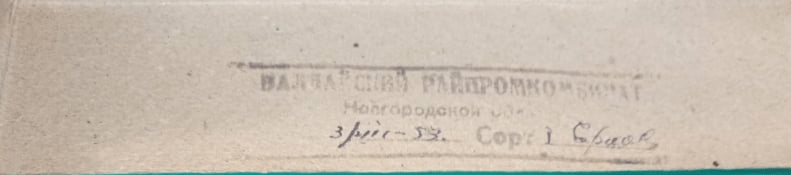
Valdai Regional Industrial Plant stamp on a cardboard box containing a Nobles set. Courtesy Sergey Kovalenko.

Nearest Gulag Camp Dug Missile Silos

Perhaps the most comprehensive online Gulag databases are maintained by Gulagmap.ru and Gulag.cz. These sites compile data on individual camps, with detailed information about each taken from the primary Russian language source,  Система исправительно-трудовых лагерей в СССР (System of Forced Labour Camps in the USSR [M. B. Smirnov, comp. 1998]) and other archival material. These online databases provide interactive maps of Gulag camp administrations as interfaces. Neither lists any camp in Valdai, Novgorod Oblast.

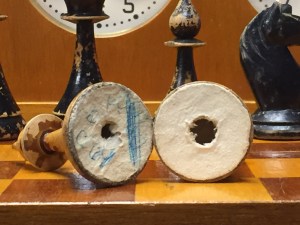
Late 1940s Valdai Nobles set. Note the slab knights. Source: Sergey Kovalenko.

Nor does the print version of Smirnov’s encyclopedia of Gulag camps. The camp nearest to Valdai was named EM ITL. It was located about 22 kilometers from Valdai near Dubrovets and engaged primarily in the construction of missile silos. Sergey provided the following map illustrating the location of ITL EM in relation to Valdai (Валдай), Novgorod Oblast.

Leningrad the upper left. Moscow on M10 to the right. Courtesy Sergey Kovalenko.

According to gulagmap.ru:

ITL “EM” was formed on January 10, 1951 and operated until May 14, 1953, when it was reorganized into the Dubogorskoye LO. The camp administration was located in the area of ​​the Dvorets station of the Kalinin railway. In operational command, it was initially subordinated to the Main Directorate of Industrial Construction Camps, but shortly before the camp’s reorganization, it came under the jurisdiction of the GULAG of the Ministry of Justice. The maximum number of prisoners held here was recorded in 1953 and amounted to 2,062 people.

ITL “EM” was engaged in the construction of defense facilities. In April 1952, the construction was assigned the first category of secrecy, and prisoners could be sent to this camp only with the permission of the Ministry of State Security…

According to sources, prisoners of the ITL “EM” were engaged in the construction of a coal mine and the maintenance of Construction 714, as well as the excavation of shafts and tunnels. In reality, the camp’s task was the construction of missile silos. The labor of prisoners of the ITL “EM” was also used to build locomotive and diesel power plants.

Likewise, Avraham Shifrin’s The First Guidebook to Prisons and Concentration Camps of the Soviet Union (1982) makes no mention of a Gulag camp in Valdai. At 276-277, 389. Nor does Anne Applebaum’s Pulitzer Prize-winning Gulag: A History (2003). At 676.

Post-Gulag Prison Colony ITK-4

Sergey accessed the Novgorod Online Archives and made an intriguing discovery. He discovered a link between the Valdai Industrial Plant and the post-Gulag Soviet correctional system, if not with the Gulag system itself. According to the Novgorod Archives, on 1 June 1957, various assets in and around Valdai were transferred to the Department of Internal Affairs (MVD), among them the Valdai District Industrial Plant, the woodworking shop of the Valdai Mechanical Plant, and the Timber Plant of the Novgorod City Industrial Plant.
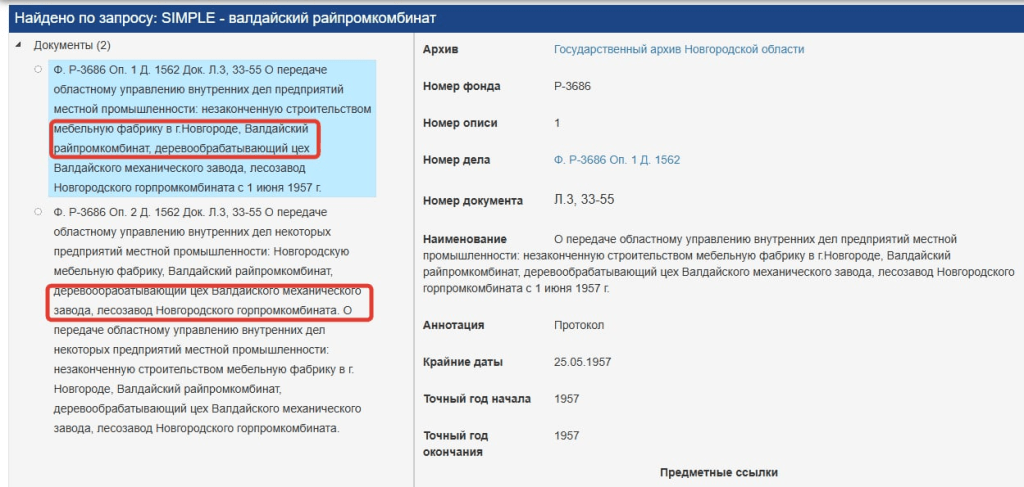
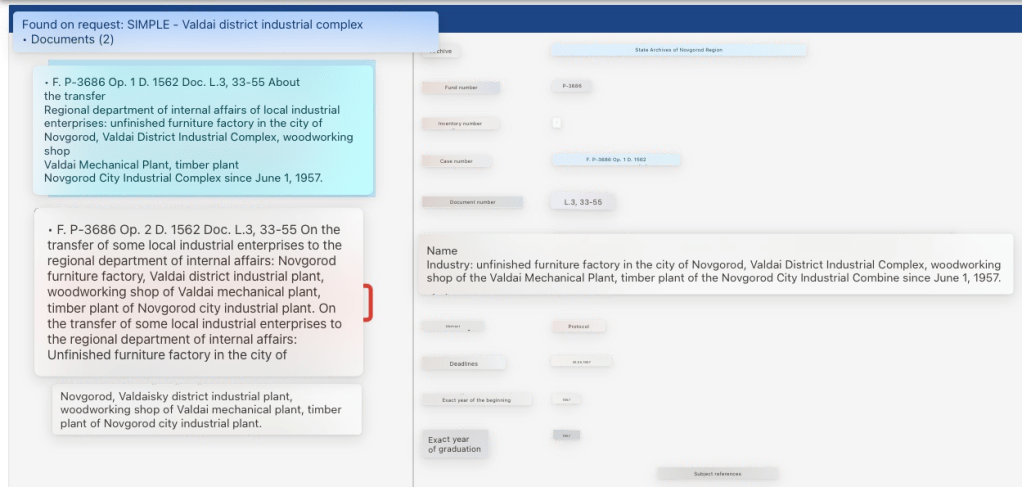
According to records Sergey found, the woodworking shops and other assets were transferred to a newly organized correctional and labor colony in Valdai, Novgorod Oblast, designated ITK-4, or Labor Colony 4, and OYA-22/4. The MVD received funds to construct housing and other structures in Valdai and the nearby town of Myza to accommodate 700-800 male prisoners. V. M. Skoryukov was appointed Deputy Chief of ITK-4 for Production. When prisoners began arriving in October of 1957, they worked in two lathe, furniture and plywood workshops, and a forest in a nearby village.

It is essential to situate ITK-4 in the history of the Gulag system. According to a recently declassified 1951 CIA report, two kinds of labor facilities operated within the Gulag system. ITLs–Labor Camps–were established in remote regions and housed prisoners with sentences of two years or greater. By contrast, ITKs–Labor Colonies–typically housed petty criminals in each oblast.

Even before Stalin’s death, MVD Minister Laventry Beria and his deputy Stepan Mamulov proposed to drastically cut back and replace the Gulag system. Stalin died in March 1953. While his corpse was still warm, Beria began to dismantle the Gulags, issuing a general amnesty that led to the release of 1.5 million prisoners–60% of the Gulag population–over the next three months. Aleksei Tikhonov, The End of the Gulag, in The Economics of Forced Labor: The Gulag (P. Gregory and V. Lazarev eds., 2003) at 67-73. Anne Applebaum writes:

As Khrushchev had feared, Beria, who was barely able to contain his glee at the sight of Stalin’s corpse, did indeed take power, and began making changes with astonishing speed. On March 6, before Stalin had even been buried, Beria announced a reorganization of the secret police. He instructed its boss to hand over responsibility for the Gulag to the Ministry of Justice, keeping only the special camps for politicals within the jurisdiction of the MVD. He transferred many of the Gulag’s enterprises over to other ministries, whether forestry, mining, or manufacturing. On March 12, Beria also aborted more than twenty of the Gulag’s flagship projects, on the grounds that they did not “meet the needs of the national economy.” Work on the Great Turkmen Canal ground to a halt, as did work on the Volga–Ural Canal, the Volga–Baltic Canal, the dam on the lower Don, the port at Donetsk, and the tunnel to Sakhalin. The Road of Death, the Salekhard–Igarka Railway, was abandoned too, never to be finished.

Supra, at 478.

In 1955, the GUITK (Glavnoye Upravleniye Ispravitelno-Trudovykh Kolony), or Chief Administration of Corrective Labor Colonies, was established within the MVD to administer the post-Gulag correctional system. After Khrushchev gave his famous speech denouncing Stalin in February 1956, the dismantling of the Gulags accelerated. Appleman writes:

In the months that followed the secret speech, the MVD also prepared to make much deeper changes to the structure of the camps themselves. In April, the new Interior Minister, N. P. Dudorov, sent a proposal for the reorganization of the camps to the Central Committee. The situation in the camps and colonies, he wrote, “has been abysmal for many years now.” They should be closed, he argued, and instead the most dangerous criminals should be sent to special, isolated prisons, in distant regions of the country, specifically naming the building site of the unfinished Salekhard–Igarka Railway as one such possibility. Minor criminals, on the other hand, should remain in their native regions, serving out their sentences in prison “colonies,” doing light industrial labor and working on collective farms. None should be required to work as lumberjacks, miners, or builders, or indeed to carry out any other type of unskilled, hard labor.

Dudorov’s choice of language was more important than his specific suggestions. He was not merely proposing the creation of a smaller camp system; he was proposing to create a qualitatively different one, to return to a “normal” prison system, or at least to a prison system which would be recognizable as such in other European countries. The new prison colonies would stop pretending to be financially self-sufficient. Prisoners would work in order to learn useful skills, not in order to enrich the state. The aim of prisoners’ work would be rehabilitation, not profit.

Supra, at 509.

By 1957, GUITK became primarily responsible for operating and administering that system. It was within the post-Gulag framework Dudorov described that Valdai’s ITK-4 went operational.

Another Valdai and Segezhlag

Sergey did find some connection between a Valdai and the Gulags, but it was a different Valdai, one located in the Segezha District of Karelia, almost 900 km north of its namesake in Novgorod Oblast. This Valdai lies within the same Segezha District as a Gulag camp known as Сегежский ITL, or Segezhlag, but across from it on Lake Vygozero and 132 km distant by road. This Valdai was founded in the early 1930s to aid in constructing the White Sea-Baltic Canal with Gulag labor.

Valdai and Segezha, Segezha District, Karelia. Source: Google Maps

Segezhlag was organized in 1939. According to gulagmap.ru:

The Segezha Corrective Labor Camp was organized no later than October 21, 1939, on the basis of the 4th camp division of the White Sea-Baltic Corrective Labor Camp and operated until June 28, 1941. The camp administration was located in the Karelo-Finnish SSR, in the area of ​​the Segezha station of the Kirov Railway. Initially, the camp was subordinate to the GULAG, but from February 1941 it came under the jurisdiction of the Main Directorate of Industrial Construction Camps (GULPS). Up to 7,951 prisoners were held here…

The labor of the prisoners of the Segezha camp was used for the construction of the Segezha timber and paper plant, the Segezha hydrolysis plant (since November 1940), the Kondopoga sulfite-alcohol plant (since March 1941), for servicing the first stage of the timber and paper plant, as well as sawmills, foam concrete, concrete, asphalt plants, a concrete products plant, for the construction of railways and dirt roads, residential and utility facilities, and agricultural work.

See also Smirnov, supra, at 390.

There is no record of chess set production at Segezhlag. While the Gulag camp there closed in 1941, Penal Colony No. 7 continues to operate there.

Conclusion

The Nobles chess sets of Valdai were not made in a Gulag, but in the woodworking shops of the Valdai District Industrial Plant. Prisoners of the Gulag camp nearest the chess-producing Valdai dug missile silos, but did not turn chess pieces or carve knights. Ironically, a different Valdai was associated with a Gulag camp, Segezhlag. But this camp had nothing to do with the production of chess sets either.

After 1957, however, sets were made by forced labor within ITK-4 of the Soviet prison system, confirming a key component of Alan’s initial claim concerning these sets. Still, the change in penal regimes was not a distinction without a difference, a mere “changing of the uniforms,” to borrow a phrase from Budapest’s House of Terror Museum. If we were to equate the two different penal regimes, we would unfairly diminish one of the most immediate and significant consequences of Stalin’s death–the abolition of the Gulag system, the release and rehabilitation of millions who had unjustly suffered under its iron hand, the reconfiguration of penal institutions, and all the social dislocation that attended the Gulag’s demise.

Many thanks to Sergey Kovalenko and the reference librarians at the Bedford, NH Public Library.
THE GULAG ‘KNIGHT’ OF MORDOVSKA (ADDENDUM)

A wonderful essay authored by Alan Power, master of artistic chess set restoration and owner of the Chess Schach. Please click the link to read Alan’s highly informative article.

“For a reader living in the free world the word “thief” perhaps sounds like a reproach? But you misunderstand the term. In the underworld of the …

THE GULAG ‘KNIGHT’ OF MORDOVSKA (ADDENDUM)

Urban Legend and the Not Very “Latvian” Set

We often see a particular style of Soviet set described as “Latvian” and as “Tal’s favorite.” Although neither claim is supported by the current state of research, both contribute to ongoing misunderstanding of the set’s origin and significance.

According to Merriam-Webster.com, an Urban Legend is an often lurid story or anecdote that is based on hearsay and widely circulated as true. While there no doubt are lurid details about the life and times of Mikhail Tal, none are known to be associated with these pieces.

Title Page to Arlindo Vieira, Chess Sets–Russian Soviet (2012).

Both claims originate from slides appearing in Arlindo Vieira’s seminal 2012 video on Soviet and Russian chess sets and associated test in his blog Xadrez Memoria. The set appearing in the banner is the one from his collection that he claims to be Latvian. The claim that the set is Latvian arises from a slide in which Arlindo proclaims that “I call this set Latvian” and the other from a slide in which he declares that “He [Tal] loved these pieces!” The first claim rests on a questionable inference; and the basis for collectors repeating either claim is little more than hearsay.

Urban Legend 1: “These Pieces Are Latvian”

Here is the slide that collectors are ultimately relying upon when they claim that sets like Vieira’s are Latvian.

Vieira 2012 Video.

When collectors and dealers claim pieces like these are “Latvian,” they are knowingly or unwittingly referring to this slide, rather than first hand information or research actually linking the sets to Latvia. They are repeating Arlindo’s designation for the truth of the matter asserted–that they’re Latvian– making the statement relied upon hearsay.

A more defensible claim might be: “I believe this set to be Latvian and I am relying on Arlindo’s expert opinion in doing so.” If we consider Arlindo as an expert witness, as I do, we are entitled to inquire into the basis of his opinion. He lays that out in this very slide–the set was popular in Latvia, as evidenced by the many photos he found of like sets being used in Latvian events. His conclusion that the set is Latvian rests on the proposition that a set’s place of origin can be inferred from the frequency with which we find photos of players using it there. As he explains in his blog, Xadrez Memoria:

I have noticed through photos that certain games were used more frequently in the former Baltic Republics, and less, much less in tournaments in the capital or Leningrad, just to give an example. This is the case with these pieces of mine, which curiously appear in dozens and dozens of photos related to Latvian schools, tournaments and players. In fact, curiosity or not, even today at Ebay auctions, when these pieces appear, the sellers are mostly from Latvia, just like the one who sold me the pieces shown here.

On its face, this seems fairly reasonable, but the more we parse it, the less reasonable it becomes. If frequency of appearance in photos and Ebay auctions implies place of origin, what happens when photos of sets used in different venues appear? Or more sets are sold by vendors in Ukraine? The most reasonable response would be to say that the set more likely comes from the place from which the most photos and sales of it arise. We have no idea of how representative his photos and Ebay vendors are. What if, notwithstanding the photos Arlindo examined, more of the sets actually were used in Moscow. Does that make it a Moscow set? Or perhaps there actually are more photos of the set being used in Leningrad, which he missed in his review? Is it now a Leningrad set? My point is that it is not inherently reasonable to definitively infer the origin of the set from a handful of photos without considering how representative the photos are of all photos of Soviet sets in all locations. We just don’t know from the evidence presented in Arlindo’s video and website. But I think it’s fair to say that since 2012, we have examined more photos of Soviet sets in use than Arlindo did or could access back then.

I think the best way to understand Arlindo’s statement “I called this set Latvian!” is as an hypothesis, rather than a firm conclusion. He called it “Latvian” based on photos and Ebay listings he found. It’s reasonable to form an hypothesis based on such limited research. But like every other hypothesis, its validity is subject to being tested by the collection and analysis.

Berezovsky Children’s Penal Colony pieces. Chuck Grau Collection, photo.

Since 2012, a great deal of data has been uncovered that overwhelmingly indicate that sets of this basic design were made in many places, but not one of them is Latvia. We find evidence of them having been made in a children’s penal colony in Siberia, in Gulags in Mordovia, artels in Khalturin and Ivanovo, and in state factories in Ivanovo and Semenov. We owe a debt of gratitude to Vladimir Volkhov for his research into the sources of production, reported in his wonderful blog, Retrorussia. And this evidence consists of much more direct evidence than photos of use. It comprises stamps and labels identifying places of origin on and in the boxes containing the actual pieces. This is hard evidence, allowing far stronger inferences than could be made in 2012 in the absence of such a rich record.

This all, of course, begs the question as to what these sets should be called. Vladimir’s solution is to adopt Russian collectors’ practice of naming sets by where they were made. So sets made in Mordovia would be called Mordovian; those in Khalturin, Khalturiskie; those in Semenov, Semenovskie; those in Ivanovo, Ob’edovskie, for the village in Ivanovo Region where the production facilities were located. I think this is a very important part of the naming solution. It incorporates and honors local practice, and ties sets to locations where they actually originated.

But I have two problems with adopting this convention as a total resolution to the naming issue. The first is that it completely ignores the important issue of style. It cannot be disputed that the “Latvian” sets from Berezovsky, Mordovia, Khalturin, Semenov, and Ivanovo are the same general style. That is an important observation, as it indicates design notions and practices transcended localities and regions, and ignoring it leaves important chapters of the story unwritten.

The second problem is that the location convention creates as much confusion as it eliminates. Take the Khalturin example. Many different styles of chess pieces were manufactured there. Under the location convention all of them would bear the same name, and we never could distinguish one from the other in writing without attaching a picture to clarify which one we were talking about. I find that unacceptable.

Ultimately, we need to accept a naming convention that recognizes both style and place of manufacture. And I would include a date, because pieces made in the same style in the same place could vary over time in some significant details. But, then, what should we call this not very Latvian design? I would be comfortable calling the style Berezovsky, in homage to the children of the Gulag who apparently first made them. I also would be comfortable calling them Everyday, in accordance with the category John Moyes found on the label of a set from Ivanov. I like two things about this option. First, it is homage to the Soviet practice of calling consumer items, including sets, by the category of intended use. Second, sets in this style were ubiquitous, truly the everyday sets of many Soviet households. Until we reach some consensus on this, I probably will continue to call the style Mordovian, as I find it the most beautiful iteration of this venerable style.

Urban Legend 2: “Tal’s Favorite Set!”

This one is a real whopper.

“Tal’s favorite set.” Mein Gott im Himmel, how do you know that?

I’ve never seen a collector or dealer asserting this claim to state his or her basis for making it, myself included. One hypothetically might have first hand knowledge: “I knew Tal, and Tal told me it was his favorite set”; or “I watched Tal play and every time he chose the set he chose this one”; or “I listened to Tal give an interview to a Filipino Grandmaster and he said it was his favorite set and that he was the victim of vast international conspiracies.” Wait, that was Fischer. Or, “I read such and such by Tal and he wrote that it was his favorite set.” Or one might have evidence from which one might infer it was his favorite, like multiple photos of Tal using the set in his residence or hotel rooms, or sitting over his mantle or displayed on a shelf.

But no, “Tal’s favorite!” is the claim, without further evidence, only a wink and a nod as if to say the claimant has some special inside information and insight into the Magician of Riga, or belongs to an exclusive club of those who do. I’ve done it myself. Hogwash.

All these claims of special insight into the predilections of one of the world’s most popular champions arise from a single slide in Arlindo’s 2012 video, which his blog does not elaborate:

Vieira 2012 video.

Arlindo’s slide doesn’t even SAY it was “Tal’s favorite.” We all leapt to that specious conclusion ourselves. I’d now characterize Arlindo’s statement as an excited utterance, expressing joy that the pieces could be connected to the charismatic Tal. But it’s not credible evidence that the set was “Tal’s favorite.” All us cognoscenti who imply we have have inside information about Tal’s preferred set, we need to present our evidence, or we need to stop repeating a baseless claim.

Children of the Forced Labor Colony: The Berezovsky Chessboards

Update 24 March 2025

Ongoing research indicates that the juvenile inmates of the Berezovsky Children’s Penal Colony made only chessboards, not the pieces discussed below, and that the MVD (Ministry of Internal Affairs, est. 1946) stamps date the boards as no earlier than 1946. I also have come to believe that the Soviet state employed Gulags only after WWII, beginning in Mordovia. With the dismantling of the Gulag system following Stalin’s death, forced labor was used to produce chess pieces and boards in labor colonies administered within the regular prison system in places like Valdai and Dagestan. A rewrite incorporating these revisions is forthcoming.

The 1930s saw the introduction of chess set production by Gulags. Gulags were used to produce chess sets in to fill the need for sets among the Soviet Union’s burgeoning army of chess-players. Increasing the production of consumer goods was a goal of Stalin’s Second Year Five Year Plan, and planners viewed Gulag labor in Gulags as one way to produce more consumer goods and toys.

The production of chess sets by Gulag labor may well have begun in the Berezovsky Children’s Penal Colony of the Ministry of Internal Affairs, located in Siberia, near Krasnoyarsk. The Krasnoyarsk camp opened in February 1938. It specialized in logging, but prisoners also made furniture, so chess set production was a natural complement. Indeed, Krasnoyarsk sits amidst large pine and birch forests. It was a major hub of the Gulag system under Stalin. The children’s penal colony likely housed the children of prisoners interred in other camps in the Krasnoyarsk area.

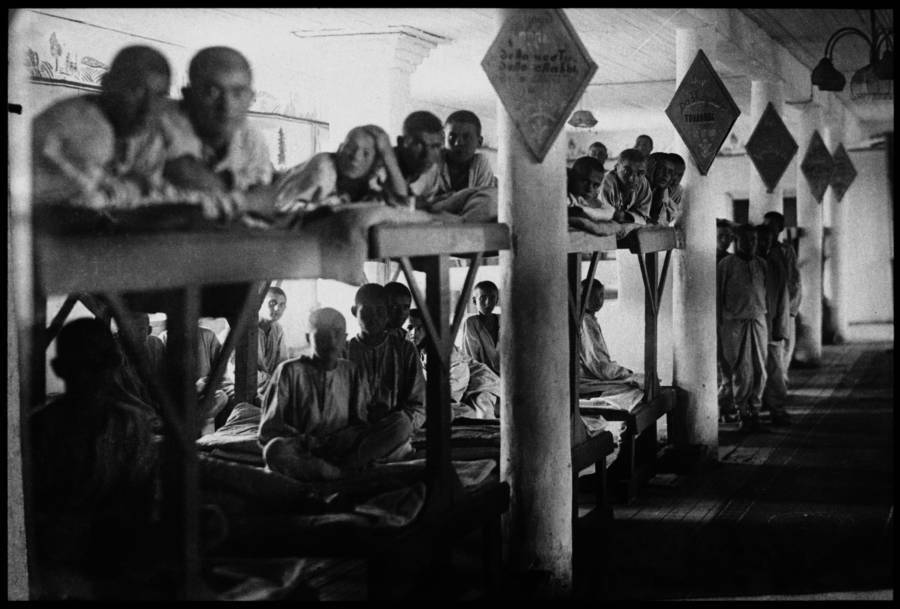
Child inmates in their Gulag bunks. Source: David Center for Russian and Eurasian Studies

Employing children employment in woodworking was a common Gulag practice. According to historian Anne Applebaum, while there are some examples of children’s work camps being assigned to hard physical labor such as mining or forestry in the harshest conditions of the far north, most children’s camps were dedicated to wood-working, metal work, and sewing. Gulag rules provided that children split their time between work and schooling, but the rules most often were honored in the breach. Camps often had no schools. Children faced the same deplorable living conditions and treatment as adult prisoners.

Here is an example of a first quality set the children of the Berezovsky camp made, and the stamp in its board.

First Quality Berezovsky Chessmen. Mike Ladzinski Collection, photo.
First Quality stamp on Berezovsky set. Mike Ladzinski Collection, photo.

Here is an example of a second quality set made in this camp, identified by a stamp inside its board/box.

Second Quality Berezovsky Chessmen. Chuck Grau Collection, photo.
Berezovsky Stamp inside board. Chuck Grau Collection, photo.

Neither box bears a date stamp, but we can reasonably date them as pre-1939, when Gulag production began bearing a five-pointed star as a registered trademark.

Gulag Trademark, registered 1939. Source: Eduard Andryushchenko

The design is both very simple and surprisingly elegant. Simplicity of design made sense for a set that was to be produced by unskilled or semi-skilled child Gulag labor. The bases and stems of the royals, clerics, and pawns form a cone, providing the pieces a good degree of balance. The “step-up” base characterizing the base-to-stem transition of the traditional Staunton design has been simplified to a circular cut. The stem ends at a disc-shaped pedestal, but the double collars characteristic of Staunton clerics and royals have been eliminated. The royals’ crowns are simply turned, the Staunton cross replaced by a tear-shaped turned finial on the king’s crown, and pointed crenels replaced by simple cuts on the queen’s coronet. The elaborately carved Elgin Marble knight has been replaced by a simply carved horse of a pleasing shape but little detail. The kings are 90 mm. The pieces are weighted with plaster. The set is made of birch, and the black pieces are simply painted. The design was successful and was produced all the way to the end of the Soviet Union, albeit in different production facilities over time. Later versions were unweighted.

Portuguese collector and historian Arlindo Vieira admired the design’s simple, slim bodies and broad bases, which afforded the pieces stability during play. He found them “elegant” and “aesthetically very pleasing” even though they are made from “poor” wood. In these ways, they reflect the “simplicity in manufacture, without great details in the pieces,” which results from “the need for serial manufacture” at “affordable prices” characteristic of Soviet pieces.

Vieira called the design “Latvian” because he found it in many pictures of Latvian events in which pieces like these were used. Many contemporary collectors of Soviet sets today would identify the pieces as “Latvian,” notwithstanding that over the course of six decades they apparently were manufactured in multiple locations from Moscow to Mordovia. However, artist-collector Alan Power and others have begun to call the pieces “Mordovian-Latvian,” or simply “Mordovian,” reflecting our our understanding that many sets of this design were manufactured in a Mordovian Gulag in the late 1940s and 1950s.

I also have seen the design referred to as “Tal’s favorite” or the “Latvian Tal” set. The basis for such claims is an exuberant exclamation Vieira uttered in his iconic 2012 video on Soviet chess sets, but neither he nor anyone else has offered any evidence for the claim other than Tal is seen playing with such pieces in several photos. Those photos by themselves do not reasonably support any claim of a special relationship between Tal and the design.

I am thinking of referring to this style as the Berezovsky design because this is where it appears to have originated based on the board stamps. I think that would be fitting homage to the child prisoners of the Gulag who first made them.