Gulag Knights? A Tale of Two Valdais

Gulag Knights

The reason I have been unwilling to pull the trigger is simple. In his engaging 2019 essay The ‘Gulag’ Knights, Alan claims the Valdai Nobles sets were born in a Gulag in Valdai. Writes Alan:

Needless to say, the hundreds of thousands of prisoners snatched up by the Gulag could produce hundreds of thousands of chess sets, and that’s exactly what Stalin had them do. There were two main factories (or camps) that concern this brief discussion. The first “Village” (a polite Stalinist term for a penal colony) was located halfway between the main artery connecting St. Petersburg and Moscow, namely, The Valdai Regional Industrial Manufactory in Novgorod (450 km north-west of Moscow), a picturesque and densely forested area used today by the rich and famous (including Putin and his entourage) for quick summer getaways. The second ‘village’ is the Yavas Township located in the Central Volga Region of Mordovia (500km south-east of Moscow)… From these two camps came the so-called ‘Valdayski’ and Mordovian (f.k.a. “the Latvian”) sets respectively…

These are intriguing claims. As a skeptic and empiricist, I began to explore their basis. Insofar as they relate to Mordovia, they are very well-supported. But as for Valdai, Novgorod Oblast, halfway between Leningrad and Moscow, I could find no evidence of a Gulag.

From a temporal point of view, it is plausible that Nobles sets of the 1940s and 1950s were made in a Gulag. But upon Stalin’s death in 1953, the general amnesty that granted Gulag prisoners with sentences of five years or less drastically cut back the Gulag system, and in 1960, Khrushchev abolished its remnants. Thus, even if the sets of the fifties and sixties could have been manufactured in a Gulag, those of the sixties could not have been. Beyond this, I simply could neither corroborate nor refute Alan’s claim.

Still, I kept searching Gulag databases and secondary sources without finding a link between Valdai and the Gulags. As I often do, I discussed the issue with my friend Sergey Kovalenko of St. Petersburg. Sergey is a well-respected chess collector, skilled carver, and denizen of Russian and Soviet archives. He regularly discusses historical issues and shares archival research with me and others. Like me, Sergey was intrigued by Alan’s claim. Like me, he could neither confirm nor refute it.

Sergey agreed with Alan’s claim that the Nobles sets were manufactured by the Valdai Regional Industrial Manufactory in Novgorod. This was evidenced by cardboard boxes like Alan’s bearing the producer’s name, Валдайский Райпромкомбинат, or Valdai Raipromkompromat, meaning Valdai Regional Industrial Plant. Unlike Alan, however, I do not equate the term Village with Gulag, and am unaware of any etymological or historical reason for doing so.
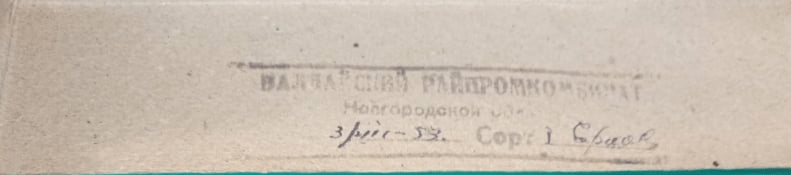
Valdai Regional Industrial Plant stamp on a cardboard box containing a Nobles set. Courtesy Sergey Kovalenko.

Nearest Gulag Camp Dug Missile Silos

Perhaps the most comprehensive online Gulag databases are maintained by Gulagmap.ru and Gulag.cz. These sites compile data on individual camps, with detailed information about each taken from the primary Russian language source,  Система исправительно-трудовых лагерей в СССР (System of Forced Labour Camps in the USSR [M. B. Smirnov, comp. 1998]) and other archival material. These online databases provide interactive maps of Gulag camp administrations as interfaces. Neither lists any camp in Valdai, Novgorod Oblast.

Late 1940s Valdai Nobles set. Note the slab knights. Source: Sergey Kovalenko.

Nor does the print version of Smirnov’s encyclopedia of Gulag camps. The camp nearest to Valdai was named EM ITL. It was located about 22 kilometers from Valdai near Dubrovets and engaged primarily in the construction of missile silos. Sergey provided the following map illustrating the location of ITL EM in relation to Valdai (Валдай), Novgorod Oblast.

Leningrad the upper left. Moscow on M10 to the right. Courtesy Sergey Kovalenko.

According to gulagmap.ru:

ITL “EM” was formed on January 10, 1951 and operated until May 14, 1953, when it was reorganized into the Dubogorskoye LO. The camp administration was located in the area of ​​the Dvorets station of the Kalinin railway. In operational command, it was initially subordinated to the Main Directorate of Industrial Construction Camps, but shortly before the camp’s reorganization, it came under the jurisdiction of the GULAG of the Ministry of Justice. The maximum number of prisoners held here was recorded in 1953 and amounted to 2,062 people.

ITL “EM” was engaged in the construction of defense facilities. In April 1952, the construction was assigned the first category of secrecy, and prisoners could be sent to this camp only with the permission of the Ministry of State Security…

According to sources, prisoners of the ITL “EM” were engaged in the construction of a coal mine and the maintenance of Construction 714, as well as the excavation of shafts and tunnels. In reality, the camp’s task was the construction of missile silos. The labor of prisoners of the ITL “EM” was also used to build locomotive and diesel power plants.

Likewise, Avraham Shifrin’s The First Guidebook to Prisons and Concentration Camps of the Soviet Union (1982) makes no mention of a Gulag camp in Valdai. At 276-277, 389. Nor does Anne Applebaum’s Pulitzer Prize-winning Gulag: A History (2003). At 676.

Post-Gulag Prison Colony ITK-4

Sergey accessed the Novgorod Online Archives and made an intriguing discovery. He discovered a link between the Valdai Industrial Plant and the post-Gulag Soviet correctional system, if not with the Gulag system itself. According to the Novgorod Archives, on 1 June 1957, various assets in and around Valdai were transferred to the Department of Internal Affairs (MVD), among them the Valdai District Industrial Plant, the woodworking shop of the Valdai Mechanical Plant, and the Timber Plant of the Novgorod City Industrial Plant.
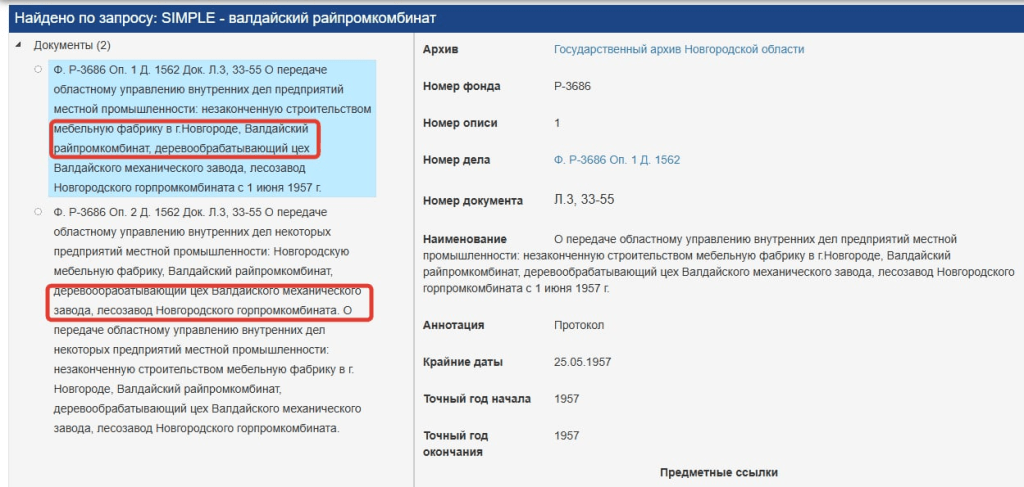
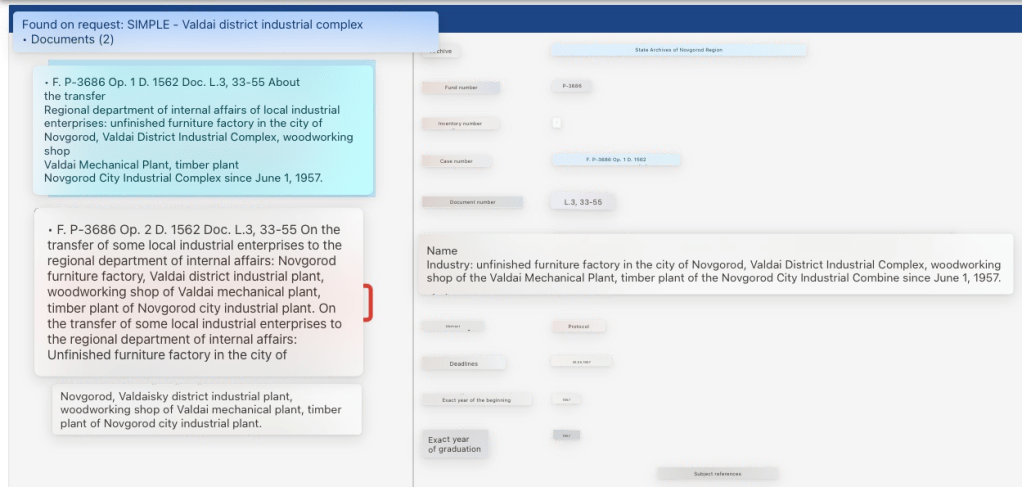
According to records Sergey found, the woodworking shops and other assets were transferred to a newly organized correctional and labor colony in Valdai, Novgorod Oblast, designated ITK-4, or Labor Colony 4, and OYA-22/4. The MVD received funds to construct housing and other structures in Valdai and the nearby town of Myza to accommodate 700-800 male prisoners. V. M. Skoryukov was appointed Deputy Chief of ITK-4 for Production. When prisoners began arriving in October of 1957, they worked in two lathe, furniture and plywood workshops, and a forest in a nearby village.

It is essential to situate ITK-4 in the history of the Gulag system. According to a recently declassified 1951 CIA report, two kinds of labor facilities operated within the Gulag system. ITLs–Labor Camps–were established in remote regions and housed prisoners with sentences of two years or greater. By contrast, ITKs–Labor Colonies–typically housed petty criminals in each oblast.

Even before Stalin’s death, MVD Minister Laventry Beria and his deputy Stepan Mamulov proposed to drastically cut back and replace the Gulag system. Stalin died in March 1953. While his corpse was still warm, Beria began to dismantle the Gulags, issuing a general amnesty that led to the release of 1.5 million prisoners–60% of the Gulag population–over the next three months. Aleksei Tikhonov, The End of the Gulag, in The Economics of Forced Labor: The Gulag (P. Gregory and V. Lazarev eds., 2003) at 67-73. Anne Applebaum writes:

As Khrushchev had feared, Beria, who was barely able to contain his glee at the sight of Stalin’s corpse, did indeed take power, and began making changes with astonishing speed. On March 6, before Stalin had even been buried, Beria announced a reorganization of the secret police. He instructed its boss to hand over responsibility for the Gulag to the Ministry of Justice, keeping only the special camps for politicals within the jurisdiction of the MVD. He transferred many of the Gulag’s enterprises over to other ministries, whether forestry, mining, or manufacturing. On March 12, Beria also aborted more than twenty of the Gulag’s flagship projects, on the grounds that they did not “meet the needs of the national economy.” Work on the Great Turkmen Canal ground to a halt, as did work on the Volga–Ural Canal, the Volga–Baltic Canal, the dam on the lower Don, the port at Donetsk, and the tunnel to Sakhalin. The Road of Death, the Salekhard–Igarka Railway, was abandoned too, never to be finished.

Supra, at 478.

In 1955, the GUITK (Glavnoye Upravleniye Ispravitelno-Trudovykh Kolony), or Chief Administration of Corrective Labor Colonies, was established within the MVD to administer the post-Gulag correctional system. After Khrushchev gave his famous speech denouncing Stalin in February 1956, the dismantling of the Gulags accelerated. Appleman writes:

In the months that followed the secret speech, the MVD also prepared to make much deeper changes to the structure of the camps themselves. In April, the new Interior Minister, N. P. Dudorov, sent a proposal for the reorganization of the camps to the Central Committee. The situation in the camps and colonies, he wrote, “has been abysmal for many years now.” They should be closed, he argued, and instead the most dangerous criminals should be sent to special, isolated prisons, in distant regions of the country, specifically naming the building site of the unfinished Salekhard–Igarka Railway as one such possibility. Minor criminals, on the other hand, should remain in their native regions, serving out their sentences in prison “colonies,” doing light industrial labor and working on collective farms. None should be required to work as lumberjacks, miners, or builders, or indeed to carry out any other type of unskilled, hard labor.

Dudorov’s choice of language was more important than his specific suggestions. He was not merely proposing the creation of a smaller camp system; he was proposing to create a qualitatively different one, to return to a “normal” prison system, or at least to a prison system which would be recognizable as such in other European countries. The new prison colonies would stop pretending to be financially self-sufficient. Prisoners would work in order to learn useful skills, not in order to enrich the state. The aim of prisoners’ work would be rehabilitation, not profit.

Supra, at 509.

By 1957, GUITK became primarily responsible for operating and administering that system. It was within the post-Gulag framework Dudorov described that Valdai’s ITK-4 went operational.

Another Valdai and Segezhlag

Sergey did find some connection between a Valdai and the Gulags, but it was a different Valdai, one located in the Segezha District of Karelia, almost 900 km north of its namesake in Novgorod Oblast. This Valdai lies within the same Segezha District as a Gulag camp known as Сегежский ITL, or Segezhlag, but across from it on Lake Vygozero and 132 km distant by road. This Valdai was founded in the early 1930s to aid in constructing the White Sea-Baltic Canal with Gulag labor.

Valdai and Segezha, Segezha District, Karelia. Source: Google Maps

Segezhlag was organized in 1939. According to gulagmap.ru:

The Segezha Corrective Labor Camp was organized no later than October 21, 1939, on the basis of the 4th camp division of the White Sea-Baltic Corrective Labor Camp and operated until June 28, 1941. The camp administration was located in the Karelo-Finnish SSR, in the area of ​​the Segezha station of the Kirov Railway. Initially, the camp was subordinate to the GULAG, but from February 1941 it came under the jurisdiction of the Main Directorate of Industrial Construction Camps (GULPS). Up to 7,951 prisoners were held here…

The labor of the prisoners of the Segezha camp was used for the construction of the Segezha timber and paper plant, the Segezha hydrolysis plant (since November 1940), the Kondopoga sulfite-alcohol plant (since March 1941), for servicing the first stage of the timber and paper plant, as well as sawmills, foam concrete, concrete, asphalt plants, a concrete products plant, for the construction of railways and dirt roads, residential and utility facilities, and agricultural work.

See also Smirnov, supra, at 390.

There is no record of chess set production at Segezhlag. While the Gulag camp there closed in 1941, Penal Colony No. 7 continues to operate there.

Conclusion

The Nobles chess sets of Valdai were not made in a Gulag, but in the woodworking shops of the Valdai District Industrial Plant. Prisoners of the Gulag camp nearest the chess-producing Valdai dug missile silos, but did not turn chess pieces or carve knights. Ironically, a different Valdai was associated with a Gulag camp, Segezhlag. But this camp had nothing to do with the production of chess sets either.

After 1957, however, sets were made by forced labor within ITK-4 of the Soviet prison system, confirming a key component of Alan’s initial claim concerning these sets. Still, the change in penal regimes was not a distinction without a difference, a mere “changing of the uniforms,” to borrow a phrase from Budapest’s House of Terror Museum. If we were to equate the two different penal regimes, we would unfairly diminish one of the most immediate and significant consequences of Stalin’s death–the abolition of the Gulag system, the release and rehabilitation of millions who had unjustly suffered under its iron hand, the reconfiguration of penal institutions, and all the social dislocation that attended the Gulag’s demise.

Many thanks to Sergey Kovalenko and the reference librarians at the Bedford, NH Public Library.
Soviet Checkers: Junior Partner in a Cultural Revolution

The history of checkers paralleled that of chess in the Soviet Union. Both games had been played for centuries, despite suffering the disapprobation of the Orthodox Church. Both were incorporated into the Soviet state’s political program to elevate and enrich the cultural level of the masses.

According to the Russian Checkers Federation, “games similar to modern Russian checkers were known to the Eastern Slavs as early as the 4th century, as indicated by numerous artifacts from archaeological excavations. References to checkers (or ‘tavleys,’ as this game was previously called in Rus) are found in some epics and other written evidence from that time.” https://shashki.ru/variations/draughts64/ During the reign of Peter I (1682-1725), checkers became popular. The first article about checkers appeared in 1803. https://www.sports.ru/others/blogs/2699763.html

Official rules were printed in 1884, and the first Russian championship was held a decade later, with the second, third, and fourth All-Russian championships played in 1895, 1898 and 1901 respectively. https://en.wikipedia.org/wiki/Russian_draughts A magazine dedicated to the game began publication in 1897. According to Russian author Maria Selenkova, by checkers had become popular, with skilled players emerging in various neighborhoods, playing in matches and and informal tournaments, and sharing their knowledge with the younger generation. https://www.sports.ru/others/blogs/2699763.html

1950s Soviet checkers set. The folding board is familiar to collectors of Soviet chess sets. Nikolai Filatov photo.

Like chess, the Russian game is played on a board with eight rows and eight ranks, the former designated by letters a-h and the latter numbers 1-8, the algebraic system familiar to modern chess players. The rules are similar to the game played in the United States, except that all pieces may capture forward or backward. Soviet players competed internationally, playing the 10 x 10 square version of draughts. Competitive games are timed, using chess clocks, and recorded using algebraic notation. Competitive players are rated using an Elo system. https://shashki.ru/federation/

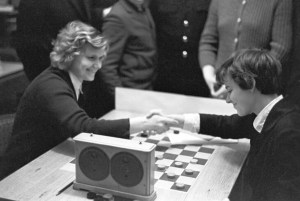
IX USSR Women’s Checkers Championship. Latvian Johanna Cine (right) congratulates Leningrader Iraida Spasskaya on her victory. Note the 8 x 8 board, the Jantar chess clock, and the scoresheets. https://www.sports.ru/others/blogs/2699763.html

During the early 20th century, checkers attracted a diverse demographic, including soldiers, workers, and traders. The game’s popularity continued to grow following the revolution, as the new government recognized the public’s interest in checkers, viewing it as a more dynamic and simpler alternative to chess.

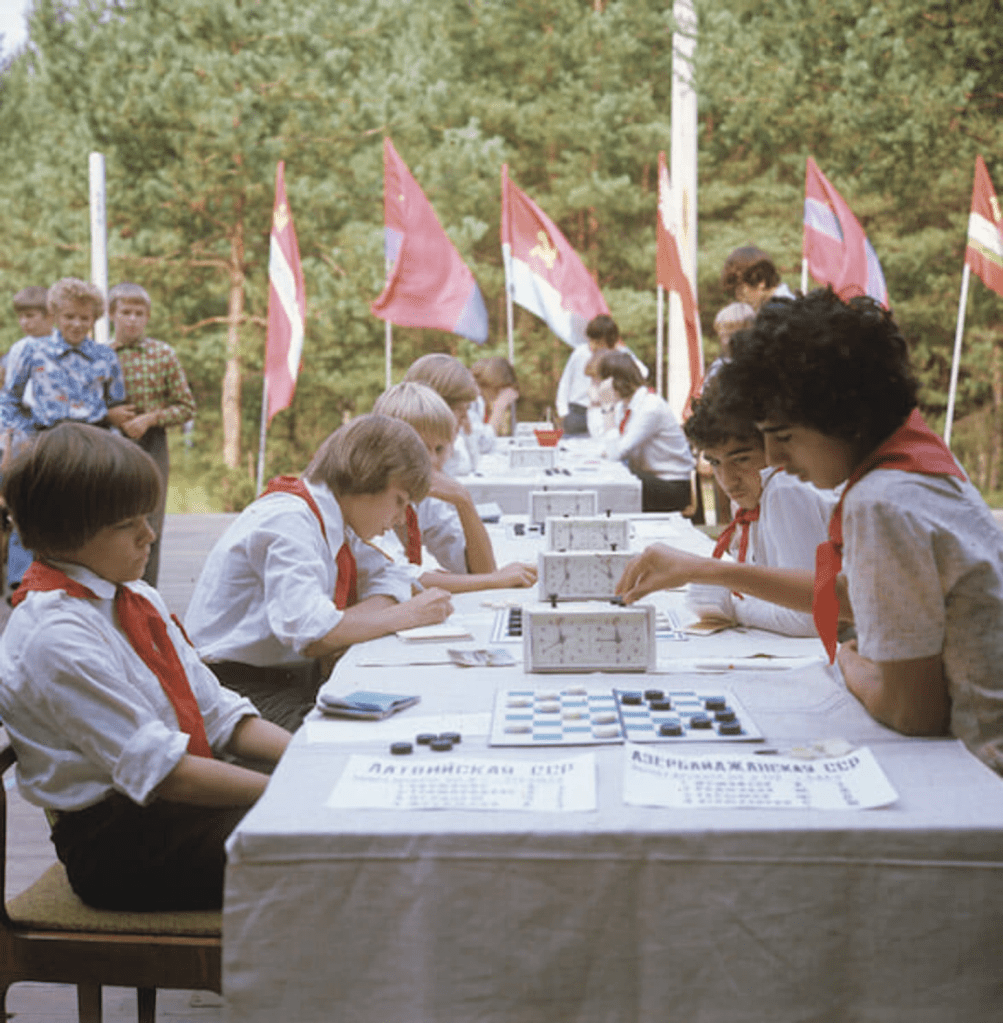
XII All-Union Pioneer Games. Note the plastic Jantar chess clocks. https://www.sports.ru/others/blogs/2699763.html

Like chess, checkers was taken very seriously in the USSR was actively promoted by the Soviet state. In August 1924, the All-Union Chess and Checkers Section was established. Bolshevik and state prosecutor Nikolai Krylenko presided over the section. Under the section’s auspices the first USSR checkers championship was played the same year.

Krylenko spoke of the games jointly as the “chess and checkers movement.” He wrote:

Ever since the conception of our organization, we have our slogan, Chess and Checkers into the Working Masses. We came up with this slogan to combat the theory that chess is pure art, the theory that chess is just art for art’s sake. The struggle for masses, the struggle for introduction of chess and checkers to the masses as a weapon of the cultural revolution – this is our first slogan, which we carry out ever since our organization was born.

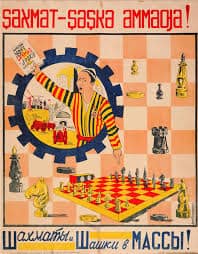
“Chess and Checkers to the Masses!” Soviet Uzbek poster. Soviet Visuals photo.

The comrades who read our political literature, our specialized chess and checkers literature, knew clearly that if we wanted to make our movement, firstly, proletarian, and secondly, truly widespread, then the conclusion should have been obvious: a mass movement, a working-class movement is ought to be a political movement. It’s plainly impossible for the working masses, who every day take active part in the country’s political life, who every day, every hour are involved in their country’s international and internal policy – for those working masses, when they study chess and checkers in clubs, or at home, or wherever, to cease being what they are: being political activists and builders of their own state, arbiters of their country’s destiny.

In our epoch, the slogan “Chess and checkers to the masses as a weapon of cultural revolution” has been expanded: “Imbue chess and checkers with political content, make our chess and checkers players into political workers, conscientious fighters, conscientious participants of socialistic building.

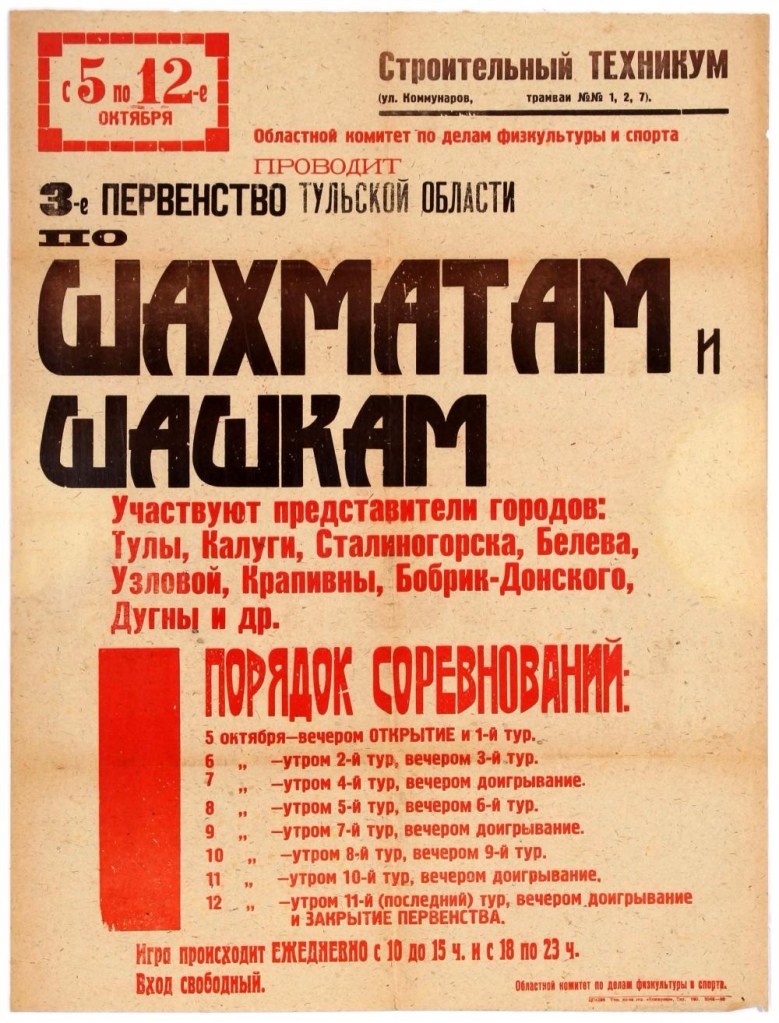
1938 Poster for Tula Chess and Checkers Competitions. Designer unknown. Antikbar Original Vintage Posters photo.

The issue of imbuing chess/checkers organizations with politics should be understood in this way: from some, we should demand that they, being organizers, being administrators, being responsible for political issues, pay much attention to political work; and we should get the others more involved in political life, make then conscientious participants of socialistic building.

I can cite a number of examples. Let’s look at the question of chess/checkers organizations’ participation in udarnik movement and socialistic competition. When you demand that the workers of this factory or that, in addition to being members of chess/checkers team, be udarniks and set high goals for themselves in socialistic competitions, as stevedores of the Lower Volga do – the checkers-playing and chess-playing stevedores – this is the way to couple cultural work with general political work, this is political work.

And there’s another form, which we can demand from more mature members of our organization – from administrators, from organizers. We measure the level of fitness for our chess/checkers work not just by purely chess/checkers talent and ability, but also by the ability to perform political and organizational work and the level of clear understanding of general political issues in our life and the imbuing of chess/checkers organizations’ work with political content.”

“In a Soviet factory lounge” 1930 [MAMM] Courtesy Sarah Beth Cohen

According to chess historian Terje Kristiansen, the above photo likely depicts “the so-called Lenin’s corner (aka Lenin’s room, Red Corner, the center of culture). Most factories and institutions had one, where pupils, students or workers met to read, chat, and play chess.” Kristiansen asked a Ukrainian-Russian friend and his Russian girlfriend about the photo. Both are now in their seventies, and are familiar with the history of chess in the Union. He shared their thoughts:

[The photo] captures the moment of the women’s chess and checkers circle. True, judging by the postures of women, by the expression of their faces and during the game on the checkerboards, the whole photo looks like a staged one (or women are just learning to play checkers and chess). You cannot see the enthusiasm and focus on the faces of the players. The two men in military uniform in the background are unlikely to be security guards. And what are they to protect here? This is clearly not a prison or a colony. Most likely, these are either the leaders of the circle, or the administrative workers of the institution (possibly the workers’ Club). In those years, many men, especially those who went through military operations, wore out military clothes (they simply did not have another). But, despite the staged plot of the photograph, I believe that it reflects the reality of that time.

https://www.chess.com/blog/Spektrowski/nikolai-krylenko-the-main-goals-of-the-chess-checkers-movement-1931

A women’s championship was held in Leningrad in 1936. The next year, the section published a “Unified Checkers Code of the USSR,” providing a comprehensive set of rules for both Russian checkers (8 x 8 squares) and international checkers (10 x 10 squares).

Checkers tournaments were held all over the Union, often in conjunction with chess tournaments. Here are several posters advertising such events.

1930s poster for Tula chess and checkers competitions. Designer unknown. Poster Connections photo.
1930s ad for a Chess and Checkers tournament held by the Kaluga Regional Council of Physical Education. Match between Moscow and Kaluga. Designer unknown.

Promoted and funded by the state, the number of Soviet checkers players in the Soviet Union surpassed 100,000 by the time of the fascist invasion, rising to 1.2 million by 1960. In fact, Selenkova claims that checkers temporarily surpassed chess in popularity after the Great Patriotic War, only to fall behind again following Mikhail Botvinnik’s ascension to World Chess Champion in 1948. https://www.sports.ru/others/blogs/2699763.html

1951 Soviet Men’s Checkers Championship. <a href=”http://Авторство: неизвестен. <a rel=”nofollow” class=”external free” href=”http://plus.gambler.ru/tavlei/igra/person_2.htm”>http://plus.gambler.ru/tavlei/igra/person_2.htm</a&gt;, Добросовестное использование, <a href=”https://ru.wikipedia.org/w/index.php?curid=2401056″>Ссылкаhttp://Авторство: неизвестен.

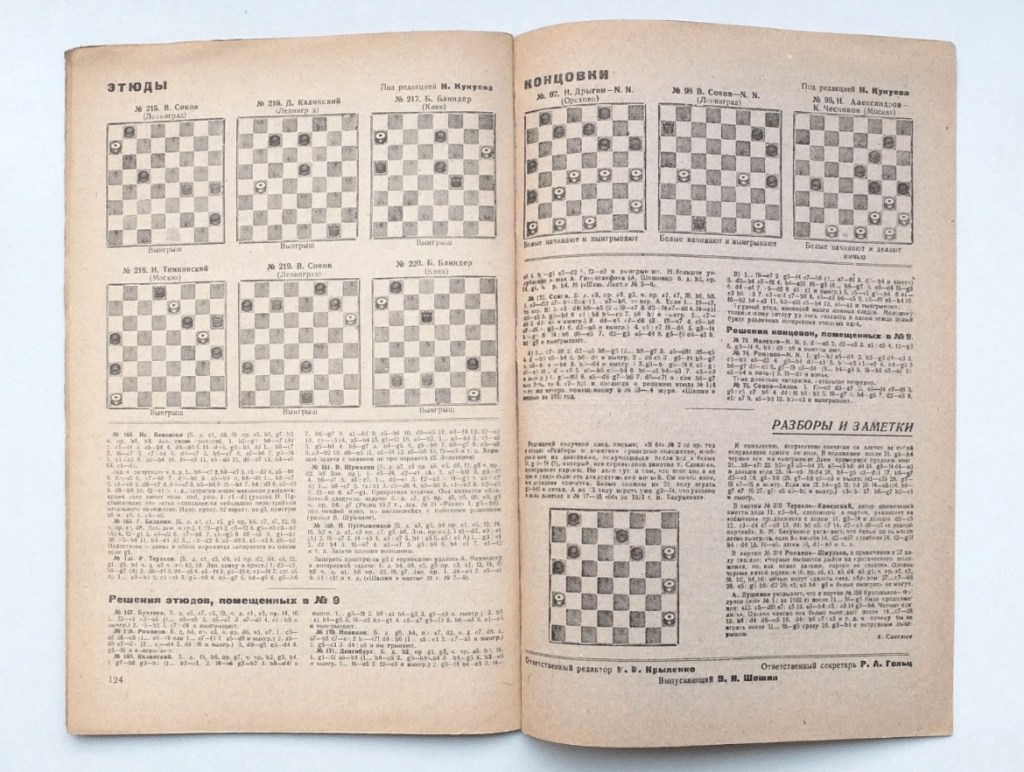
One way the Soviet state promoted chess and checkers was by publishing periodicals about them, reporting on events and presenting annotated games of instructional value. As important a chess publication as 64 carried a regular section for checkers. Here is an example:

64 No 8, 1933. “Chess and Checkers for the Masses.” Pixstock photo.
Pixstock photo.
Pixstock photo.

In the early 1950s, chess and checkers formed separate sections. By the end of the decade, checkers had developed its own federation. The USSR gained its first world champion in checkers, Iser Kuperman, in 1958. Of course, the 10 x 10 international version was played.

Iser Kuperman (R) (1922-2006). Somov/Sputnik photo (12 June 1963),

Checkers had several advantages over chess as a means of cultural enrichment. It was a much simpler game. It could be learned and played more quickly. Vodka consumption would not degrade the level of play to the same extent as in chess. While it was played on the same 8 x 8 boards as chess, the pieces were much simpler to produce, and therefore much cheaper and affordable.

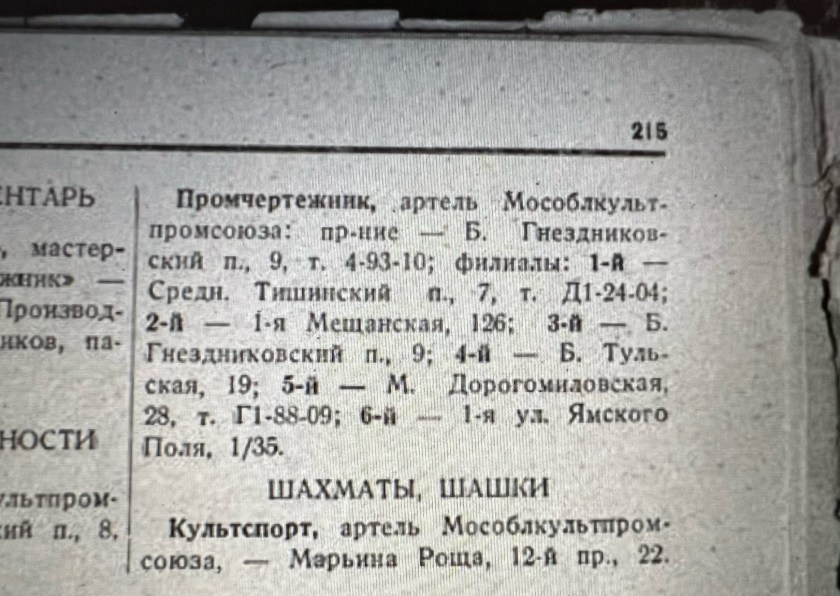
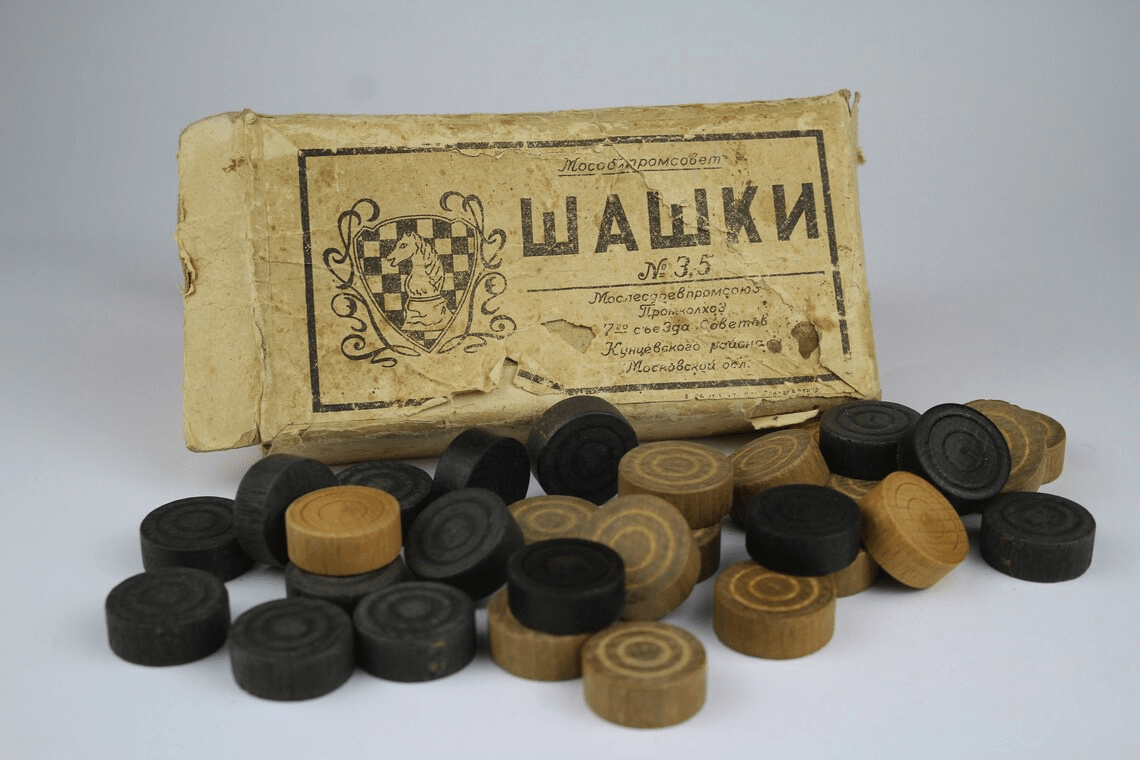
Makers of chess sets also manufactured checkers equipment. Here is a listing in the 1936 Moscow Directory for the well-known manufacturer of chess equipment, Artel Kultsport. Kultsport also advertised the sale of checkers (“шашки”) equipment.

Checkers are much simpler in design than chess pieces, and accordingly are simpler and cheaper to produce. Earlier checkers were made of wood. In the fifties, plastic pieces appeared, and soon became common.

Whereas chess pieces are not susceptible to over political messaging, checkers were not so limited. It was not uncommon for them to contain Agiprop messaging, thereby undertaking the political purpose Krylenko envisioned. A case in point is this set from the 1920s.

1920s Agitational Checkers. Russia Chess House photo.

According to Russia Chess House,

The figures depict a sickle and hammer, a star, and also a flag with the inscription “Proletarians of all countries unite”[They] are an example of agitational art of the pre-war Soviet period. There was a propaganda plan, according to which the symbols of the new government should be placed everywhere. Even matchboxes and plates had to tell the people about the accomplishments of the revolution. Utilitarian and decorative objects were to be accompanied by revolutionary slogans.”

http://chessm.com/catalog/show/5213

FineSovietGoods photo.

Some checkers contained political symbols without political slogans. Here is an example from the 1940s, where the Soviet five-point star is embossed on the wooden checkers. In Soviet heraldry, the five-point star is the symbol of the Red Army. By one account, this came about through an exchange between Krylenko and Leon Trotsky.

Another claimed origin for the red star relates to an alleged encounter between Leon Trotsky and Nikolai Krylenko. Krylenko, an Esperantist, wore a green-star lapel badge; Trotsky inquired as to its meaning and received an explanation that each arm of the star represented one of the five traditional continents. On hearing that, Trotsky specified that soldiers of the Red Army should wear a similar red star.

https://en.wikipedia.org/wiki/Red_star#:~:text=In%20Soviet%20heraldry%2C%20the%20red,sickle%2C%20which%20symbolized%20peaceful%20labour.

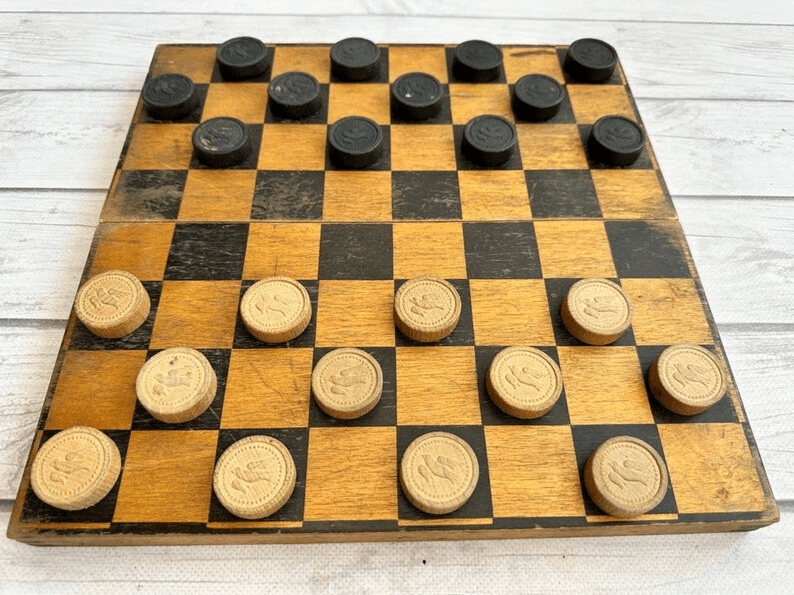
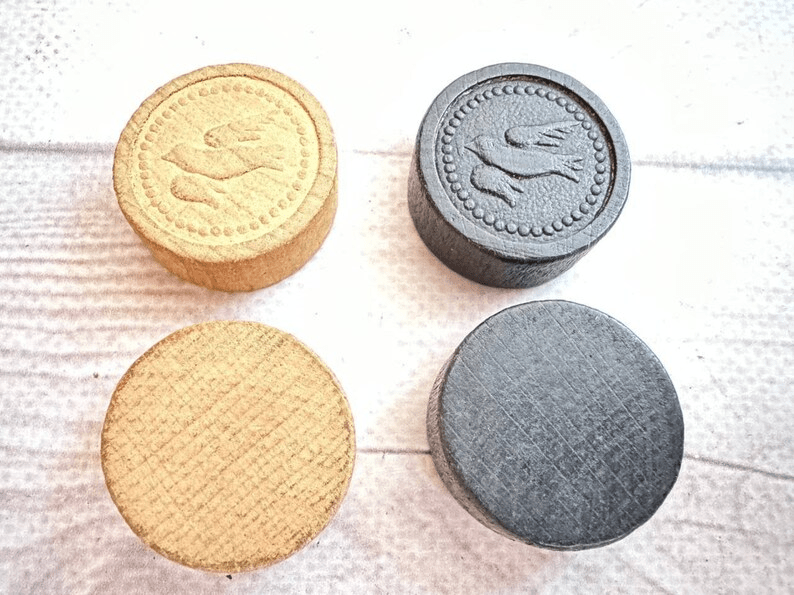
1950s Soviet checkers. Wood, with a dove of peace embossed on the front sides. Nikolai Filatov photo.

Not all the political icons carried by checkers were so bellicose. For example, these checkers (above) of the 1950s were embossed with the dove of peace. And the Bakelite checkers (below) celebrated the 1980 Moscow Olympics, which bore images of the different areas of competition.

AntiqueEmbassy photo.

Conclusion

As it did with chess, the Soviet state promoted checkers as part of its program to elevate the cultural level of the masses and to parlay the game into a means of political organizing.

Cover photo credit: USSRovskyVintage

Photos of the 1935 Second Moscow International Tournament

Our friend Sergey Dubodel, from Belarus, recently forwarded photos of the 1935 and 1936 Moscow International Tournaments. Both tournaments were held in furtherance of the Soviets’ program of Political Chess. In this context, the tournaments were intended to provide forums where top Soviet players could compete against leading Western players, both to gauge the progress of Soviet player development, and with good results, to demonstrate the superiority of socialism in an important arena of cultural competition. In this post, we’ll look at photos from the 1935 event.

Leading the 1935 Soviet contingent was Mikhail Botvinnik, whom Soviet chess tsar Nikolay Krylenko and others saw as the Soviets’ best hope to become world champion. Among the Western players were former world champions Emmanuel Lasker and Jose Raul Capablanca, and Salo Flohr, then viewed as a leading contender for the world crown. Flohr and Botvinnik drew their game and shared first place.

1935 Second Moscow International Tournament participants, with Nikolay Krylenko. Krylenko is in the middle right foreground, with the oversized head and jackboots. To his right (our left) is Emmanuel Lasker. To his left (our right) is Salo Flohr. Second from our left in the front row is Jose Raul Capablanca. Botvinnik is in the rear row to our far left. Photographer unknown.

The tournament is significant for collectors of Soviet chess sets for three reasons. First, it is an important manifestation of Political Chess, the engine driving the train for the growing production of Soviet chess sets and the evolution of their design towards simpler, more easily mass-produced pieces. We have explored these relationships here. Second, it showcased the pieces used, a design that became a workhorse for Soviet chess at its highest levels through decades in its evolving forms, as we have reviewed here. Finally, it is the event whose joint winners’ names have come to describe the pieces used for reasons we have discussed here , here, and here.

Botvinnik Flohr II chess pieces, c. 1935. Steven Kong photo.
Flohr and Botvinnik. Source: 1935 Tournament Book.

The Botvinnik-Flohr game can be found here.

Capablanca and Lasker. Photographer unknown.

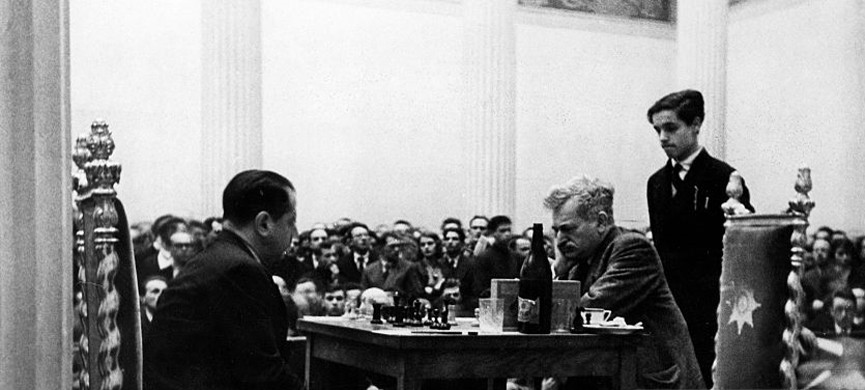
Lasker beat Capablanca to edge him by half a point for third place. Their game can be found here. Capablanca finished in fourth place. Lasker finished half a point behind Botvinnik and Flohr.

Capablanca and Botvinnik drew. Their game can be found here.

Spielman and Alatortsev. Photographer unknown.

Austrian Rudolph Spielman beat Vladimir Alatortsev in this game and finished in fifth place, one point behind Capablanca.

Flohr and Alatortsev. Photographer unknown.

Flohr and Alatortsev drew this game. Alatortsev finished in 11th place.

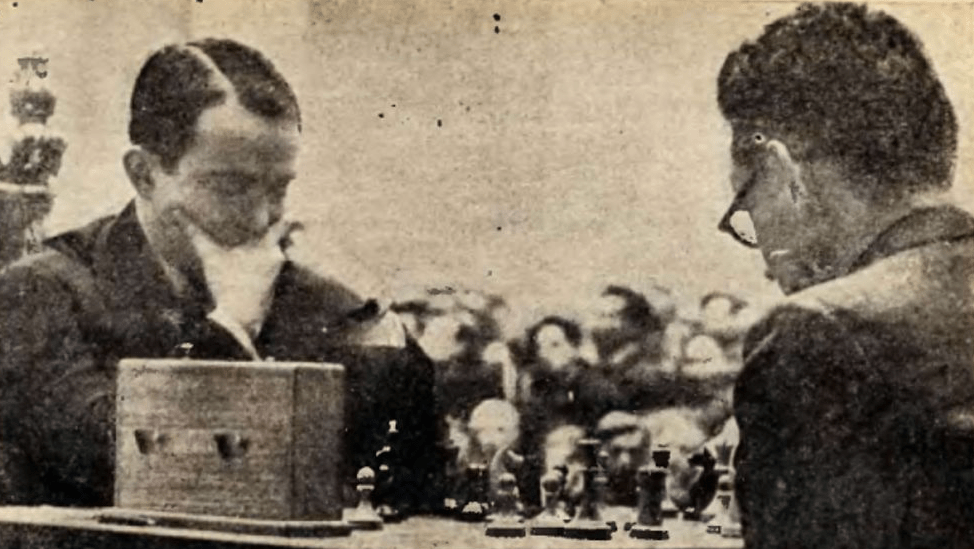
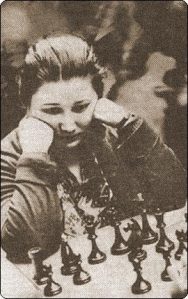
Vera Menchik was the only woman participant. She finished in last place, scoring three draws, including this game with the White pieces against Flohr.

Many thanks to Sergey Dubodel for sharing these photos with us.