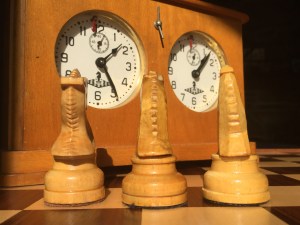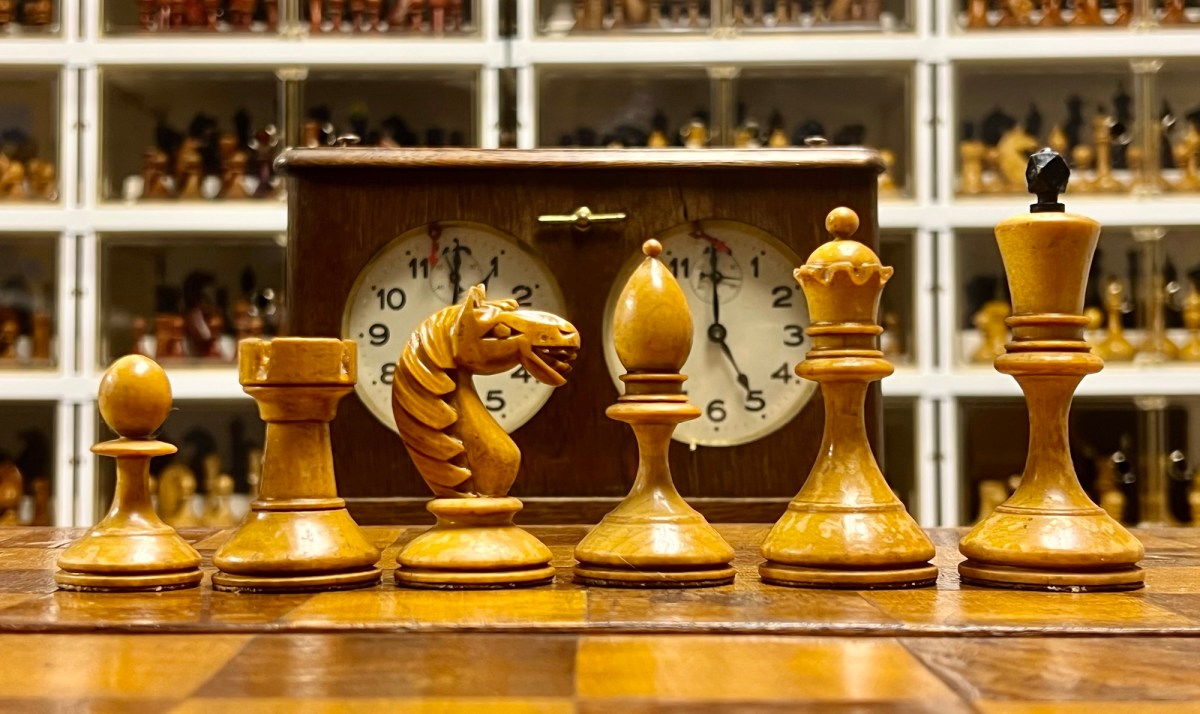
Maizelis’s Set

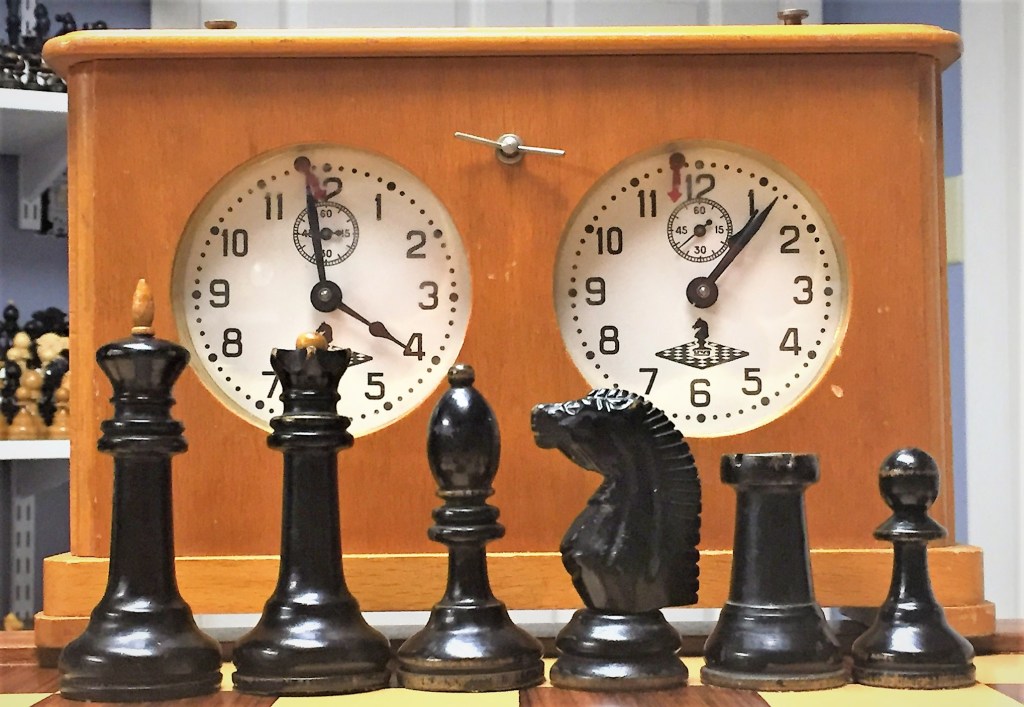
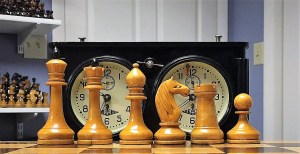
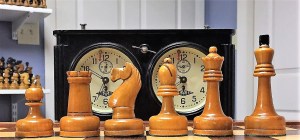
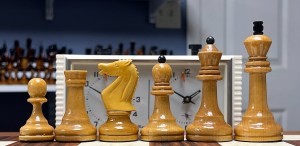
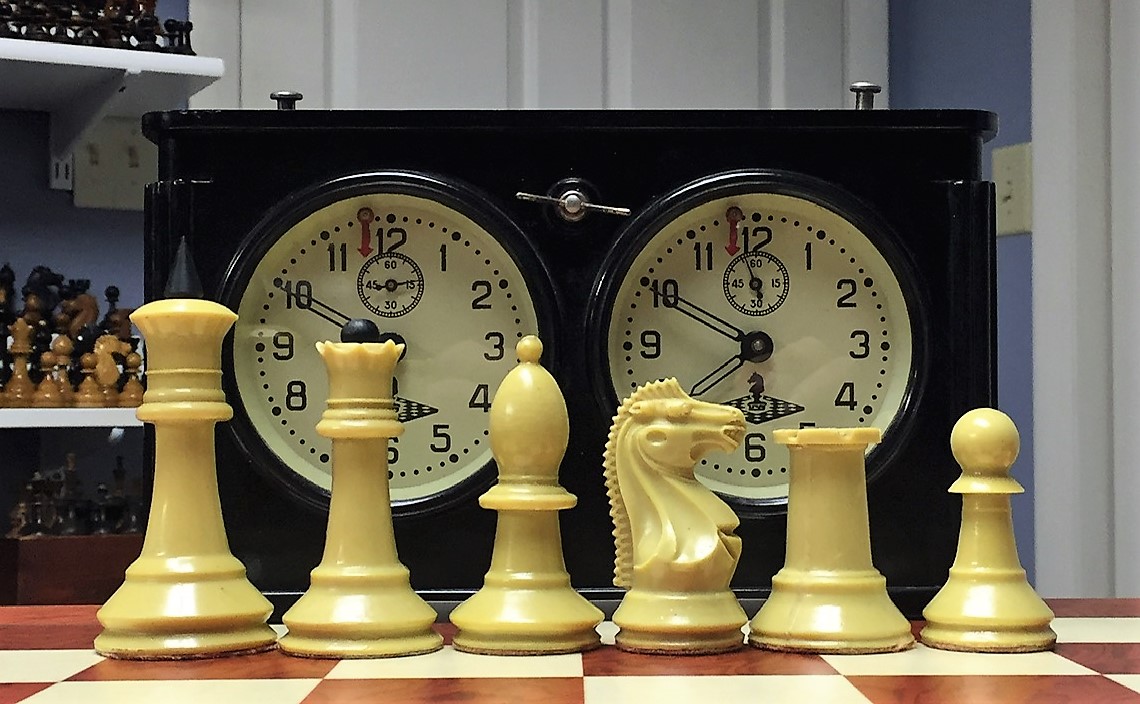
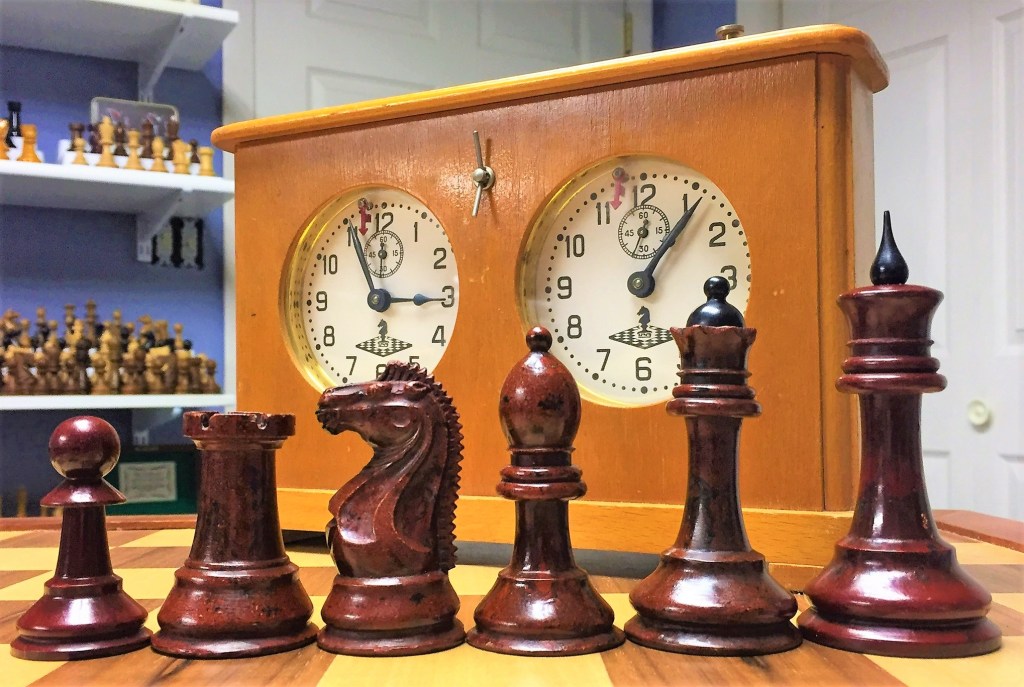
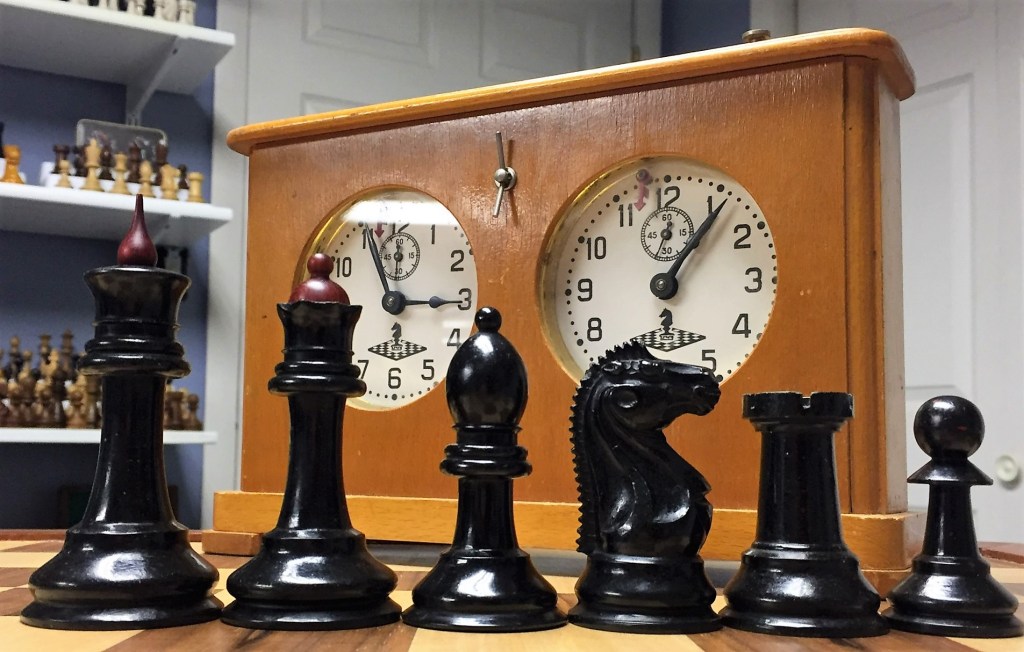
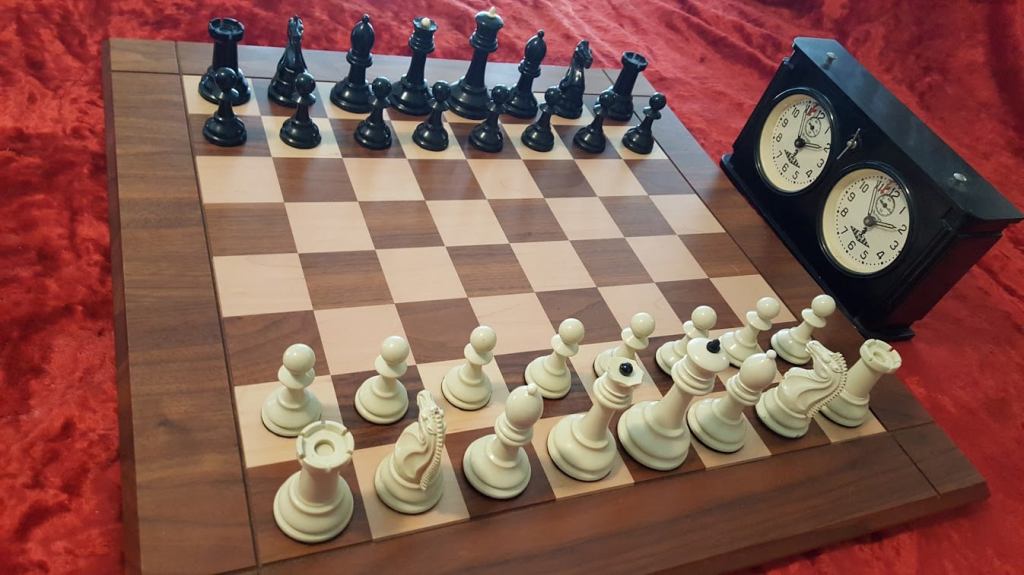
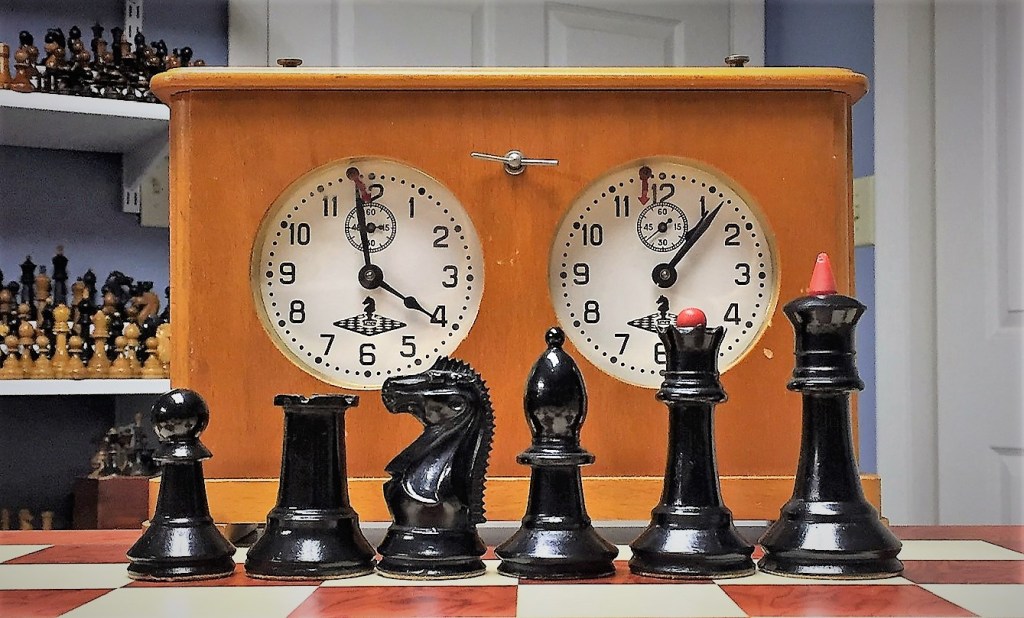
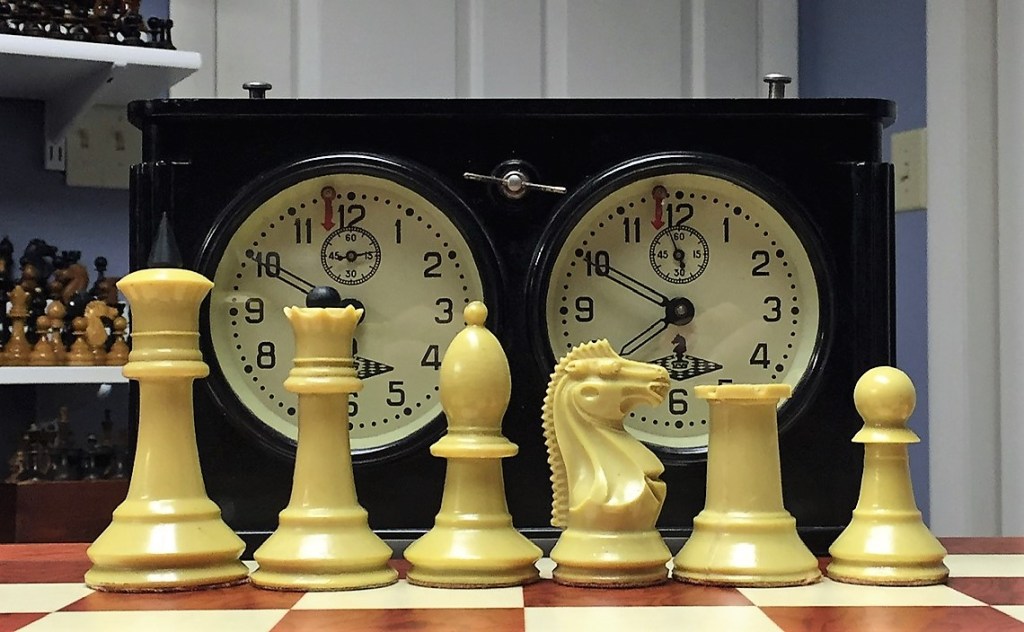
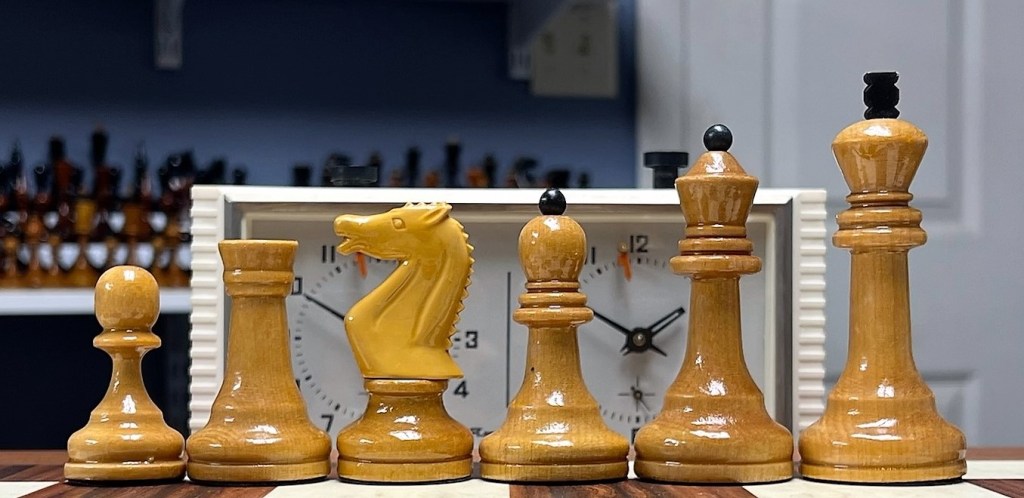
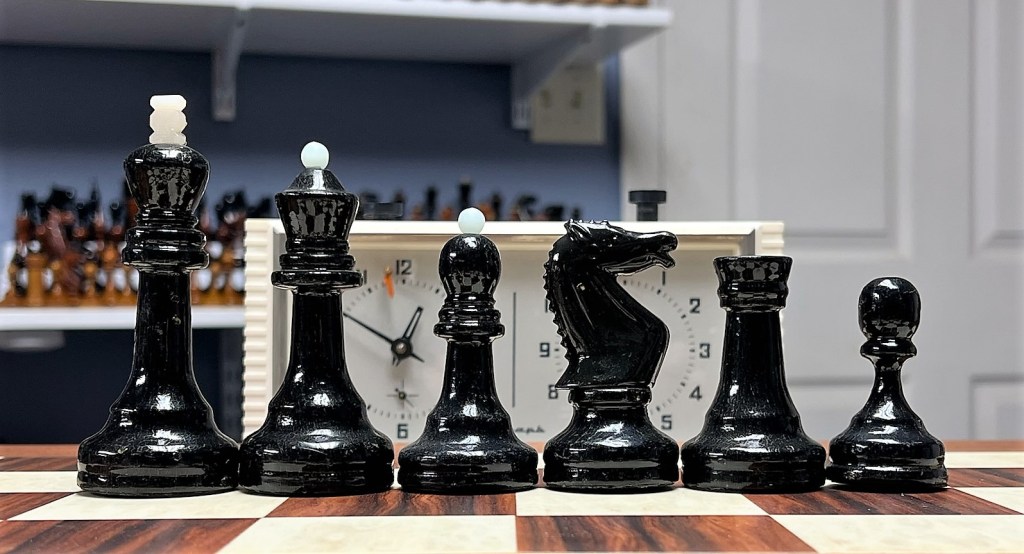
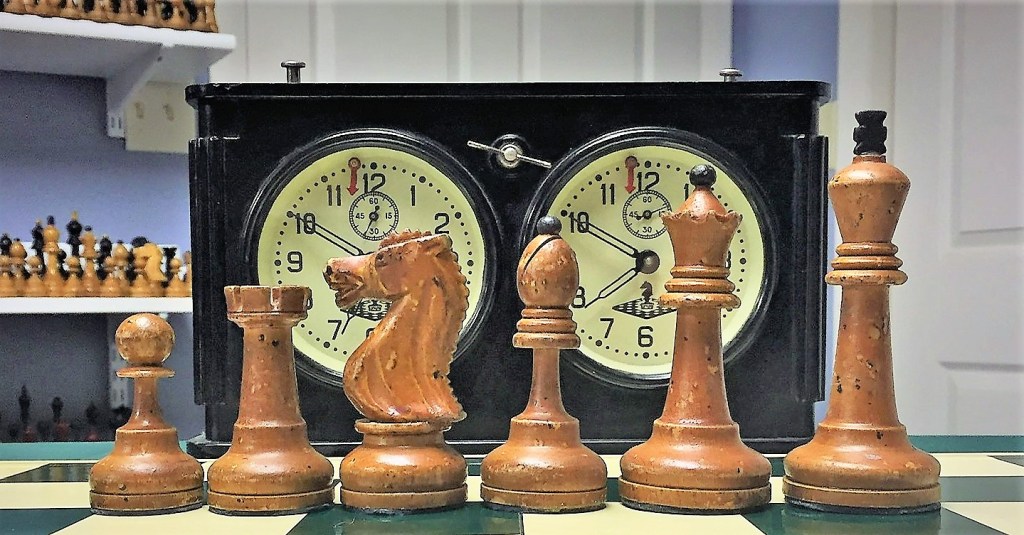
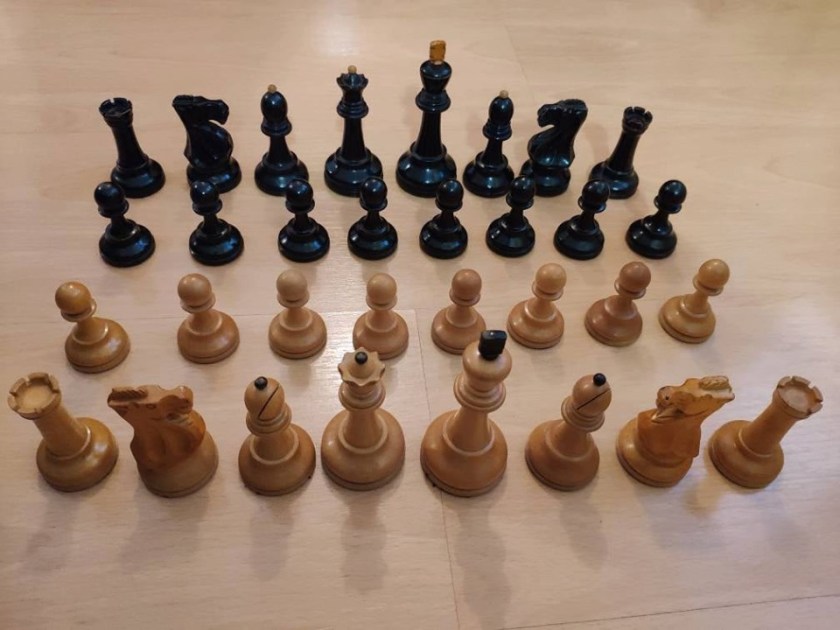
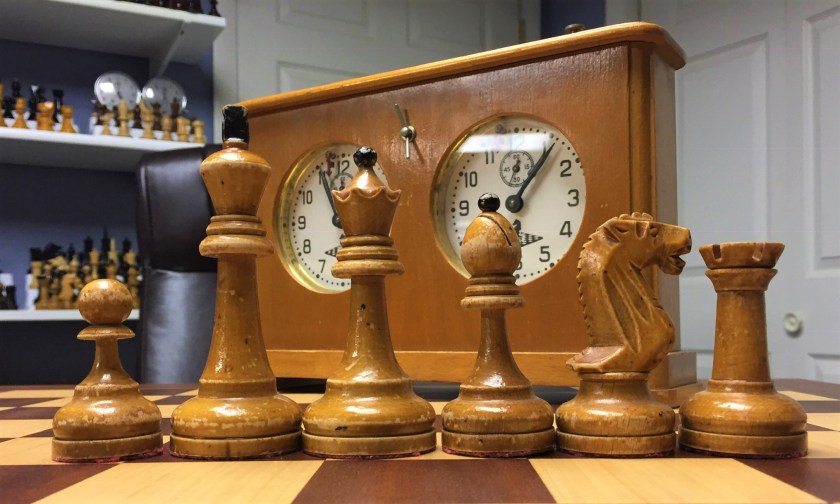
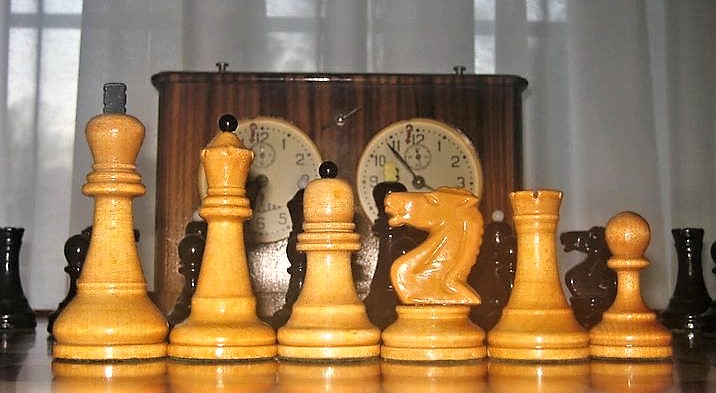
Soviet Master Ilyan Maizelis included a photo of the pictured set in his famous primer “Chess Beginnings” (1937). There he described it as “Modern Chess Figures (Staunton form).” At 9. So the set dates no later than 1937. For sake of convenience, I’ll refer to it as “Maizelis’s Set,” though I have no other evidence that he actually owned or played with one like it.
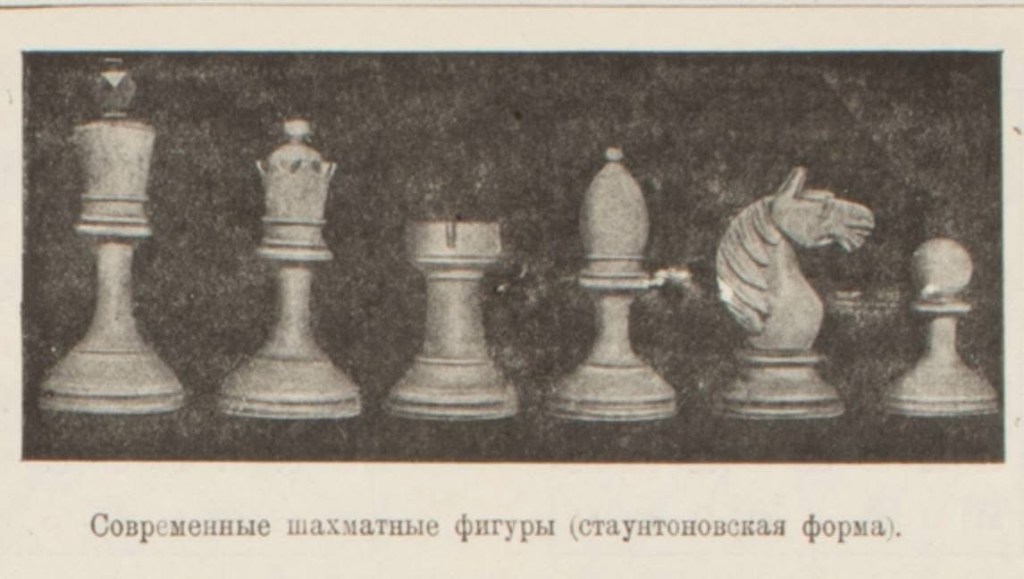
Photo courtesy of Sergey Kovalenko.

I recently added such a set to my Soviet and Tsarist collection.

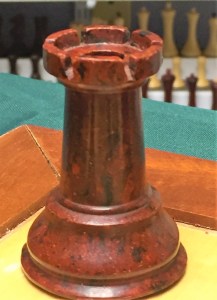
The set is magnificently turned, carved finished, and weighted, with several small defects, a couple chipped coronet tips, broken finials on a White Bishop, a partially broken off finial on the White King, a few cracks and worn finish for character.

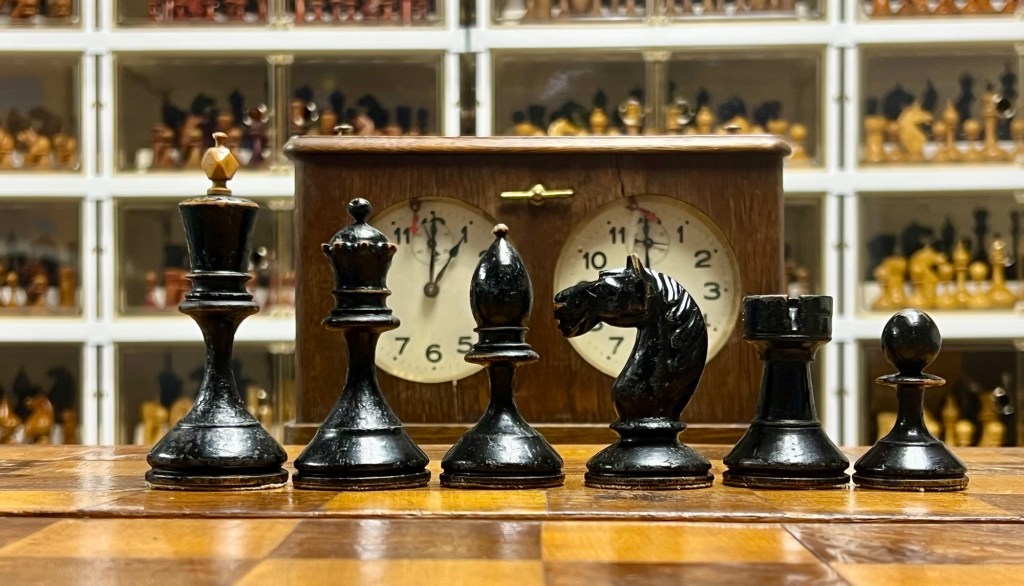
The Black King measures 97 mm with its fully intact finial. The Kings’s finials are carved in a unique diamond pattern. The Black pieces are painted with age-consistent wear and chipping, but the White pieces have a finish approximating French polish akin to two Tsarist sets that have matriculated through my collection. Beautiful patina.
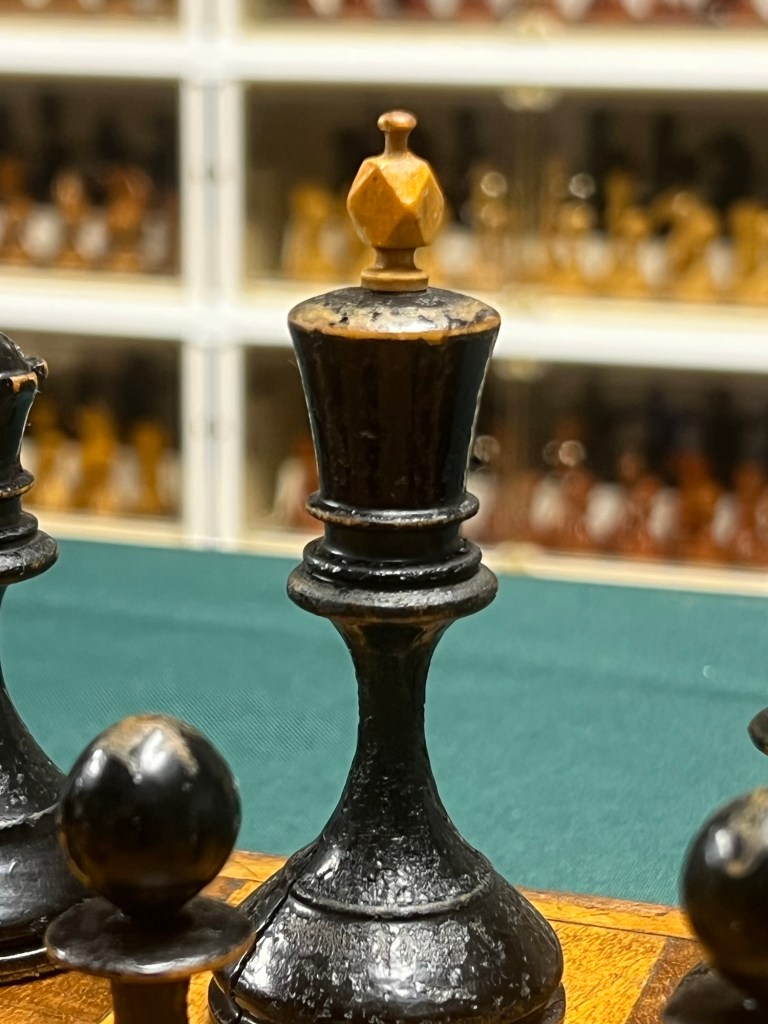
Diamond-shaped finial. Chuck Grau photo.

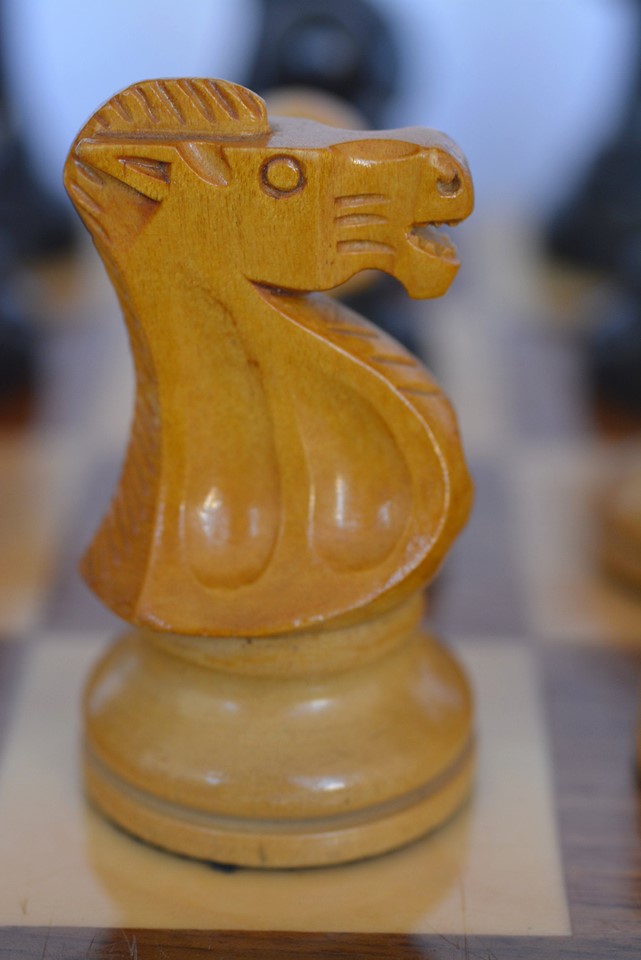
The Knight carving is spectacular, the best of any of my Soviet sets and even better than my best Tsarist ones. Highly detailed mane carvings on both sides of the torso. Crisp mouth and eye details. Just spectacular.

Chuck Grau Photo.

The style is of the group of sets commonly but not unreasonably mistaken for the 1933 Botvinnik Flohr match. I included pictures of several of these sets in my article on the 1933 set.
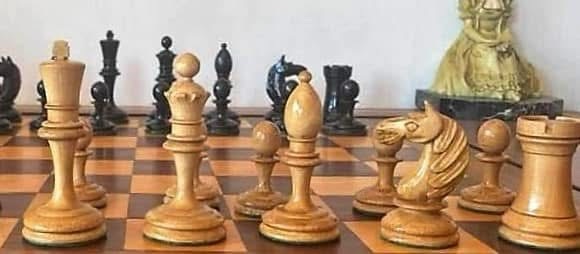
Antonio Fabiano Collection, photo.
Stephen Kong Collection, photo.
Murat Dzhemakulov Collection.

Shane Chateauneuf recently acquired a beautiful, related set.
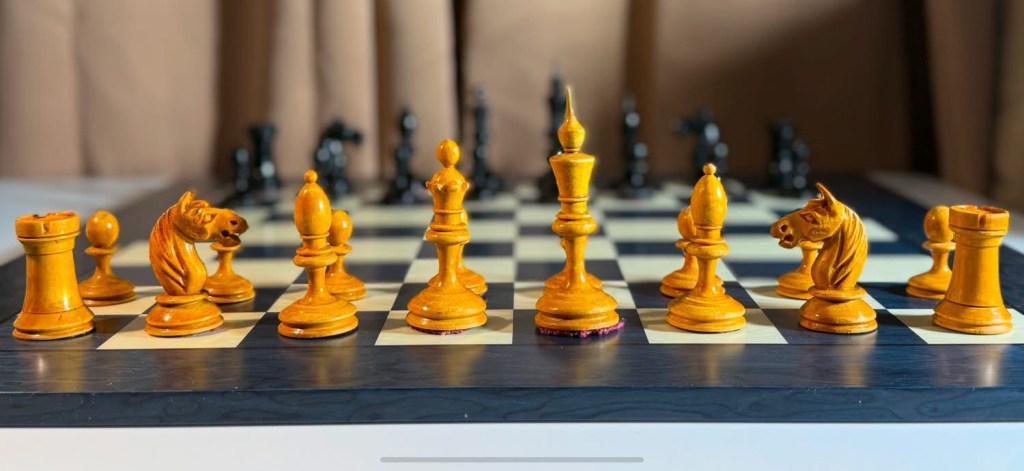
Shane Chateauneuf Collection, photo.

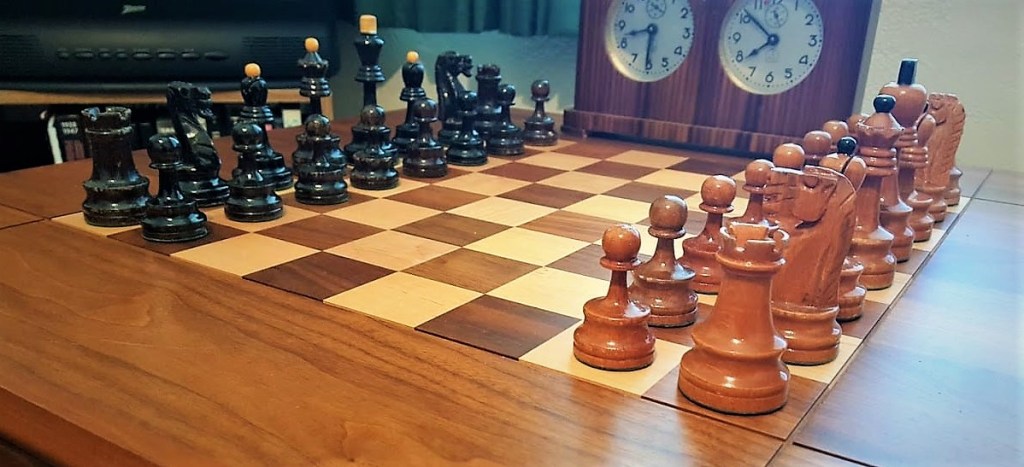
The board accompanying my set is wonderful in its own right. Beautiful veneer worn consistent with its age. Gorgeous patina. 53 mm squares are perfectly sized for the pieces, very un-Soviet. None of the asphyxiation that Arlindo Vieira repeatedly complained of. This is perhaps another factor hinting that the set may be much older than 1937.
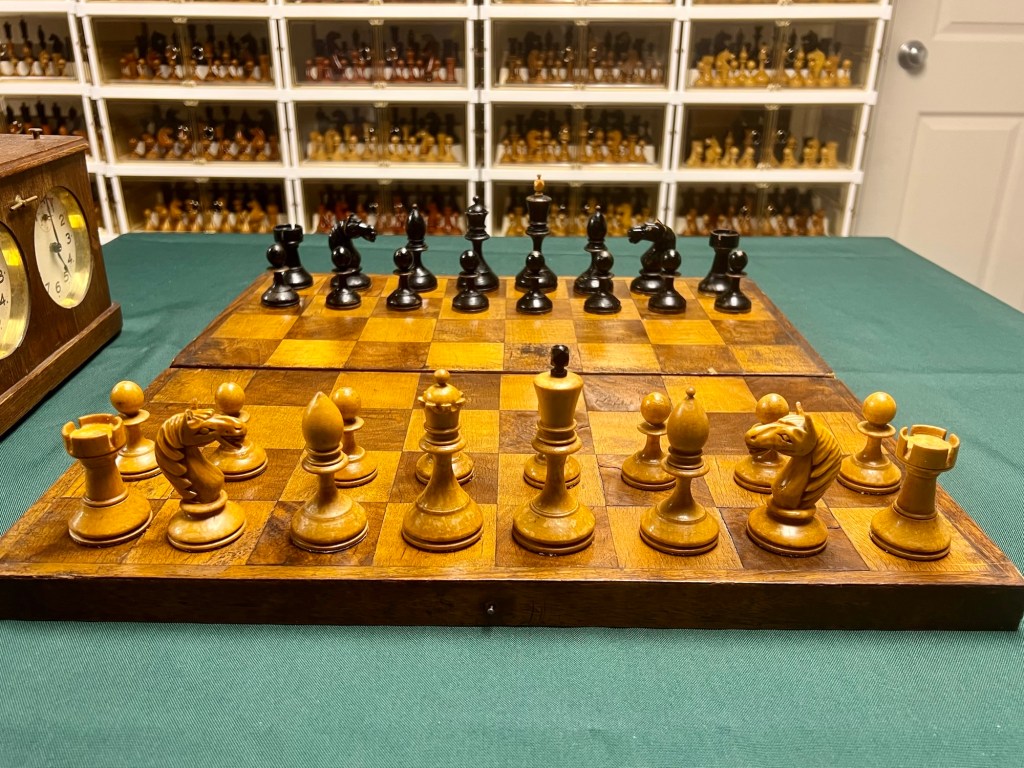
Chuck Grau photo.

Simply a gem.

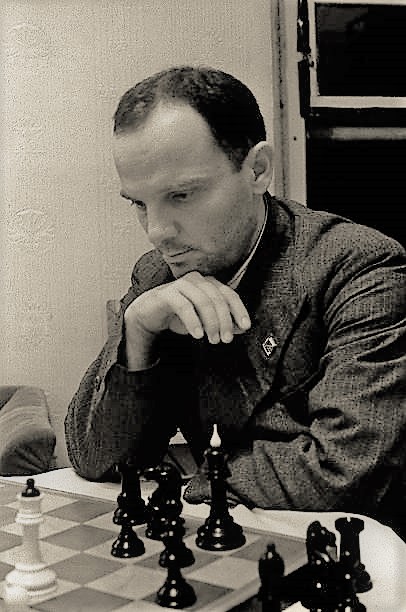
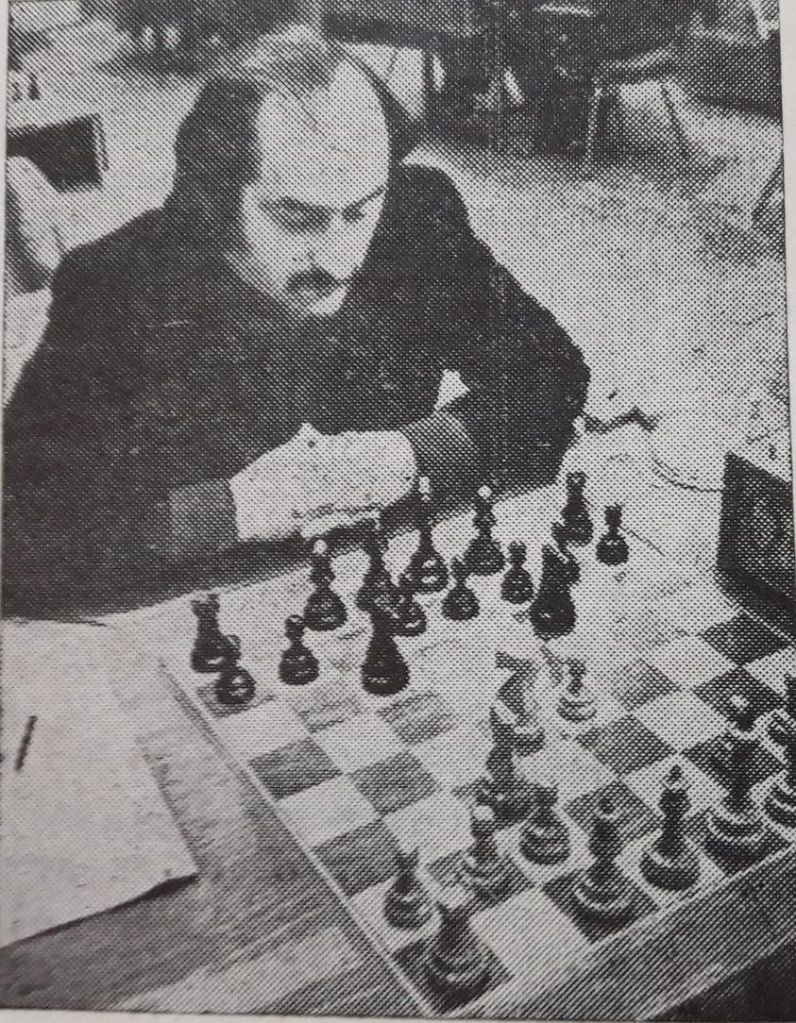
Ilyan Lvovich Maizelis

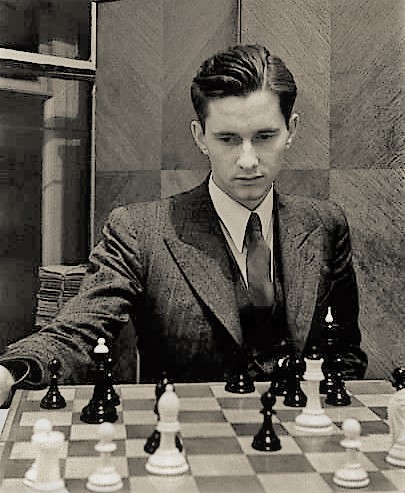
Ilya Lvovich Maizelis

A close friend of Yuri Averbakh, Maizelis was a noted teacher and author, even outside the Soviet Union. No less than Bobby Fischer studied his work.

Courtesy of Jorge Njegovic Drndak

Soviet chess historian Jorge Njegovic Drndak has compiled this brief biography:

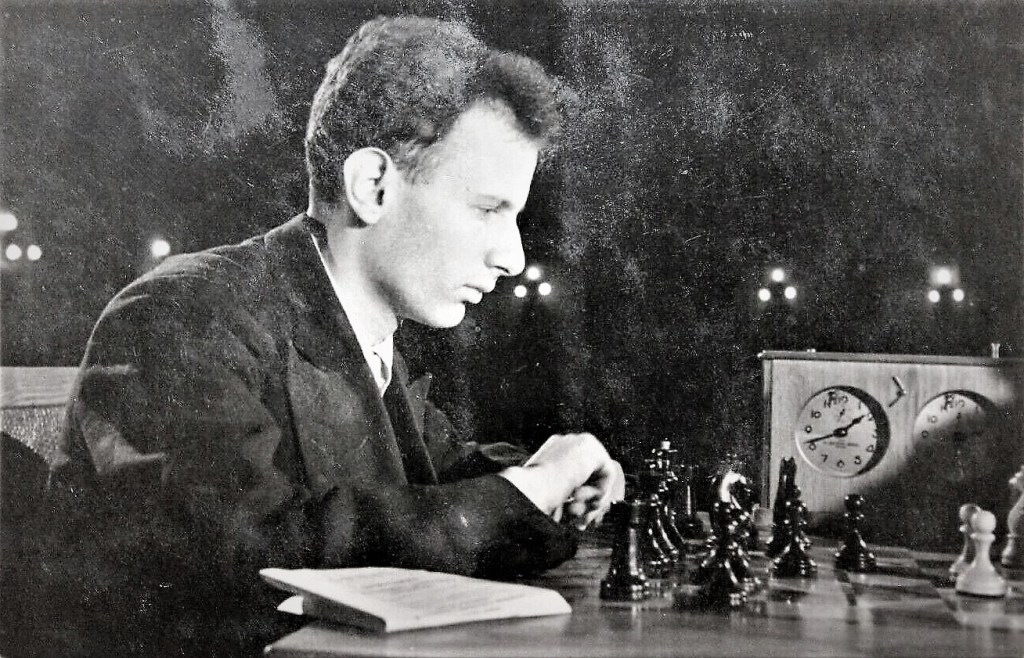
Ilya Lvovich Maizelis (1894-1978)

He was born on December 28, 1894 in Uman, a small village in the Cherkasy region. Having passed college in Ukraine, Ilya won the Union-wide Tournament of Cities in 1924 (a parallel tournament). Once in Moscow, Maizelis quickly joined the chess movement and became one of its most prominent figures.

Having started working as a chess journalist, Maizelis covered the Alekhine-Teichmann match (Berlin, 1921), at that time Alexander Alexandrovich’s name was not yet animated in his homeland. Ended with a score of 3:3.

Ilya Maizelis was close friends with Emanuel Lasker. It was he who during the Moscow International Tournament (1925) handed the great thinker a telegram saying that the work of the second world champion would be staged. The played Lasker ended up getting the foot of the “mill” in the match against Torre, but consoled the young man, who at first considered himself responsible for this defeat of the great chess player.

Maizelis was one of those who convinced Emanuel to move to the USSR, take Soviet citizenship and train for the national team. Shortly before leaving for America, Lasker handed the journalist the manuscript of his children’s book. Ilya’s friend Alexander Ilyin-Zhenevsky believed it was Maizelis’ duty to publish the book, but the work “How Victor Became a Chess Master” was only published in the 1970s.

Ilya Maizelis is a member of the editorial board of the magazine “64”. “Checkers and Chess in a Workers’ Club” (1925-1930), executive secretary of the publication “Soviet Chess Chronicle” (1943-1946), published in English in Moscow under the auspices of the Union Society for Cultural Relations (VOKS). He trained at the Pioneers House of the capital, but at the same time, until the late 1930s, he did not stop the practical performances, performed regularly at the finals of the Moscow championships. In 1932, Ilya Lvovich took fourth place in the championship of the capital and, of course, played in the strength of the master, but did not officially fulfill the title, opting for journalism.

Author of the books “Beginner Chess Player”, “Chess Yearbook 1937-1938”, “Fundamentals of Opening Strategy”, “For 4th Chess Players”. a and 3. “under category”, “Selected games of Soviet and International Tournaments of 1946”, “Chess Textbook Games”, “Tower vs Pawns”, “On the Theory of Tower End”, “Chess Finals. Pawns, Bishops, Horses” edited by Y. Averbakh, “chess. Fundamentals of Theory. Ilya Maizelis translated from German the books “Endgame Theory and Practice” by Johann Berger and “My System” by Aron Nimzowitsch.

With his article, he was the first in the USSR to draw attention to the 1603 painting “Ben Johnson and William Shakespeare,” attributed to Karel van Mander and depicts 17th-century English playwright playing chess. Ilya Lvovich studied the works of the poets Henry Longfellow and Heinrich Hein, translated their works into English and German.

Ilya Maizelis has compiled a chess library that is widely known not only in Moscow and the USSR, but also abroad.

“Everyone knows that Maizelis had the best chess library in Moscow and was often asked to clear up something from an old magazine or a rare book. There was a phone in the room and Ilya Lvovich used to dictate chess and variation games for a long time. Maizelis’ mother-in-law was always in the room, paralyzed and completely indifferent to everything that was going on. He sat like an idol and stared at one point.. And Maizelis, dictating movements, did not say “a-be”, like everyone else, but in a low voice – “a-be”. And then, one day, the mother-in-law, who was apparently tired of this hug to hell, said sadly, “Abe, abe… Fucking idiots! ” (J. Neishstadt).

Shortly before his death, Ilya Lvovich sold the library to good hands to preserve it for posterity. The master of Russian chess journalism passed away on December 23, 1978 in Moscow.

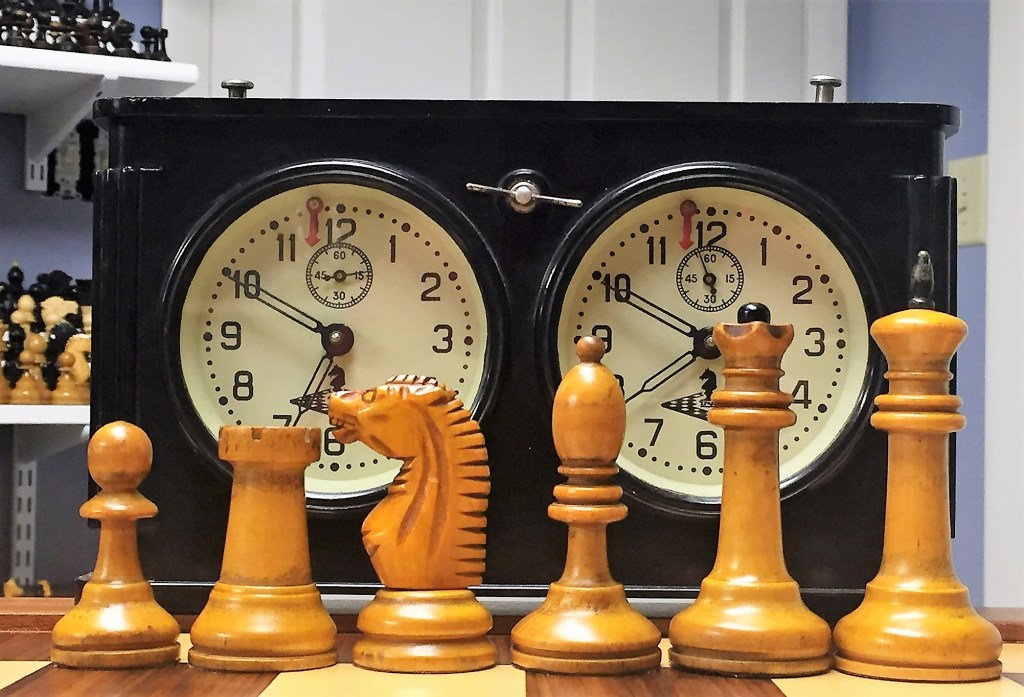
Late 1930s Grandmaster Set: A Return to the Staunton Style

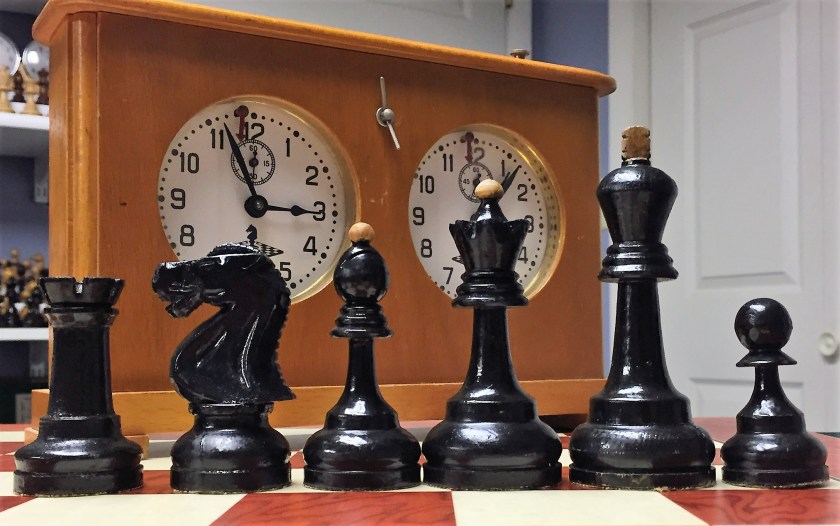
This beautiful set is named and dated by Kyiv collector and dealer Nikolay Filatov. The 110 mm kings, heavy weighting, and superior craftsmanship all mark this as a set used at the very highest levels of Soviet chess and thereby worthy of the Grandmaster name, even though I have not been able to find it in the photographic record. The lead weighting is similar to that of other tournament sets of the 1930s, a practice that ended with the outbreak of war as metal was allocated to military production. And the knight is carved in detail not found in wartime or post-war knights.

Late 1930s Grandmaster Set. Chuck Grau Collection, photo.

Breaking from the Modernist influences found in other sets of the thirties, these pieces hearken back to the Stauntonesque Karelian Birch sets of the late Tsarist period, notably in the crowns of the royals and the incorporation of more traditional English Staunton elements. These include the triple collars, the stepped up bases, the proportions of the base to stem to piece identifiers, the relative proportions of the pieces to each other, and the columnesque shapes of the stems bases.

Late 1930s Grandmaster Set. Chuck Grau Collection, photo.

The Late 1930s Grandmaster pieces resemble their contemporaries, the 1930s-40s Bakelite and Carbolite pieces made famous in a photo shoot at the 1940 USSR Championship. Interestingly, the rooks of each set find a large hole bored or molded into the top of their turrets.

The Late 1930s Grandmaster pieces are also similar in structure to tournament sets we know to be from the early forties, particularly their collar and crown patterns and proportions.

Finally, the Late 1930s Grandmaster pieces foreshadow Soviet Staunton designs that rose to the heights of Soviet Chess in the late forties and the fifties, the Tal sets, the Grandmaster 3 (and “Supreme”) sets, and the last of the Soviet Grandmaster sets, the GM 4.

Conclusion

Although the Late 1930s GM pieces are scarce if even present in the photographic record, they are significant in their high quality, their detailed knights, their rejection of Modernist influences, and their embrace of Staunton architecture, part of the Counterrevolution in Style we already have discussed.

The 1940 Soviet Staunton: A Counterrevolution in Style

In our examination of the Botvinnik-Flohr II, Smyslov, Cannon Rook, and other Soviet sets of the 1930s, we have seen how the revolutionary precepts of Soviet Constructivism and modernism influenced chess set design in the Soviet Union. We also have examined two designs comprising traditional Staunton elements, the Tal set, which first appeared in Estonia in 1940, and the Grandmaster 3 set, which first appeared in Moscow in 1950. These elements include the straight ascension of the stems; the distinct breaks between base, stem, and pedestals; the step-up from base to stem; the triple collars; the cross atop the king’s crown; the crenels in the queen’s coronet; the bishops’ miter cuts; the merlons of the rooks’ towers; the pieces arrayed mirroring the columns and pediment of classical Greek architecture; and the S-shaped backs of the knights. We have called the latter two sets Soviet Stauntons. The sets’ Soviet identity is largely cosmetic, consisting of opposite-colored finials and the vestigial nature of the king’s cross.

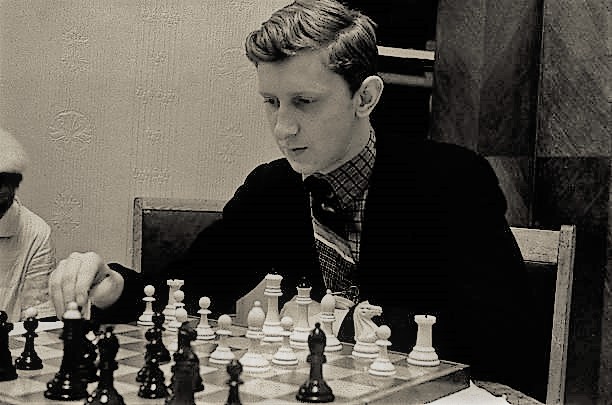
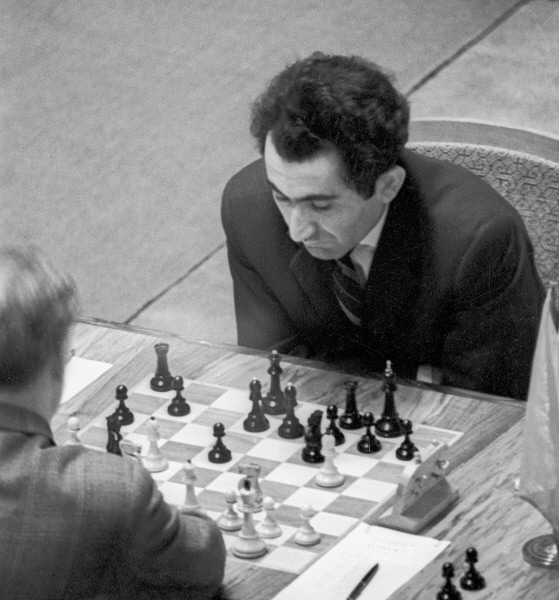
V. Smyslov, Moscow 1940. A. Yegorov, Sovfoto photograph.

Socialist Realism and Stalinist Empire Architecture

Even as Soviet chess set design saw an explosion of creative expression during the 1930s, heavily influenced by modernist concepts, a major counterrevolution in design took seed. Asserting control over art was one component of Stalin’s brutal consolidation of power from the death of Lenin to the beginning of the Great Patriotic War against Nazi Germany. Key to this was the official disbanding of all existing literary and arts organizations in 1932, their replacement with state-sanctioned and -controlled artist unions, and the formal adoption of Socialist Realism as the only acceptable theory of art by Communist Party Central Committee and the Congress of Soviet Writers in 1934. In his address to that Congress, Maxim Gorky declared that Socialist Realist art must be proletarian; it must be typical, addressing the everyday lives of the Soviet people; it must be Realist in style; and it must be partisan, actively promoting the aims of the Soviet state. For Stalin, Socialist Realism meant that art must offer unambiguously positive images of life in the Soviet Union, in a ‘true-to-life’ visual style that the masses could readily digest. The Art Story, accessed 18 May 2022.

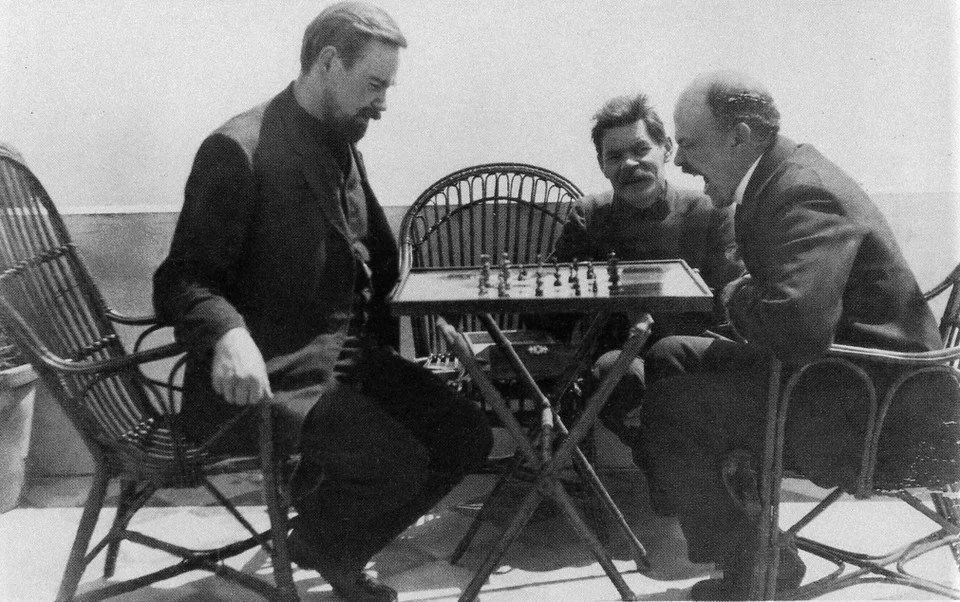
Maxim Gorky watching Lenin and Alexander Bogdanov play chess. Photographer unknown.

Socialist Realism turned Soviet architecture away from the Constructivist influences of Vladimir Tatlin and El Lissitzky and others and towards the Neoclassical influences of the likes of Ivan Fomin, Ilya Golosov, and Vladimir Vladimirov. Id. According to Russian art historians Kristina Krasnyanskaya and Alexander Semenov, the 1930s to mid-1940s saw a shift in architecture and furniture design to Art Deco and Soviet Neoclassicism, often described as Stalinsky Ampir or Stalinist Empire Style, which embraced a return to decor and classical forms. Soviet Design, From Constructivism to Modernism 1920-1980 194 (2020). In the words of Christina Lodder, “During the Stalinist era and particularly in the years just before and after the Second World War, Soviet architects and designers tended to turn their backs on avant-garde approaches and produce furniture and buildings that sought to evoke an immutable classical elegance and a timeless quality in the solidity of their materials, their historical allusions and their ornate forms.” Id. at 11-12. The purpose of this approach, Latvian lawyer Augustinas Žemaitis explains, is that “Stalin sought to make Soviet cities look grander than those of the empires gone-by and perhaps comparable to the US cities. The details inspired by previous styles (columns, towers, etc.) returned even on simple buildings such as apartment blocks.”

A good example of Stalinist Empire Style, in which the Neoclassical influences are evident, are the structures VDNKh, or the Exhibition of Achievements of the National Economy, located in Moscow and dating back to 1939. The entire VDNKh complex includes columned porticos, pediments, domes and lavish sculptural adornments “reminiscent of ancient temples and palaces.” Nataliya Kuznetsova, Stalinist Empire Style in Moscow, accessed 19 May 2022.

Bolshevik Constructivism had sought new forms to forge a new Socialist Society. Stalin’s Socialist Realism sought to prove that his brand of statism met or exceeded the West by adopting the West’s own forms. With Stalin forcibly eliminating his domestic enemies, real and imagined, it should come as no surprise that Soviet chess set designers from the mid-thirties to the rise of Nikita Khrushchev would begin to embrace Staunton chess set designs, which embodied the same Neoclassical design elements that Stalinist Empire Style employed to symbolize the success of the Soviet Union. It likely also offered them a very real form of personal and employment security.

Bakelite Version

The late 1930s saw the introduction of a Soviet tournament chess set unique in three respects. First, it was unabashedly Staunton in its design. Second, its knights copied the Elgin Marble design of the British Jaques knights. Third, it was made of Bakelite, an early phenol-formaldehyde plastic that was moldable.

Late 1930s Bakelite Soviet Staunton. Chuck Grau Collection, photo.

This Soviet Staunton is a large set, with kings 110 mm tall. It is also heavy despite being unweighted owing to the density of the Bakelite. Its beauty, size and weight mark it as intended for high level tournament play, and the photographic record of later Carbolite versions of the design confirm this.

The moldable nature of Bakelite promised to provide a set that could be easily reproduced and did not involve the labor required to hand carve each and every knight, particularly one so handsome and detailed as this one. Bakelite was hard but brittle, and therefore relied on fillers to give it structural strength. The need to hide the filler led to it appearing primarily in dark colors, typically black and dark maroon in chess sets and other consumer products.

1940 Carbolite Version

The design was made famous by a photo shoot taken at the 1940 Soviet Championship, which was held in Moscow, and therefore is often referred to as the “1940 Championship Club” set. The Smyslov photo as the top of this post is one of those photos. Here are several others.

V. A. Makogonov. 1940 Moscow. A. Yegorov, Sovfoto photograph.
Paul Keres. Moscow 1940. A. Yegorov, Sovfoto photograph.

The pieces actually used in the championship, however, were BFIIs, as photographs of the tournament itself establish.

Isaac Boleslavsky. 1940 USSR Championship. The set is clearly a Botvinnik-Flohr II design. Russian Chess Federation photo.

The black and white version of this Soviet Staunton was molded of a different plastic that the Soviets called Carbolite. Like Bakelite, Carbolite is also a moldable phenol formaldehyde resin, developed to transcend the brittleness of Bakelite and obviate the need for fillers and dark colors to mask them. It differs chemically from Bakelite in that it is made from an acidic solution, whereas Bakelite is made from a basic solution. Carbolite was initially developed by the Karpov Scientific and Research Institute of Physical Chemistry in Moscow. J. Crowther, Science in Soviet Russia 67 (1930). The sets likely were made at Karbolit Zavod (Carbolite Plant) in Orekhovo-Zuyev outside Moscow. I believe the Bakelite version of this Staunton design came first because Bakelite preceded Carbolite, but there is also reason to believe that Bakelite versions continued to be made even after the introduction of the Carbolite version.
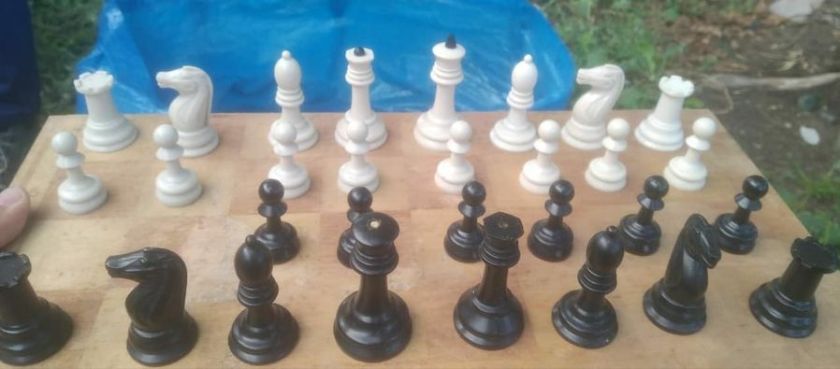
Here is a beautiful specimen of a Carbolite 1940 Soviet Staunton from the collection of Ron Harrison.

c. 1940 Carbolite Soviet Staunton. Ron Harrison Collection, photo.

Legend has it that the Carbolite chessmen of the 1940 photos were used in the Moscow Chess Club, but I am unaware of any firm evidence supporting that. The legend has the benefit of at least being consistent with known facts in that it first appeared in Moscow and was considered to be an important design. Perhaps the photo shoot was intended to showcase a practical and beautiful application of the Karpov Institute’s research.

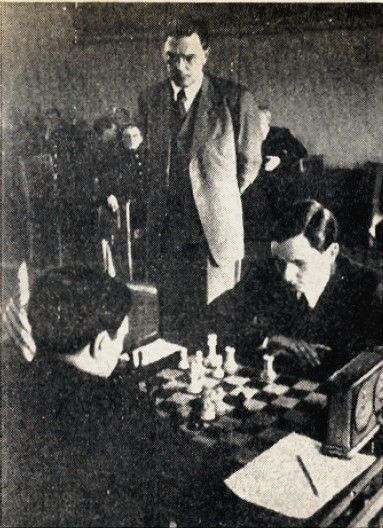
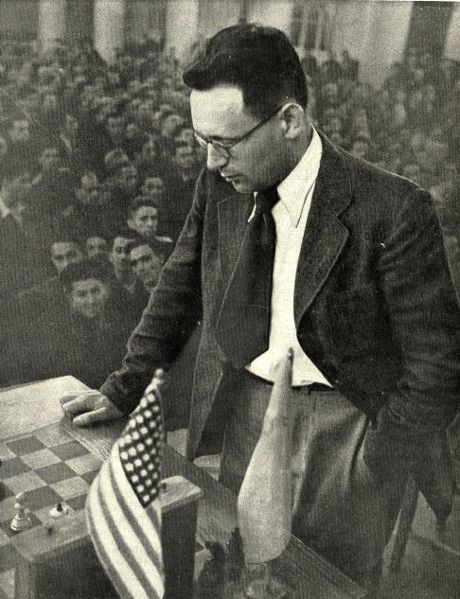
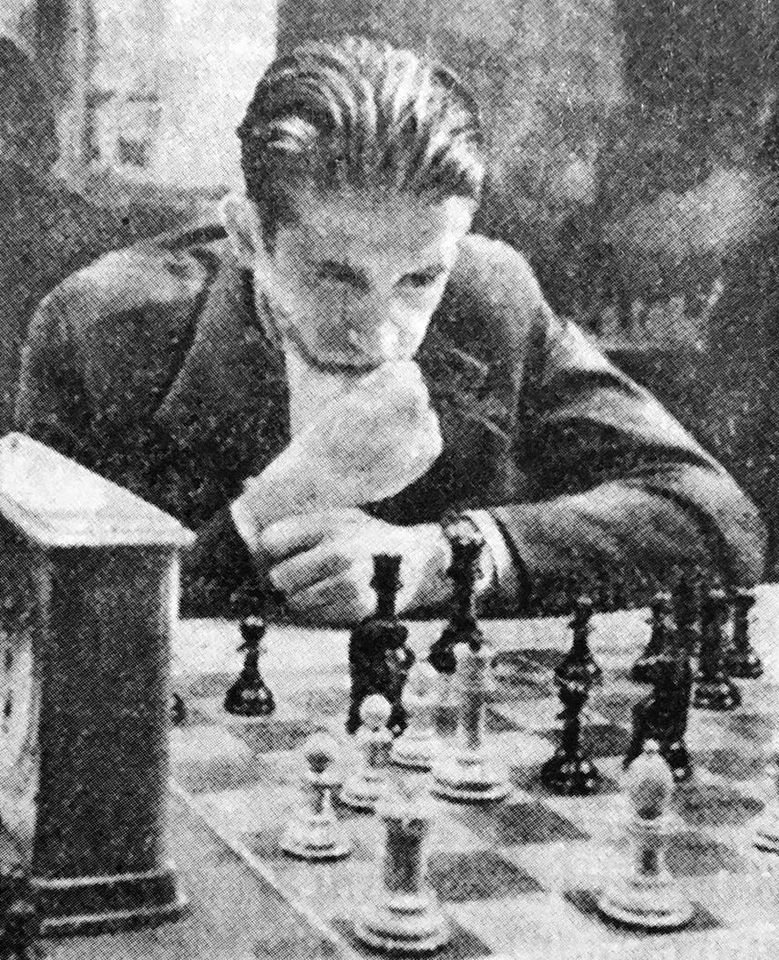
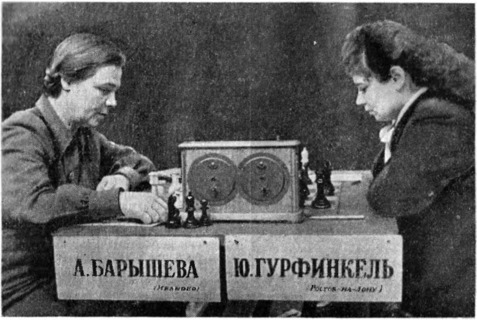
The Carbolite set appears to have been used in the 1946 US-USSR Match, the 1947 USSR Championship Semifinals, the 1948 USSR Men’s and Women’s Championship, and other events.

Keres (R) vs. Fine, 1946 US-USSR Match, held in Moscow. 1-0. Max Euwe, chief arbiter. Photographer unknown.
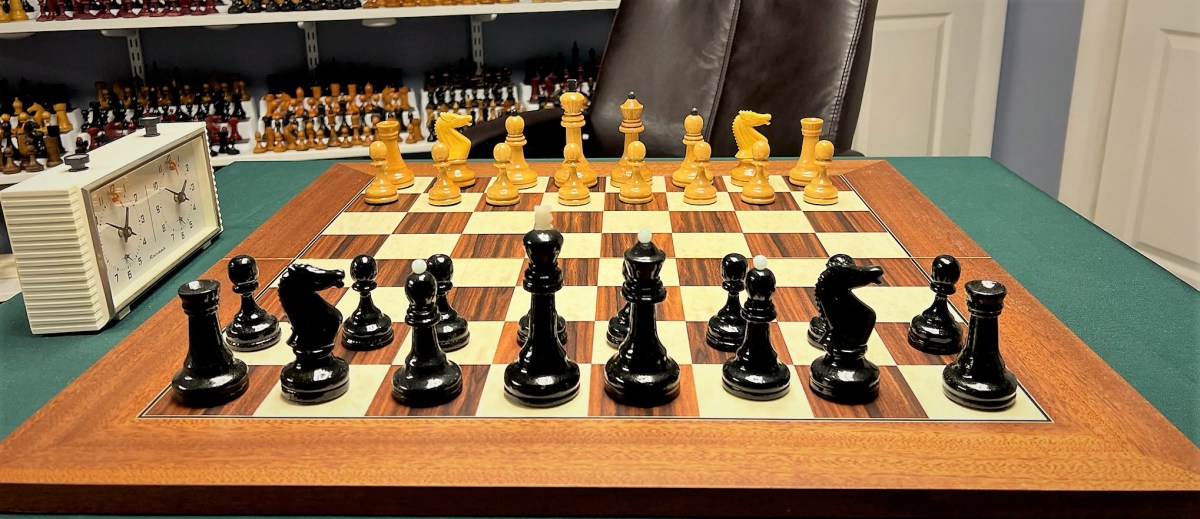
Mikhail Botvinnik, 1946 US-USSR Match, Moscow. Photographer unknown.
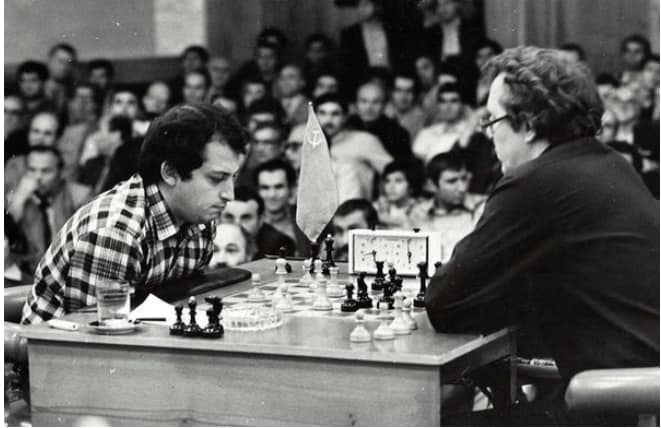
Simagin vs. Kholmov 1947 USSR Championship Semifinals, Moscow. 1-0. Photo courtesy of Jorge Njegovic Drndak. Photographer unknown.
Furman vs. Averbakh (1-0), 1948 USSR Championship, Moscow. Photograph courtesy of Eduardo Bauza. Photographer unknown.
Anna Barysheva vs. Yuzefa Gurfinkel. 1948 USSR Women’s Championship, Moscow. Photograph courtesy of Jorge Njegovic Drndak. Photographer unknown.
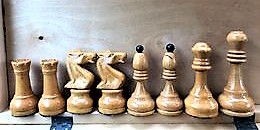
1950s Carbolite Version

The Carbolite version of this Soviet Staunton continued to be produced in the 1950s. Here are pieces from the set in my collection.

1950s Carbolite Soviet Stanton. Chuck Grau Collection, photo.

I believe these pieces to be from the fifties, owing to the yellowish cast of the white Carbolite, the red plastic finials of the Black royals, and the obvious casting seams, which suggest the decline in attention to detail that began to creep into post-war production. The castings of my Bakelite specimen and this Carbolite version are virtually identical, though great care was taken to file down the casting seams of the Bakelite pieces. The most noticeable structural difference between the two versions is there is an additional beveled level at the bottom of the Bakelite pieces, giving them a slight height “advantage” over these Carbolite pieces. These Carbolite kings are 108mm. As with their Bakelite comrades, these pieces are heavy despite being unweighted.

Miniature Versions

Both plastics were used to manufacture miniature versions of this Soviet Staunton design.

Late 1930s-1950s Miniature Bakelite Soviet Staunton Pieces. Nikolay Filatov photo.

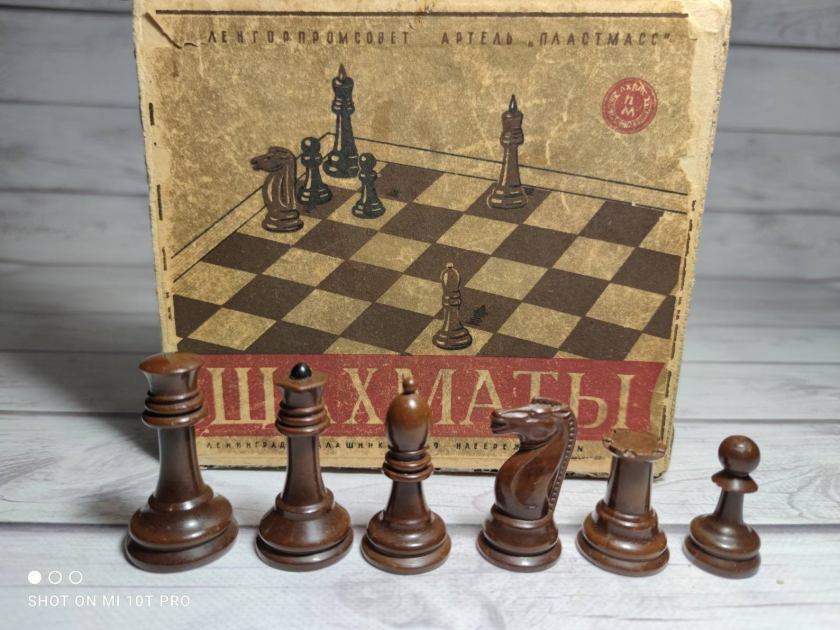
These pieces were manufactured by Artel Plastmass (артель “Пластмасс”) in Leningrad. According to Russian collector Sergey Kovalenko, one of the plants of the artel “Mineral” was reorganized into the Artel Plastmass around 1937. Sergey tells us that the most famous products of these artels were gramophone records and dominoes. The kings are approximately 70 mm and the pieces are not weighted.

Possibly 1950s Miniature Carbolite Soviet Staunton Pieces. Nikolay Filatov photo.

Conclusion

By incorporating the Neoclassical architecture of the traditional Staunton design, the Bakelite and Carbolite Soviet Staunton sets of the late 1930s, 40s, and 50s rejected the Constructivist and Modernist design influences of the 1920s and 30s, instead embracing Socialist Realism, the Soviet state’s official theory of art as of 1934. In doing so the sets symbolized the arrival of Soviet Chess to the pinnacle of the sport, much as Stalinist Empire architecture signaled the Soviet Union’s arrival as a great empire.

Four Styles of Grandmaster Chess Sets: GM4 Pieces

Grandmaster 4 chessmen are the final evolution of the GM3 sets that first appeared around 1950, the end of the line for an august design. Recognizing them to be descendants of the GM3 design, Arlindo Vieira wrote that the GM4 pieces were “the last version of this competitive set.” They represent the further simplification of the GM3 design in the interest of increasing production and reducing cost through factory production and the substitution of plastic parts for carved ones.

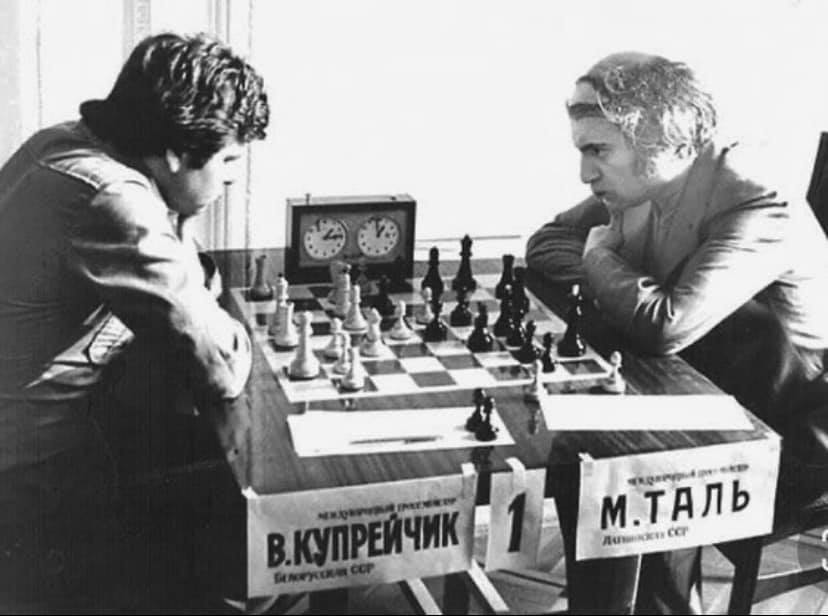
Tal glaring at Viktor Kupreichik over GM4 pieces, 1981 Soviet Team Championship. 0-1. Photographer unknown.
Arshak Petrosian-Vitaly Tseshkovsky, Yerevan 1984. GM4 Pieces. Photographer unknown.

GM4 sets were produced from the 1970s to the 1990s. They appeared in a number of variants, perhaps, as Moscow collector Alexander Chelnokov has suggested, because they were made in multiple factories which each had a slightly different take on the stylistic details. Some retained vestigial rook merlons, queen crenels, and miter cuts. All had plastic knight heads and finials. All retained the basic Staunton architecture of the GM3 design while discarding some or most of its details.

Alexander Beliavsky with GM4 pieces. Date and photographer unknown.

Here are three GM4 variants that retained vestigial cuts, crenels, and merlons. The first eliminated the miter cuts; the second and third variants retained crude ones.

Mike Ladzinski Collection, photo.
Alexander Chelnokov Collection, photo.

The next variant was known to Soviets as the Champion set, according to St. Petersburg collector Sergey Kovalenko. Sergey tells us that the Champion set was produced by Voenohot Factory No. 2, as were the GM4 set below, Yunost, Voronezh, and other GM3 sets. I include it within the GM4 category because it retains the general Staunton architecture of the GM3 sets, but with the plastic knight heads and diminished detail and quality of the GM4 sets.

GM4 Champion Pieces from Voenohot Factory No. 2. Chuck Grau Collection, photo.

The kings in this set are 104 mm tall. The pieces are unweighted, and the finish crude and badly in need of sanding. The finials are all plastic. The king’s crown is topped with a peg, rather than the vestigial cross found in other GM3 and GM4 sets.

From a design perspective, the pieces are Soviet Stauntons within the broad GM3/GM4 family, but with Soviet-styled, CV-shaped knights more like those found in the Yunost, Voronezh, and some sets of the forties and fifties, than the Stauntonesque, S-shaped knights of the GM3 and other GM4 sets. Like other GM4 sets, the knights have plastic heads and torsos. Like GM3 sets, the rooks have merlon cuts, the bishops miter cuts, and the queens shallow, scalloped cuts on their coronets. The miter cuts are asymmetrical like those in late model, mass-produced GM3 sets. Unlike GM3 sets, the merlon and coronet cuts are vestigial. The collars are irregular and unevenly and nondescriptly turned.

Below are GM4 pieces from my collection that were produced by Voenohot Factory No. 2 near Moscow, as revealed by their original cardboard box.

Chuck Grau Collection, photo.

Gone from this set are the queen’s crenels, the bishop’s miter cut, and the rook’s merlons found in the GM3 design. All the crosses, finials, and knight heads are plastic. The set’s kings are 108 mm tall. The pieces are nicely weighted. The bottoms are covered with leatherette pads, some of which on this specimen have slightly buckled. Arlindo Vieira described the GM4 as “elegant and playable.” I quite agree, despite their simplifications.

GM4 sets were used in the 1994 Moscow Olympiad. Vieira rightly criticizes the organizers for providing boards that cramped the pieces and garish tablecloths on the playing tables “made players crazy.” Here is a screenshot of a wonderful YouTube video of the game Korchnoi-Yusupov from that event.

Korchnoi-Yusopov, Moscow 1994, with GM4 pieces, likely the Voenohot version.

The mass production of GM4s meant there were plenty of them with which to play simultaneous exhibitions with them. Here are Kasparov and Smyslov doing just that.

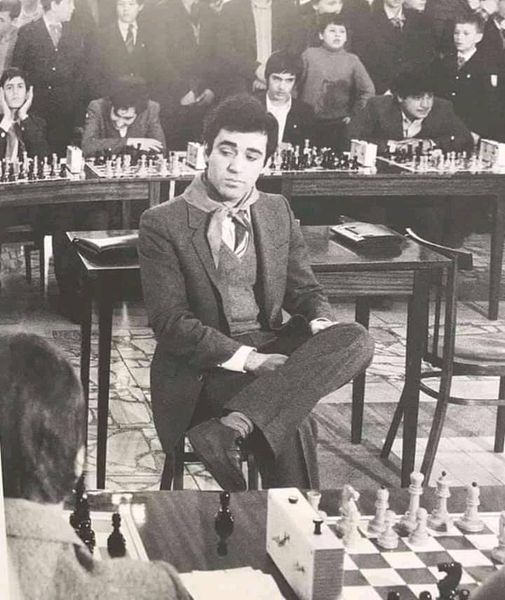
Kasparov simultaneous exhibition. Undated. Photographer unknown.
Smyslov simultaneous exhibition. Moscow 1989. I. Utkin/TASS photo.

Conclusion

The GM4 sets were the culmination of the evolution–or devolution–of the venerable Grandmaster 3 line. While the GM3 design was simplified and cheapened by the GM4’s elimination of details and its replacement of wooden parts with plastic ones, the Grandmaster 4 retained much of the original design’s basic elegance and remained a very playable set.

Four Styles of Grandmaster Chess Sets: The GM3 Design

Around 1950, a new Soviet Staunton design appeared. In its highest forms, it was used in multiple Soviet Championships and several intra Soviet World Championships over the next four decades. It was also used in lower tournaments, and in its most simplified forms mass-produced. Arlindo Vieira called these Grandmaster 3 sets, and one of the last versions the Grandmaster 4 pieces.

K. Isakov and E. Strelkov dated 1950, but unconfirmed. Event and photographer unknown.

GM3s are a markedly different design from that of the GM1s and GM2s, both of which are typically Soviet designs. Like the Tal pieces, GM3 pieces are much more traditionally Staunton, down to the straight ascension of the stems, the distinct breaks between base, stem, and pedestals, the triple collars, the vestigial cross atop the king’s crown, the crenels in the queen’s coronet, the bishops’ miter cuts, the merlons of the rooks’ towers, and the S-shaped backs characteristic of Staunton knights.

Here are GM3 pieces that I believe perhaps to be the earliest version, circa 1950, and similar to those in the Isakov photo.

c. 1950 GM3 Pieces. Chuck Grau Collection, photo.

This set is well-made, the knight’s chest has three dimples, and the rook’s tower and merlons are thin. The knight leans forward, with its snout protruding past its belly. The original finish (shown) was a detestably sticky water-based varnish that Alan Power of the Chess Schach has replaced while maintaining the set’s patina and wear. Kyiv collector and dealer Nikolay Filatov has called this variant the “Super GM” set, and I’ve adopted his usage. The kings are 120 mm and the pieces are weighted.

Kotop-Novotleno, 1951 USSR Championship. GM3 pieces. Photographer unknown.

Championship Pieces: Grandmaster Supremes

The pieces used in Soviet and intra-Soviet World Championships typically were of noticeably higher quality turning, carving, and finishing than the versions usually available to collectors. Some collectors began calling these Championship versions of the GM3 design Grandmaster Supremes to reflect their superior quality. Tal and Botvinnik played their 1960 and 1961 World Championship matches with GM Supreme pieces.

Botvinnik and Tal, 1961 World Championship match. Tass photo.

Botvinnik and Petrosian also played their 1963 World Championship match with GM Supreme chessmen.

Botvinnik and Petrosian, 1963 World Championship match. I. Novosti Press photo.

GM Supreme pieces were used regularly in Soviet Chess Championships after 1950, displacing the Botvinnik-Flohr II pieces that previously had served as the preeminent pieces of Soviet Championships. Whereas the BFII was predominantly a Soviet design, the GM Supreme set, like the Tal set, was a predominantly Staunton design dressed up in Soviet lipstick, namely the vestigial nature of the king’s cross and the opposite colored finials. For this reason I use the term Soviet Staunton to describe them. This displacement ironically reflects the triumph of Stalin’s Socialist Realism over the Bolshevik Constructivism and modernism in the design of tournament chess pieces, a matter I will examine in a future article. Here is a photo of GM Supreme pieces in use at the 1973 Soviet Championship.

Polugavesky and Karpov, 1973 USSR Championship. Novosti Press photo.

These magnificent sets were few in number, and are exceedingly rare. I know of only one complete set in the possession of a collector, and another partial set owned by a Ukrainian chess artisan and vendor. Here is a photo of the complete set.

Antonio Fabiano Collection, Nick Filatov photo.

While they exhibit variations over the many years they served in Soviet Championships, Grandmaster Supreme sets are distinguished from regular GM3 sets by a number of characteristics. They are better made and finished. Their knights appear Lardyesque, squarish in shape, with the nose never protruding beyond the belly, and with three dimples carved in the belly. The rooks have generally thinner towers and thinner merlons.

Side profile of GM Supreme knight. Antonio Fabiano Collection, photo.

Regular GM3 Sets of the 1950s and Early 1960s

GM3 sets of the 1950s and early 1960s saw minor variations in knight carvings, the shape of the bishops’ miters, finishes, and felting, but which variations occurred when or where are largely unknown. Here are several specimens of that period from my collection.

1950s Grandmaster 3 Pieces. 112 mm kings. Heavily weighted. Original sand-colored cloth bottoms. Chuck Grau Collection, photo.
1950s-60s Grandmaster 3 Pieces. 112 mm kings. Heavily weighted. Original blue felt-like cloth bottoms. Chuck Grau Collection, photo.

Here are GM3 chess pieces being used in the 1952 Ukrainian Championship, held in Kyiv.

Kiev 1952. Photo courtesy of Jorge Njegovic Drndak. Photographer unknown.

Regional Variations: Estonian and Georgian Sets

The photographic record reveals unique variations of the GM3 design in use in Estonia and Georgia SSRs. American collector Ron Harrison has specimens of each in his collection. Here is a photo of Ron’s Estonian Super GM3.

c. 1970 Estonian “Super” Grandmaster 3 Pieces. Ron Harrison Collection, photo.

My basis for dating Ron’s set is the photographic record that he has compiled and posted in Shakhmatnyye Kollektsionery. I refer to it as a Estonian because it appears prominently in photos of events there, not because of any direct evidence that it was produced there. I think it’s worthy of a specific designation because of the unique drop-jaw, “goateed” knight, which distinguishes it from other GM3s.

Estonian great Paul Keres with the Estonian GM3.

I refrain from classifying this set as a GM Supreme because it lacks two of the criteria used to categorize sets with that designation. First, the knight’s snout cannot extend over the front of the belly. Second, the front bottom of the the knight’s belly must have three dimples, as in Jaques knights. Nevertheless, I am comfortable using Nikolay Filatov’s term “Super GM” to describe Ron’s set because it embodies some of the special characteristics of “GM Supreme” sets, notably its very high production quality.

Ron’s research also has brought us another beautiful GM3 variant used in the former Georgia SSR. This design was used in the 1978 USSR Championship held in Tbilisi, Georgia SSR.

Tamaz Vasilievich Georgadze, playing Black against Gennadij Timoscenko in the 46th USSR Championship, Tbilisi 1978. Their game can be found here. Photographer unknown.

This GM3 variant is distinguished by its tall, sharply tiered bases; deep, squared knight jaws; L-shaped knight spines; rimmed rook turrets; and narrow rook merlons. Here is a specimen from Ron Harrison’s collection.

Georgian GM3 chess pieces. Ron Harrison Collection, photo.

Khrushchyovka of the Chessboard: GM3 Pieces of the Late 1960s and Beyond

Khrushchyovka, literally Khru-slum, is a derogatory term for low-cost, concrete or brick apartment buildings constructed during the premiership of Nikita Khrushchev. To meet intense demand for chess sets, the GM3 design was simplified and incorporated molded finials, crosses, and knight heads to decrease production costs.

In Xadrez Memoria, Arlindo Vieira observed that the quality of the Grandmaster pieces degraded over time: “[T]he pieces lost quality from the oldest to the most recent ones, and when I say so, the photos prove it in the very simple question of manufacture: they lost detail, care in the details: look at the Towers, the Horses, in the Bishops and what I said ends up coming to the fore.”

Here is a set from my collection that dates from around 1970, which illustrates Arlindo’s points.

c. 1970 GM3 Pieces. Chuck Grau Collection, photo.

It is apparent that plastic finials and black knight heads have replaced wooden ones, with a degradation in attention to detail and quality in general, as seen in the asymmetrical miter cuts and inconsistent collar structures. American collector John Lawson describes the miter cut as a smirk. Still, the pieces are hefty, reasonably attractive, and comfortable to play with. The kings stand 112 mm tall. The pieces are nicely weighted and their bases are covered with original tan, felt-like cloth. They possibly were manufactured by Voenohot Factory No. 2 outside Moscow.
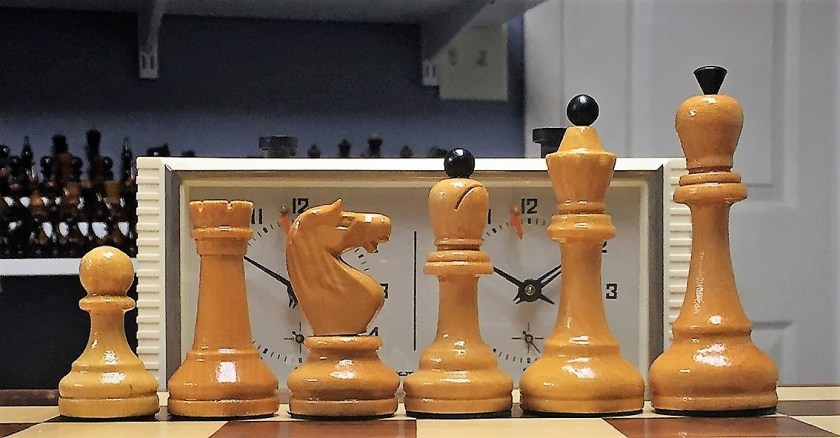
The degradation of the quality of GM3 sets continued through the end of production. We can get a sense of it by comparing three knights from GM3 sets in my collection, each more simplified and cruder than the one preceding it.

Conclusion

If Botvinnik-Flohr II sets were the workhorse of Soviet Chess before 1950, Grandmaster 3 sets pulled the plow thereafter. Grandmaster Supreme sets served in Soviet Championships and intra-Soviet World Championships, while other events used regular versions that varied across time and region. Over time, the quality of the sets generally degraded as they were simplified for mass production and cheapened for mass consumption. Ironically, the workhorse of Soviet chess for the last forty years of the Union’s life was not a true Soviet design at all, but a traditional Staunton design adorned with opposite-colored finials to give it a pinch of Soviet seasoning.

Next: GM4 Pieces–The End of the Line for the GM3 Design