Hardin’s Set

Andrei Nikolaevich Hardin (1842-1910) was a Russian lawyer and chess player. He was born and lived in Samara.

According to Alexandr Yanushvesky:

Andrei Nikolaevich Hardin was passionately fond of chess. He subscribed to a great deal of foreign chess literature and could sit alone at the board for hours. According to him, he learned to play well because, having found himself somewhere in the wilderness and having a lot of free time, he would sit for days reading chess literature and studying the theory of this game. For about a year or a little more, he did not play with anyone, and after this sitting, having met Chigorin, he showed himself to be a first-class player.

“Andrey Nikolaevich Hardin is the very first Samara extra chess player,” Learning and Playing Chess (26 September 2022), https://vk.com/@-198251430-hardin-andrei-nikolaevich-samyi-pervyi-samarskii-ekstra-sh

Hardin came to play correspondence chess with one Vladimir Ilych Lenin, who became Hardin’s law clerk when Lenin moved to Samara. They continued playing chess, with Samara giving Lenin various odds.

Two photos of Hardin taken with a chess set are known.

https://vk.com/@-198251430-hardin-andrei-nikolaevich-samyi-pervyi-samarskii-ekstra-sh

While Hardin’s garb suggests that these photos were taken at different times, they most certainly appear to feature the same set and the same location. Perhaps it was Hardin’s apartment in Samara, where he played Lenin. Indeed, it well may have been the very set that he and Lenin played with.

The building in Samara housing Hardin’s apartment, where he played chess with Lenin. https://vk.com/@-198251430-hardin-andrei-nikolaevich-samyi-pervyi-samarskii-ekstra-sh

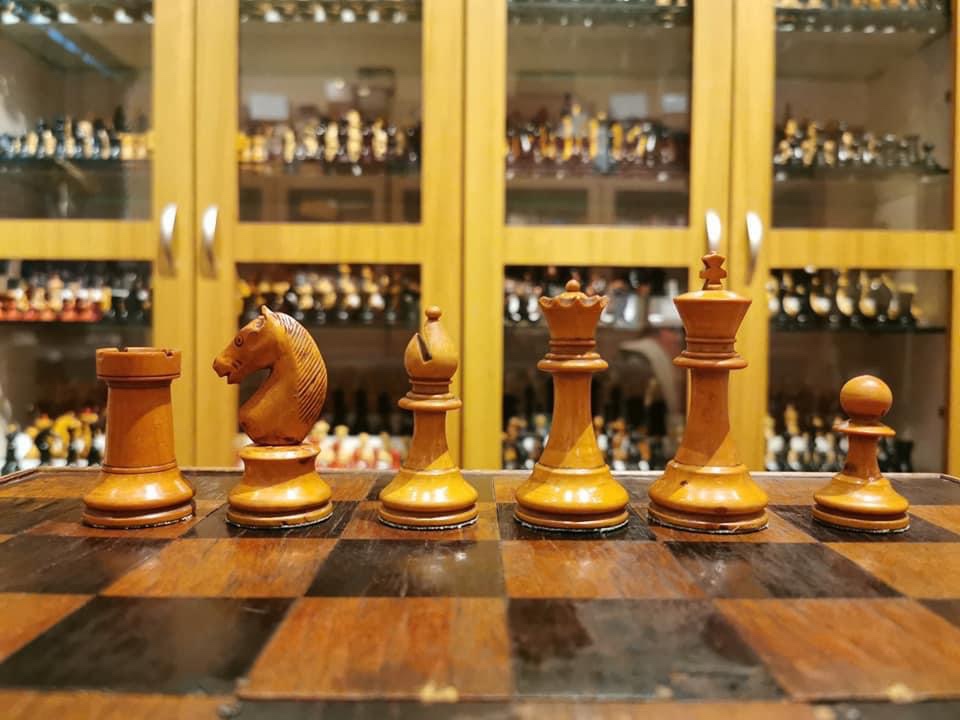
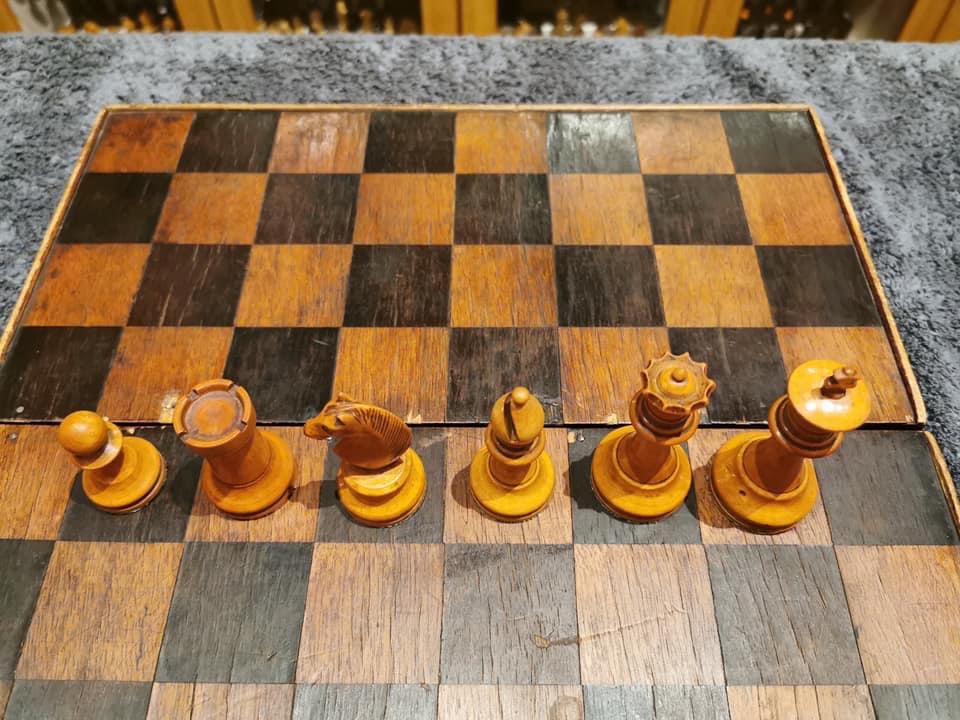
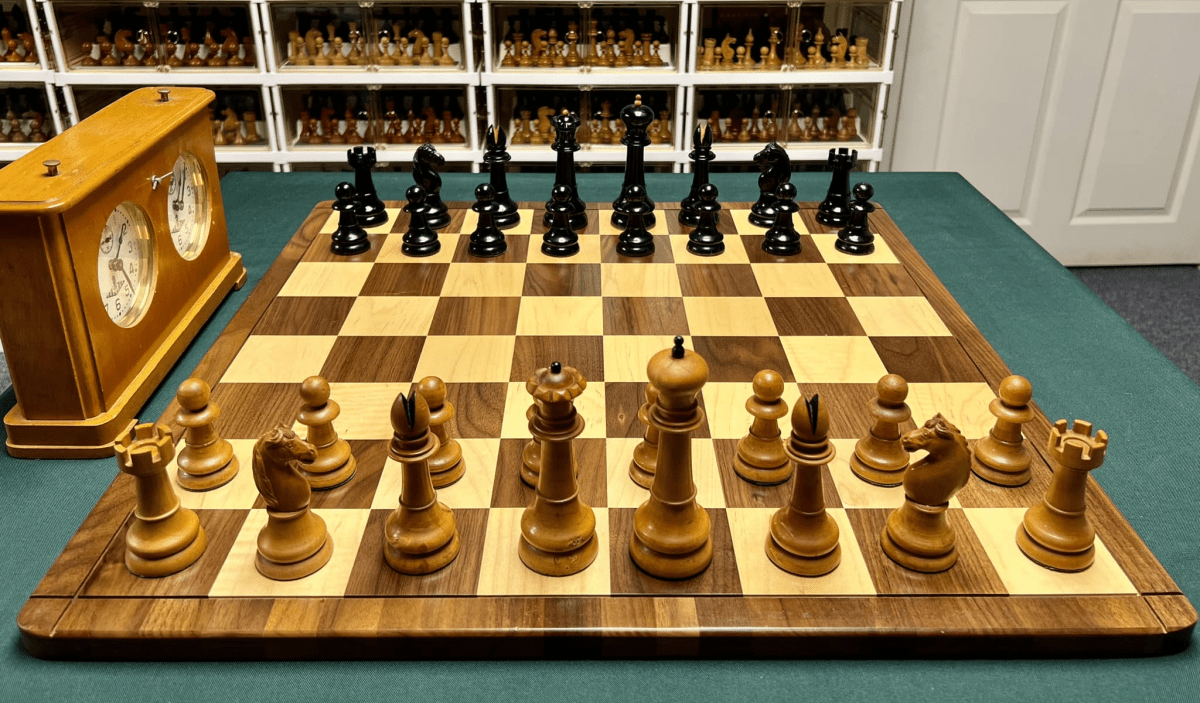
Hardin’s set is a smaller version of what we have come to know as the “Alekhine Set,” a moniker attached to it by Singapore collector Steven Kong, who acquired it from a dealer in St. Petersburg, Russia. The set now resides in my collection.

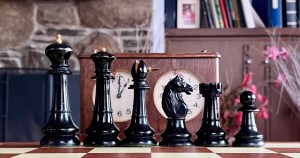
The set is tall and heavy, finely turned, carved, and finished . The pieces have a large height to base width ratio, but their weight keeps them stable in play. The king is five inches tall with a bulging crown characteristic of Tsarist sets and reminiscent of Austrian onion top sets. The queen’s coronet eschews sharp points, protecting it from damage during the rigors of play. The bishop’s miter is unique, the cut splitting it into two equal halves. The knight’s mane flows with detail, and its features are carefully carved. The rook’s turret is exaggerated, its merlons tall and distinctly cut.

A magnificent set. A jewel. Of the finest craftsmanship a Tsarist workshop could be expected to provide.
Tsarist Staunton Chessmen

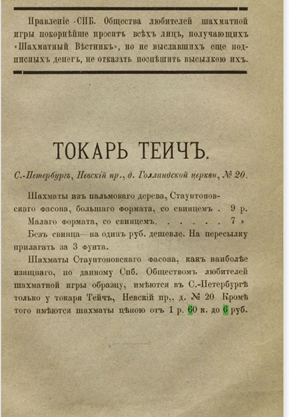
We know that “Staunton” chessmen were sold in Tsarist Russia in the second half of the 19th Century. Here, for example, is an ad from Mikhail Tchigorin’s chess journal, Shakhmatniy Vestik, in 1885, for “Turner Teich,” with a St. Petersburg street address.

Source: 1885 Shakhmatniy Vestik Nos. 2 &3. Courtesy Sergey Kovalenko.

Teich was a wood turner located at 20 Nevsky Avenue in St. Petersburg. It was operating as early as 1885, but its exact dates of operation are not known. In 1885, Teich offered Staunton style chessmen in large and small sizes, with and without lead weights. They marketed them as “sophisticated” and reminded customers that such pieces were available “only at Turner Teich. Unfortunately, the ad contains no photos or sketches of the pieces, so we are left to wonder what they looked like.

The photographic record is sparse. Lenin’s set is on display in the Museum of the Revolution, and photos of it can be found, but it is unclear that it is of Tsarist, as opposed to English, or German, or some other origin. Lenin reportedly played with it in Leipzig in 1912.

“Lenin’s Set,” RIA Novosti/Mikhail Filimonov photo.

Singapore collector Steve Kong has a very similar set in his collection.

A different set claims to be “Lenin’s Exile Set.”

Source: Sergey Kovalenko.

There are a handful of photos of the St. Petersburg Tournaments of 1909 and 1914, where Karelian Birch sets were used.

The original uploader was Mishi at French Wikipedia, GPL http://www.gnu.org/licenses/gpl.html, via Wikimedia Commons.

All of these sets arguably are “Staunton” designs, broadly construed.

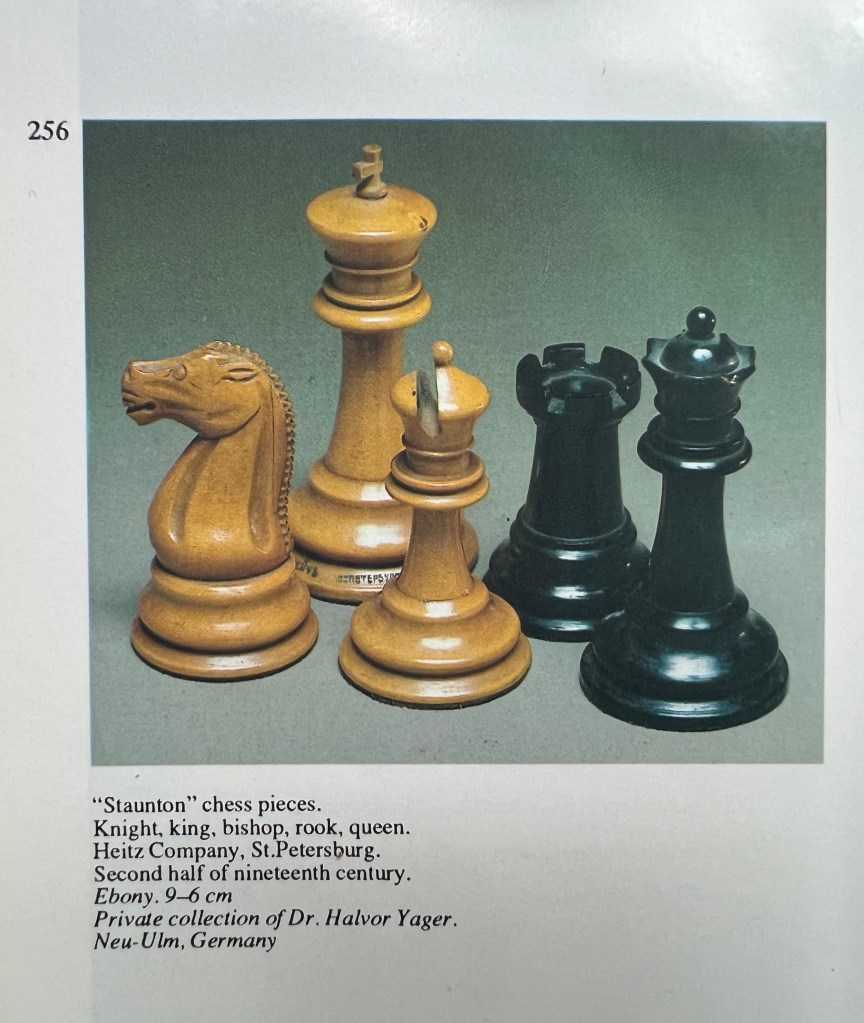
In doing some research on sets of Ancient Rus in Isaak Linder’s The Art of Chess (1994), I came across a photo of a set he identifies as coming from St. Petersburg in the late 1800s. It literally has been hiding in plain sight.

Linder, op cit. at 256.

These pieces are unquestionably Staunton, even by the strictest definition. The royals and clerics have the “three collar” structure typical of Jaques and other English Staunton pieces. The king’s crown is topped by a cross. The queen wears a distinct coronet. The bishop’s miter is cut. The knight has the S-shaped Staunton shape, and its ears are pinned back as in Jaques and other English Staunton knights. The rook’s turret contains distinct merlons. The bases step up to the stems, which rise to a near perpendicular joint with the pedestals. The pieces appear to have a high quality finish, and even bear stamping on the king’s base reminiscent of the Jaques practice. Unfortunately, as of this writing, neither Sergey Kovalenko nor I could find any further information on the Heitz Company of St. Petersburg.

Sergey, however, has enlarged and enhanced the king’s base inscription in Linder’s photo.

Sergey Kovalenko’s Enhancement of Linder’s Photo.

The right word translates to “St. Petersburg.” The left word is incomplete. It appears to say, “…ичъ (еичъ).” Sergey suggests that in its entirety it could read “Токарь Теичъ,” the same Turner Teich of Tchigorin’s 1885 journal ad. I think this is an eminently reasonable inference. What the relationship is between Turner Teich and the “Heitz Company” Linder references remains to be established. Sergey suggests it could be nothing more than a mistaken transliteration by Linder.

Hopefully more images of Tsarist Staunton sets will emerge. Perhaps new information will come to light to help us verify sets we claim or suspect to be Tsarist that will allow us to confirm their Tsarist origins. Better still, we look forward to the emergence of more sets—Staunton and otherwise—verifiably from the late Tsarist period.