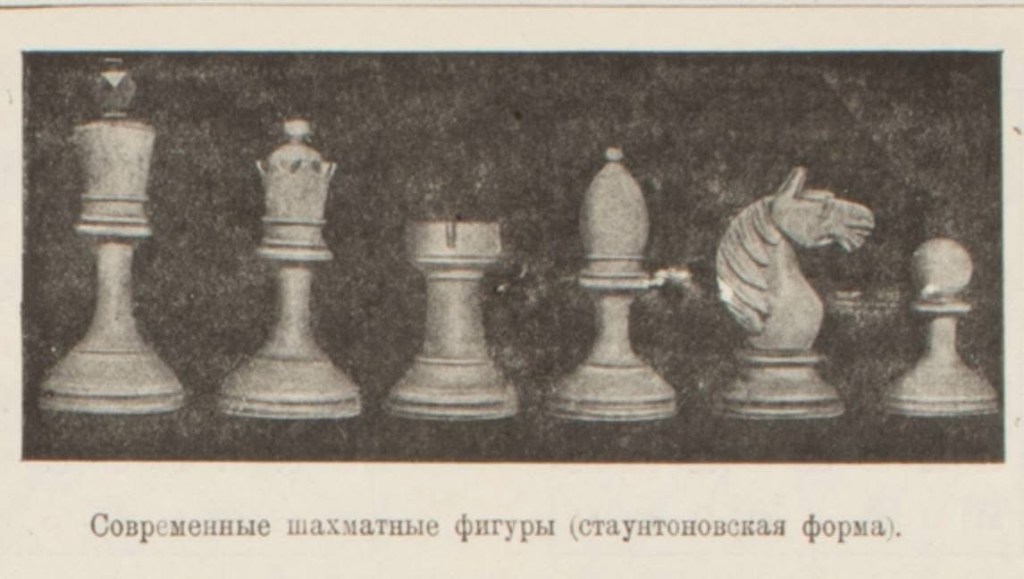
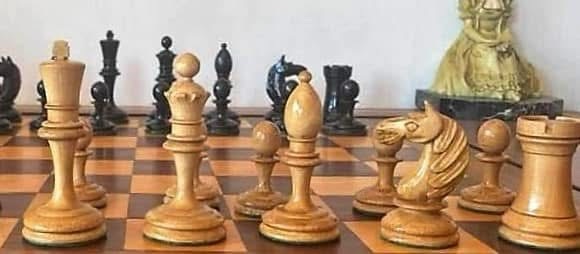
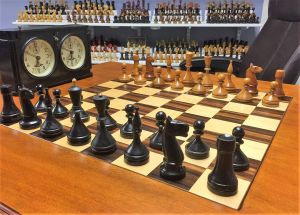
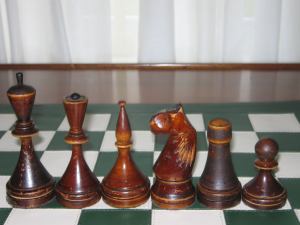
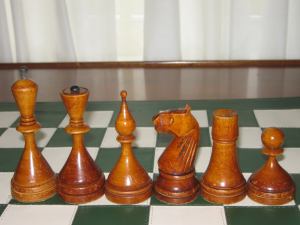
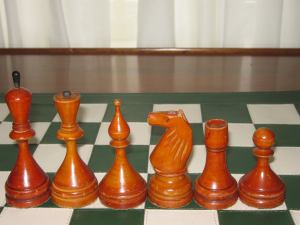
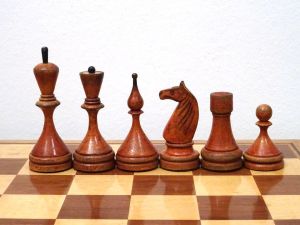
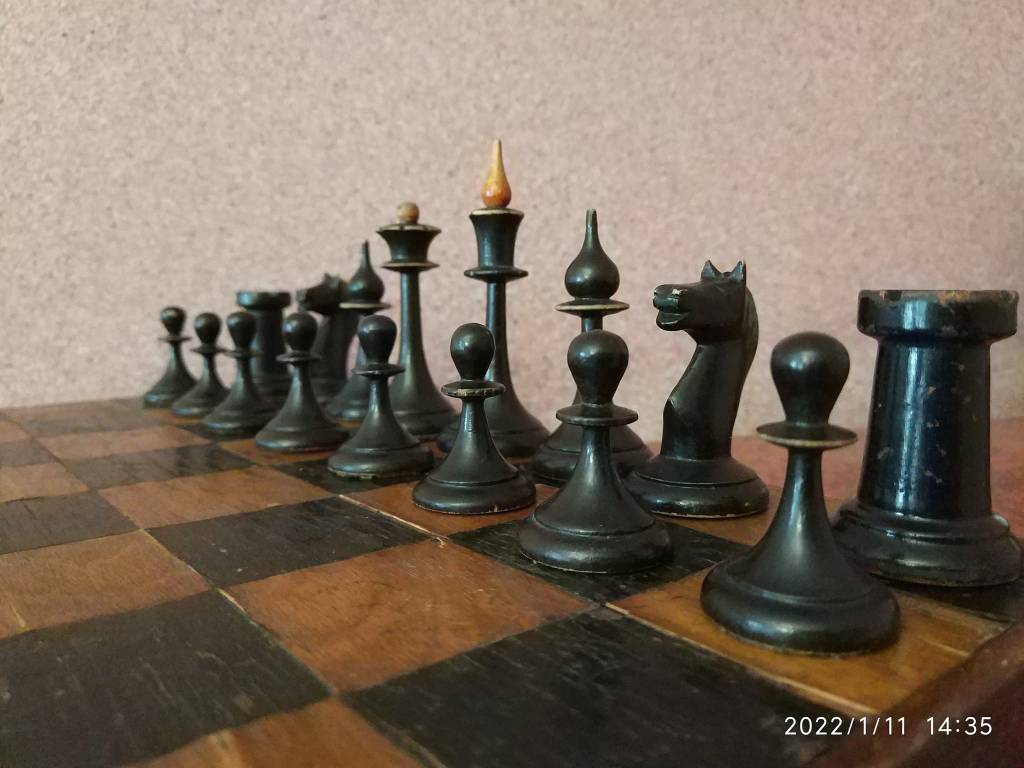
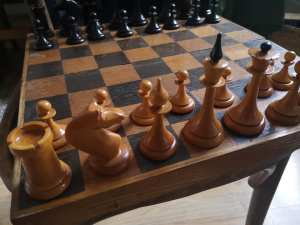
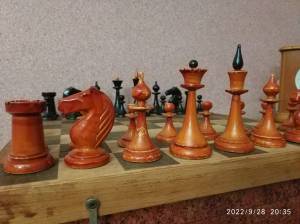
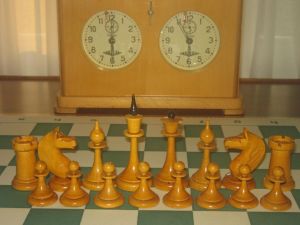
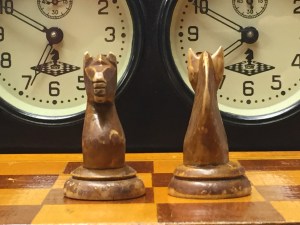
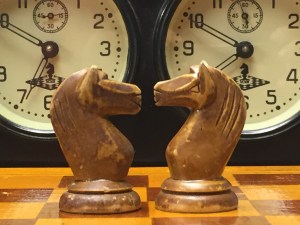
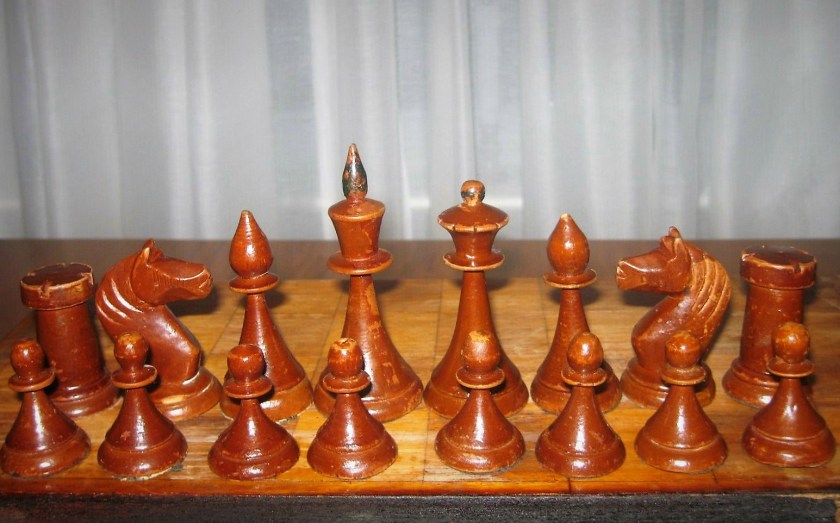
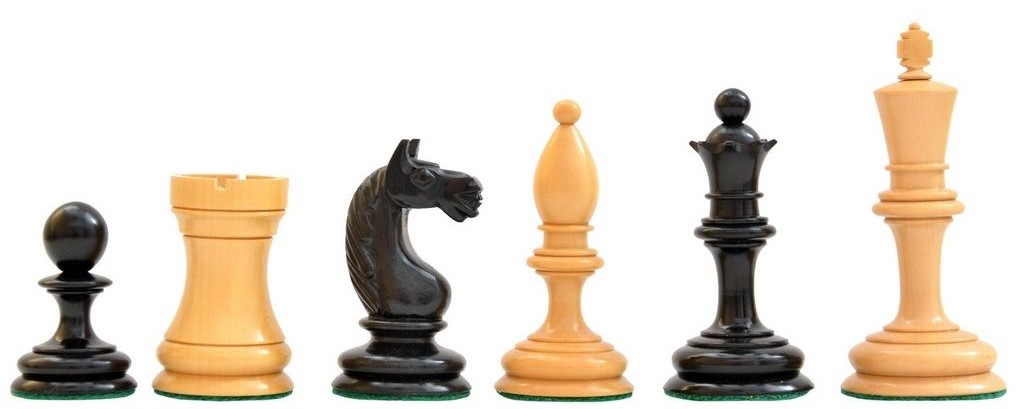
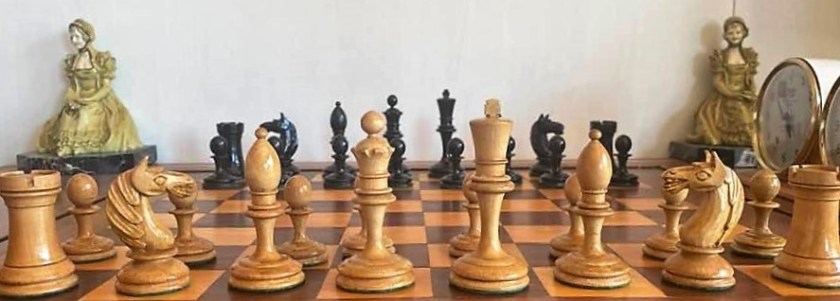
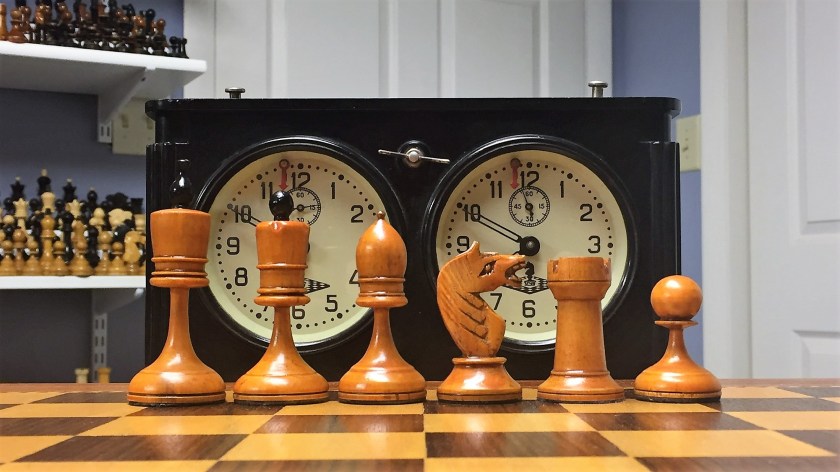
Soviet Master Ilyan Maizelis included a photo of the pictured set in his famous primer “Chess Beginnings” (1937). There he described it as “Modern Chess Figures (Staunton form).” At 9. So the set dates no later than 1937. For sake of convenience, I’ll refer to it as “Maizelis’s Set,” though I have no other evidence that he actually owned or played with one like it.
Photo courtesy of Sergey Kovalenko.Photo courtesy of Sergey Kovalenko.
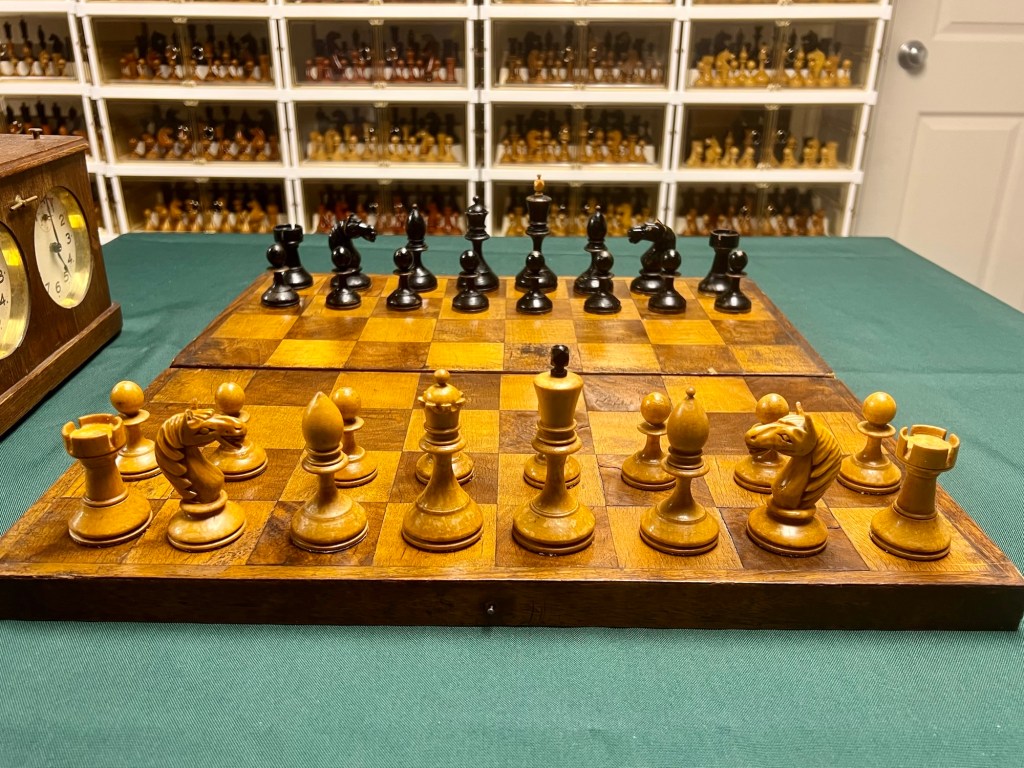
I recently added such a set to my Soviet and Tsarist collection.
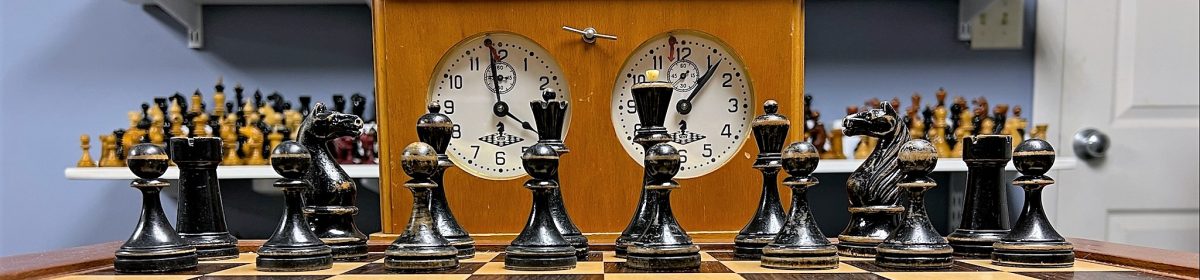
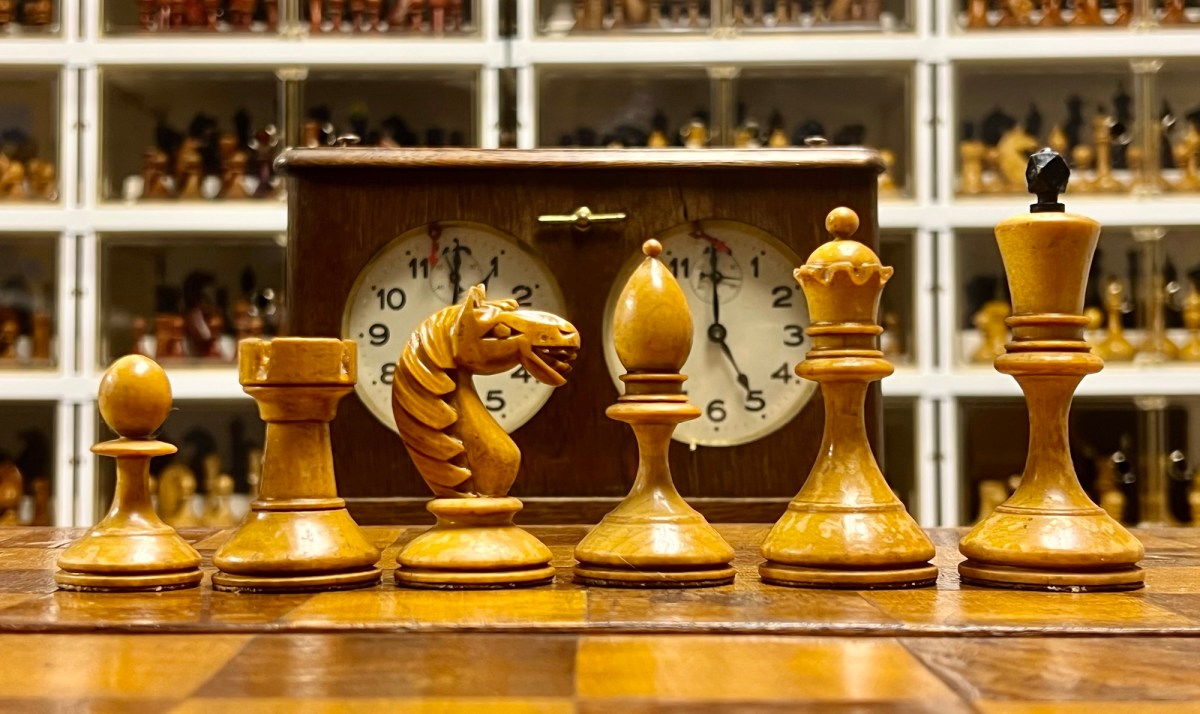
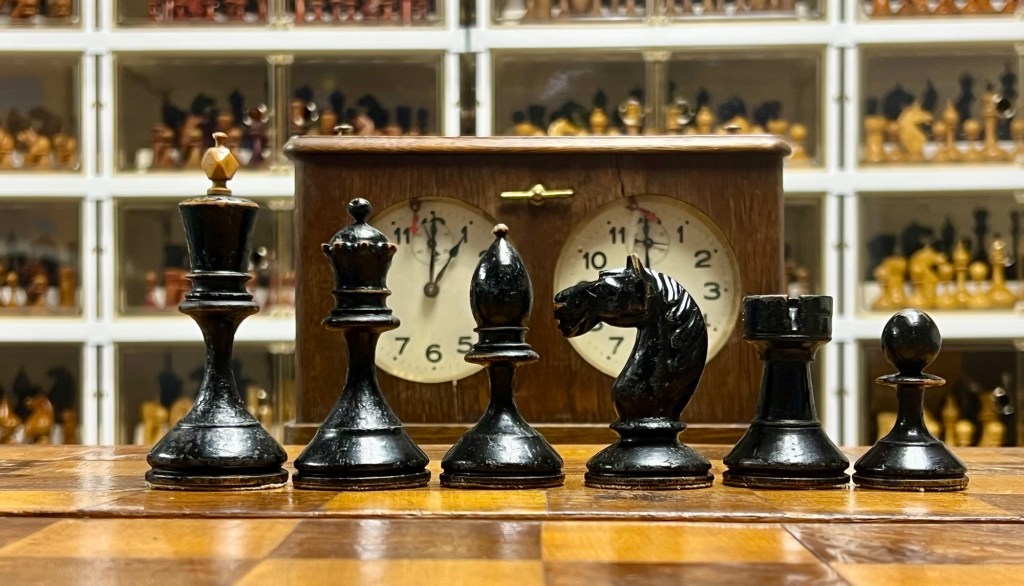
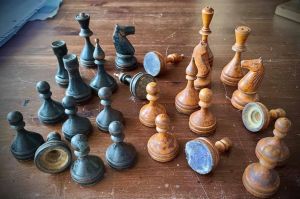
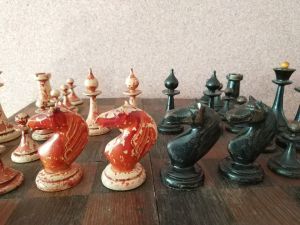
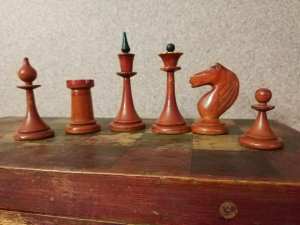
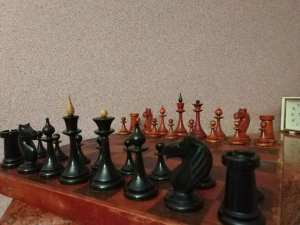
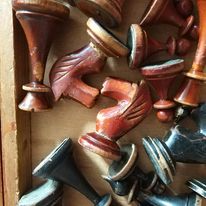
The set is magnificently turned, carved finished, and weighted, with several small defects, a couple chipped coronet tips, broken finials on a White Bishop, a partially broken off finial on the White King, a few cracks and worn finish for character.
Chuck Grau photos.
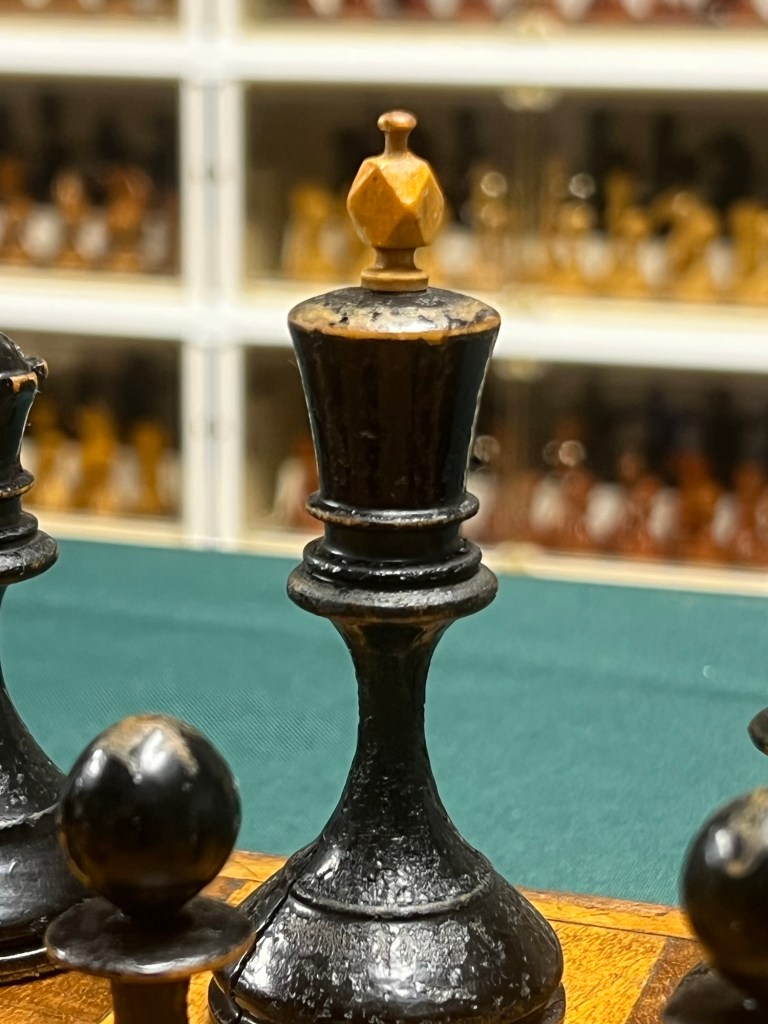
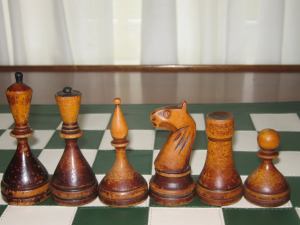
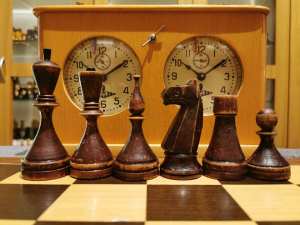
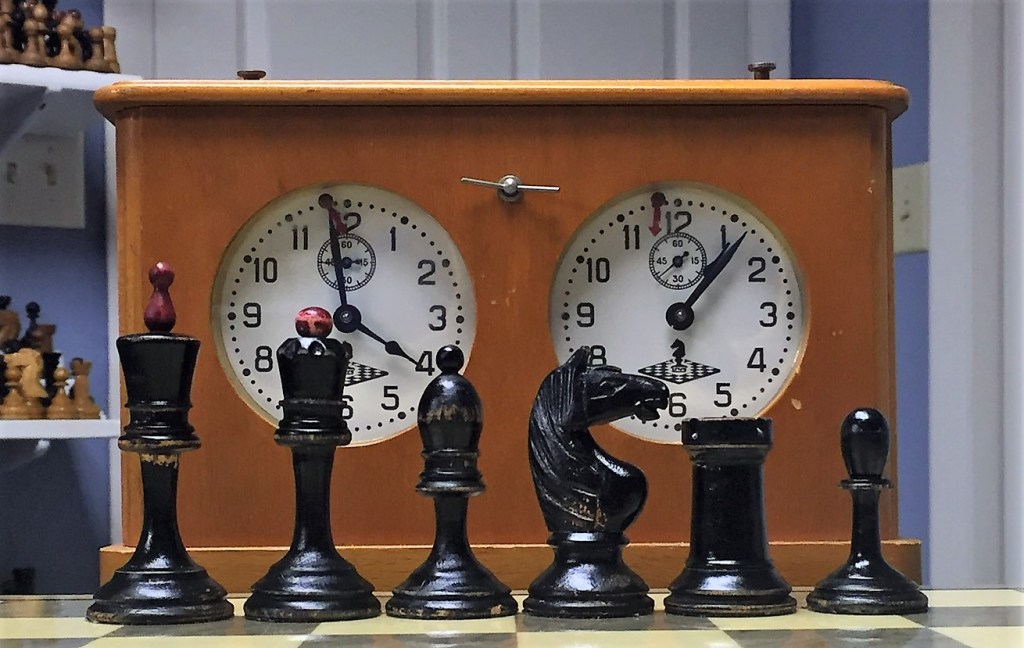
The Black King measures 97 mm with its fully intact finial. The Kings’s finials are carved in a unique diamond pattern. The Black pieces are painted with age-consistent wear and chipping, but the White pieces have a finish approximating French polish akin to two Tsarist sets that have matriculated through my collection. Beautiful patina.
Diamond-shaped finial. Chuck Grau photo.
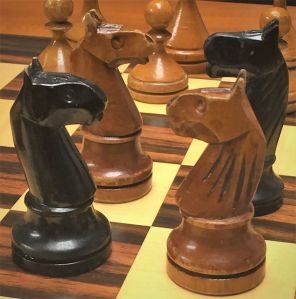
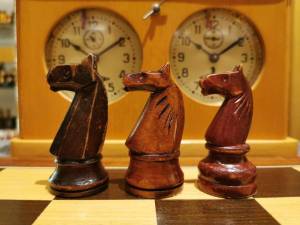
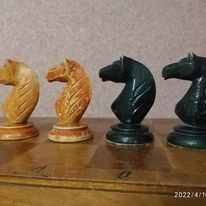
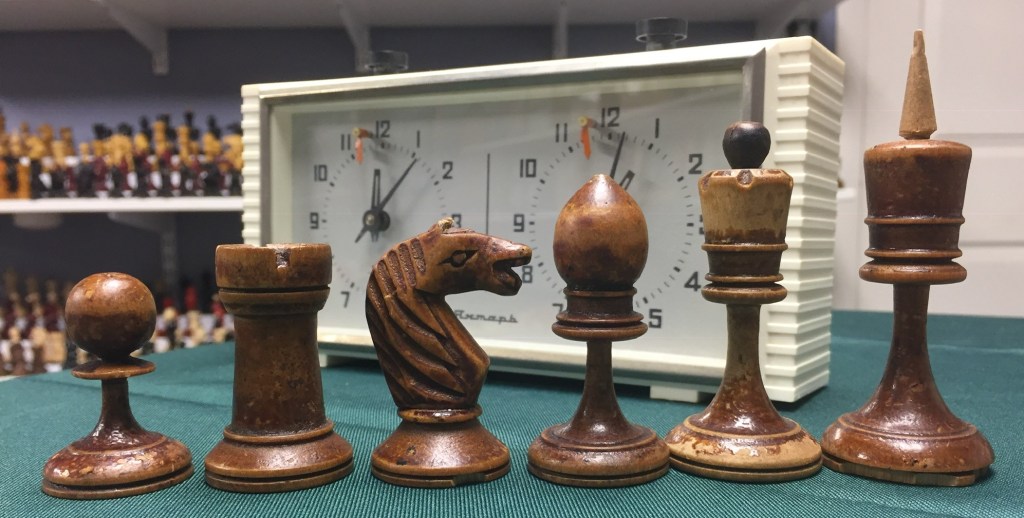
The Knight carving is spectacular, the best of any of my Soviet sets and even better than my best Tsarist ones. Highly detailed mane carvings on both sides of the torso. Crisp mouth and eye details. Just spectacular.
Chuck Grau Photo.
The style is of the group of sets commonly but not unreasonably mistaken for the 1933 Botvinnik Flohr match. I included pictures of several of these sets in my article on the 1933 set.
Antonio Fabiano Collection, photo.Stephen Kong Collection, photo.Murat Dzhemakulov Collection.
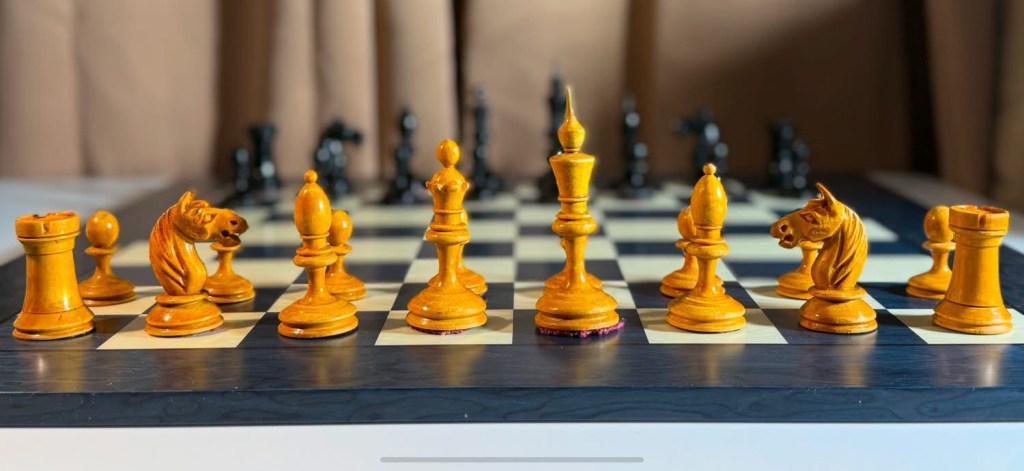
Shane Chateauneuf recently acquired a beautiful, related set.
Shane Chateauneuf Collection, photo.
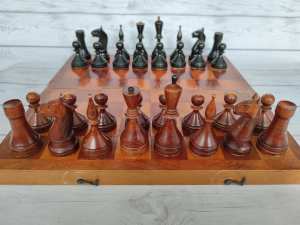
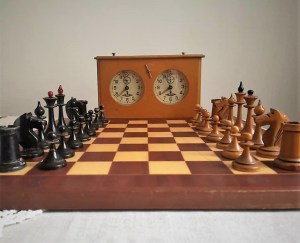
The board accompanying my set is wonderful in its own right. Beautiful veneer worn consistent with its age. Gorgeous patina. 53 mm squares are perfectly sized for the pieces, very un-Soviet. None of the asphyxiation that Arlindo Vieira repeatedly complained of. This is perhaps another factor hinting that the set may be much older than 1937.
Chuck Grau photo.
Simply a gem.
Ilyan Lvovich Maizelis
Ilya Lvovich Maizelis
A close friend of Yuri Averbakh, Maizelis was a noted teacher and author, even outside the Soviet Union. No less than Bobby Fischer studied his work.
Courtesy of Jorge Njegovic Drndak
Soviet chess historian Jorge Njegovic Drndak has compiled this brief biography:
Ilya Lvovich Maizelis (1894-1978)
He was born on December 28, 1894 in Uman, a small village in the Cherkasy region. Having passed college in Ukraine, Ilya won the Union-wide Tournament of Cities in 1924 (a parallel tournament). Once in Moscow, Maizelis quickly joined the chess movement and became one of its most prominent figures.
Having started working as a chess journalist, Maizelis covered the Alekhine-Teichmann match (Berlin, 1921), at that time Alexander Alexandrovich’s name was not yet animated in his homeland. Ended with a score of 3:3.
Ilya Maizelis was close friends with Emanuel Lasker. It was he who during the Moscow International Tournament (1925) handed the great thinker a telegram saying that the work of the second world champion would be staged. The played Lasker ended up getting the foot of the “mill” in the match against Torre, but consoled the young man, who at first considered himself responsible for this defeat of the great chess player.
Maizelis was one of those who convinced Emanuel to move to the USSR, take Soviet citizenship and train for the national team. Shortly before leaving for America, Lasker handed the journalist the manuscript of his children’s book. Ilya’s friend Alexander Ilyin-Zhenevsky believed it was Maizelis’ duty to publish the book, but the work “How Victor Became a Chess Master” was only published in the 1970s.
Ilya Maizelis is a member of the editorial board of the magazine “64”. “Checkers and Chess in a Workers’ Club” (1925-1930), executive secretary of the publication “Soviet Chess Chronicle” (1943-1946), published in English in Moscow under the auspices of the Union Society for Cultural Relations (VOKS). He trained at the Pioneers House of the capital, but at the same time, until the late 1930s, he did not stop the practical performances, performed regularly at the finals of the Moscow championships. In 1932, Ilya Lvovich took fourth place in the championship of the capital and, of course, played in the strength of the master, but did not officially fulfill the title, opting for journalism.
Author of the books “Beginner Chess Player”, “Chess Yearbook 1937-1938”, “Fundamentals of Opening Strategy”, “For 4th Chess Players”. a and 3. “under category”, “Selected games of Soviet and International Tournaments of 1946”, “Chess Textbook Games”, “Tower vs Pawns”, “On the Theory of Tower End”, “Chess Finals. Pawns, Bishops, Horses” edited by Y. Averbakh, “chess. Fundamentals of Theory. Ilya Maizelis translated from German the books “Endgame Theory and Practice” by Johann Berger and “My System” by Aron Nimzowitsch.
With his article, he was the first in the USSR to draw attention to the 1603 painting “Ben Johnson and William Shakespeare,” attributed to Karel van Mander and depicts 17th-century English playwright playing chess. Ilya Lvovich studied the works of the poets Henry Longfellow and Heinrich Hein, translated their works into English and German.
Ilya Maizelis has compiled a chess library that is widely known not only in Moscow and the USSR, but also abroad.
“Everyone knows that Maizelis had the best chess library in Moscow and was often asked to clear up something from an old magazine or a rare book. There was a phone in the room and Ilya Lvovich used to dictate chess and variation games for a long time. Maizelis’ mother-in-law was always in the room, paralyzed and completely indifferent to everything that was going on. He sat like an idol and stared at one point.. And Maizelis, dictating movements, did not say “a-be”, like everyone else, but in a low voice – “a-be”. And then, one day, the mother-in-law, who was apparently tired of this hug to hell, said sadly, “Abe, abe… Fucking idiots! ” (J. Neishstadt).
Shortly before his death, Ilya Lvovich sold the library to good hands to preserve it for posterity. The master of Russian chess journalism passed away on December 23, 1978 in Moscow.
Despite their popularity and longevity, I have hesitated to write about the ubiquitous Valdai Nobles chessmen. It’s not that I don’t like them–I have four specimens in my collection, each with unique attributes. I am fascinated by their design and evolution, particularly the faceted knights characteristic of the mature versions. Nothing has stopped my friends Alan Power and Eva Silvertant from authoring informative articles about them.
Gulag Knights
The reason I have been unwilling to pull the trigger is simple. In his engaging 2019 essay The ‘Gulag’ Knights, Alan claims the Valdai Nobles sets were born in a Gulag in Valdai. Writes Alan:
Needless to say, the hundreds of thousands of prisoners snatched up by the Gulag could produce hundreds of thousands of chess sets, and that’s exactly what Stalin had them do. There were two main factories (or camps) that concern this brief discussion. The first “Village” (a polite Stalinist term for a penal colony) was located halfway between the main artery connecting St. Petersburg and Moscow, namely, The Valdai Regional Industrial Manufactory in Novgorod (450 km north-west of Moscow), a picturesque and densely forested area used today by the rich and famous (including Putin and his entourage) for quick summer getaways. The second ‘village’ is the Yavas Township located in the Central Volga Region of Mordovia (500km south-east of Moscow)… From these two camps came the so-called ‘Valdayski’ and Mordovian (f.k.a. “the Latvian”) sets respectively…
These are intriguing claims. As a skeptic and empiricist, I began to explore their basis. Insofar as they relate to Mordovia, they are very well-supported. But as for Valdai, Novgorod Oblast, halfway between Leningrad and Moscow, I could find no evidence of a Gulag.
From a temporal point of view, it is plausible that Nobles sets of the 1940s and 1950s were made in a Gulag. But upon Stalin’s death in 1953, the general amnesty that granted Gulag prisoners with sentences of five years or less drastically cut back the Gulag system, and in 1960, Khrushchev abolished its remnants. Thus, even if the sets of the fifties and sixties could have been manufactured in a Gulag, those of the sixties could not have been. Beyond this, I simply could neither corroborate nor refute Alan’s claim.
Still, I kept searching Gulag databases and secondary sources without finding a link between Valdai and the Gulags. As I often do, I discussed the issue with my friend Sergey Kovalenko of St. Petersburg. Sergey is a well-respected chess collector, skilled carver, and denizen of Russian and Soviet archives. He regularly discusses historical issues and shares archival research with me and others. Like me, Sergey was intrigued by Alan’s claim. Like me, he could neither confirm nor refute it.
Sergey agreed with Alan’s claim that the Nobles sets were manufactured by the Valdai Regional Industrial Manufactory in Novgorod. This was evidenced by cardboard boxes like Alan’s bearing the producer’s name, Валдайский Райпромкомбинат, or Valdai Raipromkompromat, meaning Valdai Regional Industrial Plant. Unlike Alan, however, I do not equate the term Village with Gulag, and am unaware of any etymological or historical reason for doing so.
Valdai Regional Industrial Plant stamp on a cardboard box containing a Nobles set. Courtesy Sergey Kovalenko.
Nearest Gulag Camp Dug Missile Silos
Perhaps the most comprehensive online Gulag databases are maintained by Gulagmap.ru and Gulag.cz. These sites compile data on individual camps, with detailed information about each taken from the primary Russian language source, Система исправительно-трудовых лагерей в СССР(System of Forced Labour Camps in the USSR [M. B. Smirnov, comp. 1998]) and other archival material. These online databases provide interactive maps of Gulag camp administrations as interfaces. Neither lists any camp in Valdai, Novgorod Oblast.
Late 1940s Valdai Nobles set. Note the slab knights. Source: Sergey Kovalenko.
Nor does the print version of Smirnov’s encyclopedia of Gulag camps. The camp nearest to Valdai was named EM ITL. It was located about 22 kilometers from Valdai near Dubrovets and engaged primarily in the construction of missile silos. Sergey provided the following map illustrating the location of ITL EM in relation to Valdai (Валдай), Novgorod Oblast.
Leningrad the upper left. Moscow on M10 to the right. Courtesy Sergey Kovalenko.
ITL “EM” was formed on January 10, 1951 and operated until May 14, 1953, when it was reorganized into the Dubogorskoye LO. The camp administration was located in the area of the Dvorets station of the Kalinin railway. In operational command, it was initially subordinated to the Main Directorate of Industrial Construction Camps, but shortly before the camp’s reorganization, it came under the jurisdiction of the GULAG of the Ministry of Justice. The maximum number of prisoners held here was recorded in 1953 and amounted to 2,062 people.
ITL “EM” was engaged in the construction of defense facilities. In April 1952, the construction was assigned the first category of secrecy, and prisoners could be sent to this camp only with the permission of the Ministry of State Security…
According to sources, prisoners of the ITL “EM” were engaged in the construction of a coal mine and the maintenance of Construction 714, as well as the excavation of shafts and tunnels. In reality, the camp’s task was the construction of missile silos. The labor of prisoners of the ITL “EM” was also used to build locomotive and diesel power plants.
Likewise, Avraham Shifrin’s The First Guidebook to Prisons and Concentration Camps of the Soviet Union (1982) makes no mention of a Gulag camp in Valdai. At 276-277, 389. Nor does Anne Applebaum’s Pulitzer Prize-winning Gulag: A History (2003). At 676.
Post-Gulag Prison Colony ITK-4
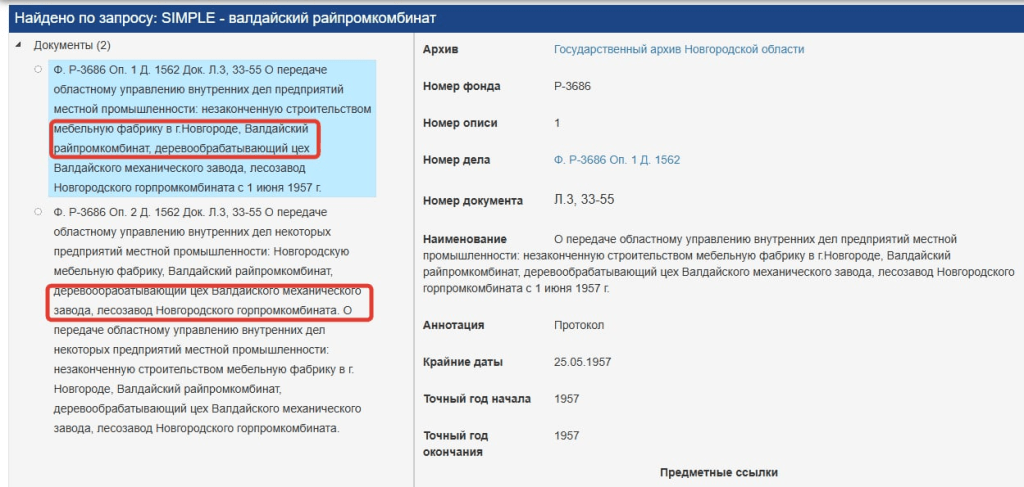
Sergey accessed the Novgorod Online Archives and made an intriguing discovery. He discovered a link between the Valdai Industrial Plant and the post-Gulag Soviet correctional system, if not with the Gulag system itself. According to the Novgorod Archives, on 1 June 1957, various assets in and around Valdai were transferred to the Department of Internal Affairs (MVD), among them the Valdai District Industrial Plant, the woodworking shop of the Valdai Mechanical Plant, and the Timber Plant of the Novgorod City Industrial Plant.
According to records Sergey found, the woodworking shops and other assets were transferred to a newly organized correctional and labor colony in Valdai, Novgorod Oblast, designated ITK-4, or Labor Colony 4, and OYA-22/4. The MVD received funds to construct housing and other structures in Valdai and the nearby town of Myza to accommodate 700-800 male prisoners. V. M. Skoryukov was appointed Deputy Chief of ITK-4 for Production. When prisoners began arriving in October of 1957, they worked in two lathe, furniture and plywood workshops, and a forest in a nearby village.
It is essential to situate ITK-4 in the history of the Gulag system. According to a recently declassified 1951 CIA report, two kinds of labor facilities operated within the Gulag system. ITLs–Labor Camps–were established in remote regions and housed prisoners with sentences of two years or greater. By contrast, ITKs–Labor Colonies–typically housed petty criminals in each oblast.
Even before Stalin’s death, MVD Minister Laventry Beria and his deputy Stepan Mamulov proposed to drastically cut back and replace the Gulag system. Stalin died in March 1953. While his corpse was still warm, Beria began to dismantle the Gulags, issuing a general amnesty that led to the release of 1.5 million prisoners–60% of the Gulag population–over the next three months. Aleksei Tikhonov, The End of the Gulag, in The Economics of Forced Labor: The Gulag (P. Gregory and V. Lazarev eds., 2003) at 67-73. Anne Applebaum writes:
As Khrushchev had feared, Beria, who was barely able to contain his glee at the sight of Stalin’s corpse, did indeed take power, and began making changes with astonishing speed. On March 6, before Stalin had even been buried, Beria announced a reorganization of the secret police. He instructed its boss to hand over responsibility for the Gulag to the Ministry of Justice, keeping only the special camps for politicals within the jurisdiction of the MVD. He transferred many of the Gulag’s enterprises over to other ministries, whether forestry, mining, or manufacturing. On March 12, Beria also aborted more than twenty of the Gulag’s flagship projects, on the grounds that they did not “meet the needs of the national economy.” Work on the Great Turkmen Canal ground to a halt, as did work on the Volga–Ural Canal, the Volga–Baltic Canal, the dam on the lower Don, the port at Donetsk, and the tunnel to Sakhalin. The Road of Death, the Salekhard–Igarka Railway, was abandoned too, never to be finished.
Supra, at 478.
In 1955, the GUITK (Glavnoye Upravleniye Ispravitelno-Trudovykh Kolony), or Chief Administration of Corrective Labor Colonies, was established within the MVD to administer the post-Gulag correctional system. After Khrushchev gave his famous speech denouncing Stalin in February 1956, the dismantling of the Gulags accelerated. Appleman writes:
In the months that followed the secret speech, the MVD also prepared to make much deeper changes to the structure of the camps themselves. In April, the new Interior Minister, N. P. Dudorov, sent a proposal for the reorganization of the camps to the Central Committee. The situation in the camps and colonies, he wrote, “has been abysmal for many years now.” They should be closed, he argued, and instead the most dangerous criminals should be sent to special, isolated prisons, in distant regions of the country, specifically naming the building site of the unfinished Salekhard–Igarka Railway as one such possibility. Minor criminals, on the other hand, should remain in their native regions, serving out their sentences in prison “colonies,” doing light industrial labor and working on collective farms. None should be required to work as lumberjacks, miners, or builders, or indeed to carry out any other type of unskilled, hard labor.
Dudorov’s choice of language was more important than his specific suggestions. He was not merely proposing the creation of a smaller camp system; he was proposing to create a qualitatively different one, to return to a “normal” prison system, or at least to a prison system which would be recognizable as such in other European countries. The new prison colonies would stop pretending to be financially self-sufficient. Prisoners would work in order to learn useful skills, not in order to enrich the state. The aim of prisoners’ work would be rehabilitation, not profit.
Supra, at 509.
By 1957, GUITK became primarily responsible for operating and administering that system. It was within the post-Gulag framework Dudorov described that Valdai’s ITK-4 went operational.
Another Valdai and Segezhlag
Sergey did find some connection between a Valdai and the Gulags, but it was a different Valdai, one located in the Segezha District of Karelia, almost 900 km north of its namesake in Novgorod Oblast. This Valdai lies within the same Segezha District as a Gulag camp known as Сегежский ITL, or Segezhlag, but across from it on Lake Vygozero and 132 km distant by road. This Valdai was founded in the early 1930s to aid in constructing the White Sea-Baltic Canal with Gulag labor.
Valdai and Segezha, Segezha District, Karelia. Source: Google Maps
Segezhlag was organized in 1939. According to gulagmap.ru:
The Segezha Corrective Labor Camp was organized no later than October 21, 1939, on the basis of the 4th camp division of the White Sea-Baltic Corrective Labor Camp and operated until June 28, 1941. The camp administration was located in the Karelo-Finnish SSR, in the area of the Segezha station of the Kirov Railway. Initially, the camp was subordinate to the GULAG, but from February 1941 it came under the jurisdiction of the Main Directorate of Industrial Construction Camps (GULPS). Up to 7,951 prisoners were held here…
The labor of the prisoners of the Segezha camp was used for the construction of the Segezha timber and paper plant, the Segezha hydrolysis plant (since November 1940), the Kondopoga sulfite-alcohol plant (since March 1941), for servicing the first stage of the timber and paper plant, as well as sawmills, foam concrete, concrete, asphalt plants, a concrete products plant, for the construction of railways and dirt roads, residential and utility facilities, and agricultural work.
See also Smirnov, supra, at 390.
There is no record of chess set production at Segezhlag. While the Gulag camp there closed in 1941, Penal Colony No. 7 continues to operate there.
Conclusion
The Nobles chess sets of Valdai were not made in a Gulag, but in the woodworking shops of the Valdai District Industrial Plant. Prisoners of the Gulag camp nearest the chess-producing Valdai dug missile silos, but did not turn chess pieces or carve knights. Ironically, a different Valdai was associated with a Gulag camp, Segezhlag. But this camp had nothing to do with the production of chess sets either.
After 1957, however, sets were made by forced labor within ITK-4 of the Soviet prison system, confirming a key component of Alan’s initial claim concerning these sets. Still, the change in penal regimes was not a distinction without a difference, a mere “changing of the uniforms,” to borrow a phrase from Budapest’s House of Terror Museum. If we were to equate the two different penal regimes, we would unfairly diminish one of the most immediate and significant consequences of Stalin’s death–the abolition of the Gulag system, the release and rehabilitation of millions who had unjustly suffered under its iron hand, the reconfiguration of penal institutions, and all the social dislocation that attended the Gulag’s demise.
Many thanks to Sergey Kovalenko and the reference librarians at the Bedford, NH Public Library.
The history of checkers paralleled that of chess in the Soviet Union. Both games had been played for centuries, despite suffering the disapprobation of the Orthodox Church. Both were incorporated into the Soviet state’s political program to elevate and enrich the cultural level of the masses.
According to the Russian Checkers Federation, “games similar to modern Russian checkers were known to the Eastern Slavs as early as the 4th century, as indicated by numerous artifacts from archaeological excavations. References to checkers (or ‘tavleys,’ as this game was previously called in Rus) are found in some epics and other written evidence from that time.” https://shashki.ru/variations/draughts64/ During the reign of Peter I (1682-1725), checkers became popular. The first article about checkers appeared in 1803. https://www.sports.ru/others/blogs/2699763.html
Official rules were printed in 1884, and the first Russian championship was held a decade later, with the second, third, and fourth All-Russian championships played in 1895, 1898 and 1901 respectively. https://en.wikipedia.org/wiki/Russian_draughts A magazine dedicated to the game began publication in 1897. According to Russian author Maria Selenkova, by checkers had become popular, with skilled players emerging in various neighborhoods, playing in matches and and informal tournaments, and sharing their knowledge with the younger generation. https://www.sports.ru/others/blogs/2699763.html
1950s Soviet checkers set. The folding board is familiar to collectors of Soviet chess sets. Nikolai Filatov photo.
Like chess, the Russian game is played on a board with eight rows and eight ranks, the former designated by letters a-h and the latter numbers 1-8, the algebraic system familiar to modern chess players. The rules are similar to the game played in the United States, except that all pieces may capture forward or backward. Soviet players competed internationally, playing the 10 x 10 square version of draughts. Competitive games are timed, using chess clocks, and recorded using algebraic notation. Competitive players are rated using an Elo system. https://shashki.ru/federation/
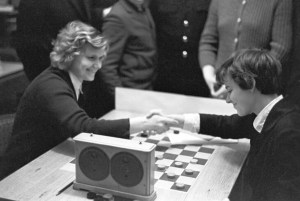
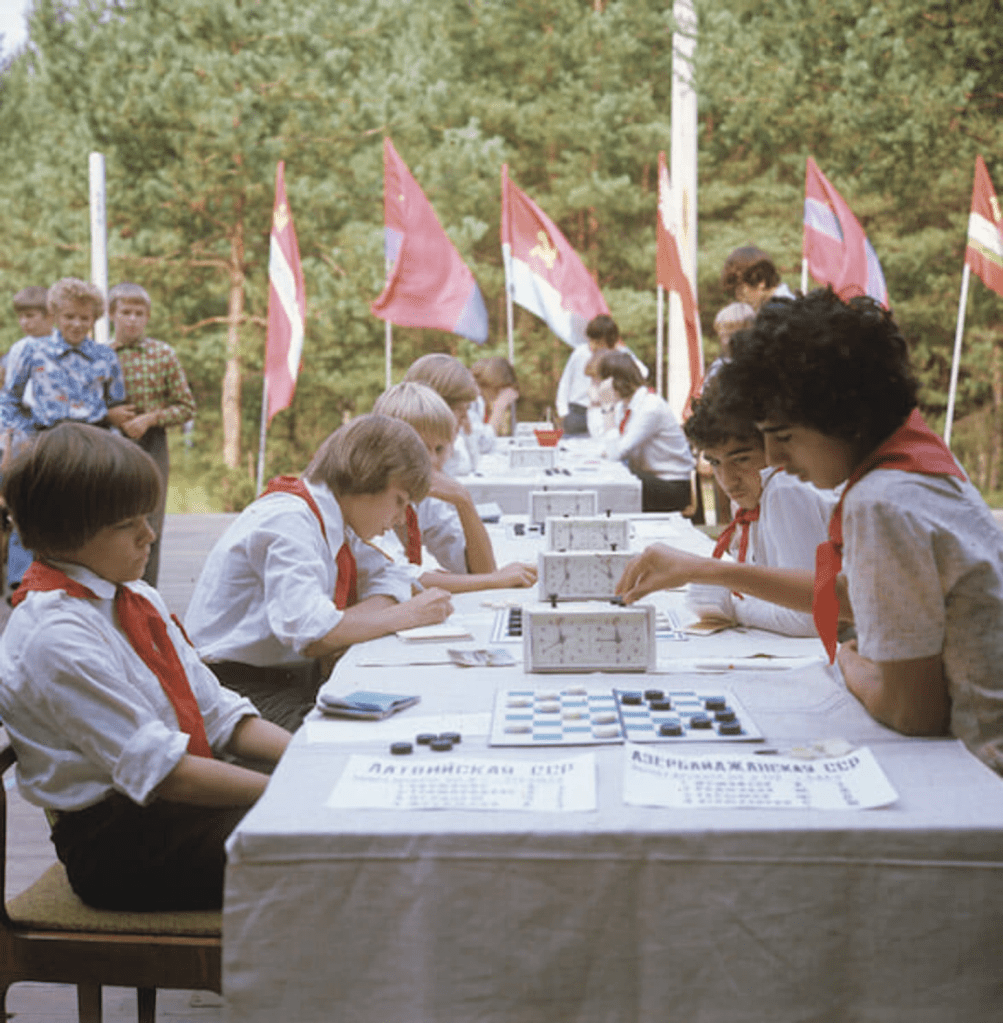
IX USSR Women’s Checkers Championship. Latvian Johanna Cine (right) congratulates Leningrader Iraida Spasskaya on her victory. Note the 8 x 8 board, the Jantar chess clock, and the scoresheets. https://www.sports.ru/others/blogs/2699763.html
During the early 20th century, checkers attracted a diverse demographic, including soldiers, workers, and traders. The game’s popularity continued to grow following the revolution, as the new government recognized the public’s interest in checkers, viewing it as a more dynamic and simpler alternative to chess.
Like chess, checkers was taken very seriously in the USSR was actively promoted by the Soviet state. In August 1924, the All-Union Chess and Checkers Section was established. Bolshevik and state prosecutor Nikolai Krylenko presided over the section. Under the section’s auspices the first USSR checkers championship was played the same year.
Krylenko spoke of the games jointly as the “chess and checkers movement.” He wrote:
Ever since the conception of our organization, we have our slogan, Chess and Checkers into the Working Masses. We came up with this slogan to combat the theory that chess is pure art, the theory that chess is just art for art’s sake. The struggle for masses, the struggle for introduction of chess and checkers to the masses as a weapon of the cultural revolution – this is our first slogan, which we carry out ever since our organization was born.
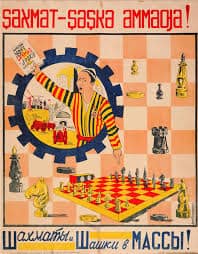
“Chess and Checkers to the Masses!” Soviet Uzbek poster. Soviet Visuals photo.
The comrades who read our political literature, our specialized chess and checkers literature, knew clearly that if we wanted to make our movement, firstly, proletarian, and secondly, truly widespread, then the conclusion should have been obvious: a mass movement, a working-class movement is ought to be a political movement. It’s plainly impossible for the working masses, who every day take active part in the country’s political life, who every day, every hour are involved in their country’s international and internal policy – for those working masses, when they study chess and checkers in clubs, or at home, or wherever, to cease being what they are: being political activists and builders of their own state, arbiters of their country’s destiny.
In our epoch, the slogan “Chess and checkers to the masses as a weapon of cultural revolution” has been expanded: “Imbue chess and checkers with political content, make our chess and checkers players into political workers, conscientious fighters, conscientious participants of socialistic building.
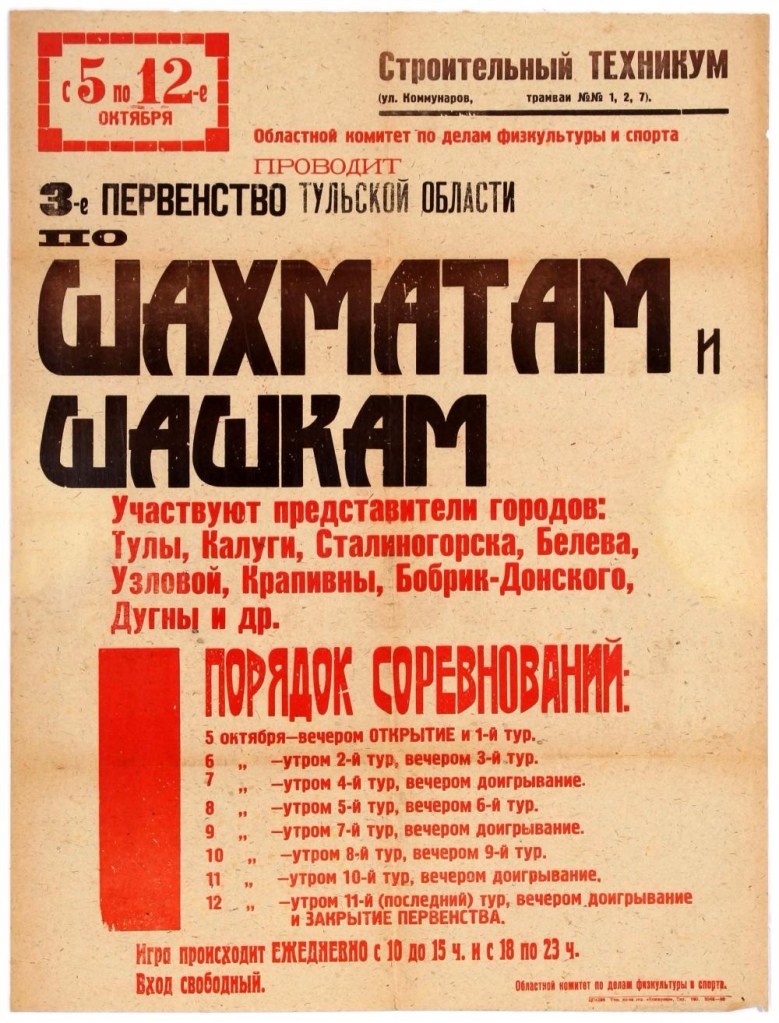
1938 Poster for Tula Chess and Checkers Competitions. Designer unknown. Antikbar Original Vintage Posters photo.
The issue of imbuing chess/checkers organizations with politics should be understood in this way: from some, we should demand that they, being organizers, being administrators, being responsible for political issues, pay much attention to political work; and we should get the others more involved in political life, make then conscientious participants of socialistic building.
I can cite a number of examples. Let’s look at the question of chess/checkers organizations’ participation in udarnik movement and socialistic competition. When you demand that the workers of this factory or that, in addition to being members of chess/checkers team, be udarniks and set high goals for themselves in socialistic competitions, as stevedores of the Lower Volga do – the checkers-playing and chess-playing stevedores – this is the way to couple cultural work with general political work, this is political work.
And there’s another form, which we can demand from more mature members of our organization – from administrators, from organizers. We measure the level of fitness for our chess/checkers work not just by purely chess/checkers talent and ability, but also by the ability to perform political and organizational work and the level of clear understanding of general political issues in our life and the imbuing of chess/checkers organizations’ work with political content.”
“In a Soviet factory lounge” 1930 [MAMM] Courtesy Sarah Beth Cohen
According to chess historian Terje Kristiansen, the above photo likely depicts “the so-called Lenin’s corner (aka Lenin’s room, Red Corner, the center of culture). Most factories and institutions had one, where pupils, students or workers met to read, chat, and play chess.” Kristiansen asked a Ukrainian-Russian friend and his Russian girlfriend about the photo. Both are now in their seventies, and are familiar with the history of chess in the Union. He shared their thoughts:
[The photo] captures the moment of the women’s chess and checkers circle. True, judging by the postures of women, by the expression of their faces and during the game on the checkerboards, the whole photo looks like a staged one (or women are just learning to play checkers and chess). You cannot see the enthusiasm and focus on the faces of the players. The two men in military uniform in the background are unlikely to be security guards. And what are they to protect here? This is clearly not a prison or a colony. Most likely, these are either the leaders of the circle, or the administrative workers of the institution (possibly the workers’ Club). In those years, many men, especially those who went through military operations, wore out military clothes (they simply did not have another). But, despite the staged plot of the photograph, I believe that it reflects the reality of that time.
A women’s championship was held in Leningrad in 1936. The next year, the section published a “Unified Checkers Code of the USSR,” providing a comprehensive set of rules for both Russian checkers (8 x 8 squares) and international checkers (10 x 10 squares).
Checkers tournaments were held all over the Union, often in conjunction with chess tournaments. Here are several posters advertising such events.
1930s poster for Tula chess and checkers competitions. Designer unknown. Poster Connections photo.
1930s ad for a Chess and Checkers tournament held by the Kaluga Regional Council of Physical Education. Match between Moscow and Kaluga. Designer unknown.
Promoted and funded by the state, the number of Soviet checkers players in the Soviet Union surpassed 100,000 by the time of the fascist invasion, rising to 1.2 million by 1960. In fact, Selenkova claims that checkers temporarily surpassed chess in popularity after the Great Patriotic War, only to fall behind again following Mikhail Botvinnik’s ascension to World Chess Champion in 1948. https://www.sports.ru/others/blogs/2699763.html
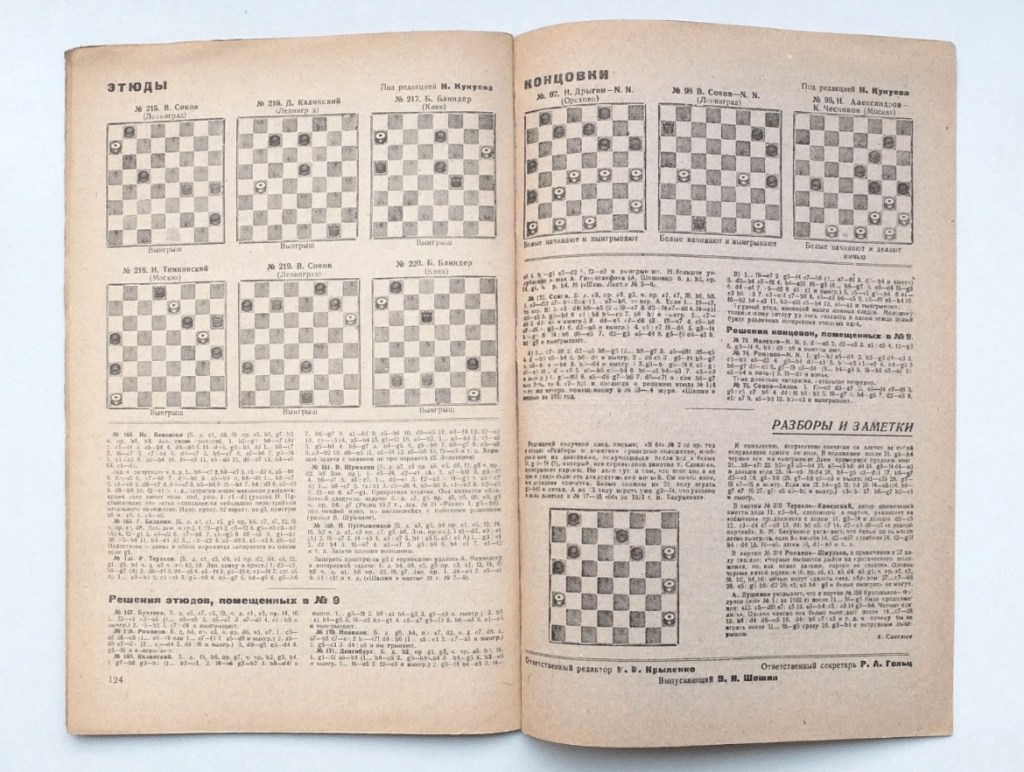
One way the Soviet state promoted chess and checkers was by publishing periodicals about them, reporting on events and presenting annotated games of instructional value. As important a chess publication as 64 carried a regular section for checkers. Here is an example:
64 No 8, 1933. “Chess and Checkers for the Masses.” Pixstock photo.
Pixstock photo.
Pixstock photo.
In the early 1950s, chess and checkers formed separate sections. By the end of the decade, checkers had developed its own federation. The USSR gained its first world champion in checkers, Iser Kuperman, in 1958. Of course, the 10 x 10 international version was played.
Iser Kuperman (R) (1922-2006). Somov/Sputnik photo (12 June 1963),
Checkers had several advantages over chess as a means of cultural enrichment. It was a much simpler game. It could be learned and played more quickly. Vodka consumption would not degrade the level of play to the same extent as in chess. While it was played on the same 8 x 8 boards as chess, the pieces were much simpler to produce, and therefore much cheaper and affordable.
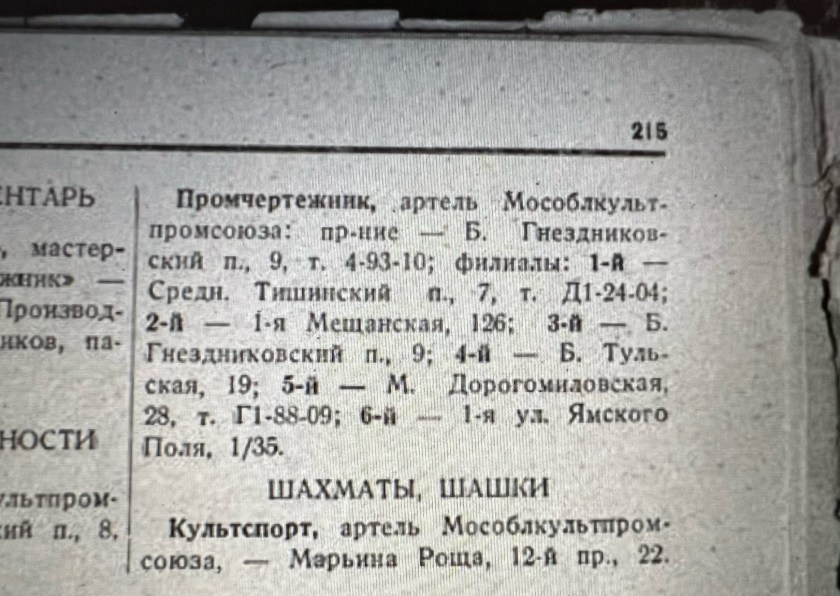
Makers of chess sets also manufactured checkers equipment. Here is a listing in the 1936 Moscow Directory for the well-known manufacturer of chess equipment, Artel Kultsport. Kultsport also advertised the sale of checkers (“шашки”) equipment.
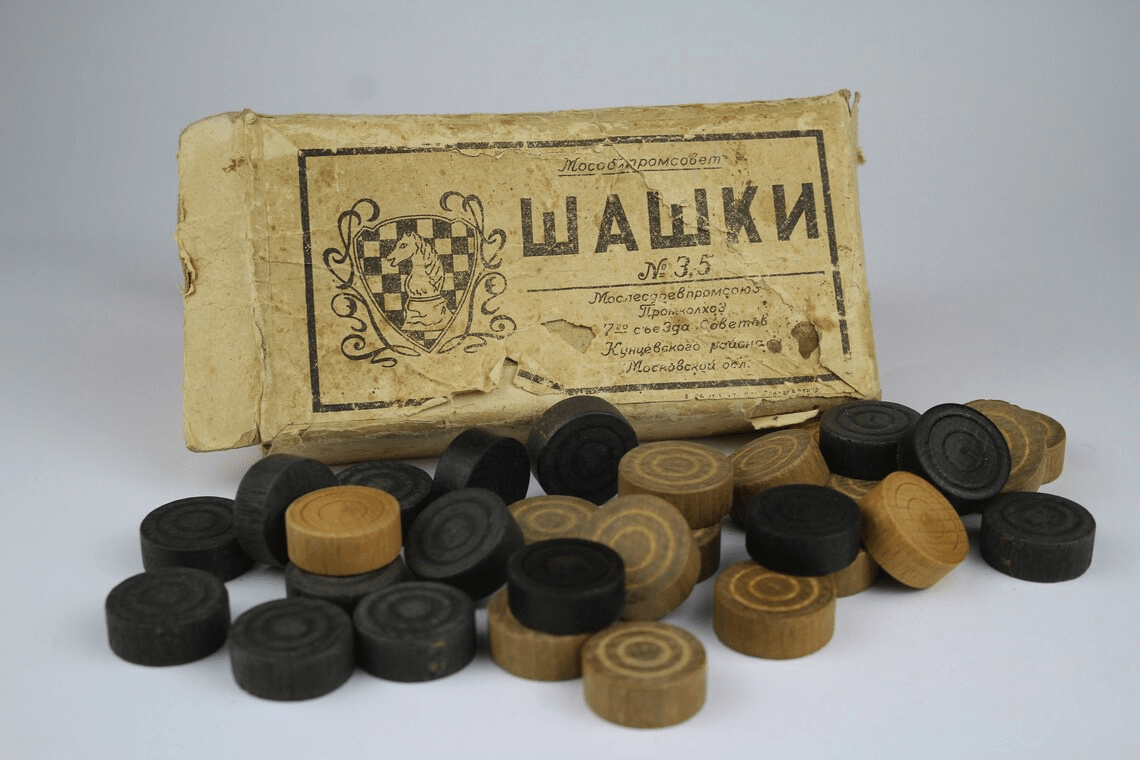
Checkers are much simpler in design than chess pieces, and accordingly are simpler and cheaper to produce. Earlier checkers were made of wood. In the fifties, plastic pieces appeared, and soon became common.
Whereas chess pieces are not susceptible to over political messaging, checkers were not so limited. It was not uncommon for them to contain Agiprop messaging, thereby undertaking the political purpose Krylenko envisioned. A case in point is this set from the 1920s.
1920s Agitational Checkers. Russia Chess House photo.
According to Russia Chess House,
The figures depict a sickle and hammer, a star, and also a flag with the inscription “Proletarians of all countries unite”[They] are an example of agitational art of the pre-war Soviet period. There was a propaganda plan, according to which the symbols of the new government should be placed everywhere. Even matchboxes and plates had to tell the people about the accomplishments of the revolution. Utilitarian and decorative objects were to be accompanied by revolutionary slogans.”
Some checkers contained political symbols without political slogans. Here is an example from the 1940s, where the Soviet five-point star is embossed on the wooden checkers. In Soviet heraldry, the five-point star is the symbol of the Red Army. By one account, this came about through an exchange between Krylenko and Leon Trotsky.
Another claimed origin for the red star relates to an alleged encounter between Leon Trotsky and Nikolai Krylenko. Krylenko, an Esperantist, wore a green-star lapel badge; Trotsky inquired as to its meaning and received an explanation that each arm of the star represented one of the five traditional continents. On hearing that, Trotsky specified that soldiers of the Red Army should wear a similar red star.
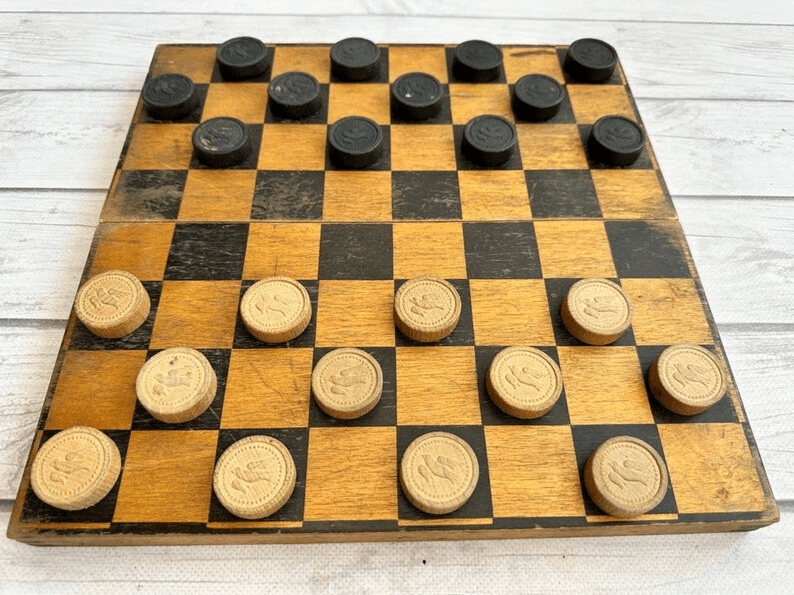
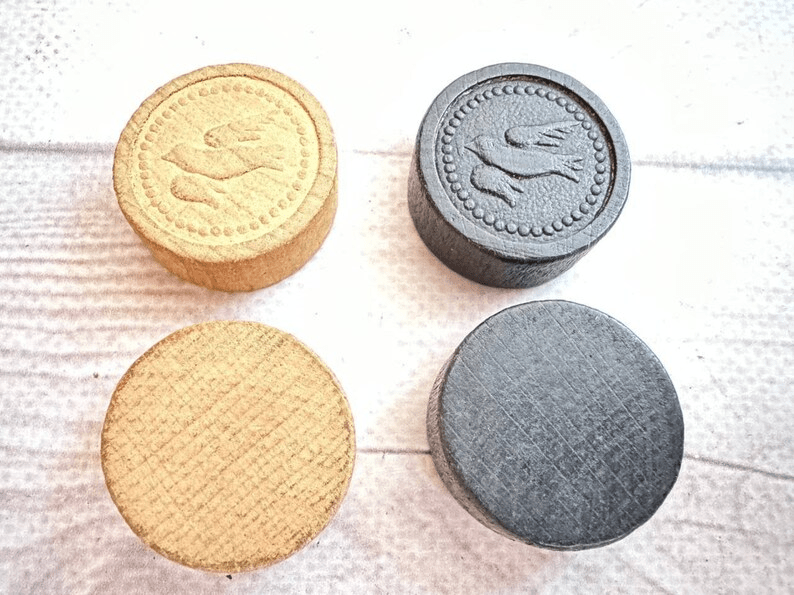
1950s Soviet checkers. Wood, with a dove of peace embossed on the front sides. Nikolai Filatov photo.
Not all the political icons carried by checkers were so bellicose. For example, these checkers (above) of the 1950s were embossed with the dove of peace. And the Bakelite checkers (below) celebrated the 1980 Moscow Olympics, which bore images of the different areas of competition.
AntiqueEmbassy photo.
Conclusion
As it did with chess, the Soviet state promoted checkers as part of its program to elevate the cultural level of the masses and to parlay the game into a means of political organizing.
A wonderful essay authored by Alan Power, master of artistic chess set restoration and owner of the Chess Schach. Please click the link to read Alan’s highly informative article.
“For a reader living in the free world the word “thief” perhaps sounds like a reproach? But you misunderstand the term. In the underworld of the …
To follow up on our recent article on Artel Drevprom’s “Baku” set, here are images of Baku sets that have been posted in the Facebook Group Shakhmatnyye Kollektsionery by its members, together with a few photos of the set appearing in the historical record.
Chuck Grau Collection, photosNick Filatov photosRon Harrison Collection, photosGeorge Henderson Collection, photosLokahi Antonio Collection, photoMike Ladzinski Collection, photos Keres and Petrosian, Tallinn 1964Holger Langer Collection, photosAlan Power photosAnatoly Karpov, photographer unknownSteven Kong Collection, photosJohn Moyes Collection, photoSource: Sergey Kovalenko, photographer unknownNick Rizzuto Collection, photoGurgenidze and Tal, Baku 1961, photographer unknown
I call this hypermodern set Belarusian because so many specimens originate from Minsk and its surrounds. Many collectors of Soviet sets describe it as Mushroom because the architecture of the king and queen resemble mushrooms: the flat, disc-shaped crowns resemble mushroom caps resting directly on long, thin, pedestal-free stems.
This specimen is from Minsk. The seller dated it as from the 1960s, and I concur. The kings are roughly 90mm tall, and the pieces are unweighted, deriving their stability from their oversized conical bases. Long, narrow stems rise from the large bases of the royals, attaching directly to the mushroom cap crowns, unmediated by a pedestal or connector as typically found in Staunton designs.
In contrast to the royals, the clerics and pawns have no stems. Their conical bases terminate directly at the bottom of their disc-shaped pedestals. Tear-shaped miters sit atop the bishops. The knights are oversized, slightly taller than the bishops and towering over the rooks. They are simply carved, with manes cut only on the left sides of their heads. The rooks are undersized. There is no demarcation between the rook’s base and tower walls, which rise up in a single uninterrupted curve.
Here we see a Mushroom set being used on the streets of Moscow in 1947. Some of the pieces appear to be taken from other types of sets.
Robert Capa photo.
Nick Lanier called the pieces “Svelte,” and listed the set as German, though he admitted “some details point to Russia or even the Baltics.” Given the pieces’ fat bottoms, I find the name inapt. Nor do I find any credible evidence to support his opinion of geographical origin in Germany or the Baltics. While a German influence is theoretically possible from Germans living with Russia in the twenties 1920s and 30s, the German population around Minsk and other western regions was relocated eastward during WWI.
This design likely can be traced to the 1930s. Kiev collector and vendor Nikolay Filatov believes this set is from the 1930s, but does not express a view as to its geographical origin.
c. 1930s Mushroom set. Nikolay Filatov photo.
The 1930s version is weighted, and its kings are slightly taller than the 1960s version, measuring 10.2 cm in height. Unlike the later version, the royals have three collars separating their crowns from their stems. The bishops also have three collars separating their miters from their stems, whereas the later versions have single disc-shaped pedestals. The shape of the earlier knight is also different from the later version, most notably in its straight chest. The chest of the later version is v-shaped. Thus, over time, the Mushroom design was simplified, making it easier and cheaper to produce.
The hyper-modernist design of the Mushroom set is reminiscent of another, later hypermodern design with Belarusian connections, the plastic Minsk 1980 Olympic set.
Chuck Grau Collection, photos.
It is interesting that two hypermodern set designs are linked to Minsk and Belarus. Belarus was devastated and Minsk leveled during the Great Patriotic War. It was rebuilt to exemplify Soviet Socialist Modernism and designated a Hero City for its reconstruction efforts. Minsk is home to myriad examples of Soviet Socialist Modernist architecture.
Other examples of Soviet Socialist Modernist architecture in Minsk can be viewed here, here, and here. While modernist architecture built after 1945 cannot explain set designs that arose in the 1930s, it can help explain why the hypermodern design of the Mushroom set became popular in Belarus in the 1960s, and why the 1980 Minsk Olympic set took a hypermodern design.
The hypermodern Mushroom sets were popular in Belarus in the 1960s, though the design originated before the war in a place yet to be determined. The post-war sets reflected the post-war Soviet Modernist architecture of Minsk, and remain monuments of their own to Soviet Modernism.
After the Great Patriotic War, sets of the Berezovsky design were mass-produced in labor camps located in and around the villages of Temnikov and Yavas, Mordovia. The set pictured above is one from my collection that has been restored to its original finish. The pieces below are in their original red. The opposing pieces are black. They are from 1954.
Chuck Grau Collection, photo.
The Gulag Museum provides a history of the Mordovian camps:
The Temnikovsky ITL was opened on 6 June 1931 and operated until 12 October 1948 when it was reorganized into the Osoby (Special) Camp № 3 (“Dubravny Camp”). The administration of Temlag initially was located in Temnikov District, Sredne-Volzhsky Krai, later it was in the settlement of Yavas in Mordovian ASSR (Autonomous Soviet Socialist Republic). The Temnikovsky Camp was established for logging but it was reorganized in 1940 for producing goods for mass consumption and conducting other works. The maximum number of prisoners held in Temlag was recorded in 1933 as 30,978. Many of them were women: 6,204 out of 14,896 prisoners in 1943. In terms of operational command, the camp was initially subordinate to the GULAG (Chief Administration of Corrective-Labor Camps and Colonies), later it was transferred to the control of the Administration of the NKVD (People’s Commissariat of Internal Affairs) in Sredne-Volzhsky Krai, and beginning on 8 May 1935 it was transferred to the GULAG again. In 1937 the Vetluzhsky ITL was included into Temlag. During its reorganization into the Osoby (Special) Camp № 3, all its property and some part of its prisoners were transferred to the Dubravny Camp and the Temnikov Industrial Complex of the GULAG.
Like the Berezovsky camp, the Mordovian camps were located near forests that provided the raw materials for logging, and the production of furniture, toys, chess sets, and other wooden consumer goods. It is after the 1948 transfer that we find chess sets being produced. Here is one of the earliest of the Mordovian Gulag sets, from 1949.
Mykhailo Kovalenko Collection, photo.
Many of these Mordovian Gulag sets have survived. Here are a variety posted by members of the Facebook group of Soviet chess set collectors, Shakhmatnyye Kollektsionery.
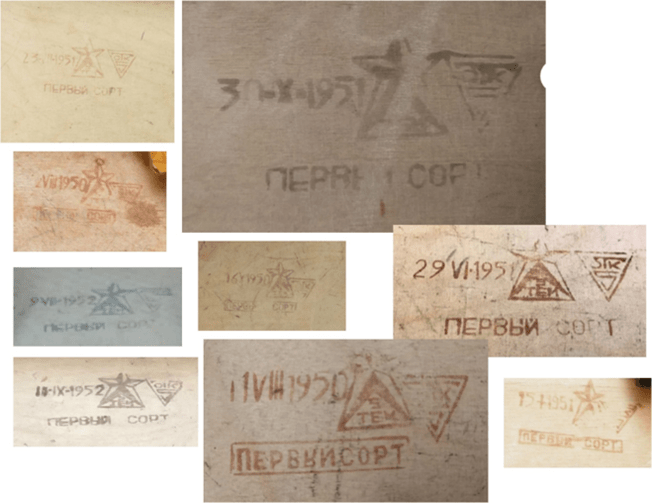
Here is a montage of stamps from the boxes of the posted sets.
Steve Phillips photo
These stamps bear dates from 1950 to 1952. The five-pointed star is the registered trademark of Gulag production. The “5 TEM” marks denote production by Factory 5 of the “Temlag” or Teminovsky Corrective Labor Camp. The triangular OTK stamp is the mark of the factory. Temlag’s major industries included logging, woodworking, railroad construction, and consumer goods, so it is no surprise to find chess sets were produced there.
Following Stalin’s death and Beria’s general amnesty of 1953 , the star Gulag trademark disappeared on many of the Mordovian sets, and stamps bearing the Tempromkombinat name begin appearing. Tempromkombinat is a Soviet acronym for the Temnikovsky Industrial Combine of Gulag. Here are some examples.
Steve Phillips photo
The Gulag trademark did not entirely disappear after 1954, though the reasons for this are unknown. Here is an example.
Sergey Kovalenko Collection, photo.
The sets produced by the Mordovian camp are quite attractive and relatively well-made. Unlike the Gulag sets of the 1930s, the Mordovian sets were unweighted, and relied upon their wide, conical stems and bases for stability. Portuguese collector and historian Arlindo Vieira admired the pieces’ simple, slim bodies and broad bases that afforded them stability during play despite being unweighted. He found them “elegant” and “aesthetically very pleasing” even though they are made from “poor” wood. In these ways, they reflect the “simplicity in manufacture, without great details in the pieces,” which results from “the need for serial manufacture” at “affordable prices” characteristic of Soviet pieces.
The knights of the Mordovian Gulag sets are simply carved, but aesthetically very pleasing. Here are some examples.
In 1960, the Gulags were officially terminated, though prisoner labor remained part of the Soviet penal system. By 1954, Soviet officials widely acknowledged that Gulag production was inefficient and unprofitable. The Berezovsky Gulag design perhaps reached the pinnacle of its development in the camps of Mordovia, but it would continue to be produced in State factories in ever more simplified and regrettably degraded versions.
Ongoing research indicates that the juvenile inmates of the Berezovsky Children’s Penal Colony made only chessboards, not the pieces discussed below, and that the MVD (Ministry of Internal Affairs, est. 1946) stamps date the boards as no earlier than 1946. I also have come to believe that the Soviet state employed Gulags only after WWII, beginning in Mordovia. With the dismantling of the Gulag system following Stalin’s death, forced labor was used to produce chess pieces and boards in labor colonies administered within the regular prison system in places like Valdai and Dagestan. A rewrite incorporating these revisions is forthcoming.
The 1930s saw the introduction of chess set production by Gulags. Gulags were used to produce chess sets in to fill the need for sets among the Soviet Union’s burgeoning army of chess-players. Increasing the production of consumer goods was a goal of Stalin’s Second Year Five Year Plan, and planners viewed Gulag labor in Gulags as one way to produce more consumer goods and toys.
The production of chess sets by Gulag labor may well have begun in the Berezovsky Children’s Penal Colony of the Ministry of Internal Affairs, located in Siberia, near Krasnoyarsk. The Krasnoyarsk camp opened in February 1938. It specialized in logging, but prisoners also made furniture, so chess set production was a natural complement. Indeed, Krasnoyarsk sits amidst large pine and birch forests. It was a major hub of the Gulag system under Stalin. The children’s penal colony likely housed the children of prisoners interred in other camps in the Krasnoyarsk area.
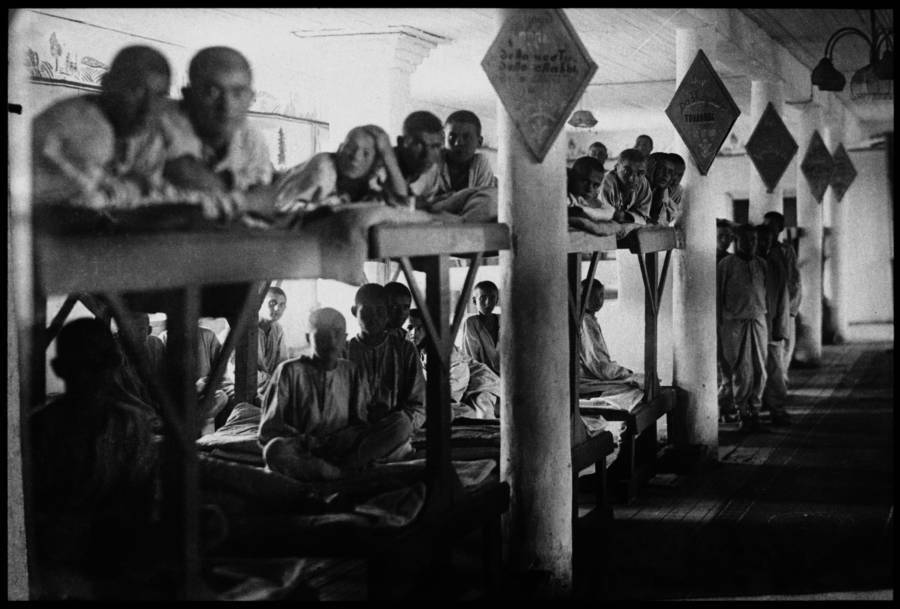
Child inmates in their Gulag bunks. Source: David Center for Russian and Eurasian Studies
Employing children employment in woodworking was a common Gulag practice. According to historian Anne Applebaum, while there are some examples of children’s work camps being assigned to hard physical labor such as mining or forestry in the harshest conditions of the far north, most children’s camps were dedicated to wood-working, metal work, and sewing. Gulag rules provided that children split their time between work and schooling, but the rules most often were honored in the breach. Camps often had no schools. Children faced the same deplorable living conditions and treatment as adult prisoners.
Here is an example of a first quality set the children of the Berezovsky camp made, and the stamp in its board.
First Quality Berezovsky Chessmen. Mike Ladzinski Collection, photo.First Quality stamp on Berezovsky set. Mike Ladzinski Collection, photo.
Here is an example of a second quality set made in this camp, identified by a stamp inside its board/box.
Neither box bears a date stamp, but we can reasonably date them as pre-1939, when Gulag production began bearing a five-pointed star as a registered trademark.
Gulag Trademark, registered 1939. Source: Eduard Andryushchenko
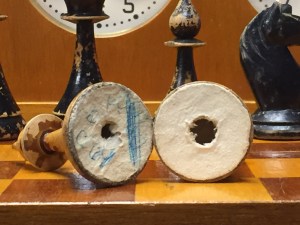
The design is both very simple and surprisingly elegant. Simplicity of design made sense for a set that was to be produced by unskilled or semi-skilled child Gulag labor. The bases and stems of the royals, clerics, and pawns form a cone, providing the pieces a good degree of balance. The “step-up” base characterizing the base-to-stem transition of the traditional Staunton design has been simplified to a circular cut. The stem ends at a disc-shaped pedestal, but the double collars characteristic of Staunton clerics and royals have been eliminated. The royals’ crowns are simply turned, the Staunton cross replaced by a tear-shaped turned finial on the king’s crown, and pointed crenels replaced by simple cuts on the queen’s coronet. The elaborately carved Elgin Marble knight has been replaced by a simply carved horse of a pleasing shape but little detail. The kings are 90 mm. The pieces are weighted with plaster. The set is made of birch, and the black pieces are simply painted. The design was successful and was produced all the way to the end of the Soviet Union, albeit in different production facilities over time. Later versions were unweighted.
Bore holes for weighting. Detail of Berezovsky knights. Chuck Grau Collection, photos.
Portuguese collector and historian Arlindo Vieira admired the design’s simple, slim bodies and broad bases, which afforded the pieces stability during play. He found them “elegant” and “aesthetically very pleasing” even though they are made from “poor” wood. In these ways, they reflect the “simplicity in manufacture, without great details in the pieces,” which results from “the need for serial manufacture” at “affordable prices” characteristic of Soviet pieces.
Vieira called the design “Latvian” because he found it in many pictures of Latvian events in which pieces like these were used. Many contemporary collectors of Soviet sets today would identify the pieces as “Latvian,” notwithstanding that over the course of six decades they apparently were manufactured in multiple locations from Moscow to Mordovia. However, artist-collector Alan Power and others have begun to call the pieces “Mordovian-Latvian,” or simply “Mordovian,” reflecting our our understanding that many sets of this design were manufactured in a Mordovian Gulag in the late 1940s and 1950s.
I also have seen the design referred to as “Tal’s favorite” or the “Latvian Tal” set. The basis for such claims is an exuberant exclamation Vieira uttered in his iconic 2012 video on Soviet chess sets, but neither he nor anyone else has offered any evidence for the claim other than Tal is seen playing with such pieces in several photos. Those photos by themselves do not reasonably support any claim of a special relationship between Tal and the design.
I am thinking of referring to this style as the Berezovsky design because this is where it appears to have originated based on the board stamps. I think that would be fitting homage to the child prisoners of the Gulag who first made them.
The key to understanding Soviet chess sets is to consider them as an economic problem born from a political choice.
The first things I learned in college as a student of political science and economics were that 1) politics is who gets what, when, and how; and 2) economics is what is to be produced, when, where, and how. I came to see economics and politics as two sides of the same coin, much in the way Classical Economists did, considering them to be the single subject of Political Economy.
John Stuart Mill, much maligned by Marx, saw production to be determined by natural laws, but distribution to be a product of political choices. In the Soviet Union, however, the decision that drove most everything related to chess sets was political: the program of Political Chess I have written about elsewhere established as state policy exponentially increasing chess play among the masses.
The program of Political Chess was wildly successful, ultimately drawing millions of players to the sport. According to Professor Richards, in 1923, at the end of the Civil War, there were approximately 1,000 registered players in the Soviet Union. In one year, that number ballooned to 24,000. By 1929, the number had grown to 150,000, and more than tripled to 500,000 within the next five years. The number of players doubled to 1 million by 1951, six years after the end of the Great Patriotic War, and then tripled to 3 million by 1964.
All these new players needed sets to play on. To appropriate a phrase from Lenin, what was to be done? Who was to produce these sets? Where? How? The Soviets’ answers to these questions was reflected in evolving state policy that first eliminated the market, then reinstated it, then abandoned it in favor of artisan collectives–artels–and workers imprisoned in Gulags, and finally by state factories worked by wage labor.
The Soviet Union inherited a system where the handful of sets needed were produced by private artisans working in ateliers and artels. During the Civil War, however, the Bolsheviks went to great lengths to replace private markets with a command economy, a set of policies given the name War Communism (1918-1921). Of course, it is hard to believe that anyone was making or buying new chess sets during this period of political, economic, and social upheaval.
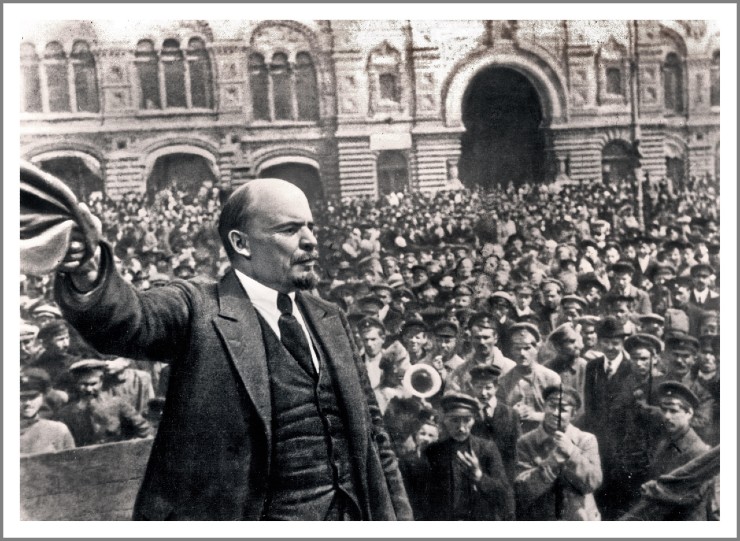
Lenin orating.
War Communism succeeded in arming, clothing, and feeding the Red Army enough to defeat the Whites and their Western allies, but it left everyone else cold, hungry, and wanting. So Lenin adopted what he called the New Economic Program (1921-1928), or NEP, that dialed back the command economy and promoted private markets to produce necessities and consumer goods. This gave ateliers and artels the space to operate and grow. They likely were able to provide the sets needed for the early stages of growth in player numbers, but there is scant direct evidence for chess sets being produced under NEP, even though we can infer that there were enough sets to service an increase of 23,000 players from 1923 to 1924, and of another 126,000 by 1929.
NEP Man and Woman enjoying the high life again.
Lenin died in January 1924, and Stalin successfully maneuvered to succeed him. Surrounded by hostile neighbors, Stalin saw a command economy to be the way the Soviet Union could rapidly industrialize. Plus, a command economy was more for him to command. So the expansion of private ateliers and artels was reversed under his First Five Year Plan (1928-1932). This could only have hurt anyone who had been making chess sets under NEP and strained the state’s ability to supply sets to the relentlessly growing army of players, which reached half a million by 1934.
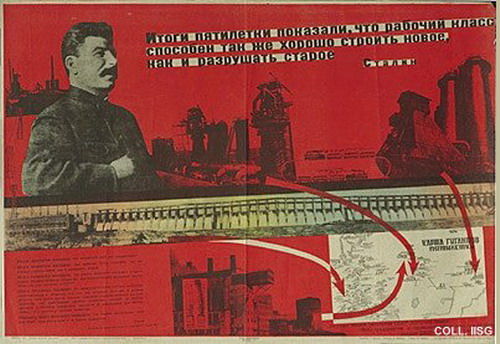
Poster for Stalin’s First Five Year Plan
Agricultural collectivization and drought brought famine and mass starvation from 1930 to 1933, and the singular focus on industrialization generated sizeable shortages of other consumer goods. Stalin addressed this with his Second Five Year Plan (1932-1937) and expansion of forced labor camps known as Gulags. While maintaining rapid industrialization as a goal, the Second Five Year Plan promised to expand the production of consumer goods, a category that included chess sets, and promoted the used of cooperatives–artels–to do so. Similarly, Gulags were seen as an economic engine to develop natural resources, build infrastructure, and manufacture consumer goods. Among the natural resources was timber, and among the consumer goods were furniture, toys, and chess sets, all made in workshops associated with timber harvesting.
These economic policies bore fruit. From 1932 to the onset of the Great Patriotic War, the number of artels and the value of their production markedly increased. We also can see from surviving sets and their affixed labels that artel chess production increased dramatically during this period, as a dazzling array of designs have survived.
The Gulags, too, turned to chess production. In the thirties, a Siberian children’s penal colony began producing simple, functional sets in a design that continued to be produced in a Mordovian Gulag in the forties and fifties and then in state factories until the fall of the Soviet Union and beyond.
1930s Gulag chessmen. Mike Ladzinski Collection, photo.
Both the Gulag design and many of the artel designs evidence the influence of Constructivists and other modernists. In the case of the artels, this influence likely was a matter of artistic expression. In the Gulags, however, it was a matter of economization. Simplification enabled unskilled and semis-skilled workers to more easily and economically manufacture the sets. It is ironic that one of the most enduring contributions of the Constructivists–champions of human liberation from wage slavery and commodity fetishism–was produced in Gulags. Such is the tragedy of Stalin’s Soviet Union.
The Great Patriotic War brought a decline in the artels, as war production required greater economies of scale. Surviving artels were able to continue largely by adopting mass production techniques characteristic of state factories. By 1956, the Central Committee of the Communist Party had decided that “many enterprises of industrial cooperation have ceased to have the character of artisanal cooperative production and essentially do not differ from enterprises of state industry.” Remaining artels began to be nationalized, becoming state-owned enterprises under the control of the various state authorities.
By the early 1950s, state authorities had come to realize that Gulag production was inefficient and uneconomical. Upon Stalin’s death, Beria’s general amnesty sounded the death knell of the Gulag system. By 1960, it was formally abolished, though prison labor continued to be used in state prisons.
The 1950s saw the dramatic rise of chess set mass production by state factories employing wage labor. Designs were simplified and often degraded. Wooden knights and finials were replaced with molded plastic ones. What had begun as an artisan trade fifty years earlier was now mechanized. Even so, players voiced protests over the unavailability of sets. By 1964, their numbers had reached 3 million.
The key to understanding Soviet chess sets is to appreciate that their history was driven by a political choice to grow the sport among the masses. How the Soviet economy produced the sets for that burgeoning army of chess-players in turn was driven by the evolution of Soviet economic policy and organization, from War Communism to the NEP to the Five Year Plans to the end of Gulags and artels. You can read about this in more detail in my forthcoming article in CCI-USA, “The Means of Soviet Chess Set Production,” later this year.
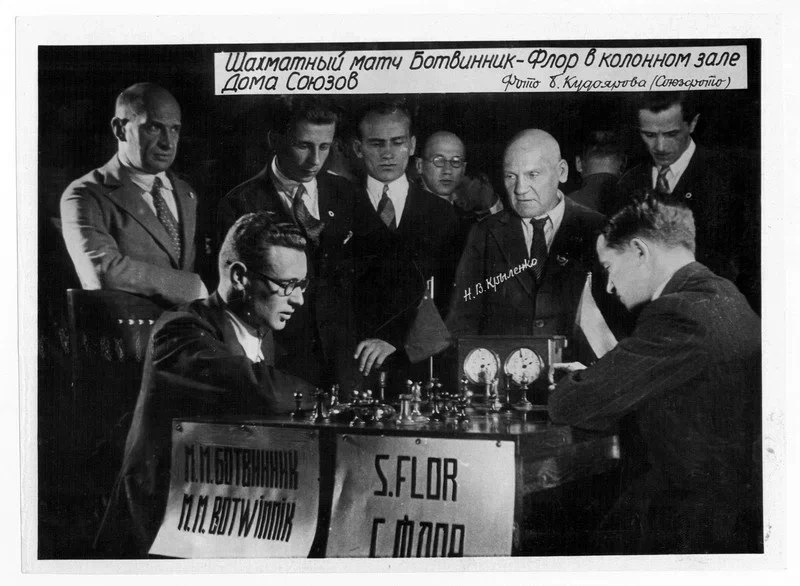
Confusion remains as to the identity of the set (or sets) used in the 1933 Match between the Soviet Mikhail Botvinnik and then-Czech Grandmaster Salo Flohr. The Match, comprising twelve games, six of each played in Leningrad and then Moscow, was engineered by Nikolai Krylenko, head of the Soviet Chess and Checkers Section, editor of 64 magazine, and Soviet Commissar of Justice to pit the rising Red Star against Flohr, then considered to be a leading challenger for the world championship. Krylenko sought to gauge the progress of his program of political chess in achieving its goal of surpassing the West in this arena of cultural and intellectual competition. Wrote Krylenko in the introduction to Botvinnik’s book on the match:
The moment came when we had to test our quality growth, our strength against the professionals of Western Europe. This was the first purpose of the Flohr-Botvinnik match we organized.
M. Botvinnik, Botvinnik – Flohr: Match 1933 at p. 5 (Kindle Edition, 2020).
Sources of Confusion
One source of the confusion stems from the close proximity of the 1933 match to the 1935 Second Moscow International Tournament, where Flohr and Botvinnik drew their only game and shared first place ahead of former world champions Emanuel Lasker and Jose Raul Capablanca; and the 1936 Third Moscow International Tournament, where Botvinnik won the famous “Mop the Flohr” game en route to taking second place behind Capablanca, Flohr finishing third. Photos of the three events, often lacking proper labels, were conflated and confounded, even in Botvinnik’s book on the match, and the sets used in the 1935 and 1936 events were thought by some to be those used in 1933.
Recent research has determined that the 1935 and 1936 Moscow events used one design, and the 1933 match another. The design used in those events has been definitively identified and has come to be known as the Botvinnik-Flohr II(or BFII) set. The set used in the 1933 match has come to be known as the Botvinnik-Flohr I (or BFI) set so as to distinguish it from the later design. Although this distinction has allowed us to identify and study the BFII design in its evolving variations, it has not clarified the identity of the 1933 Match set
A second source of the confusion is the paucity of photos of the 1933 Match that have sufficient clarity to readily identify the set used. Because photographic evidence from the 1933 Match is so scarce and of such poor resolution, collectors, myself included, and others have misidentified the design actually used, and only compounded confusion by repeating the mistake as if it was an established historical fact.
A third source of the confusion is that the numbers of Soviet sets and their many creative designs had not yet begun to explode until later in the 1930s. Not only is less known about sets and designs in the immediate post-Civil War Soviet Union, but there were far fewer of them made and even fewer, if any, that have survived. Thus exemplars of these sets are hard to come by, making it difficult to compare candidate sets to the one appearing in the 1933 photos.
Examining the Photographic Record
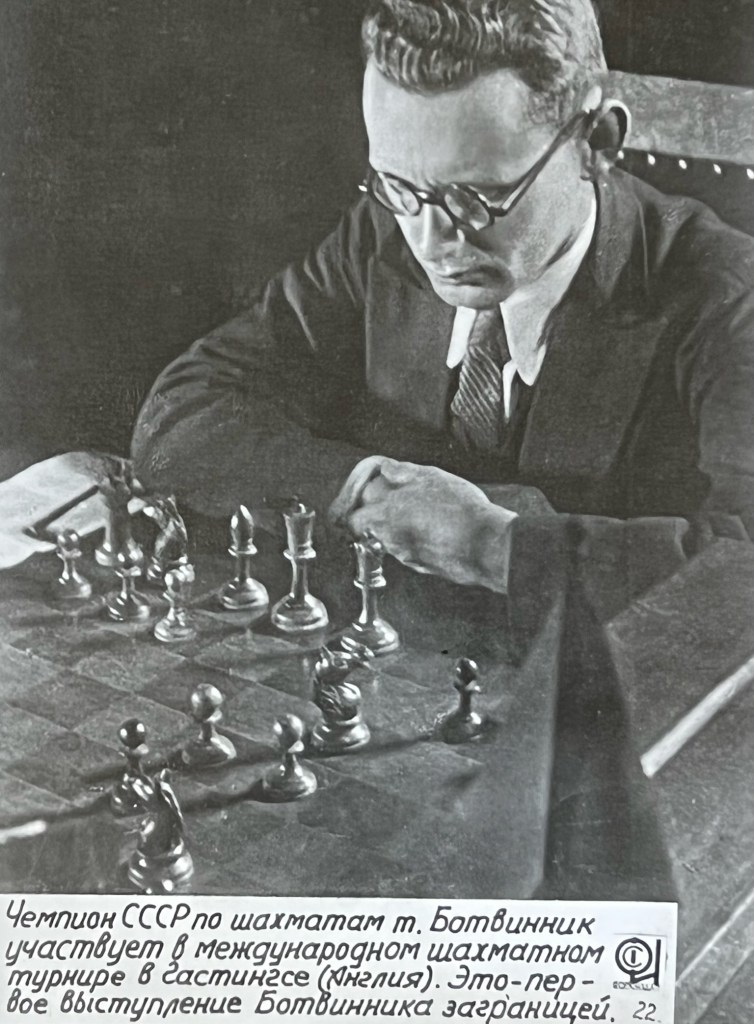
Perhaps the clearest photo of the set used in the match is found in Igor Botvinnik’s Photochronicle of his uncle’s career. Although the photo’s caption refers to Hastings, the position on the board and a comparison to other photos known to be from the 1933 match indicate that it is indeed from the 1933 match and not Hastings.
Figure 1.Botvinnik-Flohr Game 9, 14 December 1933, Moscow. Caro Kann, Panov attack, after 5. … Nc6. 1-0. Source: I. Botvinnik, Mikhail Botvinnik: Photochronicle 20 (2011).
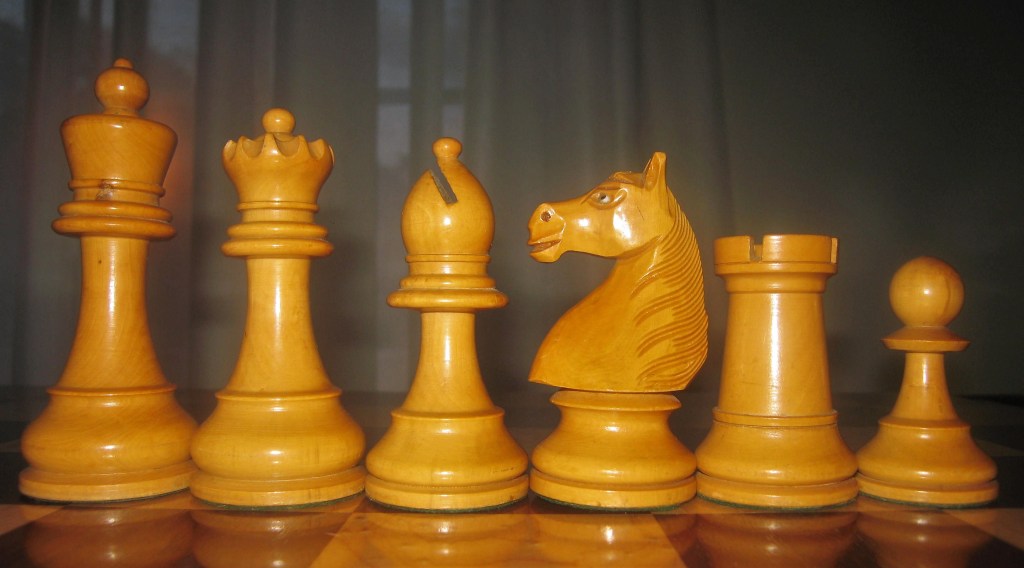
Moreover, it is clear from even a cursory examination that the pieces in the photo above are not those used for decades at the Hastings Chess Congresses.
Figure 2. Hastings Congress Chess Pieces. Mike Ladzinski Collection, photo.
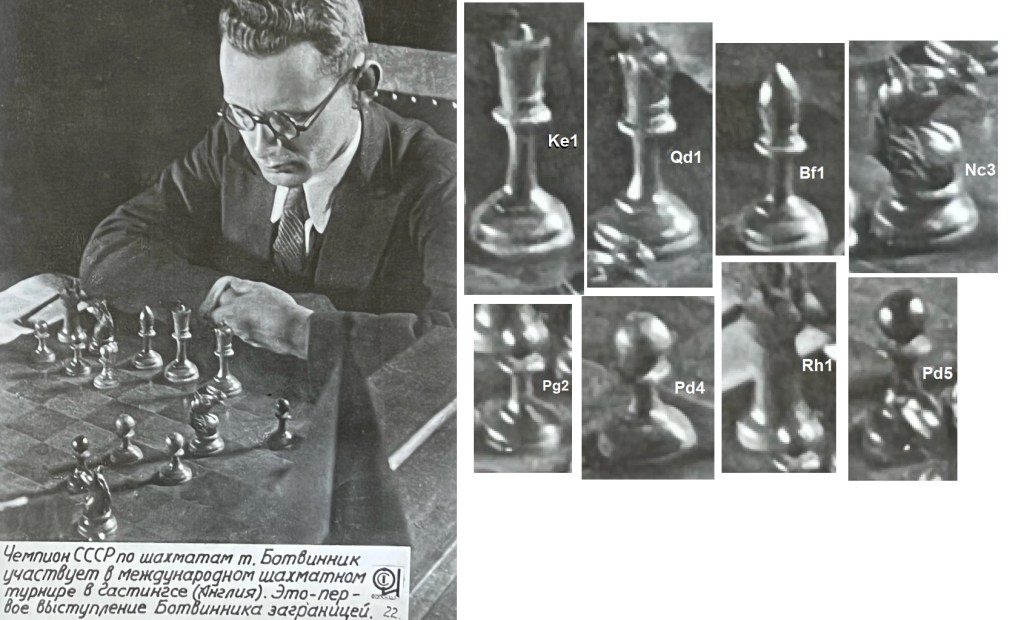
In Figure 3, I have enlarged images of the pieces in Figure 1 and labeled the squares on which they are set. They are not perfectly to scale because I enlarged them a constant 300% from the photo, and the pieces were all at slightly different distances from the camera.
Figure 3. Enlargement of pieces from Game 9. Source: I. Botvinnik, supra.
We can glean a number of observations from these images. The stems of the royals are concave, though possibly skewed towards the bases. The stems of the bishop and pawns appear more vertical. The pedestals of the king, queen, and bishop are all substantially wider than the connectors. The connectors of these pieces appear to have two rings defining the top and bottom of the connectors. together with the pedestals, the rings form the “triple collar” characteristic of the original Staunton design. The ratios of the heights of the royals’ crown + connector/base + stem are high. It appears less in the bishop.
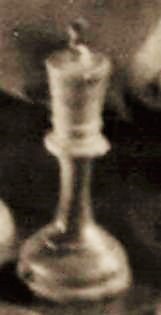
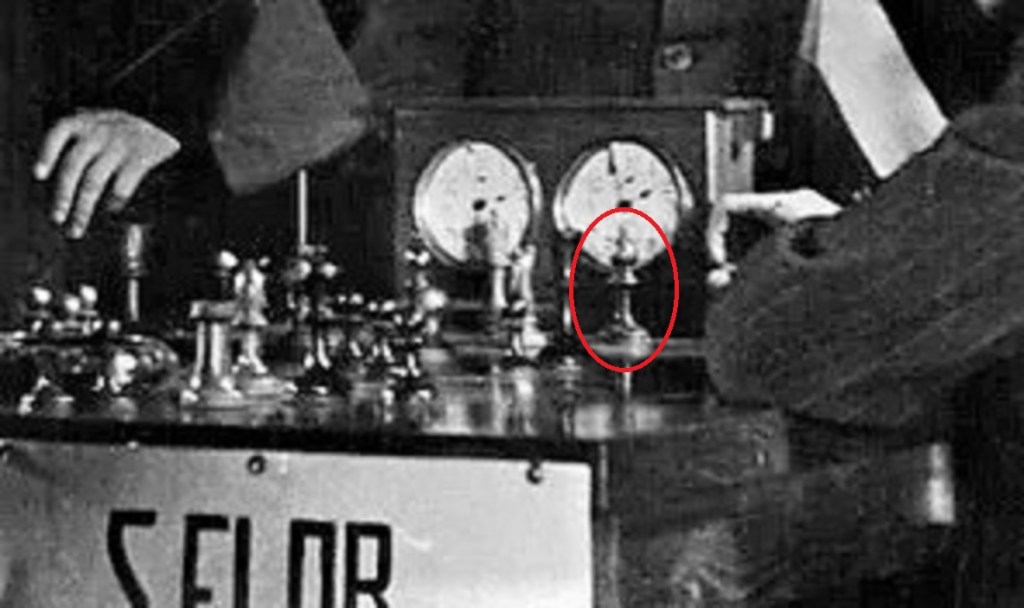
The king on e1 at first appears to lack a finial. Further examination of a higher resolution version of the photo provided by Sergey Kovalenko suggests otherwise. This image is shown in Figure 4. The finial appears to incorporate compound curves.
Figure 4. Source: Sergey Kovalenko
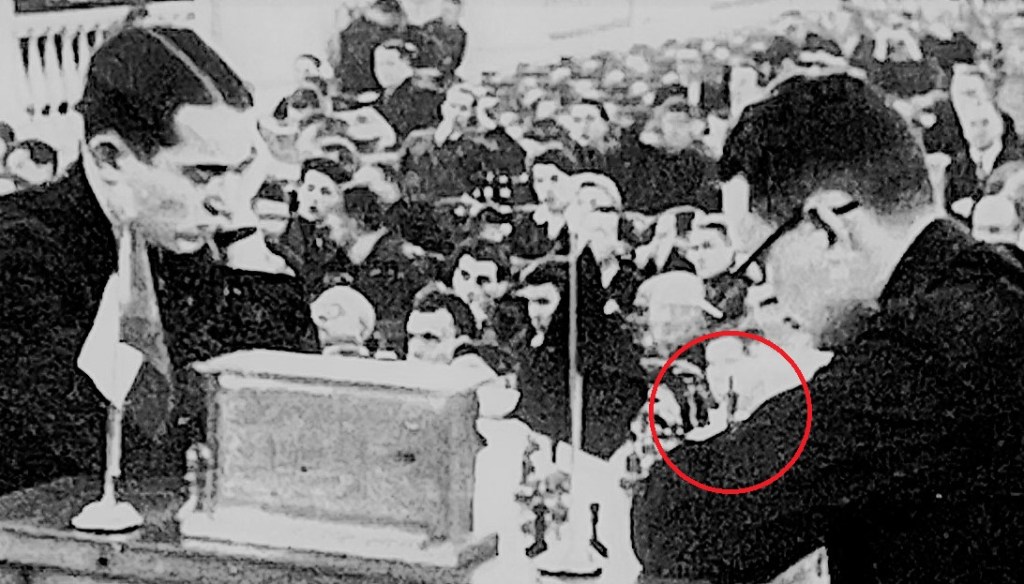
The use of a finial on the kings is confirmed by Figure 5, which appears to show a peg-shaped finial on the White king just above Botvinnik’s left arm (circled in red).
Figure 5. Source: I. Botvinnik, supra at p. 12.
Returning to Figure 3, the queen’s coronet includes multiple crenelations. Both the royals’ crowns appear to trumpet somewhat at the top. The bishop on f1 lacks a finial and does not appear to have a miter cut. Examination of other photos from the match leads me to think that the finial was been broken off from this bishop. However, Sergey Kovelenko has found what appears to be a miter cut in an enlarged and enhanced version of this post’s cover photo, presented here as Figure 5.1. Note the bishop right beneath Flohr’s clock
Figure 5.1. Source: Yandex courtesy of Sergey Kovalenko.
The knight on c3 of Figure 3 exhibits a C-shaped back and a V-shaped neck. Its back may extend beyond the cylinder of the base. The snout appears to angle up like the Tal knight. It appears to extend beyond the cylinder of the base. It appears to have carved nostrils and Chagall eyes. The ears protrude from the torso. The mouth is open as in the Laughing Knight sets. Teeth are not evident, but neither is their presence precluded. There appears to be a carving cut into the top of the neck extending most of the length of the top of the neck. The mane extends to roughly the mid-line of the torso, which was carved away to leave the mane. the mane has a number of flares, possibly four.
The rook’s tower in Figure 3 appears to have straight walls. The number of merlons is less clear, but it seems to me that there are four. The pawns are all of the same basic form, but the sizes of the heads vary. The d4 pawn’s head is substantially larger than those of a2, d5, f2, g2, and h2. The head of the pawn on c4 is larger than all of the others except for that on d4.
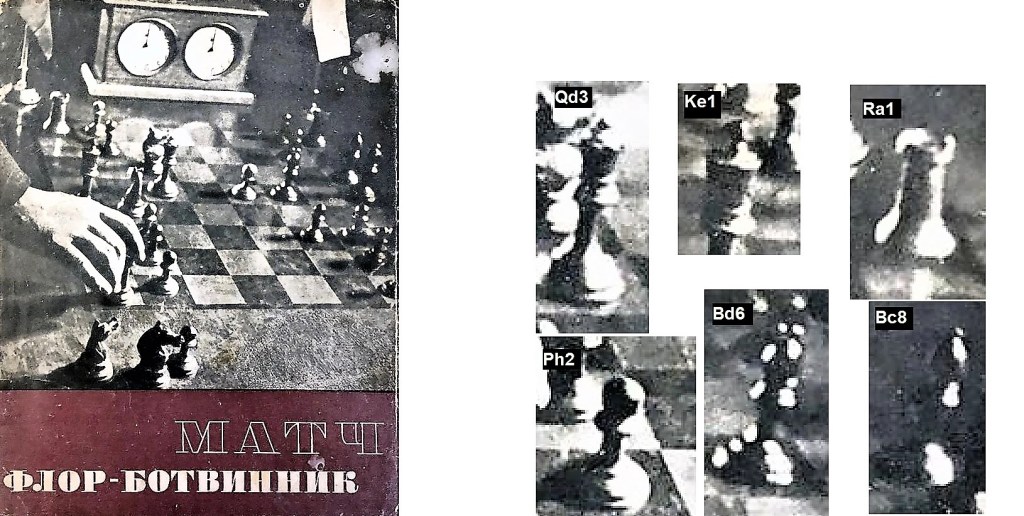
Figure 6. The cover of Botvinnik’s account of his 1933 match with Salo Flohr and enlargements of the king, queen, bishop and pawn.
The cover to the Match book authored by M. Botvinnik (Figure 6) remains one of the best sources as to the design of the 1933 set despite its somewhat poor quality. I use it here to supplement some of the observations made above. I have enlarged images of certain pieces from the squares indicated.
The first matter of note is that the crown of the white king on e1 appears to bear a cross. This, together with the set’s many other Staunton elements suggests a pre-Soviet origin of either the set or its design. Second, the bishop on c8 definitely is topped by a small, spherical finial. Neither this bishop nor the one on d6 appears to have miter cuts. Third, the tower walls of the rook on a1 appear to be straight. It also appears to me that this rook’s turret has four merlons.
Except for the king’s cross and the bishop’s finial, I don’t see anything in this photo to alter my observations of the Photochronicle photo (Figures 1 & 3 supra) described above.
Let’s examine several sets that have been thought to be the design used in the 1933 match.
The Moscow Chess Museum Set & Fabiano Specimen
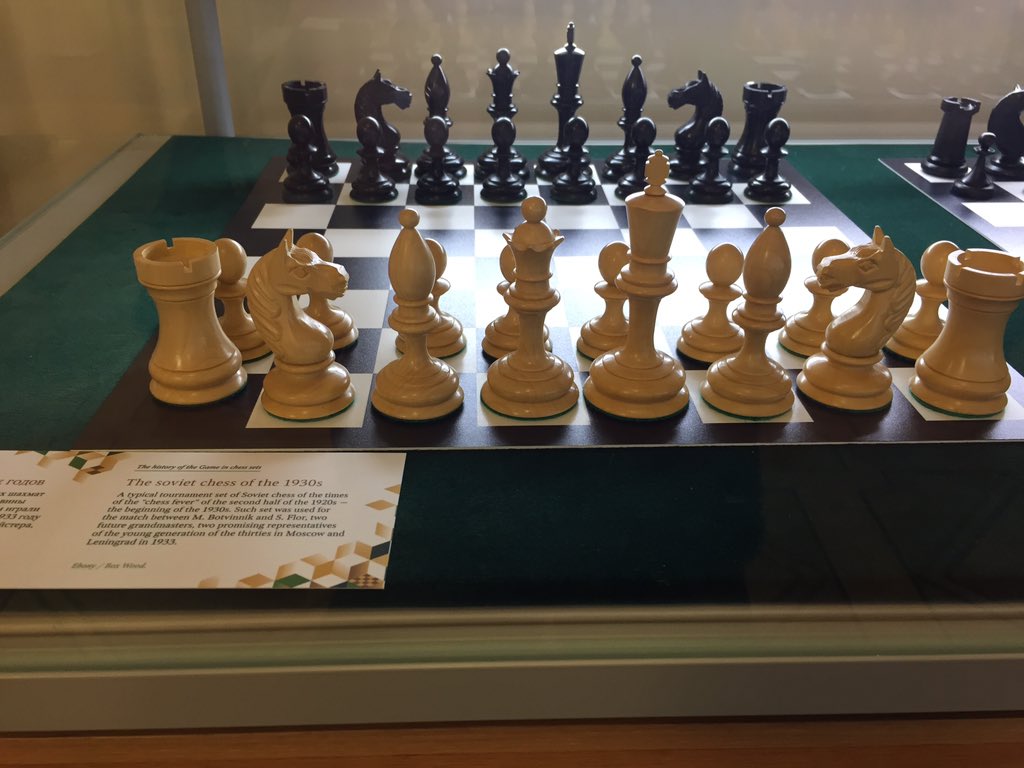
Figure 7. Moscow Chess Museum Set. Antonio Fabiano photo.
This set resides in the Russian Chess Federation’s Moscow Chess Museum. Alluding to the famous 1925 film starring Jose Raul Capablanca, it describes the set as “A typical tournament set of Soviet Chess of the times of the ‘Chess Fever’ of the second half of the 1920s – the beginning of the 1930s.” It asserts that sets like this were used in the 1933 Botvinnik-Flohr match. Alas, the set is a reproduction manufactured by the Indian firm ChessBazaar, not an original. Here is the reproduction:
Figure 8. Chess Bazaar Reproduction of 1933 match set. ChessBazaar photo.
The reproduction is consistent with the photographic evidence in many respects. This consistency at one time had led me to believe that it accurately reproduced the 1933 set. But further analysis has forced me to recognize that this reproduction also diverges from the Match set in important respects. The bases employ a double step up from the base to the stem, whereas there is a single step-up shown in the historical photos. The stems of the pawns and bishops are noticeably more arced than those in the photos of the originals. The rook walls are quite concave whereas the originals are straight. The original rook has a discernible base, whereas that of the reproduction merely continues the line of the tower walls. Although we cannot see the connection between the stems and pedestals of the original pieces, the way it is turned in the reproduction gives the royals and clerics the appearance of four collars, which I have yet to see in any other Soviet or late Tsarist set. I find the pedestals narrower on the reproduction than the originals. The rings defining the tops and bottoms of the connectors of the royals and clerics are more pronounced in the reproductions than in the originals. The base of the queen’s coronet in the reproduction is narrower than in the original, its upward curve and crenels more pronounced. Its finial is larger than the original’s. The queen is proportionally shorter relative to the bishop and king than in the set in Figure 3. The reproduction’s king’s crown does not have the same half-globe connector to the finial that the original’s does. The reproduction’s knight torso appears thinner and more serpentine than the originals. Its snout does not have the hourglass shape of the originals, and its mouth does not open as wide as those of the originals, if at all, perhaps because it includes detailed teeth carvings.
Figure 9. Antonio Fabiano’s specimen. Antonio Fabiano Collection, photo.
ChessBazaar’s reproduction is in fact a very good copy of the beautiful set, shown in Figure 9, from Brazilian collector Antonio Fabiano’s astounding collection. In some respects, such as the more subdued crenels on the queen’s coronet, it is closer to the 1933 match set than the reproduction is. But most of the analysis of the reproduction above also relates to this original. One item of particular note is that the kings’ crowns are topped with small crosses, like the king on e1 in Figure 6 appears to be.
The Kong Specimen
A set nearly identical to the Fabiano specimen resides in the collection of Singapore collector Steven Kong.
Figure 10. Steven Kong Collection, photo.
The Kong set shares many of the design elements of the sets in the handful of photos we have of the 1933 Match set. It’s very close in its features to Fabiano’s set. A couple noticeable differences from the sets in the 1933 photos: this queen is shorter, particularly in relation to the bishop; this rook turret is taller; the tower walls of this rook are concavely curved; the king’s finial is a large ball rather than a cross or complex curve; this queen finial has a stem and larger ball. Finials are ephemeral elements in many ways because they are prone to get lost and be replaced, and I tend to afford them less weight than other elements when identifying sets. That said, placing a ball atop a stem is a strong and unique element that I’d tend to treat as original. Indeed, Steve assesses his finials to be original. Overall, I think the Kong specimen is very close to the 1933 set but isn’t the exact set seen in the 1933 photos.
The Dzhemakulov Specimen
A third set is nearly identical to the Fabiano and Kong specimens. Photos of it were posted in chess.com by collector Murat Dzhemakulov in 2017.
Figure 11. Source: Murat Dzhemakulov.
This set is very peculiar in its coloring. Under Stalin, playing sets contained Red and Black Armies, but never Red and White Armies so as to not afford any credibility to the White Army of the Civil War. This leads me to think this may be a pre-Stalin set. It certainly would not have been used in the 1933 Match with these colors.
The rooks in this set appear to have the same proportions and straight tower walls as those in the 1933 photos. The ball and stem queen finials differ from those of the Match photos, but the pegs might resemble those apparently atop Botvinnik’s king in Figure 5.
Moscow collector Alexander Chelnokov has indicated that he has similar sets in his collection, but as the time of this publication, photos of them are not available.
The pieces in Figure 12 often are mistakenly called “BFI” or “Botvinnik-Flohr I” pieces, suggesting erroneously that they were used in the 1933 match between Botvinnik and Flohr. While they bear some similarities to those used in that match, notably the structure and details of the knight and the straight walls of the rook’s tower walls, they have a distinctly different base, stem, and pedestal structure, among other differences. The base lacks the step-up to the stem found in Figures 1, 3, and 6; the stems rise straight from the base after an initial curve ascending from the base and cannot in my view be considered concave; the pedestal connects to the stem at a right angle rather than an arc meeting a horizontal plane; and the piece-identifying crowns and miters extend almost the entire diameter of the pedestals, whereas they are indented in Figures 1,3, and 6.
The designation BFI first arose after it was demonstrated that the pieces used in the 1935 First Moscow International Tournament differed significantly from those used in the 1933 Botvinnik-Flohr Match. When I first acquired a different specimen of these pieces (Figure 13), which I later sold, I mistakenly identified them as pieces like those used in the 1933 Match.
Figure 13. Chuck Grau photo.
The foregoing analysis has convinced me I was mistaken. The design is beautiful and significant in its own right, and deserves its own name. I have begun to call these pieces a Soviet Upright design.
A Fifth Candidate Set
I likewise have misidentified at least one other set as the pieces of the 1933 match.
I believe this set to be from the 1930s. Although with a 3.7″ king it is perhaps on the short side for a tournament set, its very heavy weighting suggests that it was. It shares many design elements with the sets in the photos from the match above, but a number of dissimilarities preclude it from being the set of the Match. The stems of the royals and clerics are mildly concave, and the bases share the same general three-level structure as the Match set, but the diameters of the piece signifiers on those pieces are too close to that of their respective pedestals. The king’s finial incorporates a complex curve that seems consistent with the king in Figure 3.
This knight incorporates a C-shaped back and V-shaped neck, but it is too large in relation to the rook and bishop when compared to the pieces on f1,g1, and h1 in Figure 3. It lacks the upward tilt of the head found in the knight on c3 of that photo, and its ears seem angled too far forward.
The rook’s tower walls are straight, and its turret has four merlons, but its tower is wider and appearance more squat than the rooks in Figure 3 and Figure 6. It is the same height as the pawn, whereas the rooks on h1 of Figure 3 and a1 of Figure 6 appear noticeably taller than the pawns in front of them. And the pawn’s head is very elliptical, whereas the pawns’ heads in Figures 3 and 6 are all spherical, even if of varying sizes.
Conclusion
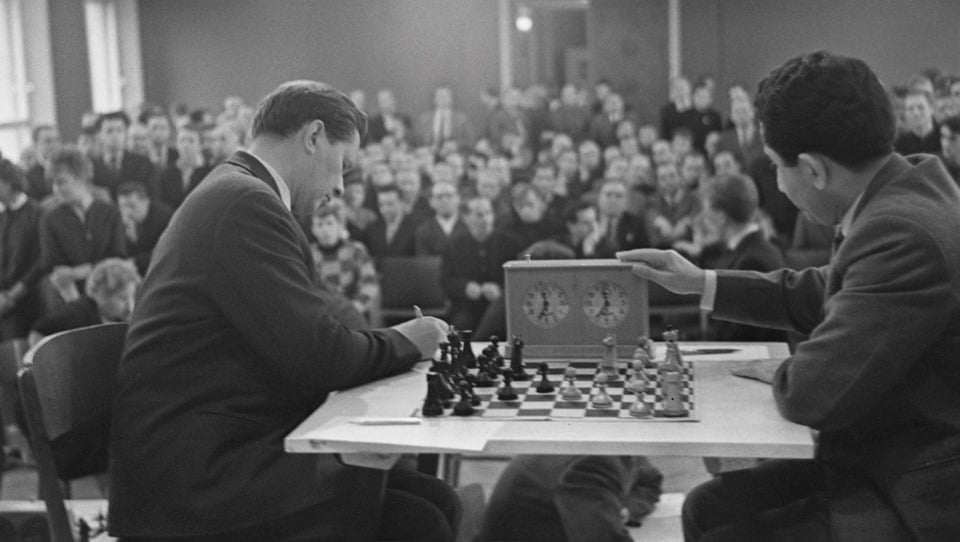
Figure 15. Flohr and Botvinnik. Provided by Eduardo Bauza. Photographer unkown.
The set used in the 1933 match between Mikhail Botvinnik and Salo Flohr has received much interest and generated much confusion. It has been reproduced by two major modern manufacturers. One of these reproductions resides in the Moscow Chess Museum, which identifies it as the set of the match. This set appears to be a very close copy of an original set held in the collection of an esteemed collector. Two other similar sets have appeared, one with the elusive straight rook walls. None of these sets have the miter cuts appearing in one of the photos. While these sets contain more elements of the original set than other sets that have mistakenly been identified as the Match set, most notoriously the misnamed BFI set, I am convinced that a specimen of the 1933 Match set is yet to publicly emerge. Perhaps that will change when photos of the Chelnokov specimens become available.


















































 Soviet and Late Tsarist Chess Sets
.jpg)