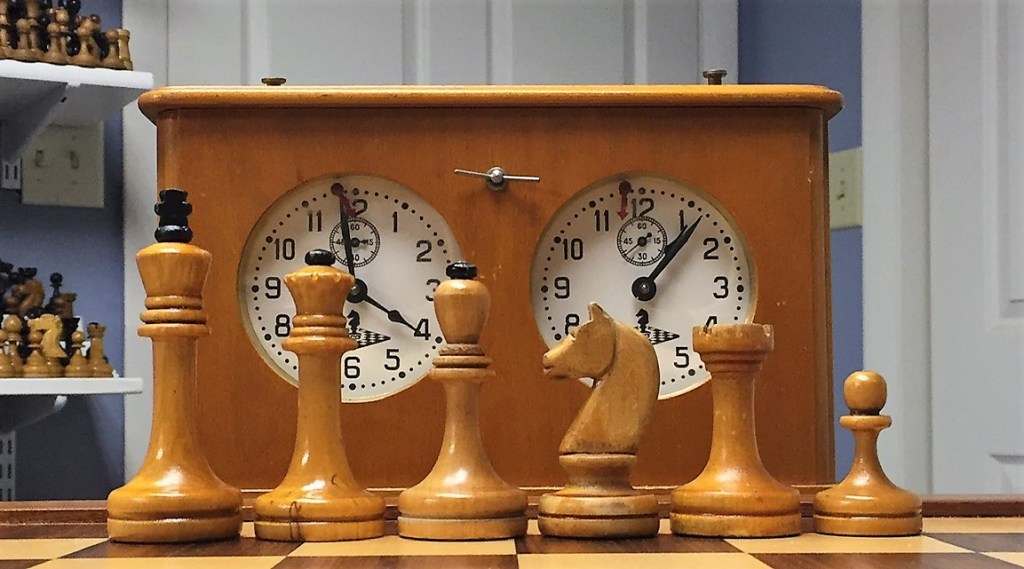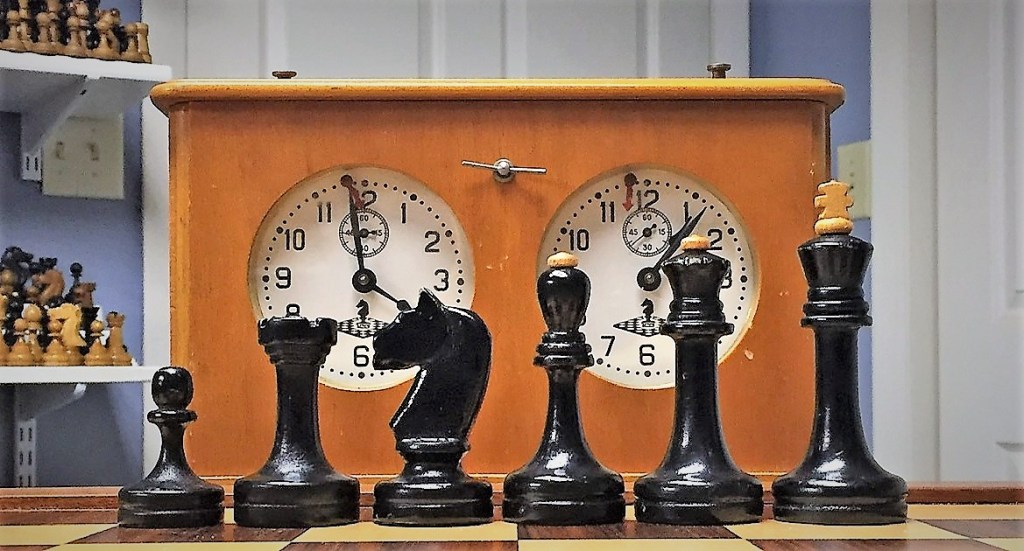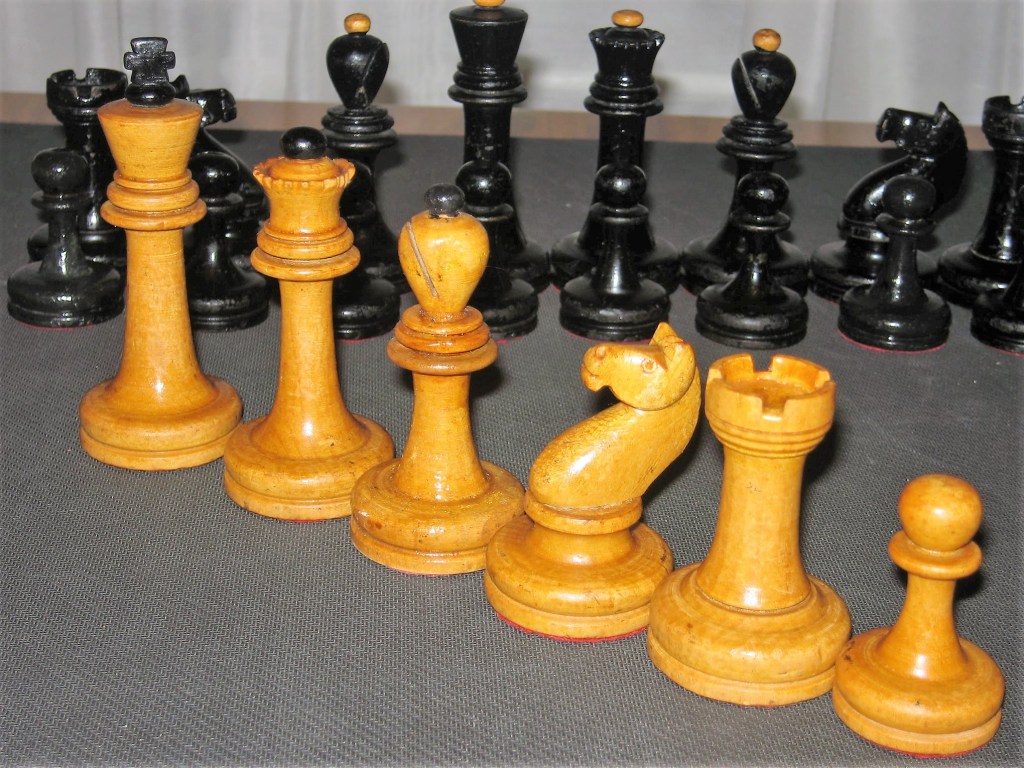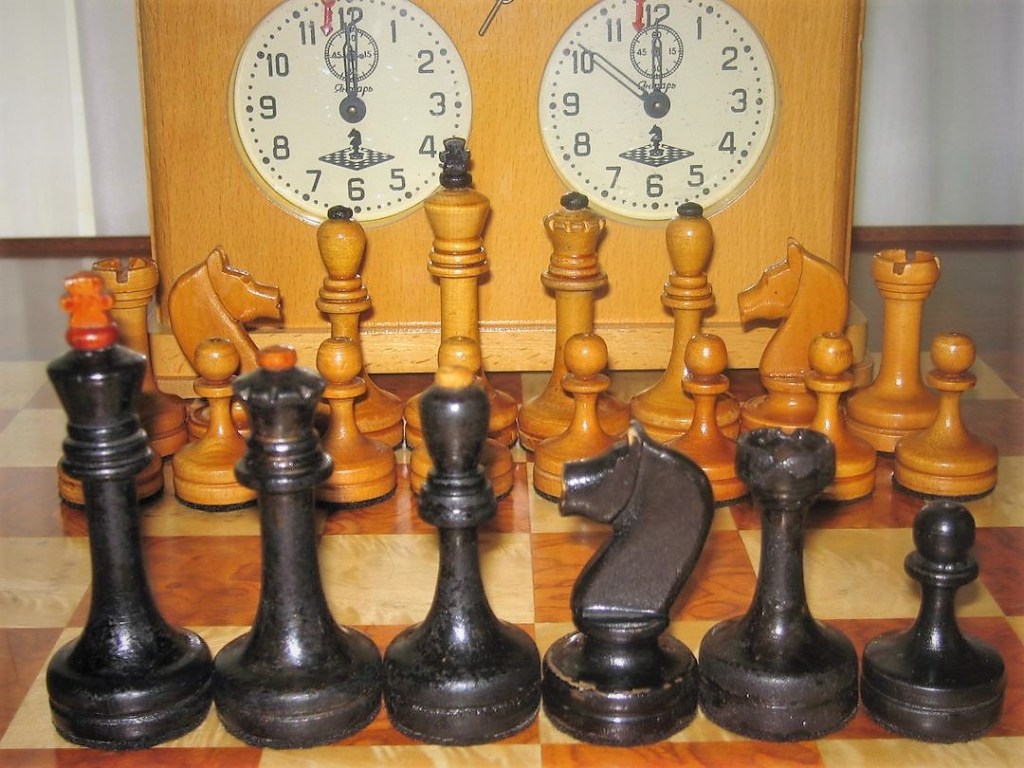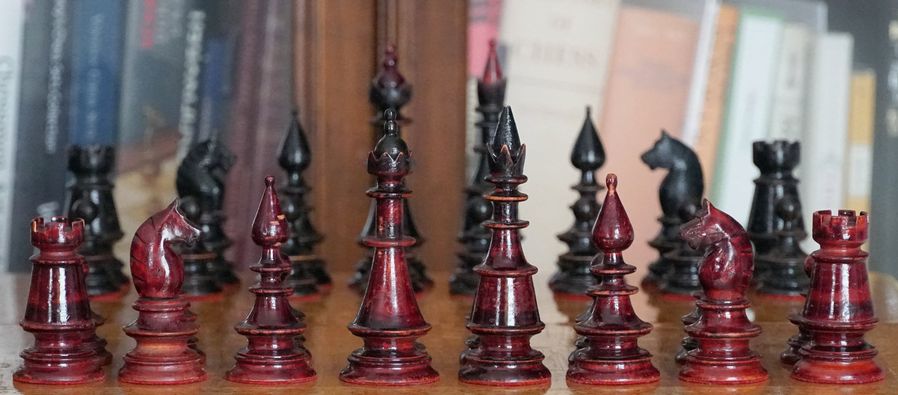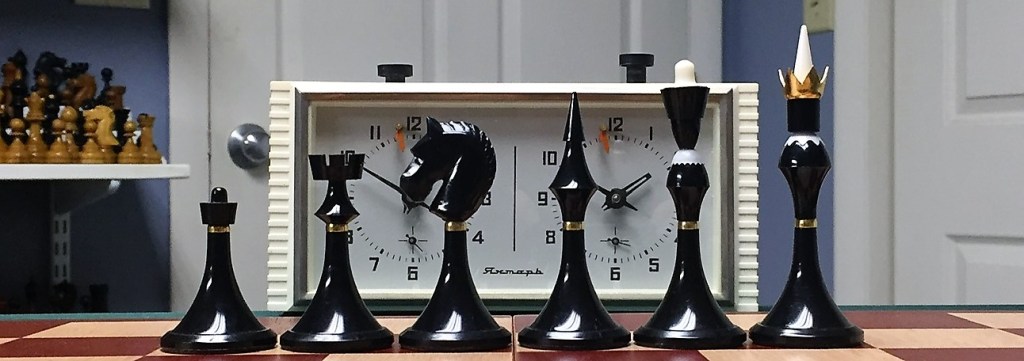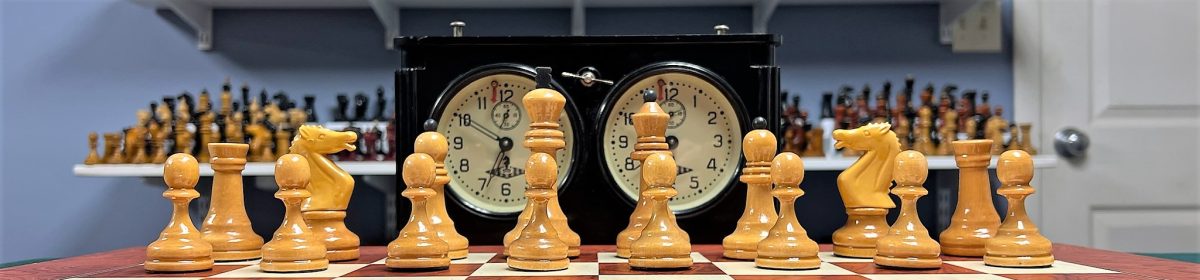
The Curious Case of Leningrad Factory No. 8 and the “1943 Leningrad” Set

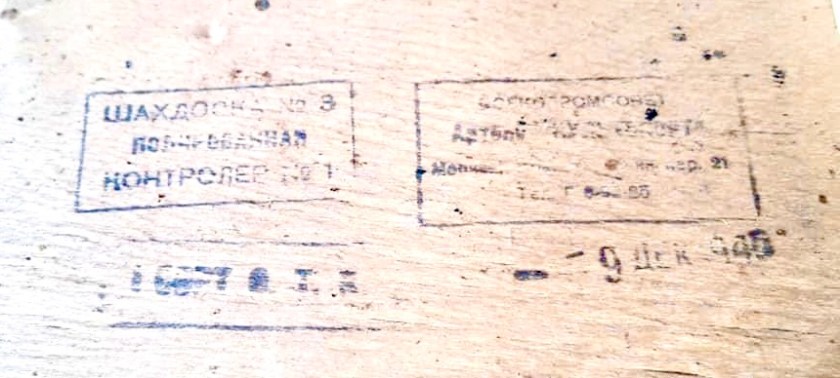
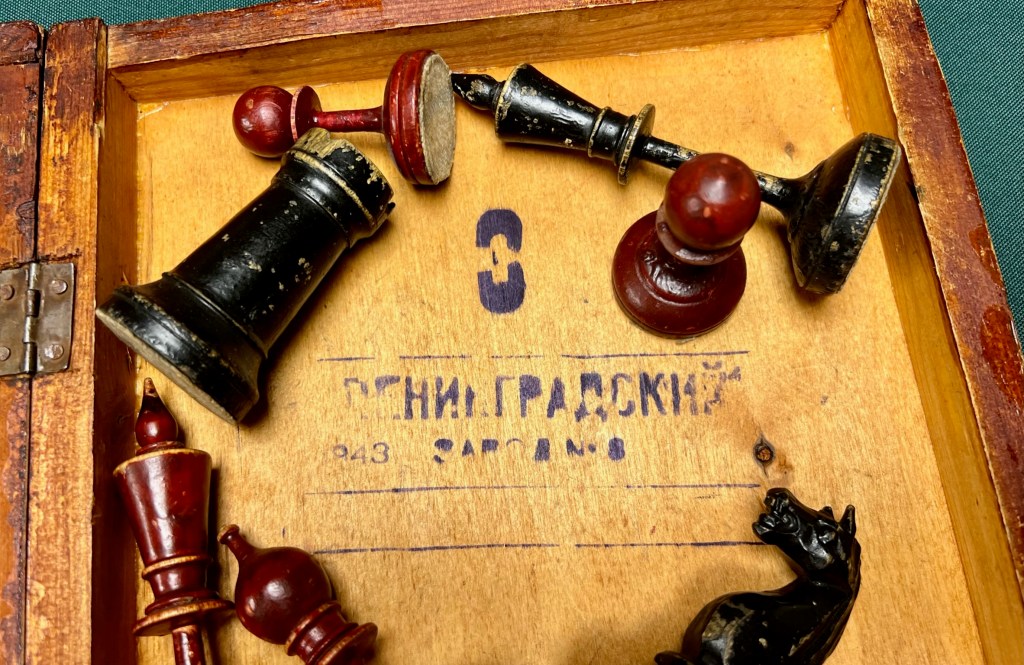
Studying Soviet chess sets forces us to confront a good number of uncertainties. In many cases, direct evidence of a set’s provenance is simply lacking. Secondary information is scarce, even more so information that is available in English. So it is with these beautiful pieces and the board with which they came to me, which bears stamps that read: Leningrad Factory No. 8, 1943. Here is a close-up of the board’s stamps.

Leningrad Zavod No. 8, 1943 stamps. Chuck Grau Collection, photo.

The Pieces

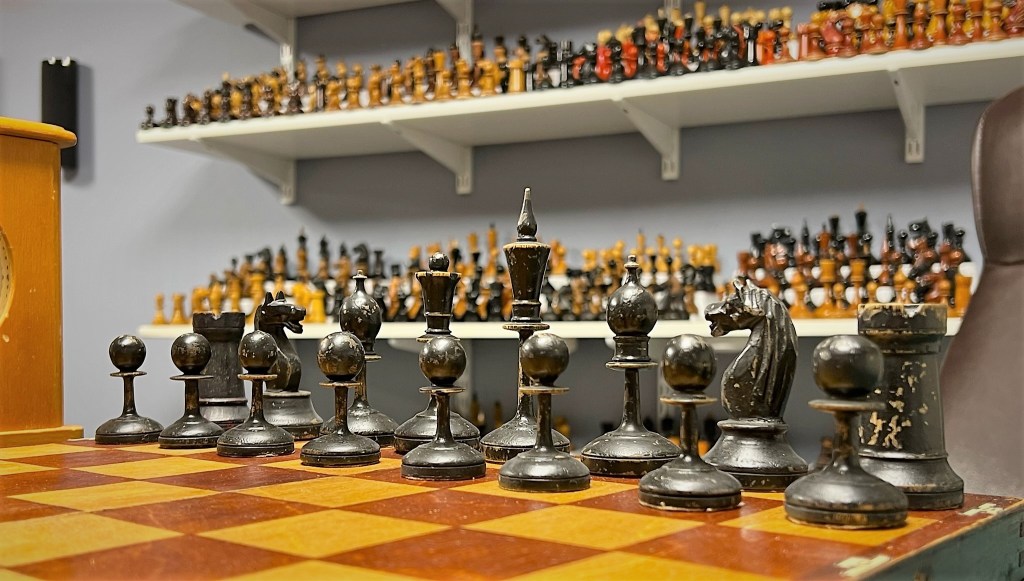
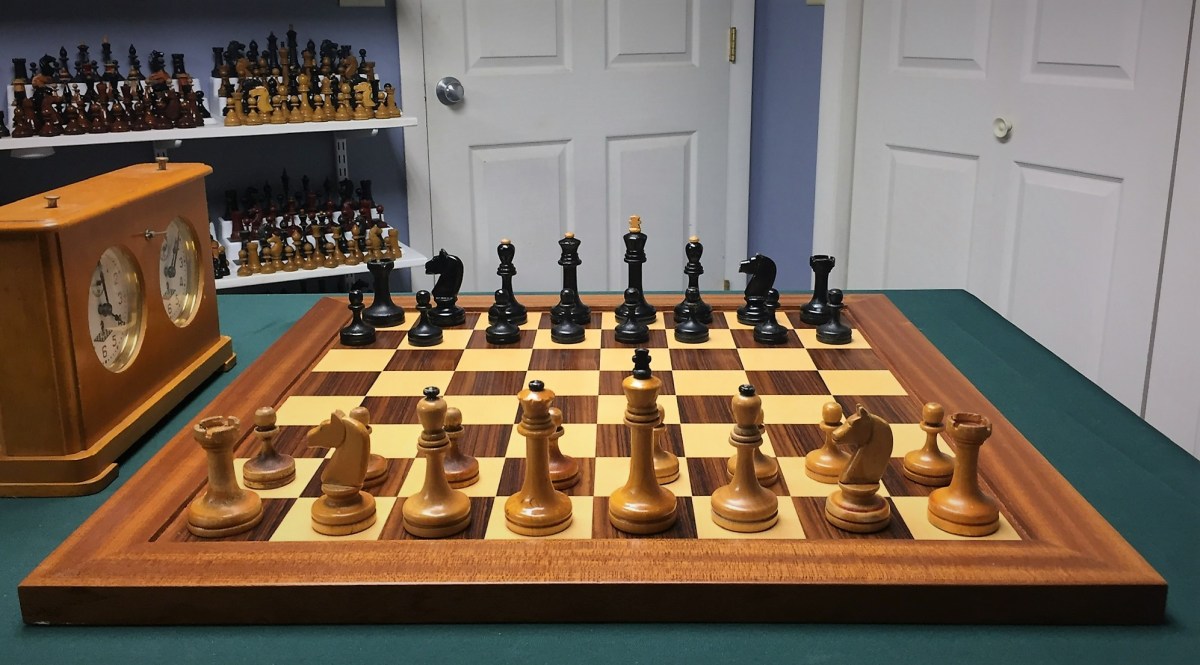
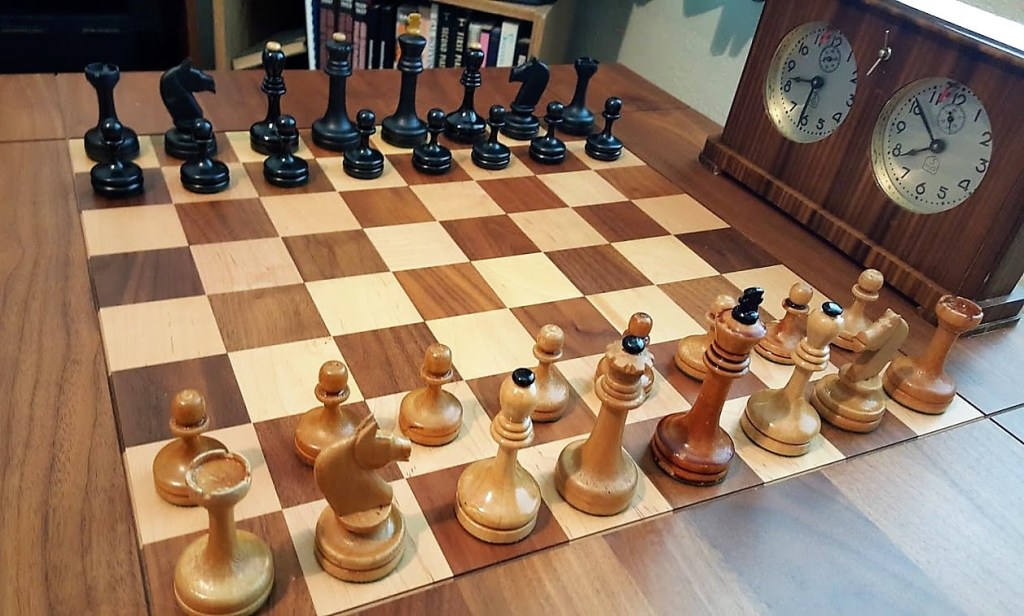
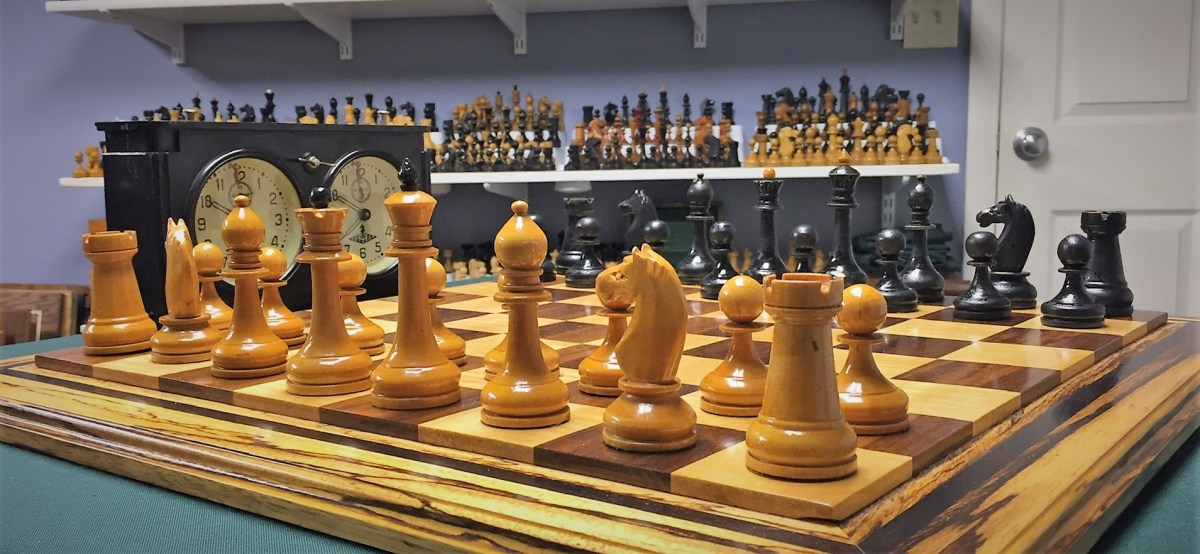
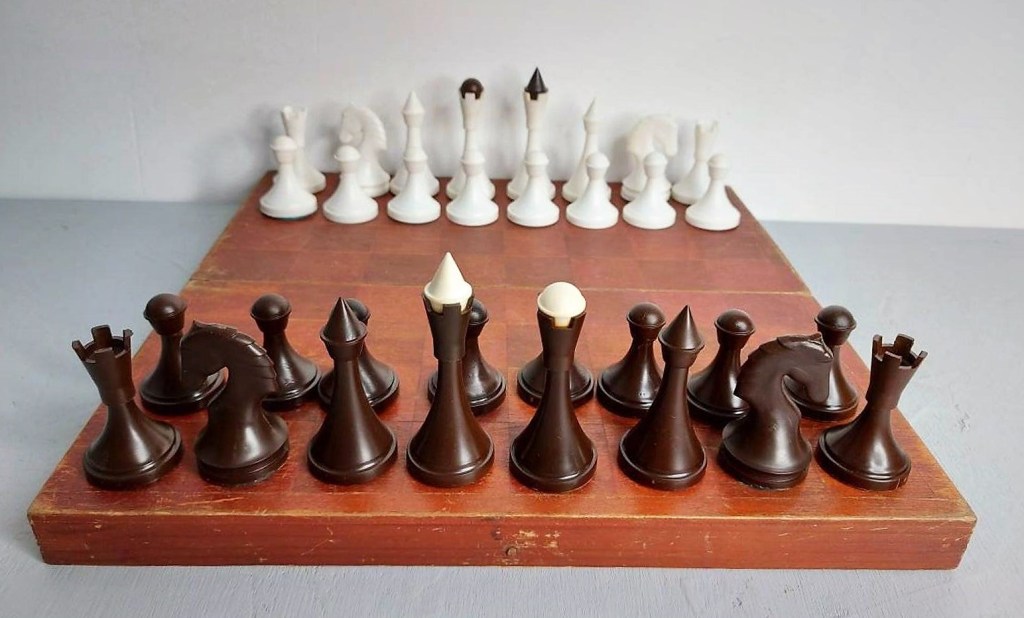
Here are the nicely turned and carved red and black pieces arrayed on the board.
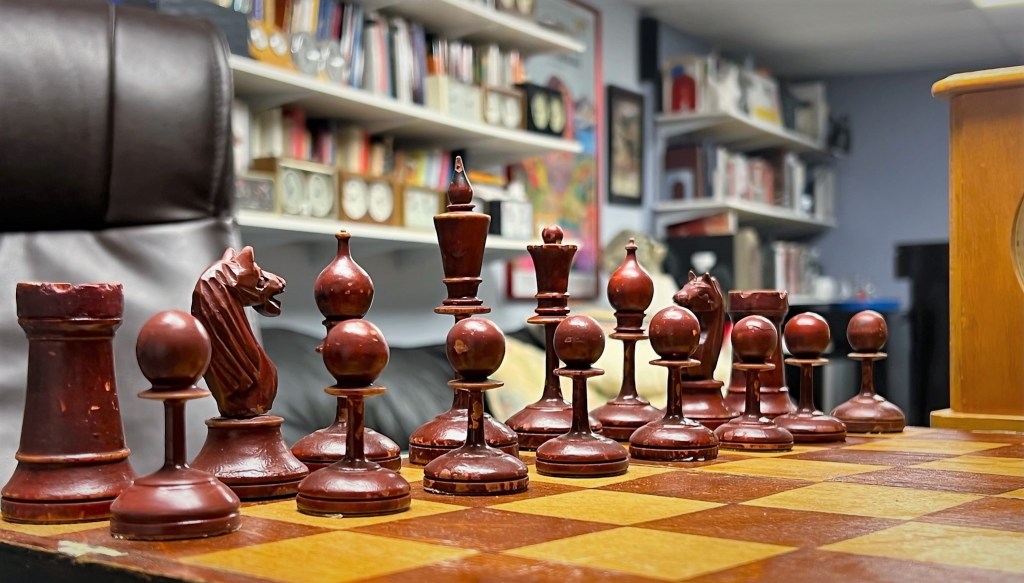
Leningrad Pieces. Chuck Grau Collection, photo.

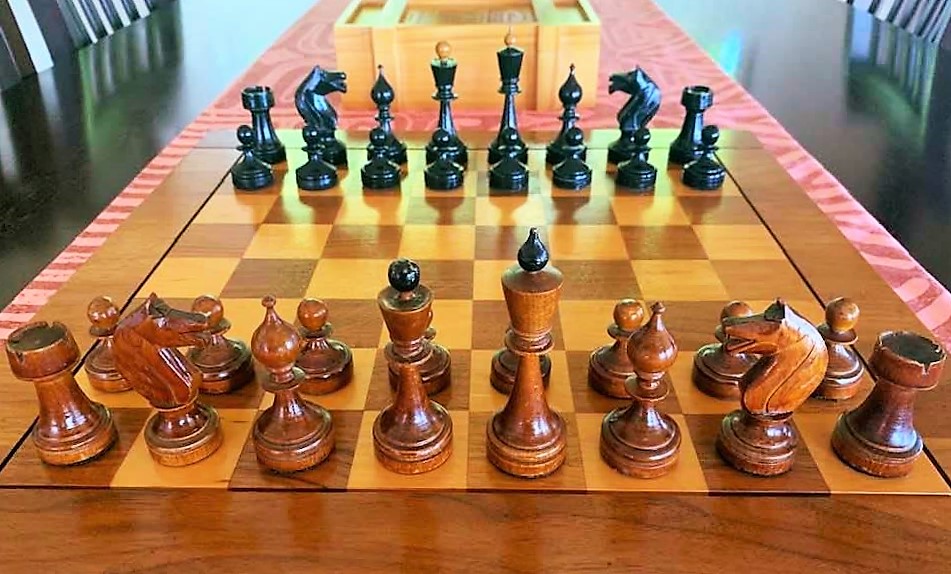
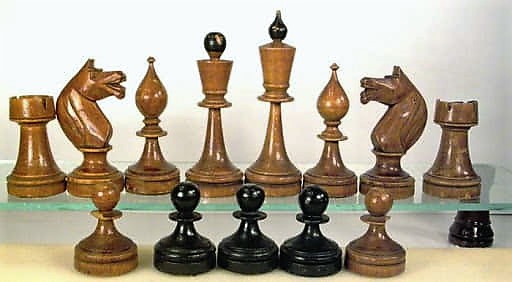
I initially thought that the stamps signified that the pieces and board both originated in Nazi-besieged Leningrad, writing, “It is nothing short of miraculous that the set survived, as wood shortages doomed most wooden sets to the stoves to survive the brutal winters.” But evidence soon emerged that the board was paired with the pieces sometime after they were manufactured. Here are two photos that seem to show these same pieces being offered for sale in a different container.
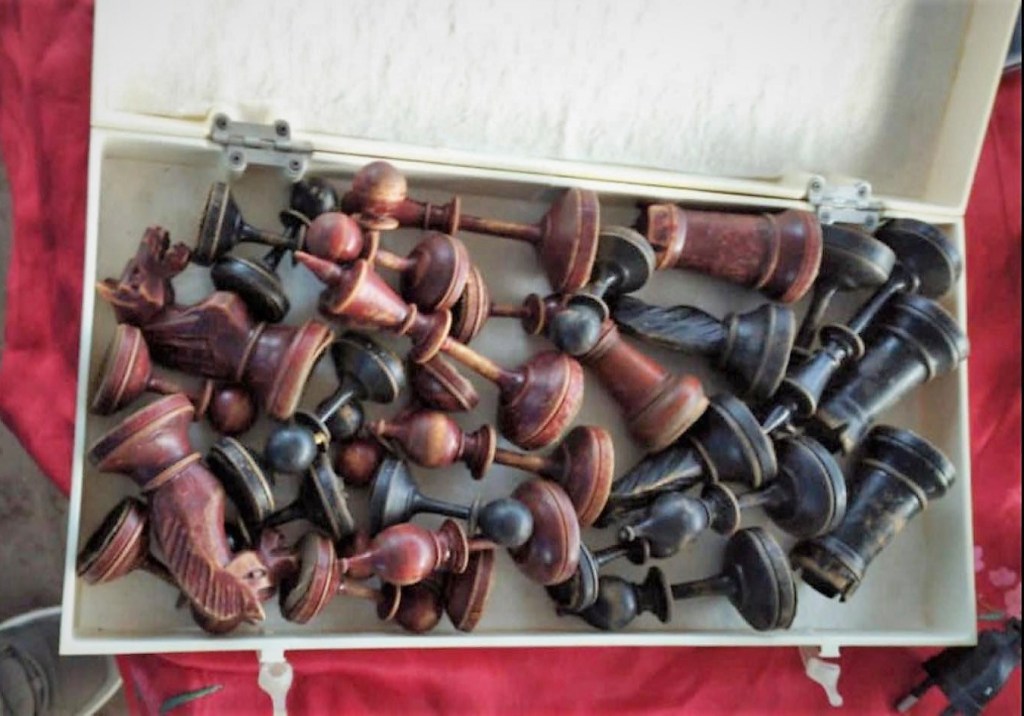
Leningrad Pieces, different container. Source withheld.

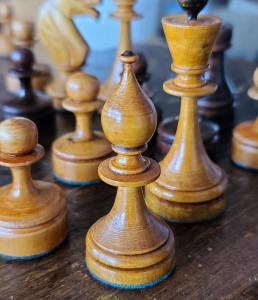
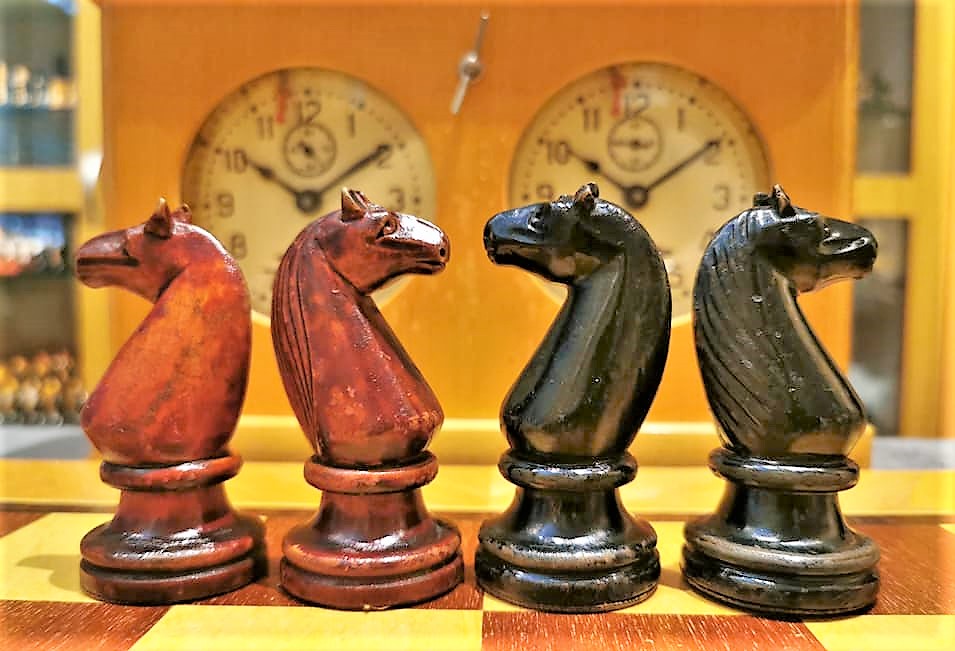
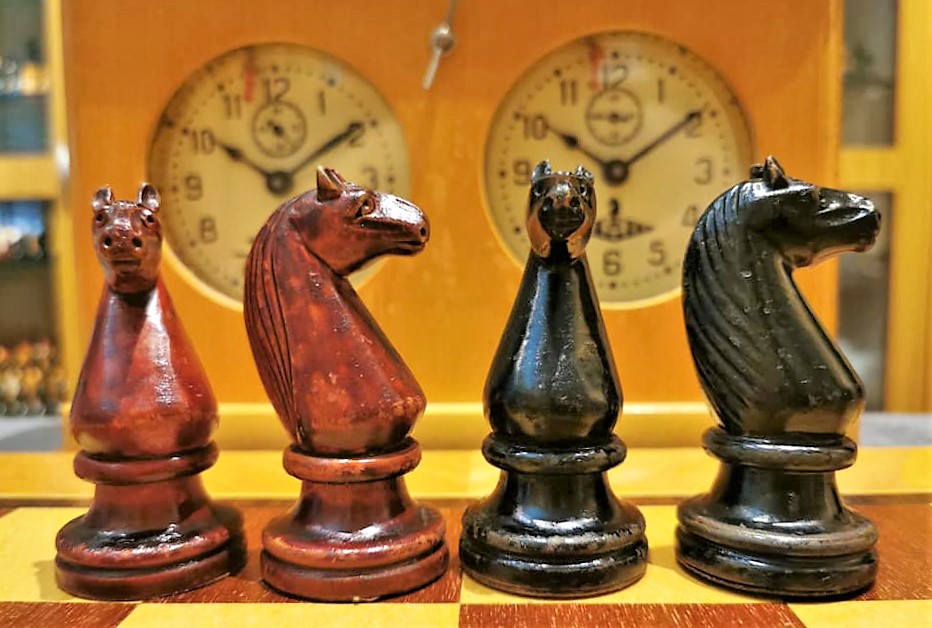
The dropped jaw of the knights, the steeple rings of the bishops, and style of the stem and base suggest this is what we typically call a “Laughing Knight” set. At the same time, the pieces also incorporate a slender verticality and stem and base structure reminiscent of the Soviet Upright chessmen sometimes called “Averbakh II” pieces, mistakenly implying a stylistic relation to the set Averbakh is seen playing with in a well-known photo from the 1949 Moscow Championship.
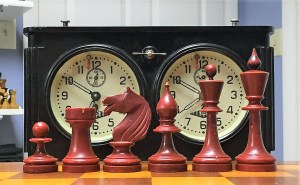
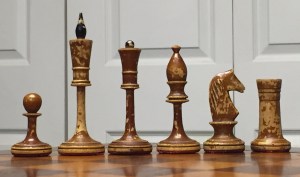
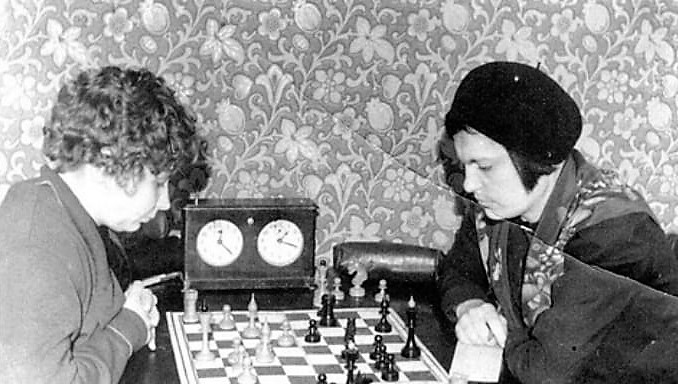
All this said, the set is unweighted, which is a noted characteristic of sets manufactured while the Soviet Union was on a war footing, metal being needed for weapons and munitions production. And there is photographic evidence circumstantially linking sets like this one to Leningrad. Here is a photo of a like set being played with by then-future World Champion Lyudmila Rudenko (b. 1904).

Lyudmila Rudenko. Date, photographer unknown.

Although this photo is undated, Rudenko’s first major success in chess was her victory in the 1928 Moscow Championship, and it is said that her style and form did not finally develop until she moved to Leningrad in 1929 and began studying under the likes of Romanovsky and Tolush. It is conceivable that she is twenty-five in the above photo.

Rudenko is not the only public figure circumstantially linking the set to Leningrad. Below is a photo of Mikhail Kalinin, who was born in 1875, moved to St. Petersburg 1n 1895, undertook revolutionary activity in 1905, and became one of the earliest members of the Bolshevik Party. In 1917 he became mayor of Petrograd, and in 1919 a member of the Central Committee of the Russian Communist Party. He ascended to full membership in the Politburo in 1926. Kalinin served as titular head of the Soviet state from 1917 until his retirement in 1946, a largely ceremonial role. Of him Khrushchev supposedly said, “I don’t know what practical work Kalinin carried out under Lenin. But under Stalin he was the nominal signatory of all decrees, while in reality he rarely took part in government business. Sometimes he was made a member of a commission, but people didn’t take his opinion into account very much. It was embarrassing for us to see this; one simply felt sorry for Mikhail Ivanovich.” One could not feel too sorry for him. It was very rare for any Bolshevik of consequence to have survived the Great Purges of the 1930s, and his signature could be found authorizing heinous acts like the murder of thousands of Polish prisoners, signed ceremoniously or not. If Kalinin is sixty in the following undated photo, then it was taken around 1935.
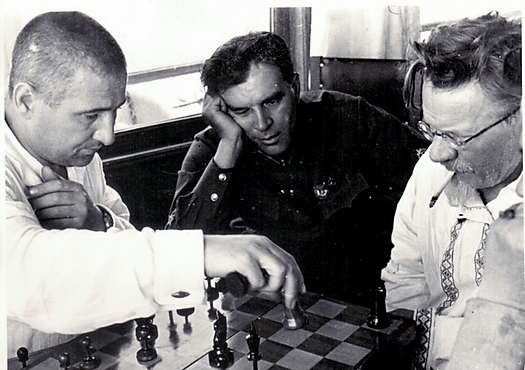
Mikhail Kalinin, Right. Undated. Photographer unknown.

Further photographic evidence likely links pieces like these to the mid- to late-1930s. St. Petersburg collector and researcher Sergey Kovalenko dates the following photo to be from 1935.
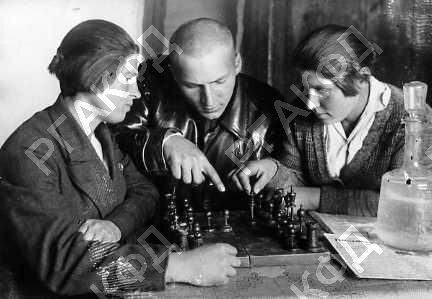
RGAKFD photo. Dated as 1935 by Sergey Kovalenko.

The set also appeared in other finishes. Here is a dark red/brown and black specimen from Steven Kong’s collection. It originally was finished in a black and orange/red combination. It is unweighted.
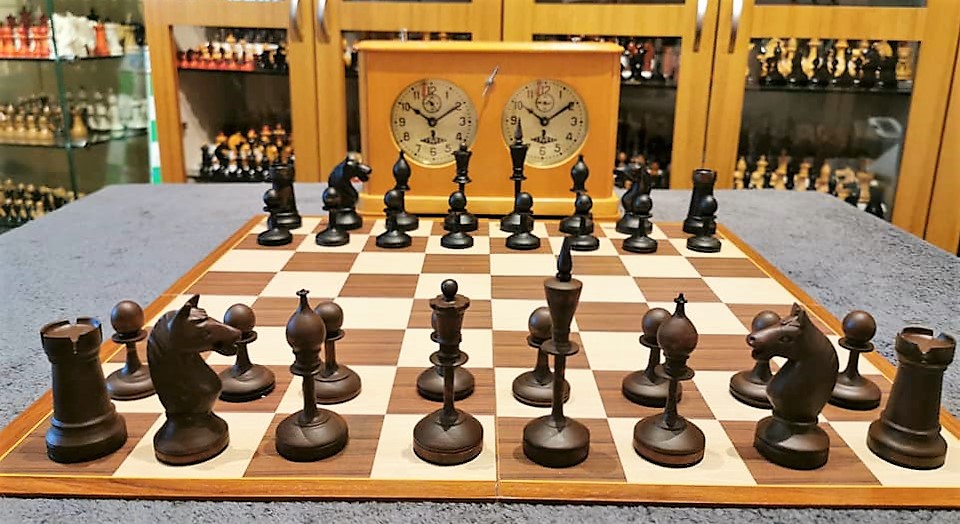
Steven Kong Collection, photo.

And here is a magnificent specimen from Steve’s collection, in a natural finish. These pieces are weighted, perhaps signifying they are an early version of the design. The exquisite dental work seen in the knight on g1 supports an early dating.

Steven Kong Collection, photo.

The Board

We have seen the stamps inside the board above. The board itself is constructed from plywood. It is roughly 40 cm square. Its squares are irregular, ranging from 45-50 mm. The dark squares and sides are finished with a reddish-brown stain. The board seems to have gone through several generations of hooks and hinges. Notation was added to the borders after market.
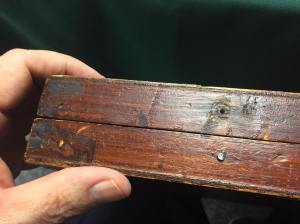
Sergey Kovalenko assesses the board as follows: “Such simplifications are typical for boards of the 60s, but, in my opinion, this is also normal for wartime. The colors look early. In any case it is interesting board. Some of evacuated Leningrad factory could make this board, for example.”

The Factory

What was Leningrad Factory No. 8, and could it have made chessboards amidst the devastating siege?

According to Russian sources unearthed by Sergey, Leningrad Factory 8 was an electromechanical plant launched in 1934. It produced radio broadcasting equipment, charging stations, welding units, related boxes and coils. In July 1941, it merged with the Molotov Telephone plant into a single enterprise, and much of the plant’s equipment and personnel were shipped to Molotov, which was renamed Perm in 1957, a large industrial center on the Kama River and near the Ural Mountains. The joint plant in Molotov began operation in September 1941 located on the site of the former confectionary plant Red Ural, and was renumbered as Plant No. 629. In May 1942, a woodworking operation was added to the joint plant. Among its products were wood boxes for military telephones manufactured at the plant.
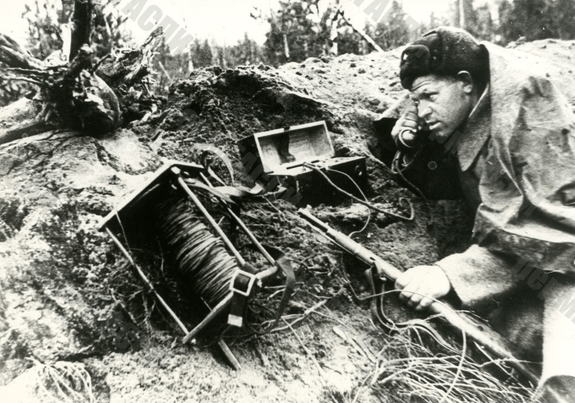
Soviet WWII Military phone with wooden box. Source: Sergey Kovalenko. Photographer unknown.

There is no evidence that either Sergey or I could find of what, if anything, any remnants of Plant No. 8 remaining in Leningrad may have produced. According to Wikipedia, “86 major strategic industries were evacuated from the city. Most industrial capacities, engines and power equipment, instruments and tools, were moved by the workers. Some defense industries, such as the LMZ, the Admiralty Shipyard, and the Kirov Plant, were left in the city, and were still producing armor and ammunition for the defenders.” According to the Museum of the Siege of Leningrad, “upon the outbreak of hostilities, the leading enterprises of Leningrad were reoriented to produce weapons and ammunition. In January 1942, at the most critical time of the blockade, 22 enterprises produced more than 100 types of military equipment, weapons, ammunition, communications equipment, instruments, and so on.”

1943 Tass Political Cartoons. Source: Siege of Leningrad Museum.

Based on this information, two possibilities present themselves for the origins of the Leningrad Factory No. 8 board. The first is that it was manufactured in Leningrad by remnants of the plant remaining there after the bulk of its productive assets were evacuated to Molotov. It is conceivable that these remnants continued to manufacture military phones for use by the besieged defenders, and that scraps from the phone boxes were used to fashion some crude chess boards. Communications equipment is among that believed to have been made there during the siege. But there is no direct evidence of woodworking to have continued there, and it seems unlikely that scraps from the production of military phones were used to make luxury goods when thousands were freezing to death for lack of fuel, even under Stalin.

The second possibility is that the stamps from Leningrad Factory No. 8 traveled to Molotov with the bulk of the plant’s other assets, and were used to stamp chessboards made in the merged plant’s woodworking shop from scraps from the production of wooden boxes for military phones, even though the joint plant had been relocated and renumbered. I find this possibility more plausible than the first.

Finally, a third possibility must be considered. That is that the stamp inside my board is not from Factory No. 8, but Factory No. 3. Russian sources tell us that Leningrad Factory No. 3 began making gramophone records in the mid-1930s and children’s toys and radios in the late 1930s, but lacked its own woodworking shop. For this reason, as well as the circumstances of the siege outlined above, I find it unlikely to have been the manufacturer of my chessboard.
Conclusion

This slender, elegant set with wide bases incorporates a design that originated in the 1930s, but it is highly unlikely that it was turned and carved in besieged Leningrad, even though it has several discernable links to that city. The board that housed it when it came to me bears stampings literally telling us it was made by Leningrad Factory 8 during the siege, but there are good reasons not to interpret them literally. More plausibly, the stamps evacuated Leningrad in 1942 with the bulk of the plant’s productive assets, only to be used in Molotov, their new home near the Urals, and were affixed to a board made by the Molotov plant’s woodworking shop from scraps of plywood left in the production of boxes for military telephones. Many thanks to Sergey Kovalenko for sharing his research and thoughts on this curious case.
Laughing Knight Chess Set

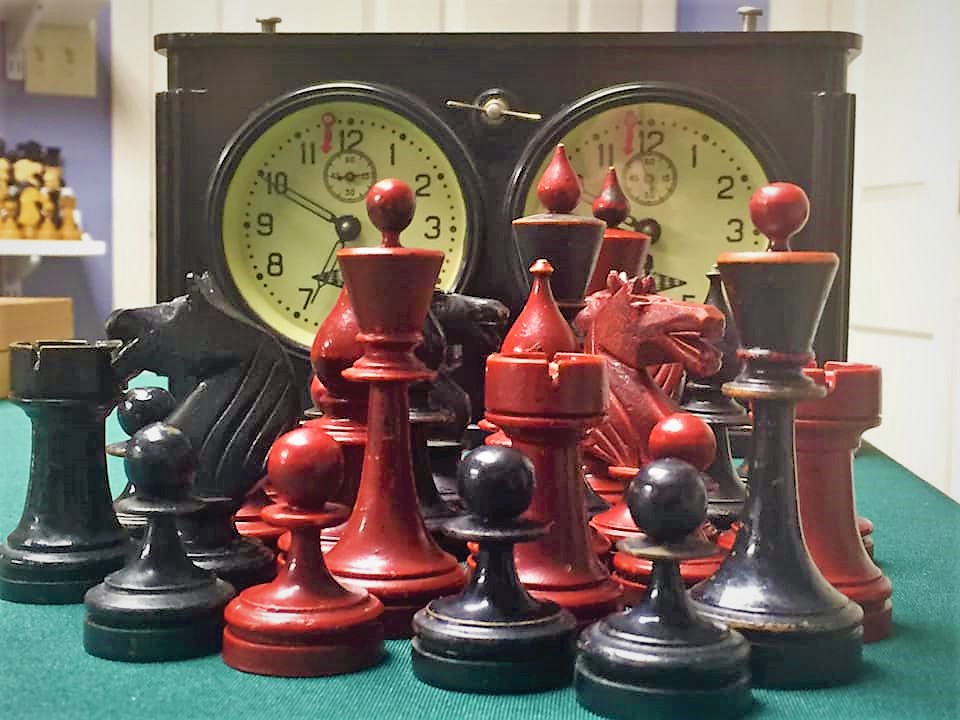
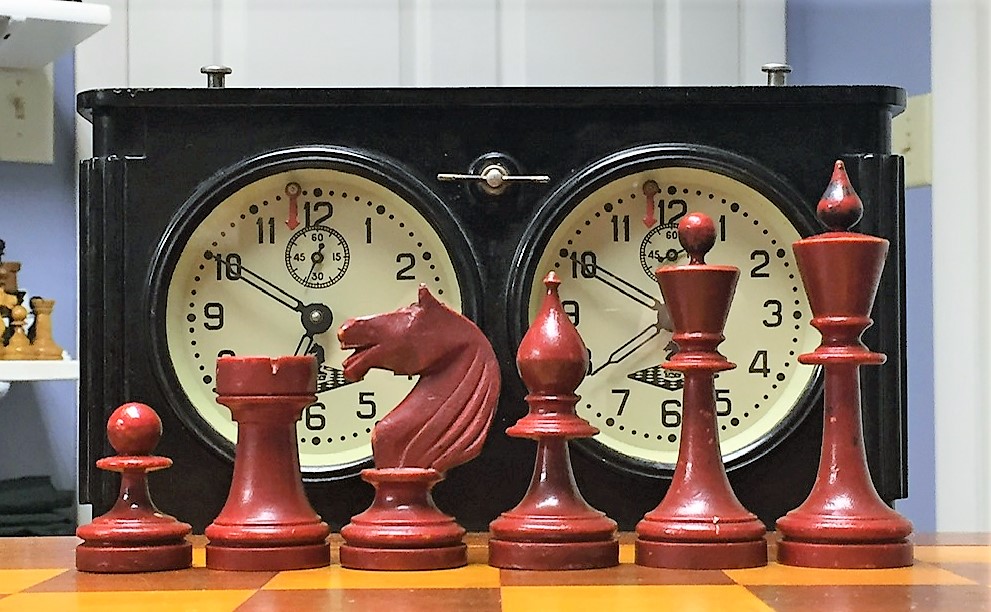
This set is fine specimen of a not uncommon design, characterized by 1) the open mouths of the knights, which suggests to many that they are laughing, and 2) the ring or ball perched atop its bishops’ onion-shaped miters, echoing the globus cruciger found on the spires of many onion-shaped Orthodox church domes.

Laughing Knight Chessmen. Chuck Grau Collection, photo.

The kings are 97 mm tall and the pieces are unweighted. Coupled with the modest bases lack of weighting renders them more unstable than other unweighted Soviet sets, which compensate for the lack of weighting with substantial bases.

Laughing Knight Chessmen. Chuck Grau Collection, photo.

My specimen, as are many others, is finished in black and Stalin Red. Yet other specimens are finished in black and brown varnish. Here is a brown and black version in Lokahi Antonio’s collection.

Laughing Knight Chessmen. Lokahi Antonio Collection, photo.

The late Nick Lanier of the Chess Museum has suggested that this design may be of Tsarist origin, but his suggestion is offered without supporting research. I know of no direct or circumstantial evidence and no morphological analysis supporting his suggestion. His specimen is brown and black. He describes the pieces as “very well finished” and the knights as “happy.”

Nick Lanier Collection, photo.

The design is generally thought to arise in the thirties. This is the view expressed in Russian auction sites and by knowledgeable dealers in Soviet chessmen. The photographic record supports this view. Here is a photo from the 1939 Moscow-Leningrad Match for the Deaf.

1939 Moscow-Leningrad Match. Source: Jorge Njegovic Drndak from
chess.deaf.portal.com. Photographer unknown.

Here is a 1943 photo from the Evacuation Hospital in Vologda, which, according to chess historian Jorge Njegovic Drndak, specialized in infectious diseases that and treated the victims of the Great Patriotic War. The set appears to be a black and red version.

1943 Vologda Hospital. Source: Jorge Njegovic Drndak. Photographer unknown.

And here is a photo of what seems to be another black and red version of the set being used by schoolchildren in Udmurt Autonomous SSR in 1947, provided by Sergey Kovalenko.

Vladimir Novoselov photo.

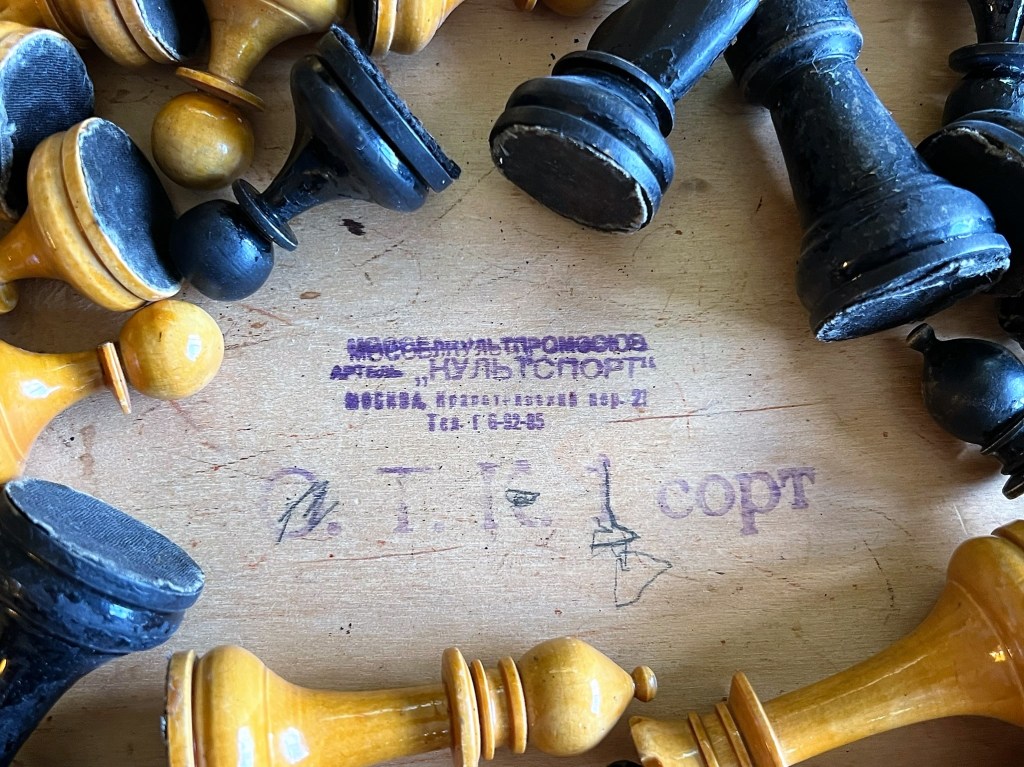
The Laughing Knight set is thought to have been produced by Artel Kultsport in Moscow. Two dealers in the chain of title of my set represented that it originated with Kultsport. Although my set came in a box/board that had only remnants of a paper label, the board itself was nearly identical to another from the mid-1940s that bears an Artel Kultsport ink stamp. Moreover, Kultsport is known to have affixed paper labels prior to 1941, further supporting the pre-war Kultsport inferences of the set’s origins.

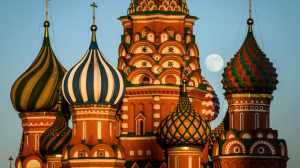
One of the interesting design elements in these chessmen is the almost spherical ring near the top of the peak of the bishop miter, echoing those on the spires of the onion domes of St. Basil’s Cathedral in Moscow.


But the defining characteristic of this set is the knight’s gaping mouth, which makes it appear to be heartily laughing. To be sure, some horses, like the American TV star, the late Mr. Ed, played by the palomino gelding Bamboo Harvester (1949-1971), have exhibited a sense of humor. Mr. Ed, America’s first “Stable Genius,” elsewhere has been described as “an obnoxious and inconsiderate troublemaker.”

Mr. Ed plays his owner Wilbur with a large club size Lardy chess set. CBS image.

As gaping mouths are a recurring theme in knight design, Soviet and otherwise, I did some cursory research into what it means when a horse opens its mouth. Here are some of the explanations offered:

  • The horse has colic (who would send sick horses to war?);
  • It has detected an unusual odor, as a mare in heat, and curls his lip in what’s called a “Flehmen Response” to get a better whiff (it would seem inappropriate to call them “Horny Knights”);
  • It is relaxed in contentment (unlikely for a warhorse headed into battle);
  • It indicates aggression (befitting a warrior steed); and
  • It is vocalizing, as in neighing, opening the mouth and exposing the teeth to allow the sound to resonate, typically an expression of anxiety or excitement (largely consistent with our “laughing” interpretation).

Conclusion

The popular Laughing Knight design originated prior to the Great Patriotic War. It is named for the gaping mouth of its knights, which appears to be caught in mid-laugh. It seems to have been made by Artel Kultsport in Moscow, though the evidence for this is circumstantial and inferential.

Proto-Tal Chess Pieces, c. 1940

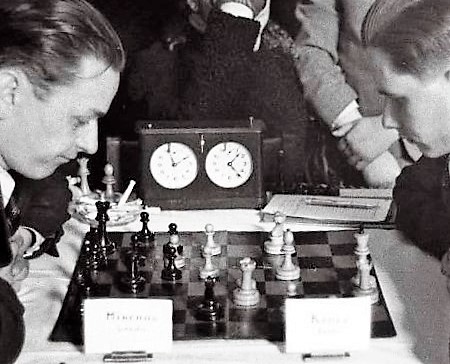
An interesting set that adopts a good number of Staunton design elements. I call it the “Proto-Tal” set because it is so similar to the Tal set in a pre-Annexation photo of Keres and Mikenas playing in an Estonia-Lithuania Friendship Match in Tallinn in Spring 1940 that the two must be related. We already have examined the development of the Tal chessmen here in From Tallinn to Tbilisi: the Evolution of the Tal Chess Pieces.

Tal chess pieces of the 1940 Keres-Mikenas game in Tallinn, Estonia. Photographer unknown.

The Prot0-Tal set is tournament-sized but unweighted. My specimen retains its original black cloth bottoms. The king’s cross is decidedly non-Soviet, evidence of its origin in Estonia or another Baltic state prior to their Annexation by the Soviet Union late in 1940. Here are the proto-Tal pieces:

Proto-Tal chess pieces. Chuck Grau Collection, photo.

For comparison sake, here are the 1940 Tal pieces in Mike Ladzinski’s collection. The knight is better developed and carved. The bishop’s miter is cut. The pieces are weighted and are covered with red rather than black cloth.

1940 Tal chess pieces. Mike Ladzinski Collection, photo.

I believe the Proto-Tal set preceded the 1940 Tal set because the knight of the Keres-Mikenas photo is a mature Tal knight, very similar to those appearing in photos of events from 1940 to 1979, whereas the Proto-Tal knight is barely pubescent. I also believe it to be of Baltic, possibly of Estonian origin. We know that Tal sets appeared in the Baltic region as early as 1940 from the Keres-Mikenas photo. We also know that Mike Ladzinski’s c. 1940 Tal set came to him from Lithuania, and that Ron Harrison’s Proto-Tal set like this one came to him from Estonia. These facts support an inference of the set’s Baltic origins.

Proto-Tal chess pieces. Mike Ladzinski Collection, photo.
Proto-Tal chess pieces. Ron Harrison Collection, photo.


Alternatively, it is also possible that rather than being the source of the Tal set, the Proto-Tal set is a simplified version of the early Tal set manufactured for popular rather than tournament use. This would explain the greatly simplified knights, the lack of weighting, and the absence of a miter cuts on the bishops.
The Proto-Tal set appears to have originated in the Baltic region prior to its annexation by the Soviet Union, and to be the progenitor of the widely loved Tal chess pieces.

Young Kamsky and the 1941 Leningrad Championship Chess Set

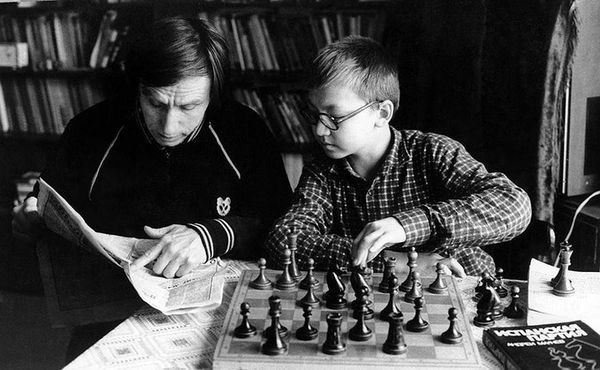
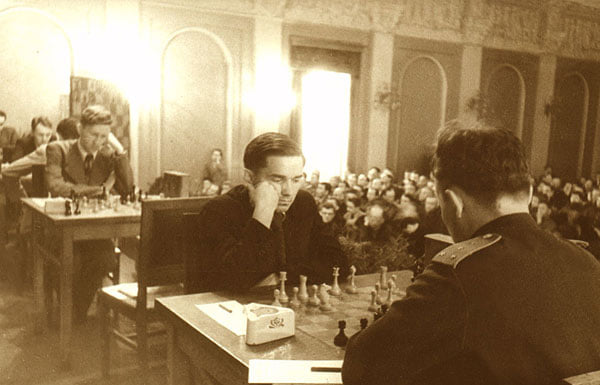
This photo of young Kamsky came across my Facebook feed recently. The set he and his father are using reminds me very much of the set used in the 1941 Leningrad Championship, a variation of the venerable Botvinnik-Flohr II pieces first introduced at the 1934 Leningrad Masters Tournament.

Gata Kamsky and his father Rustam, c. 1987. N. Adamovich /TASS photo. Source: Douglas Griffin.

According to Wikipedia, “The [1941 Leningrad] championship continued to be played, in spite of tremendous difficulties, during the siege of Leningrad in the Second World War, though the tournament of 1941 could not be finished…”

1941 Leningrad Championship. Players, photographer unknown.

Here is a discussion of chess in besieged Leningrad by Dmitry Oleinikov, Director of the Moscow Chess Museum, who begins by referring to chessmen printed on paper cubes for the city’s beleaguered citizens:

The spirit, enclosed in weak flesh-this is what these lightest, hollow inside, cardboard cubes, painted with red and black ink, remind of. This is the chess of besieged Leningrad.

Instead of the boards and figures that burned down in the stoves of the insatiable bourgeoisie in the terrible winter of 1941-1942, the Leningrad Industrial Complex launched the production of the most simple and cheap chess. And all because in the besieged city thousands of people played and wanted to play chess.

Besieged Leningrad Set. Moscow Chess Museum Photo.

Just as the citizens of Leningrad continued to play chess through the siege, the city championship went on. Writes Oleinikov:

Already in November 1941, the strongest chess players of Leningrad (among those who were not evacuated or drafted into the active army) announced: “Today, in a difficult and tense situation in the city of Leningrad, we are opening the next chess championship. <…> We are in good spirits, and no blockade, no hardships can hinder us.”

The newspapers of December 1941 became smaller, appeared less frequently, and nevertheless found space for messages: “The unfinished games were played out in the chess championship of Leningrad. Before the fifth round, Novotelnov is ahead … Today the next round will take place in the N hospital “. In the hospital – because the chess players came to their spectators and fans, and the further, the more the chess proved its healing effect.

The siege lasted almost three years, and up to a million and a half Soviets died from it. Among them were many chess organizers and highly ranked players. Oleinikov continues:

The organizer of the tournament was Samuel Weinstein, an active figure in the Soviet chess movement from its very first years. The 1941 championship will be Weinstein’s last chess brainchild: he will die in that terrible winter. The blockade will take away many famous and not famous chess players from Leningrad. Among them are Vsevolod Rauser, a renowned theorist who proclaimed: “e2 – e4, and White wins!” composers brothers Kubbeli … On the way to evacuation, Alexander Ilyin-Zhenevsky will die under bombing; having already reached Perm, the master and author of popular books Ilya Rabinovich will die of exhaustion. Many young chess players of Leningrad, who were predicted to have great achievements before the war, will die at the front, and remain as candidates for the master… having already reached Perm, the master and author of popular books I.L. Rabinovich.

Alexander Ilyin-Zhenevsky, father of Political Chess, died during the Siege of Leningrad. Public domain photo.

But despite the hunger and the cold, the hard labor and the death, organized competition went on. Oleinikov writes:

And yet, … participants [in the Leningrad Championship] recalled that even getting to the site of the tournament was not easy: they had to reckon not only with enemy shells, but also with police squads and military patrols that directed pedestrians to bomb shelters during shelling. 16-year-old Aron Reshko, the future foreman, and then the youngest participant in the 1943 and 1944 championships, was sent out of town for agricultural work and walked tens of kilometers every day to participate in the championship. One of the tournament participants, Vasily Sokov, spent the whole night on the eve of the next round on duty, extinguished seven incendiary bombs, and the next day he was offered to postpone the game. He replied: “At the front, they are fighting day and night, and there is no need to arrange a resort for me here!”

The conditions were abysmal:

They played to the accompaniment of exploding shells, bomb explosions and antiaircraft artillery shots; frozen over a difficult position, they forgot about the bomb shelter – even when one day the blast wave knocked out all the glass in the room! To maintain the strength of the participants – and to fight scurvy – they were given nettle soup and pine compote…

1941 Leningrad Championship BFII pieces. Steven Kong Collection, photo.

Surviving specimens of the set used in the 1941 Leningrad City Championship are exceedingly rare, but one is held in the collection of Steven Kong of Singapore.

1941 Leningrad BFII Pieces. Steven Kong Collection, photo.

The pieces incorporate the architecture and detail of the original mid-1930s BFII pieces, but for three aspects. Instead of the angular miter of the earliest versions, the miter of the 1941 Bishop is ovoid. Unlike the earliest miters, the 1941 miters lack cuts. And, finally, the 1941 Rook towers are carved with mortar work not found in the earlier versions.

1941 Leningrad Championship BFII Rooks, showing mortar work detail. Steven Kong Collection, photo.

The knights are exceptionally beautiful, and bear a striking resemblance to the Novgorod Knight of the 15th Century.

1941 Leningrad Championship Knights. Steven Kong Collection, photo.
Novgorod Knight. 15th Century. I. Linder, Schachfiguren im Wandel der Zeit photo.

The set of the 1941 Leningrad Championship, held under the horrendous conditions of the Siege of Leningrad, was a fascinating evolution of the venerable Botvinnik-Flohr II design. Surviving examples of this beautiful and historic set are extremely rare.

1944 USSR Championship Set

The set used in the 1944 Soviet Championship continued to steer chess set design away from the Modernist elements of earlier Soviet sets and towards the incorporation of more traditionally Staunton elements. The source of production for the set remains a mystery despite an unusually large amount of relevant evidence.

The 13th USSR Championship was held in Moscow in May and June 1944 by which time tide of the Great Patriotic War had turned against the Nazi invaders. Mikhail Botvinnik won the tournament over a field of seventeen players. It was the first Championship played since 1941. Breaking from the practice of using Botvinnik-Flohr II pieces, which were heavily influenced by Modernist design concepts, the 1944 Championship pieces were much more traditionally Staunton in their design, an evolution of the Barrel Rook set we previously have examined.

Here are several photos of the 1944 event.

Kotov v. Versov, 1944 USSR Championship, 1-0. Photographer unknown.
Closeup of the pieces in the Kotov-Veresov.
Smyslov v. Botvinnik, 1944 USSR Championship, 0-1. Photographer unknown.

The pieces are very similar in structure to those of the Barrel Rook set, except for the angled walls of the Rooks, which are straight in the Barrel Rook set, and the smooth spine of the knight, which bears a toothed mane upon its spine. In addition, there is a faintly discernible shadow pattern on the side of the 1944 knight, which I believe to be the product of mane carvings on the side of the horse’s neck.

The following pieces are like those in the photographs from the 1944 Championship.

Chuck Grau Collection, photo.

The pieces reject the concave and dendriformic stems so typical of sets of the late 1920s and the 1930s, and instead employ the long, narrow stems resembling neoclassical columns and in proportions like those found in Staunton pieces. As with Staunton pieces, the joint between the stems and the pedestals of the royals, clerics, and pawns are perpendicular; and the crowns and miters of the royals and clerics are connected by cylinders bordered top and bottom with distinct rings, which together with the pedestals comprise the “three collars” common to Staunton sets.

Chuck Grau Collection, photo.

The design abstracts away the step-up base of Staunton sets, replacing the step with a carved ring which defines the boundary between base and stem, but, as in Soviet designs of the earlier two decades, maintains the curved flow from base to stem. The set also retains the Soviet CV structure of the knight’s torso, and the use of finials rather than crosses atop the kings, a practice that hearkens back to ancient Rus.

Although the bishop miters lack the typical Staunton cut, like Staunton pieces, the rook turrets bear clearly carved merlons and the queen’s coronet contains crenel cuts. The royals follow the Eastern European practice of opposite-colored finials.

The pieces came housed in a customary veneered Soviet board/box that is of better than average quality and larger than average 50 mm squares. Still, the pieces, with 100 mm kings, are more appropriate for at board with at least 55 mm squares.

1944 Championship Pieces on original 50 mm board. Chuck Grau Collection, photo.

The board bears a stamp indicating the manufacturer to be Artel Kultsport, with a Moscow address, and that the item is 1st Sort, or highest quality.

1944 Championship Set Artel Kultsport stamp. Chuck Grau Collection, photo.

Unlike the Ladzinski and Adamski Kultsport stamps we examined in our review of the Barrel Rook set, this box does not contain a separate stamp indicating the item to be a chess board, or what type of chess board the item is. I interpret this as evidence that the stamp applies to the pieces as well as the board. At the same time, there is extrinsic evidence suggesting that the pieces were made by an entity other than Artel Kultsport.

Moscow collector Alexander Chelnokov believes this line of sets was produced by the Red Combine, located near Zvenigorod, roughly 65 km west of Moscow, whereas Artel Kultsport was located in central Moscow. Chelnokov administers a Facebook group titled Russian Chess Sets (Tsarist, Soviet, and Modern) that features his magnificent collection of Tsarist and Soviet sets, and which I heartily commend to your viewing. It is ironic that this rare instance of a relative abundance of information about the production of a set provides us conflicting data, but such is the enigma of Soviet chess sets.

Conclusion

The set used in the 1944 Soviet Championship continued to steer chess set design away from the Modernist elements of earlier Soviet sets and towards the incorporation of more traditionally Staunton elements. The source of production for the set remains a mystery despite an unusually large amount of relevant evidence.

c. 1940 Barrel Rook Tournament Set

The looming world war had its impact on Soviet Chess design. Sets began to appear without metal weights, as metals were reallocated to the production of instruments of war. And from a visual perspective, designs began to retreat from the Constructivist and Modernist influences of the late 1920s and 1930s, adopting more traditional Staunton elements, following a trend towards Neoclassicism we already have noted in Soviet architecture.

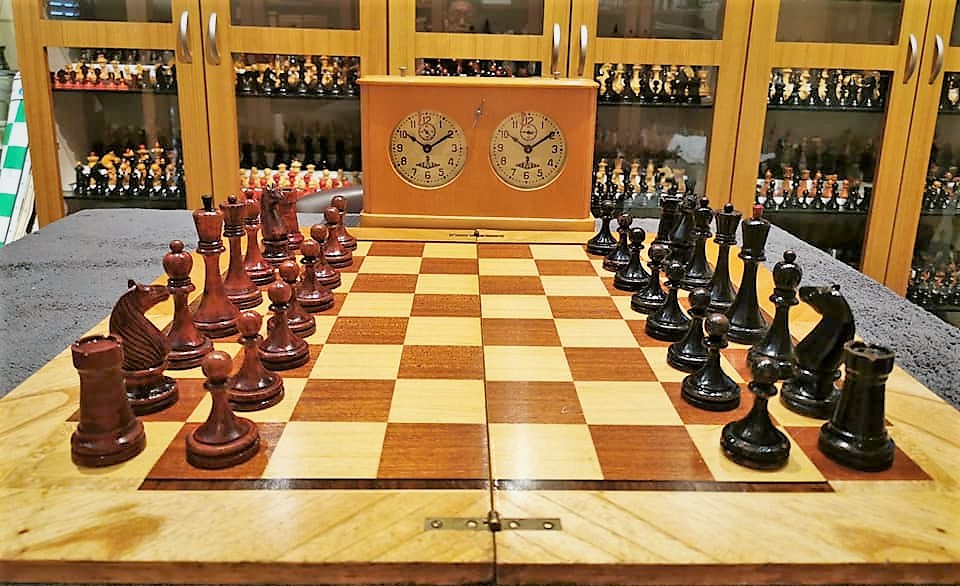
c. 1940 Barrel Rook Tournament Chessmen. Chuck Grau Collection, photo.

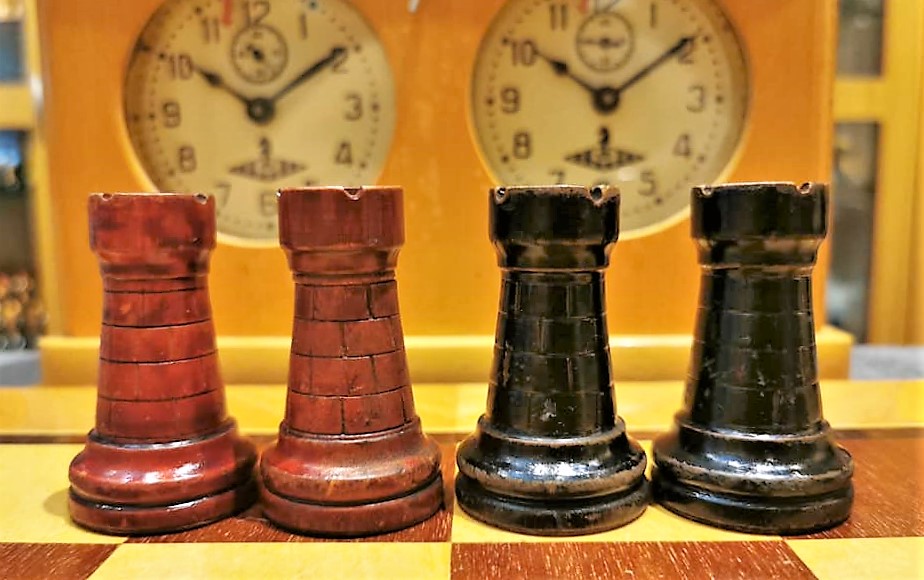
I use the term “Barrel Rook” to describe this set because of the barrel-like shape of its rooks, perhaps the set’s most notable visual attribute. The kings are 98 mm tall, a typical size for a tournament set, and the pieces are unweighted. Nevertheless, the pieces remain fairly stable because of the solid bases and conical bottom of the stems.

c. 1940 Barrel Rook Tournament Chessmen. Chuck Grau Collection, photo.

Gone are the sweeping concave stem curves of the Voronezh Pattern. But at the same time, so is the stepped up base characteristic of the Staunton design and found in the Late 1930s Grandmaster and the phenol resin Soviet Stauntons of the same period. Instead, the stem flows organically from the base in accordance with Soviet design precepts, the only demarcation a shallow turned ring.

c. 1940 Barrel Rook Tournament Chessmen. Chuck Grau Collection, photo.

The beautiful knights incorporate the typically Soviet CV structure of the back (C-shaped) and chest (V-shaped) and are nicely carved. Perhaps their most prominent feature are what Berlin collector and artist Porat Jacobson Chagall eyes, because they whimsically resemble those seen in so many of the Belarussian’s images of horses and other paintings.

The photographic record shows the set in use at high levels in what appears to be some time in the 1940s, but the date, location, and name of the event have as yet not been established.

Salo Flohr, Alexander Konstantinopolsky, Barrel Rook chessmen. Event, date, photographer unknown. Source: S. Voronkov, 2 Masterpieces and Dramas of the Soviet Championships 375 (2021).

The set probably was made by Artel Kultsport, though Moscow collector Alexander Chelnokov suggests Artel Sila may have been the maker. I infer the date and manufacturer from stamps included in the boxes of similar sets in the collections of Mike Ladzinski and Tom Adamski.

Mike Ladzinski Collection, photo.

The top stamp from the Ladzinski set tells us that Artel Kultsport is the maker, with an address in Moscow. The next stamp identifies the item as Chess Board no 4-a, which according to Kyiv collector and dealer Mykhailo Kovalenko, may indicate squares of 4 cm. The second stamp also tells us that the item was inspected by Controller No. 1, who in the third stamp has indicated it to be of “1 Sort,” or first quality. The final stamp provides the year of manufacture to be 1941.

c. 1941 Barrel Rook Set. Mike Ladzinski Collection, photo.

Tom Adamski’s set provides similar information. His set also originated at Artel Kultsport, and comprised or included Chess Board No. 3. Like Ladzinski’s it is of first quality and was produced in 1945. Many thanks to Mykhailo Kovalenko and Eduardo Bauza for their help in translating the stamps.

Tom Adamski Collection, photo.

Even if the stamps apply only to the boards but not to the pieces found inside them, they are evidence as to when and where the pieces were produced, absent any evidence that they were not. This inference is strengthened by the fact that the pieces in the boxes are very similar, suggesting that both sets of pieces are of similar origin. If the pieces were placed in these boxes randomly, it is far more likely that these two examples would be different than as similar as they are.

Conclusion

The c. 1940 Barrel Rook set, characterized by its stout rooks and Chagall-eyed knights, was used at high levels of Soviet chess. Incorporating more elements of Staunton design than most Soviet sets of the late 1920s and 1930s, it was part of the general repudiation of the Constructivist and Modernist ideas that had helped shape them.

Rocket City Molodets Set

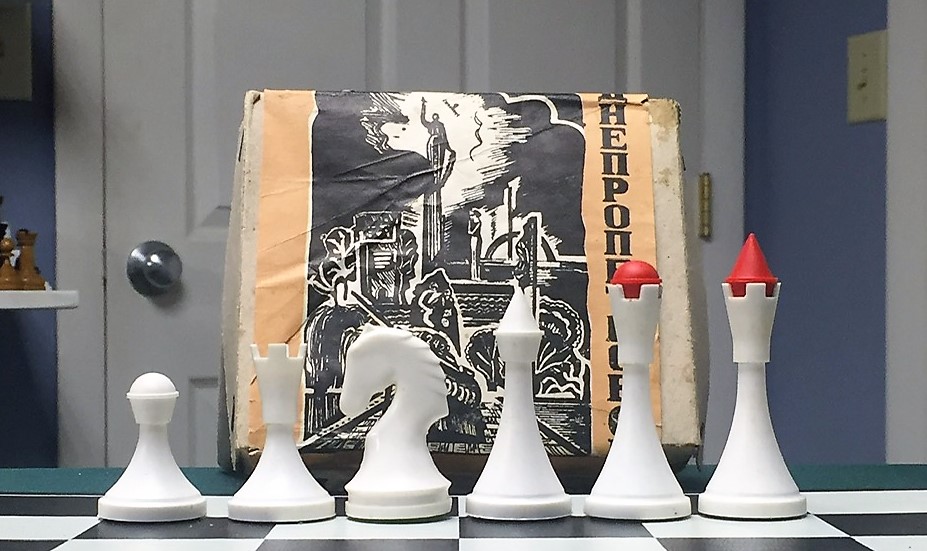
Rocket City Molodets Set. Chuck Grau Collection, photo.

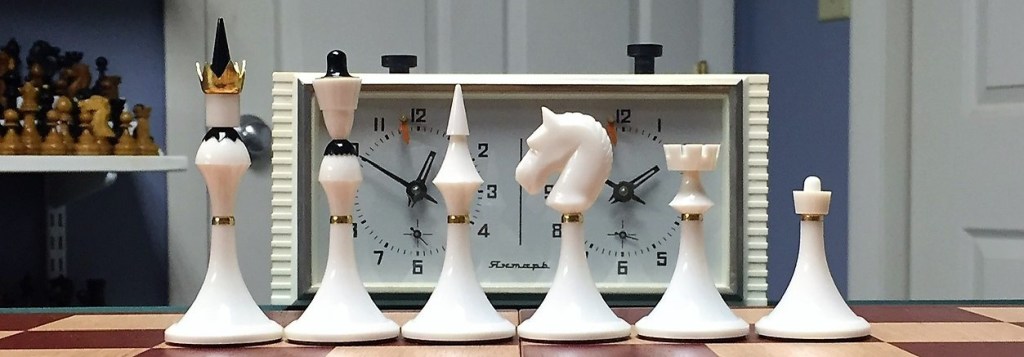
A beautiful, cleverly simple plastic set.

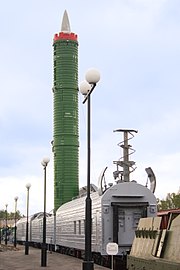
The set’s original box indicates that it was manufactured in Dnepropetrovsk (since 2016 simply Dnipro), the fourth largest city in Ukraine, with about one million inhabitants, located in east central Ukraine, about 400 km southeast of Kyiv. I use the term Rocket City because Dnepropetrovsk was the center of Soviet strategic rocket development and manufacture. I use the term Molodets in reference to Toronto-based artist and collector Alan Power’s description of the king’s similarity to a particular Soviet ICBM, the RT-23 Molodets, which translates to Brave Man or Fine Fellow. Its NATO designation was the SS-24 Scalpel. Alan owns and operates The Chess Schach, where he artistically restores vintage sets, many of them Soviet, and provides both set specific commentary and related essays.

RT-23 Molodets ICBM at the Varshavsky Rail Terminal, St.Petersburg, Home of the Central Museum of Railway Transport, Russian Federation

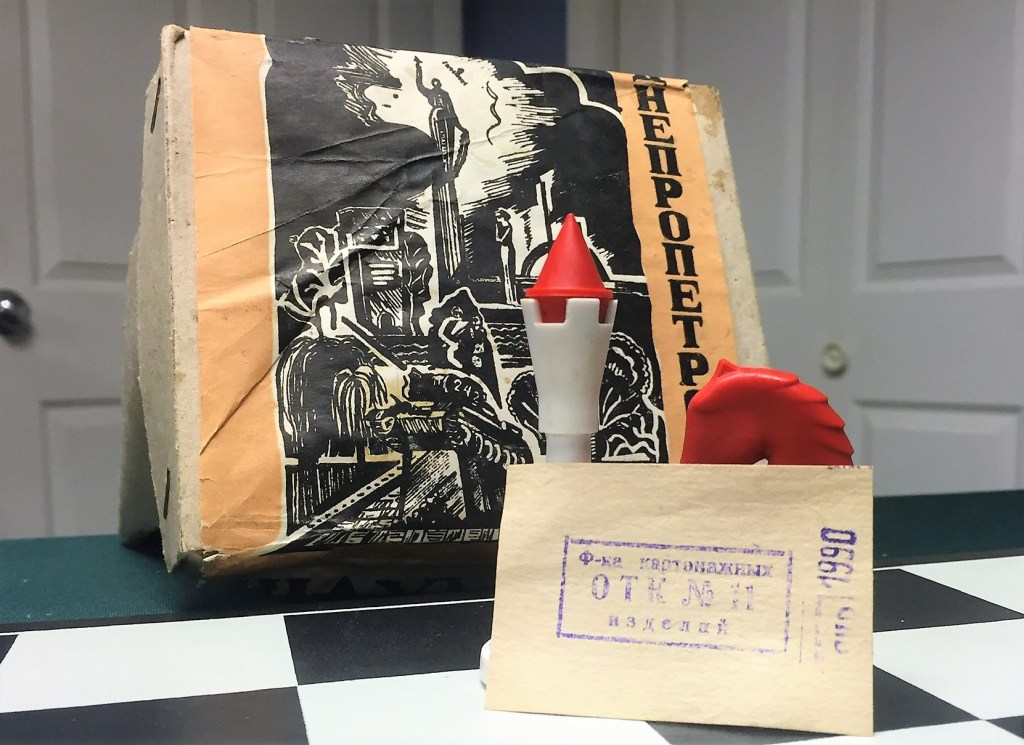
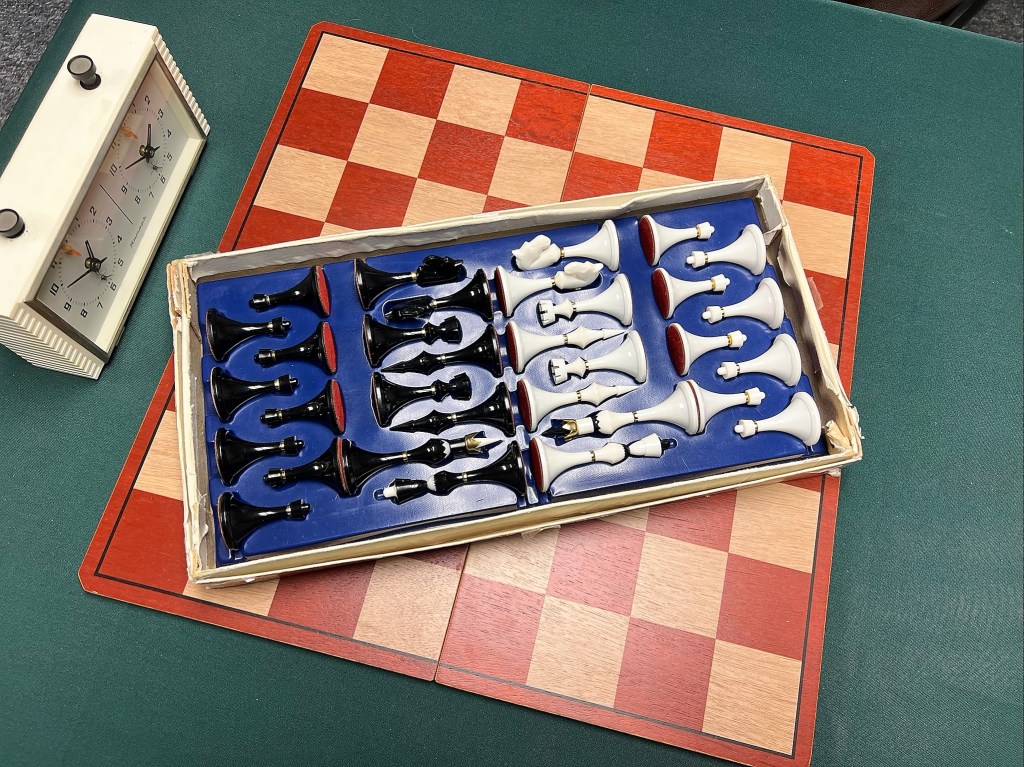
I date my specimen from an inspection stamp found inside the set’s box.

Molodets Set with original box and inspection certificate. Chuck Grau Collection, photo.

Original boxes accompanying sets are important sources of data on the sets’ dating and manufacturer. They more frequently are found with plastic sets than with wooden ones, which typically are paired with wooden box/boards that may or may not be original to the sets they accompany.

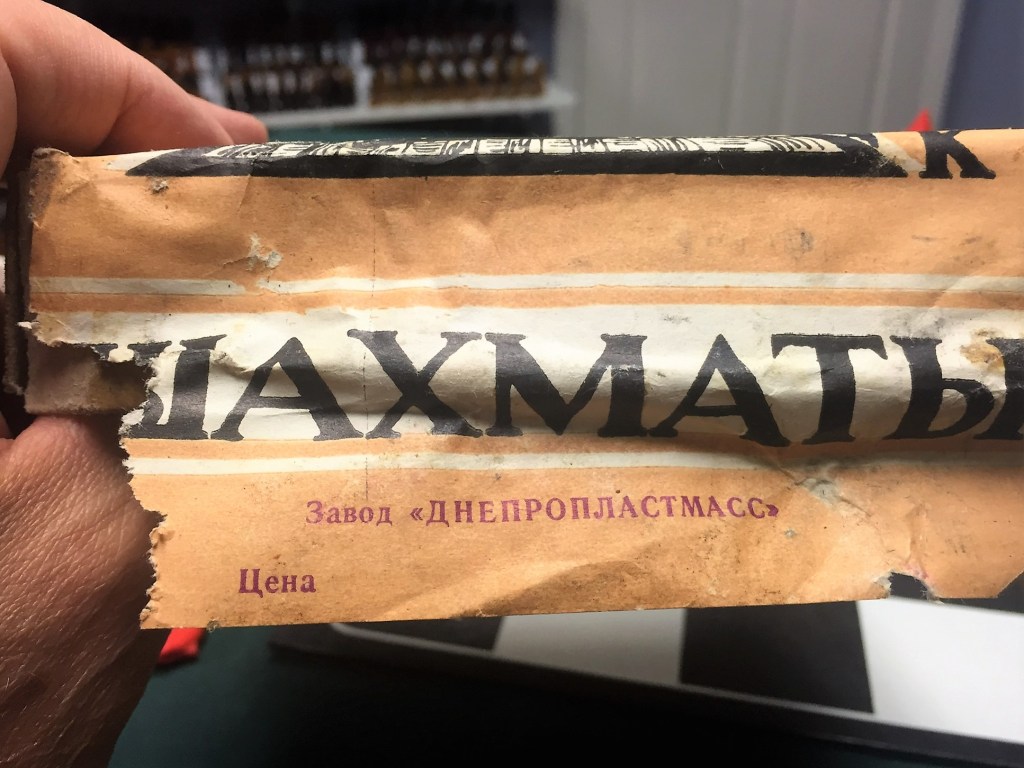
Alan Power describes the graphic on the top of the box as follows: “It has the words ‘CHESS’ at the top and bottom and DNEPROPETROVSK to the right of the illustration, depicting war machines (a tank and a rocket being launched) and a statue of a cosmonaut reaching up into space. The words ‘Plant DNEPROPLASTMASS’ appear at the bottom of the label. Unfortunately, the ‘цена’ (‘price’) is left blank.” Here is the bottom of the label from my set, which extends to the side of the box’s top.

Translation: “Chess/Factory Dneproplastmass/Price” Chuck Grau Collection, photo.

The clever simplicity of the set lies in its redundancy, its repeated use of the same parts to construct different pieces. The bases and stems of the king, queen, and bishops are identical. Only the crowns and miter distinguish them. The bottom portions of the king and queen crowns are identical. The top portions of their respective crowns vary to identify them. The king’s crown bears an opposite-colored conical top, identical in shape to that of the bishop, but of a different color, and set in a crown, whereas the conical piece in the bishop sits directly atop the stem. The shape of the king’s crown echoes the structure of the Molodets ICBM. The top of the queen’s crown is likewise opposite-colored, but is dome-shaped rather than conical.

Rocket City Molodets Set. Chuck Grau Collection, photo.

In similar fashion, the rook and pawn share identical bases. Again, it is their tops which identify and distinguish them. Atop the rook sits a turret that is none other than the same part used for the bottom portions of the royal crowns. Atop the pawn rests the same dome used to distinguish the king from the queen, but of the same color as the pawn’s base, whereas for the queen, the dome is opposite-colored. Alan Power suggests the dome shapes allude to the Soviet Sputnik satellite.

Sputnik I, Cosmos Magazine image.

It is not at all surprising that the Soviets would incorporate stylistic elements reminiscent of icons of Soviet achievements like the Sputnik satellite or the Molodets ICBM, for it was common practice for them to use art to glorify the successes of Soviet socialism, and to name places and things after heroes of the Revolution or Soviet socialism. It is also consistent with the theory and practice of Socialist Realism, the theory of art formally sanctioned by the Soviet State in 1934, which, simply put, mandated the use of “realist styles to create highly optimistic depictions of Soviet life.”

Dnepropetrovsk Proplastymass manufactured the Molodets set in other colors. Here is one in chocolate and white.

Chocolate and White Rocket City Molodets set. Collection and photographer unknown.

This beautiful set from the Soviet Union’s Rocket City is an echo chamber of form and color so clever it could have been designed by a rocket scientist. In the tradition of Socialist Realism, the Molodets set pays homage to the Soviet Union’s military and scientific rocketry by incorporating design elements reminiscent of the RT-23 ICBM and the Sputnik satellite.

From Tallinn to Tbilisi: The Evolution of the Tal Chess Pieces

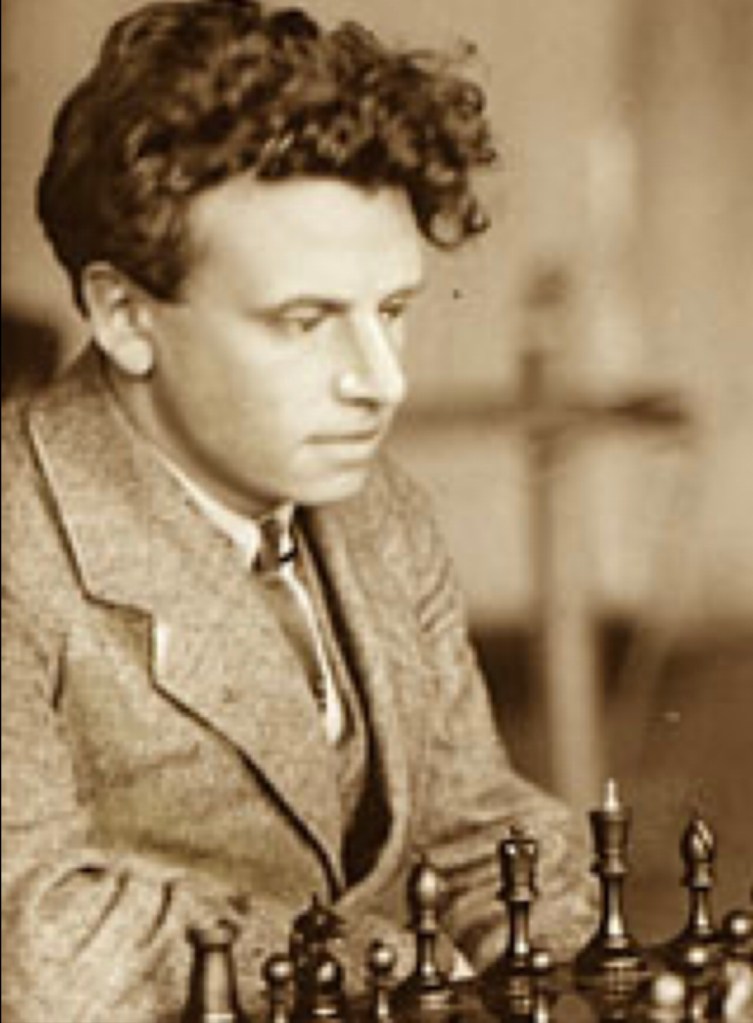
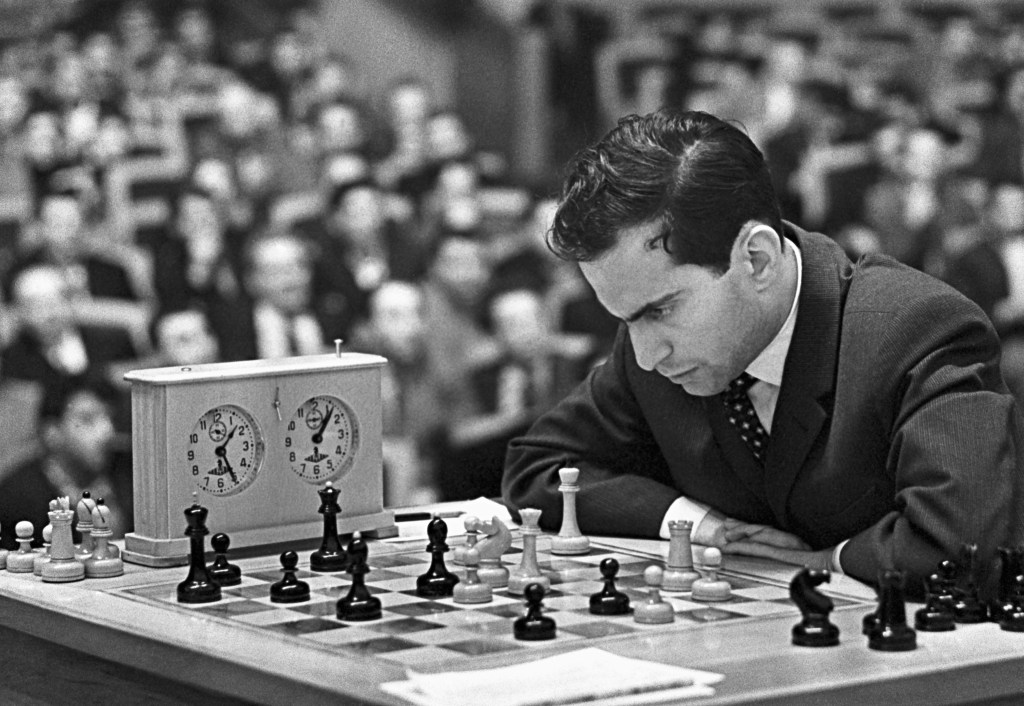
Former world chess champion Mikhail Tal, USSR Ch. Yerevan 1962. Sputnik photo.

Collectors typically study photographs of events to help them determine what type of pieces they have in their collections, when they were used, in which events, and by which players. Sometimes, however, they discover pieces in photographs of which they have not seen surviving examples, launching them on a quest to find them. So it is with the chessmen appearing on the cover of the Cadogan and Everyman paperback editions of former World Champion Mikhail Tal’s autobiography, The Life and Games of Mikhail Tal.

Chuck Grau photo.

The book’s cover bears a photo of Tal contemplating his position after Black’s 32nd move in Tal v. Krogius, played in the 30th Soviet Championship in Yerevan in 1962, a Ruy Lopez won by Tal. These chess pieces comprise one of three sets Portuguese collector Arlindo Vieira described as “Utopia” in his 2012 video on Soviet and Russian chess sets. Collectors of Soviet chessmen have come to call them “Tal Pieces” in homage to the former World Champion’s connection to them in this photo.

The photographic record of the Tal chess pieces strongly suggests that they originated in the pre-Annexation Baltic states around 1940, most probably Estonia, but then evolved stylistically, and migrated to a new home in Georgia SSR in the fifties, where they remained in use until at least 1979.

The pieces largely follow neoclassical Staunton conventions, while also incorporating certain Soviet design elements, the combination of which collectors have come to call Soviet Stauntons. Among the traditional Staunton elements present in Soviet Stauntons are: relatively wide bases that incorporate a step as they rise to meet the stem; vertical stems that rise from the bases’ steps with a bottom diameter appreciably less than that of the base; stems that taper as they ascend to form a largely vertical segment and intersect the pedestal at a distinct, perpendicular or near-perpendicular joint; upon the pedestal rests a piece signifier resembling the symbolic representation of the piece in chess diagrams; which is offset from the circumference of the pedestal and connected by a connecting section defined by two collars resembling the rims of crowns or miters (together with the pedestal the two collars of the connector are often referred to as a “three collar structure”); the king’s signifier often incorporates a cross-like finial; the queen wears a coronet; the bishop’s miter often bears a cut; and the rook’s turret typically contains merlons; when arrayed on their starting squares the pieces resemble a series of columns supporting a triangular pediment. The shape of the knight’s back approximates the S curve characteristic of Staunton knights.

Tal Chess Pieces’ Staunton, Soviet Attributes. NOJ reproduction. Chuck Grau Collection, photo.

Among the typically Soviet design elements of Soviet Stauntons are the opposite colors of the king, queen, and bishop finials; the modification of the king’s cross to one not quite recognized by Christian iconography; and, with one notable exception, a knight not patterned after the Elgin Marbles. Among the features that distinguish the Tal set are the hefty wide and tall bases; the thick rook towers; the crisply carved angled merlons; the squat pawns; and the jaunty knights, which appear to lean backwards with their heads tilted up toward the sky. The traditional and idiosyncratically Soviet elements of Soviet Stauntons are illustrated above.

The origins of the design have been a matter of some interest. Based on his extensive review of photographs from Georgia SSR and elsewhere, American collector Ron Harrison has suggested that the design is Georgian in origin. To be sure most of the photos of the sets in use from the fifties, sixties, and seventies were shot in or nearby Georgia. My own research, however, suggests that the set originated in the Baltic states, where it appears in the photographic record as early as Spring 1940, notwithstanding its later ubiquity in Georgia.

Mikenas and Keres with first generation Tal pieces. Tallinn 1940. Photographer unknown.

The photo above shows Paul Keres and Vladas Mikenas playing in a match between Estonia and Lithuania held in Tallinn prior to the annexation of the Baltic states by the Soviet Union later in 1940.

A specimen of this set from the collection of Mike Ladzinski is shown below. Ladzinski obtained his set from a Lithuanian dealer in 2019. Lacking several elements of the mature Tal design of Yerevan 1962, these chessmen adopt traditional elements of the English Staunton design, most notably the long stems narrower at the top than the bottom; the distinctly jointed pedestals, the three-ring collar system, the cross-crowned king, the bishop miter cuts, the merlons of the rook turrets, and the collective column-pediment. Unlike traditional Stauntons, the crosses and finials are opposite-colored. The unique, jaunty knights do not emulate the Elgin Marbles in realism or detail, but are very close in design to those of the 1959 Tbilisi and 1962 Yerevan sets. The pieces contain the wide, almost squared-off bases characteristic of the mature sets, but not yet as tall. The cross is a true cross, not the quasi-cross of the 1962 set. While the rooks’ turrets incorporate merlons, their towers are noticeably narrower than their successor’s, and concave rather than the straight Tbilisi and Yerevan towers. The pawns’ stems are longer than the late versions, making the pawns less squat.

First generation Tal pieces. Mike Ladzinski Collection, photo.

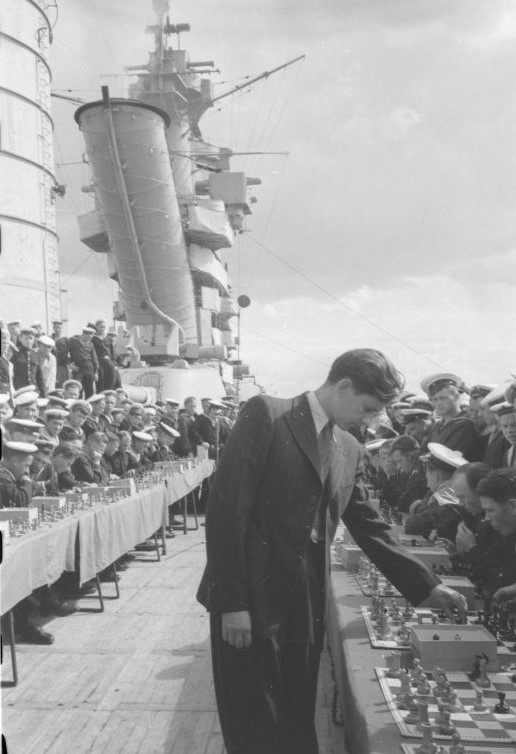
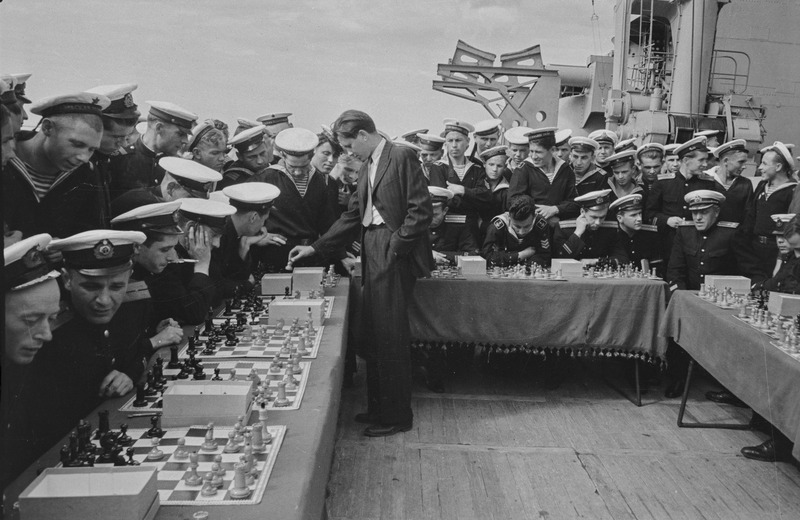
Shortly after the Second World War, Tal sets were used in a simultaneous exhibition that Estonian great Paul Keres played with players from the crew of the Soviet battleship October Revolution when it docked in Tallinn in 1946. The pieces in the following two photos seem to have evolved. The bases appear thicker, the pawns stubbier, and the rook stems thicker and straighter.

Paul Keres Simultaneous Exhibition aboard Soviet Battleship October Revolution, Tallinn, 1946. Grigori Akmolinski photo, AM N 33716:8, Estonian Sports Museum.

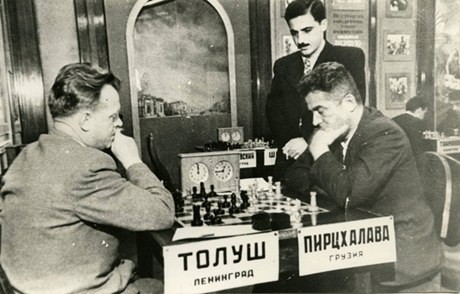
Over the next few years, the pieces continued to be used in the then-annexed Baltic states and in nearby Leningrad, as the following three photos indicate. In these photos, the pieces can be seen evolving towards their 1962 form, with widened, straightened rook towers and stouter pawns. The first photo depicts Akaki Pirtskhalava and Alexander Tolush playing in the match between Leningrad and Georgia in the 1948 USSR Team Championship. The tournament was held in Vilnius, Lithuania.

Pirtsskhalava-Tolush, 1948 USSR Team Ch., Vilnius, Lithuania. Photographer unknown.

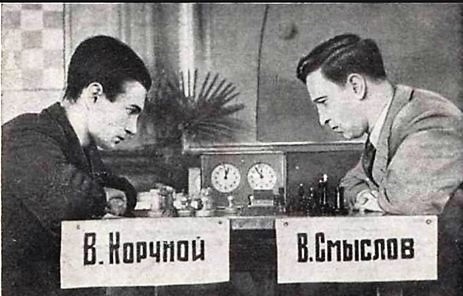
The second photo documents a game between Viktor Korchnoi and Vasily Smyslov playing in the 1951 Mikhail Chigorin Memorial tournament, held in Leningrad.

Korchnoi-Smyslov, 1951 Chigorin Memorial, Leningrad. Photographer unknown.

In the third photo, Vytautas Landsbergis and Tigran Petrosian are seen playing in the 1951 Lithuanian Championship, held in Vilnius, Lithuania.

Landsbergis-Petrosian, 1951 Lithuanian Championship, Vilnius. Photographer unknown.

By the late fifties, use of these pieces migrated to Georgia SSR, where they became very popular, and used in major tournaments there and nearby Yerevan for decades. It was in Georgia that they likely evolved into the form seen on the cover of Tal’s biography, complete with the taller bases and stout pawns with very short stems. The next three photos show the Tal pieces in use in Georgia from 1959 to 1979.

Gufeld-Tal, 1959 USSR Championship, Tbilisi, Georgia SSR.
Alexandra-Gaprindashvili, Tbilisi 1960. History of Romanian Chess. Photographer unknown.
Gurgenidze-Klovan, Tbilisi 1979. Photographer unknown.

The next photo shows in great detail the Tal set used in the 1959 USSR Championship held in Tbilisi, Georgia SSR. The pieces have reached their mature form, with stout bases, extraordinarily squat pawns, and chunkier, less tubular knights than in the original Tallinn version of the set. The photo depicts the pieces at use in Tigran Petrosian’s game against Yuri Averbakh, a Najdorf Sicilian Defense won by Petrosian, who won the game and the championship.

Averbakh-Petrosian, 1959 USSR Championship, Tbilisi, Georgia SSR. T. Archvadze/TASS photo.

The next two photos depict original Tal pieces like those shown in the photos above from the 1959 Soviet Championship in Tbilisi. Whereas the pieces in the photos appear to be natural and black, these originals are natural and a very dark brown. The finials on the dark pieces are painted rather than finished natural wood.

1959 Tal Pieces. Chuck Grau Collection, photo.

Although photos have emerged purporting to show a surviving set of pieces like those used in Yerevan, 1962, there is no evidence corroborating the pieces’ authenticity, and at least one collector and dealer from Kyiv believes the pieces are modern reproductions.

Tal pieces continued in front line service until at least 1979 but were largely displaced as pieces of Soviet Championships by another Soviet Staunton design, the so-called Grandmaster 3 design, after the 1962 Championship in Yerevan. They enjoyed a long and storied existence on the front stages of Soviet chess at the apex of its dominance, beginning with their appearance in Tallinn in 1940 to their popularity in Georgia SSR in the 1950s, 1960s, and 1970s. Tied to the ever-popular World Champion Mikhail Tal by the cover of his autobiography, the Tal pieces remain a favorite to collectors of Soviet chess sets.

A version of this article is appearing in a forthcoming issue of Chess Collector International Magazine.

Aristocratic Olympians: The 1980 Minsk Olympic Set

c. 1980 Minsk Olympic Commemorative Pieces. Chuck Grau Collection, photo.

Much Soviet chess set collecting focuses on wooden tournament sets, and understandably so, as those were the sets with which the giants of Soviet chess played their magnificent chess. But Soviet plastic sets provide many delights of their own. To the program of Political Chess, they provided an opportunity to produce great numbers of sets cheaply. For players, they offered sets better able to stand up to the elements for the inevitable games played on park benches whatever the weather. For designers, they provided ways to express creativity not afforded by wood.

This design is showcased in Arlindo Vieira’s seminal 2012 video on Soviet and Russian chess pieces and in his blog Xadrez Memoria. He describes them as “Unusual Plastic/Metal Chess Pieces,” which he acquired from a friend who knew only that they were Soviet. His video tells us little about the pieces, other than they were made in Minsk in 1984, according to a page from a Christies catalog he displays.

c. 1980 Minsk Olympic Commemorative Pieces. Chuck Grau Collection, photo.

In Xadrez Memoria, Arlindo elaborates his views, describing the pieces as “quite different” from traditional Soviet pieces, “almost say, aristocratic in their design.” Vieira was fascinated with their “Flowery… somewhat complex and turned shapes.” He tells us that his research determined that the pieces had been offered to certain personalities and sold to the public in commemoration of the 1980 Olympic games held in the USSR. He shows the set depicted on the cover of a chess book, from which he concludes the pieces had gained “some popularity.”

c. 1980 Minsk Olympic Commemorative Pieces. Chuck Grau Collection, photo.

What I find fascinating about this design is how it incorporates the principle of redundancy found in other Soviet plastic sets. By this I mean the use of the same plastic part to serve different or like functions in different pieces. In this set, the base/lower stem structure is a single unit, and is identical for all the pieces. It comprises the set signifier. Each piece is then identified by a different piece signifier, which either sits directly upon the base/lower stem section, as with the knights, rooks, and pawns, or together with an upper stem section that increases in height from bishop to queen to king. One wonders whether the subliminal message of the design is that “at base, we are all equal.”

c. 1980 Minsk Olympic Commemorative Pieces. Chuck Grau Collection, photo.

Kiev collector and dealer Михайло Коваленко, from whom I acquired my set, provides the following commentary: “As for this type of chess pieces, I already wrote in Facebook that there are three types of this type of chess. The first is Belarusian. It can be in a separate package (like mine), or in a plastic chessboard. If in a board, the color of the substrates should be identical to color of an upholstery of a board inside. Belarusian pieces in white turn yellow over time, especially in the sun. There are also Ukrainian-made (the city of Severodonetsk) two types of pieces. The first Ukrainian is similar to the Belarusian, but does not turn yellow. The second Ukrainian is reinforced. The stems are thick and all the pieces are coarser. These pieces are more resistant to shocks. Also, Ukrainian pieces come with yellow metal and ‘silver’ metal. Belarusian only yellow metal.”

My pieces in their efficient storage tray. Chuck Grau collection, photo.

The pieces also are packaged in a variety of boxes. Some commemorate the 1980 Olympics; others different events; yet others contain only the pieces without commemoration. Regardless of the designation, the pieces are referred to generally as an “Olympic” set.

Ukrainian 1980 Olympic Commemorative Set. ChessUSSR photo.

One Ukrainian variation in this design is of particular note. Perhaps as a means to reinforce their relatively longer stems, it incorporates a double base for the kings and queens. Basically, the flare at the bottom of the base is repeated before the ascension of the stem. Perhaps this suggests that, to paraphrase Orwell, “All bases are equal, but some bases are more equal than others.”

Pushki on the Chessboard: The Soviet Cannon Rook Set

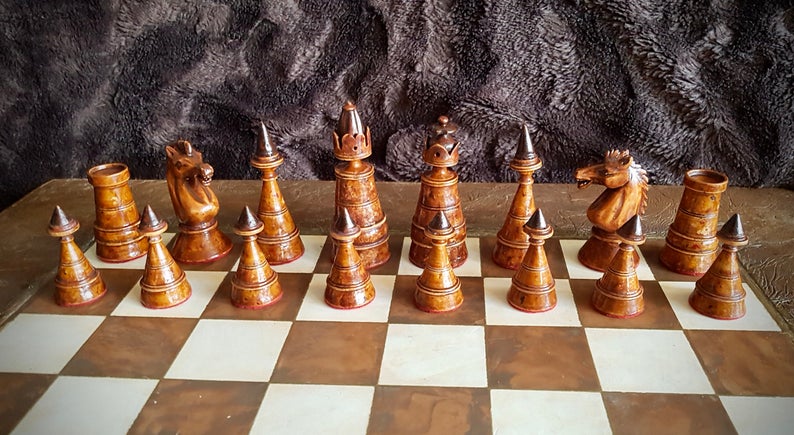
c. 1935 Cannon Rook Pieces. Chuck Grau Collection, photo.

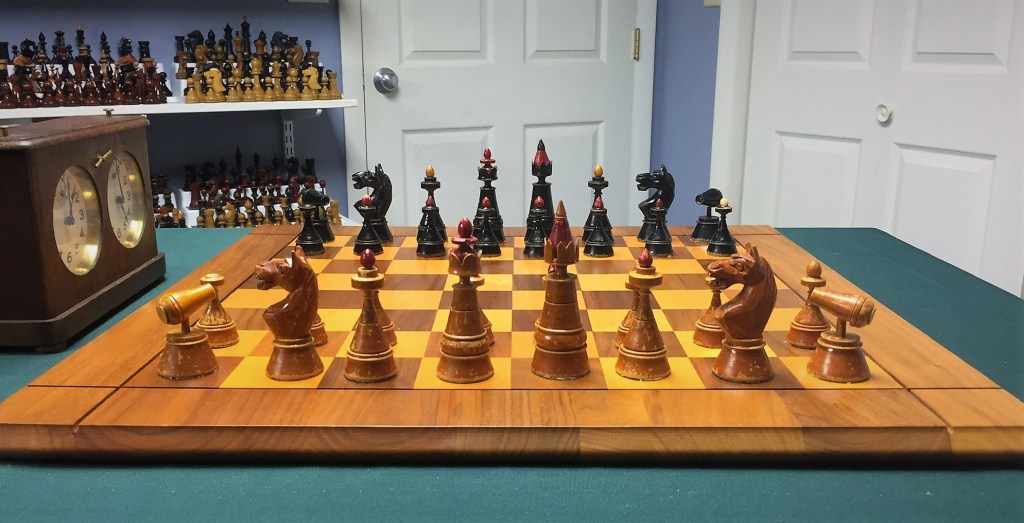
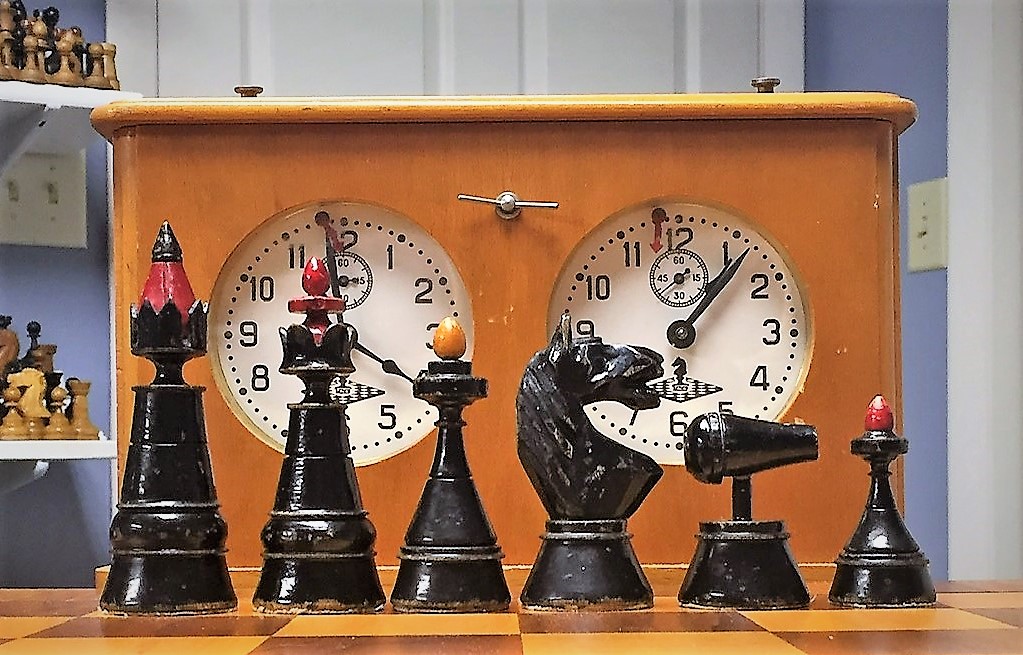
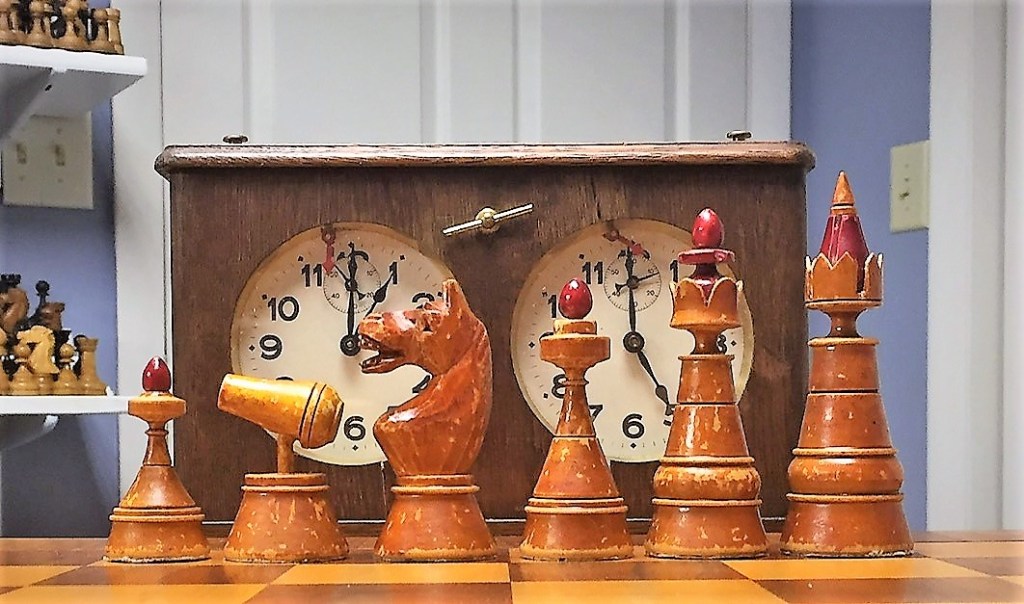
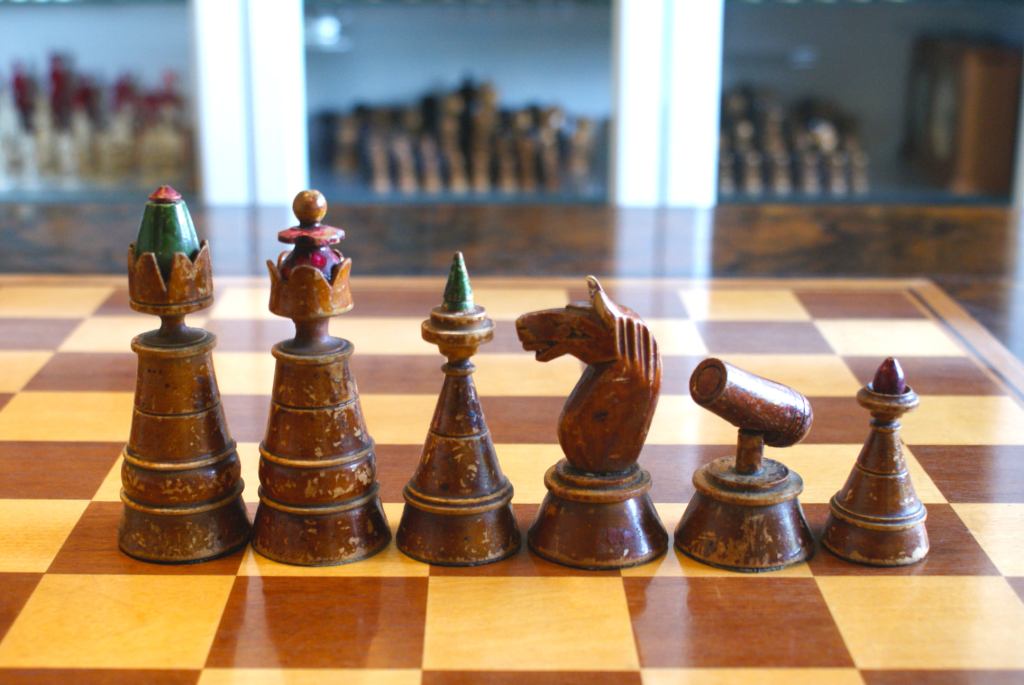
One of the most interesting sets in my Soviet collection comprises what I call the “Cannon Rook” pieces, a non-Staunton design characterized by its unusual rooks, represented not by the traditional towers, but by cannons mounted on stems above bases.

c. 1935 Cannon Rook Pieces. Chuck Grau Collection, photo.

The pieces present an overall conical impression, tapering from bottom to top without distinct base and stem sections. The piece signifiers share a common theme—a bullet-shaped cap, mostly in red for both sides, but with some varnished in natural wood. The king is 107 mm tall with a base of 37 mm. Its crown consists of two parts–a colored cone situated within a ring of saw-toothed points. The queen has a rhyming structure, but instead of a cone her crown inlay consists of a tear-shape atop a disc-shaped pedestal. The tear-shape also appears atop the bishop and the pawn. The knights are nicely carved with large, prominent teeth like those found in other late Tsarist and early Soviet knights, and resemble other well-carved knights thought to be made by Artel Kultsport. The pieces are nicely weighted and felted with patterned cotton cloth.

c. 1935 Cannon Rook pieces. Chuck Grau Collection, photo.

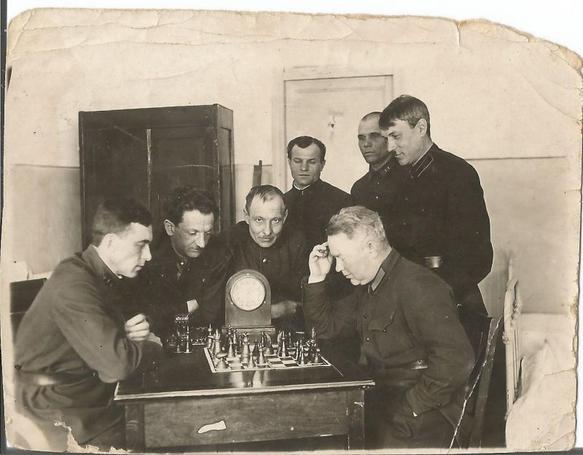
Moscow’s Russia Chess House, from whom I acquired it, dated the set as late 19th century, but I think this is too early. The design appears in the photographic record in 1935, which I think much closer to its time of origin owing to the “Kultsport” knights and the nature and condition of the varnish finish. Here is a photo said by St. Petersburg collector Sergey Kovalenko to be from the Leningrad region in 1935.

CDN Molypolk.ru photo, provided by Sergey Kovalenko.

I know of three sets that share this basic design. Of a somewhat smaller set, noted German collector Holger Langer writes: “An unusual Soviet chess set with unusual rooks, probably made in the 1920’s or 1930’s. The pieces are made of wood and are moderately weighted. King height is 9.85 cm or 3.85″. The white side is covered with the usual reddish-brown varnish often seen in Soviet sets. The black side is covered with a black lacquer. The kings with a very pronounced crown and hat in green color with a red finial, the queens of almost equal height but with a red ball inside the crown with a red disc and a small ball finial on top (the black queen with some damage, unfortunately). The rooks are extremely unusual in that they are shown as cannons mounted on a circular pedestal. The knights as carved horses’ heads of typical Russian or early Soviet shape. The bishops with a long cone shaped corpus and a green colored pointed finial. The pawns also with a smaller cone shaped corpus and a colored drop finial (in red for the white side and in brown for the black side).”

Holger Langer Collecti0n, photo.

Of the second similar set, artistically restored by The Chess Schach, artist Alan Power writes: “Militibus ex Antiquis Ruthenorum (Old Russian Warriors), 32 heavily-weighted chessmen without board, wood, white v. red, Soviet (post Revolution era), circa 1920 – 1930 Height: King 10cm, weight 55g, base width 3.8cm, Queen 9.2cm, Bishop 9cm, Knights 8/7.5cm, Rook 5.8cm, Pawn 5.8cm. W: red felt bases B: black felt bases.

Militibus ex Antiquis Ruthenorum. The Chess Schach Gallery, Alan Power photo.

“An extremely rare set of Soviet chessmen (most probably hand-turned for personal use or as a gift, perhaps). It came to me in pretty poor condition; two of the Knights muzzles have been repaired and two Bishop mitres and five pawn caps (I’ve lost track of which pawns) have been replaced. There is also a certain amount of ‘head-bowing,’ also called stooping or leaning amongst the pieces, which adds overall character, therefore, it has been left as is. A few ‘battle-scars’ have also been left here and there for the same reason.” Unlike the Langer and Grau specimens, the Chess Schach rooks are traditional towers, not cannons mounted on bases. The knights are more delicately and intricately carved.

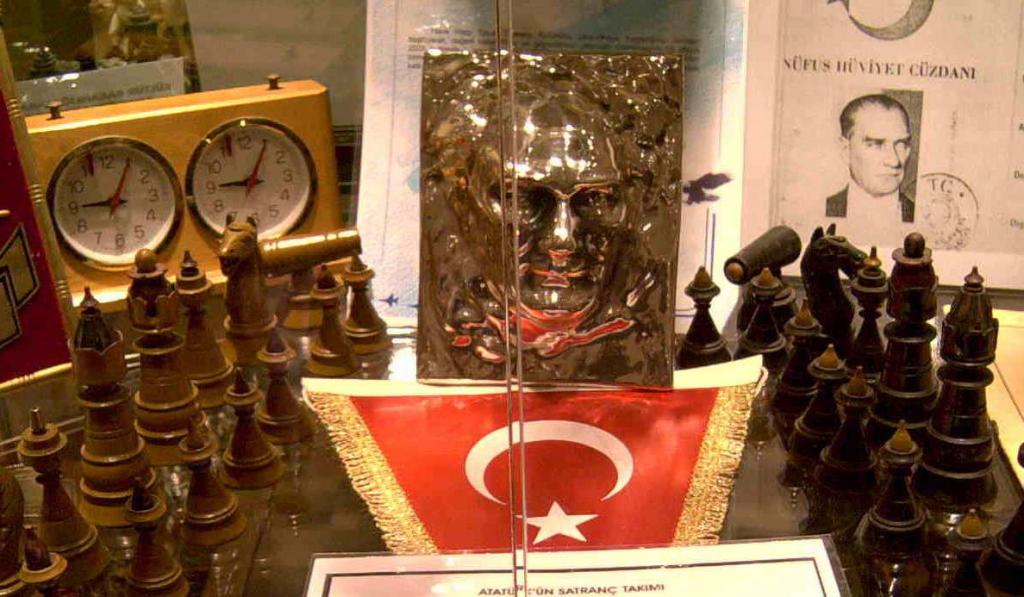
The third specimen is the most intriguing. According to a well-regarded collector who goes by the penname Schachkunst BL on Facebook, Stalin presented Turkish President Mustafa Kemal Atatürk (1881-1938) with it as a gift. The set made its way into the hands of Turkish Master Halil Sertac Dalkiran (b. 1955), who displayed it in a chess museum he opened in Istanbul.

Set gifted to Ataturk by Stalin in Dalkiran’s Istanbul Museum. Photographer unknown. Source: Schachkunst BL on Facebook, accessed 3 April 2022.

Indeed, a photograph of a Soviet Cannon Rook set appears on the cover of Dalkiran’s 1995 book Chess Training Method, as posted on Facebook by Moscow collector Alex Chelnokov.

Source: Goodreads

According to Schachkunst, Dalkiran’s museum closed in 2008. The whereabouts of the Atatürk set are unknown as of this writing.

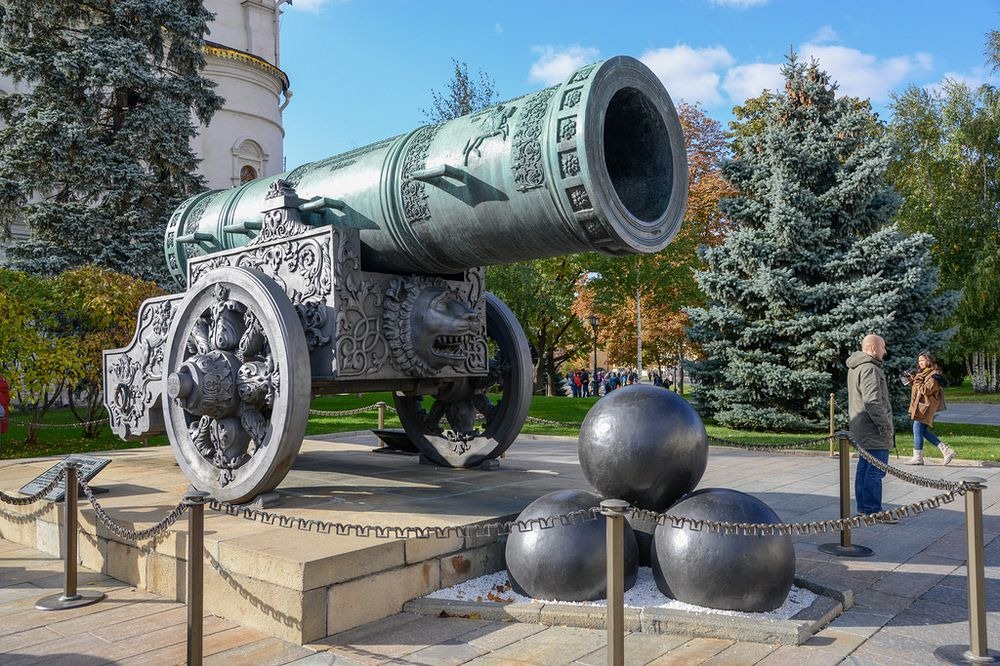
The cannon is an important part of Russian cultural heritage. We are all familiar with Tchaikovsky’s 1812 Overture, commemorating the successful defense of the Motherland from Napoleon’s invading armies, and the rousing cannonade of its finale. Less well-known in the West is the massive Tsar Cannon, cast in bronze in 1586 by the master caster Andrey Chokhov and displayed on the grounds of the Kremlin in Moscow.

Jorge Láscar/Flickr photo.

The set’s likely origin in the early 1930s came at a time of great experimentation in Soviet chess design, much of it challenging central Neoclassical elements of the Victorian Staunton design. Some games sought to displace classical chess. One such game was Victrix, as explained by Moscow Chess Museum Curator Dmitry Oleynikov: “The revolutionary changes in the world of the 1920s gave rise to attempts to ‘revolutionize’ the old war game, and not only by depriving it of its ‘monarchist’ regalia.” Advertisements described Victrix as “An exciting new game of chess pieces on a board of 100 squares. In addition to the usual figures, new figures MACHINE GUN, PLANE AND TANK are participating! Anyone who knows the rules of an ordinary chess game very soon, at once, LEARNS THE MOVES OF NEW FIGURES!” While Victrix did not include a Cannon piece, it does evidence a willingness to experiment with the identity of the playing pieces, and its Machine Gun bears an eerie resemblance to the Cannon Rooks of the c. 1935 set.

1920s Victrix Set. Russian Chess Federation photo.

Elements of the crown structures can be seen echoed in other Soviet sets. The first is from my collection, a diminutive Constructivist-influenced set from the 1920s or thirties, where the king’s crown is reminiscent of that in the Cannon Rook set.

1920s-30s Constructivist-Influenced Pieces. Chuck Grau Collection, photo.

The second set resides in the collection of New York collector Eduardo Bauza. The royals’ crowns in this set beautifully restored by Ron Fromkin echo those of the Cannon Rook set.

Eduardo Bauza Collection, photo.

Finally, the king’s crown of the c. 1980 Minsk Olympic Commemorative set recall those of the much earlier Cannon Rook set.

c. 1980 Minsk Olympic Commemorative Pieces. Chuck Grau Collection, photo.

The fascinating design of the wonderful Cannon Rook pieces well reflects the creativity of Soviet chess design in the 1930s and its challenge to Neoclassical Staunton design. Elements of the Cannon Rook set’s design can be found in other Soviet sets spanning the decades.