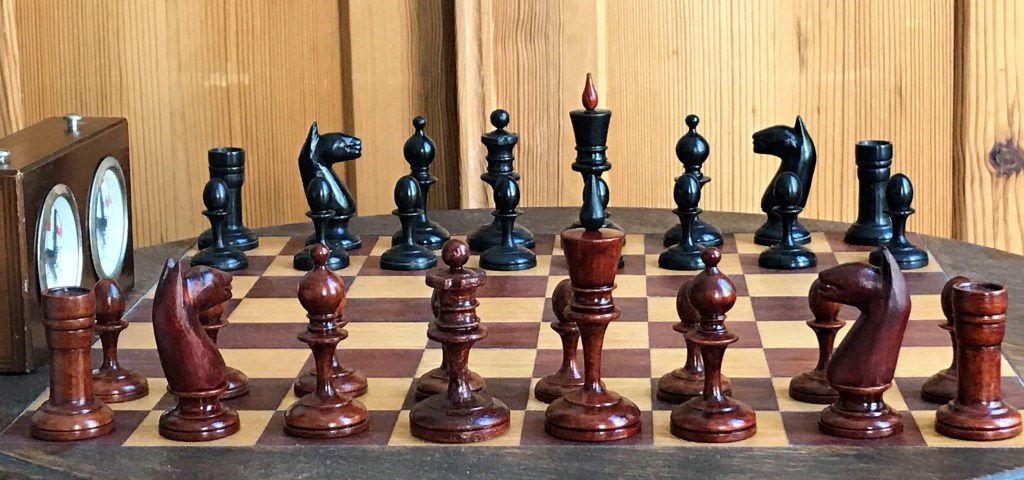
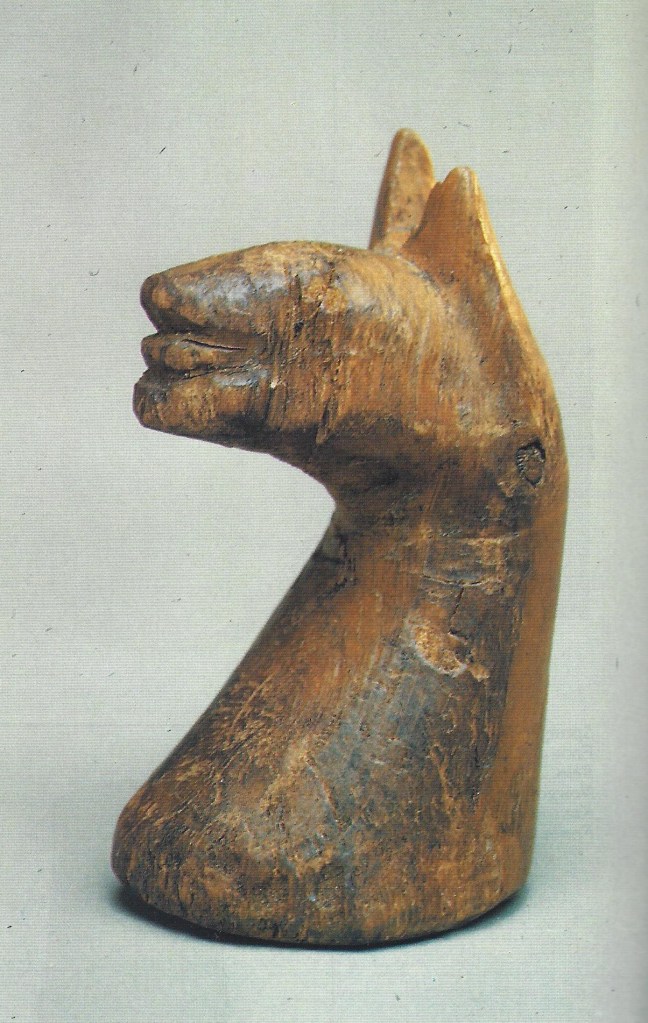
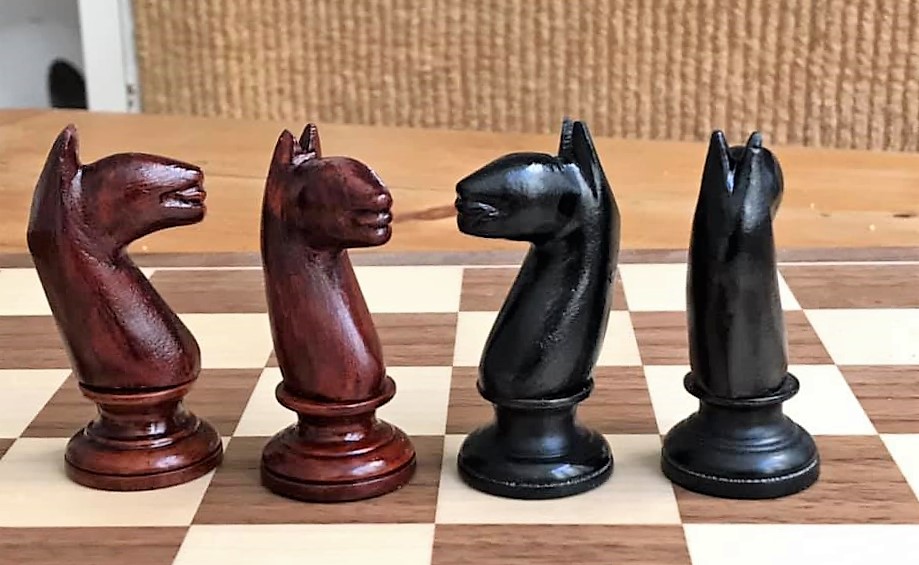
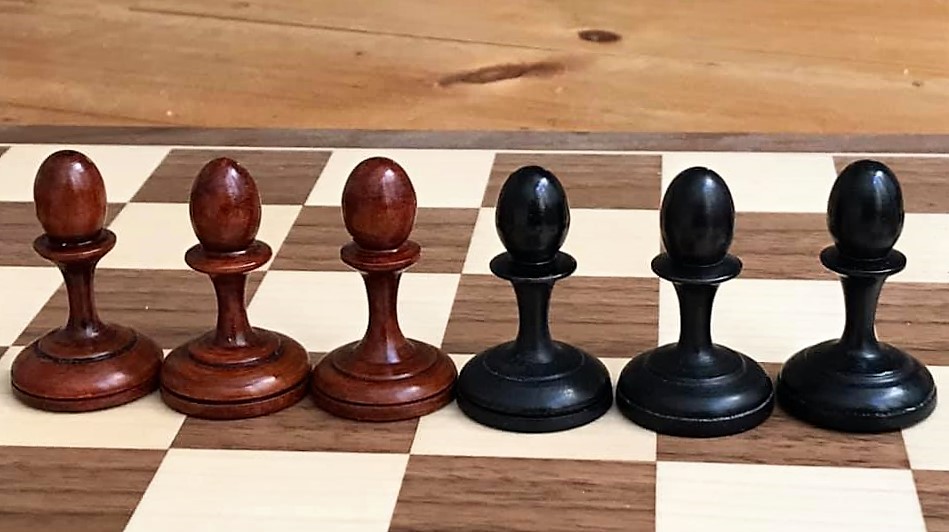
Berlin Artist Porat Jacobson has designed and produced an original Soviet chess set design melding design concepts spanning six centuries. The pieces are inspired by at least four sets. The knight derives from one found from a Novgorod set of early 15th Century Rus.
Early 15th Century Novgorod Knight. Photo from Isaac Linder, The Art of Chess Pieces (1994).Porat Jacobson’s Smyslova Knights. Porat Jacobson photo.
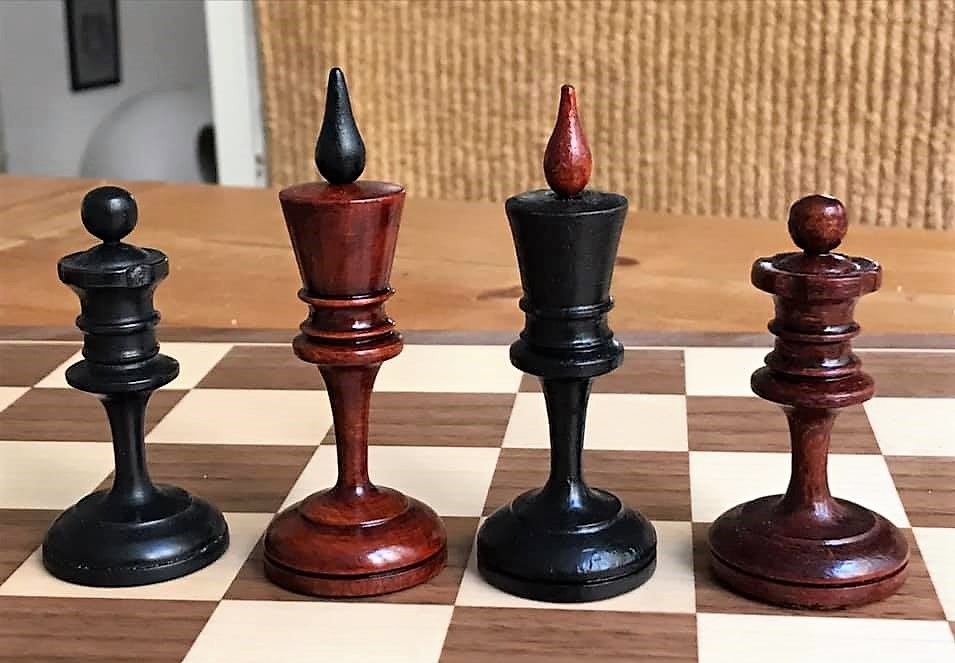
The King and Queen are inspired by those of the Smyslov set of the 1920s and 1930s, as are the pawns. Perhaps the most striking feature of the Smyslov design is the dendriform structure of the stems, an Modernist architectural feature found in Frank Lloyd Wright’s dendriformic columns in the S.C. Johnson office building in Racine, Wisconsin USA and in Moscow’s Stalin Award-winning Kropotkinskaya Metro Station.
The bishop is inspired by another undetermined set, but incorporates the Smyslov’s dendriformic stem. Porat melds the ideas borrowed from these disparate Soviet sets with rhyming bases and dendriformic stems (“set identifiers” in Mike Darlow’s parlance).
The Smyslova set manifests Porat’s theory that Soviets had a “toolbox” of ideas from which they drew in different combinations and variations. It also illustrates his corollary that knights in Soviet sets are largely fungible. Different styles of knights can pair equally well with the same set; the same style knight can pair equally well with multiple sets.
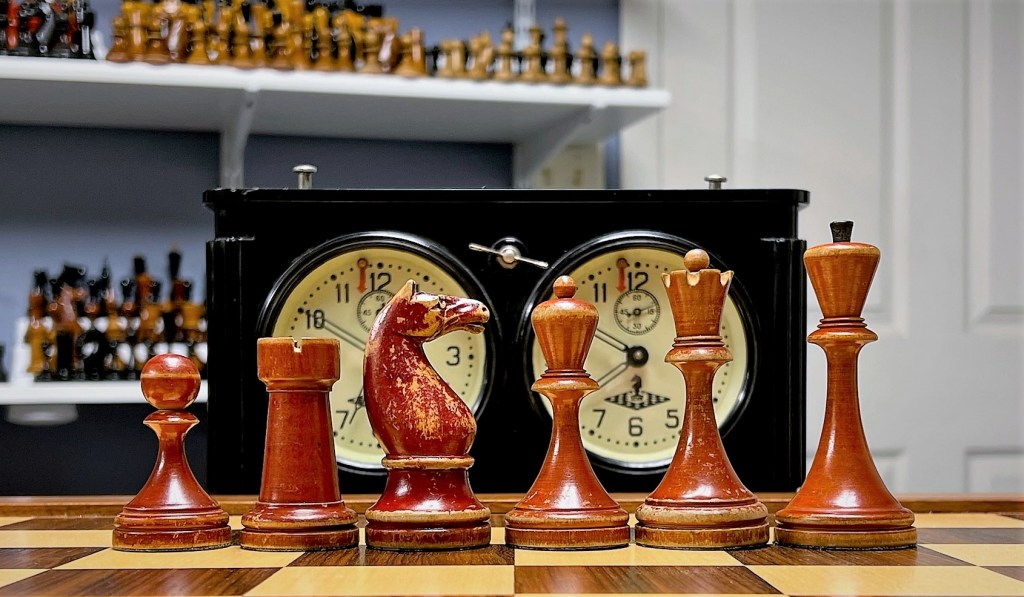
Mid-1930s Botvinnik-Flohr II Pieces, Chuck Grau Collection, photo.
Perhaps the most iconic Soviet chess pieces of all are what we have come to call Botvinnik-Flohr II pieces, BFII for short. In evolving variations, they were used at the highest levels of Soviet chess from the 1930s to the 1960s, including the 1934 Leningrad Masters Tournament, the 1935 Second Moscow International Tournament, the 1936 Third Moscow International Tournament, multiple Soviet Championships, and the 1956 Moscow Olympiad. World Champions Lasker, Capablanca, Euwe, Botvinnik, Smyslov, Tal, Petrosian, Spassky, and Fischer all played with pieces of this style.
For decades, BFII chess pieces served as soldiers in the front lines of the Soviet state’s program of Political Chess first pioneered by Alexander Ilyin-Genevsky in the 1920s and firmly established by Nikolai Krylenko in the thirties.
Alexander Ilyin-Genevsky, photographer unknown. Genevsky died during the Siege of Leningrad.
Genevsky served as a Red Army Commissar during the Revolution and was a master-level player and chess organizer. He believed chess was a way to teach soldiers initiative and strategic thinking. Chess, he wrote, “sometimes to an even greater degree than sport, does develop boldness, inventiveness, willpower, and something more that sport cannot do, develop strategical ability in a person.” Genevsky believed chess could do the same for the working masses, arguing that “In this country where the workers have gained victory, chess cannot be apolitical as in capitalist countries.” Krylenko had served as Commander in Chief of the Red Army during the Revolution, and later became Chief Prosecutor of the Soviet Union as well as Chairman of the All-Union Chess Section of the Supreme Council for Physical Culture. “We must finish once and for all with the neutrality of chess,” wrote Krylenko, “We must condemn once and for all the formula ‘chess for the sake of chess,’ like the formula ‘art for art’s sake.’ We must organize shock-brigades of chess-players, and begin immediate realization of a Five-Year Plan for chess.”
Nikolai Krylenko, photographer unknown. He was shot in 1938, a victim of the Purges and guilt-by-confession trials he had helped perpetrate. Ironically, one of the counts in the indictment against him alleged that he had practiced “Chess for Chess’s sake.”
Political Chess advanced on two fronts. First, it sought to increase the cultural level of the masses by teaching them chess and expanding clubs in workplaces, unions, youth organizations, and the armed forces, thereby drawing them into the political and social life of the Soviet Union. “In our country,” wrote Krylenko, “where the cultural level is comparatively low, where up to now a typical pastime of the masses has been brewing liquor, drunkenness and brawling, chess is a powerful means of raising the general cultural level.” This expansion would also improve the quality of chess play by identifying, nurturing, and advancing talent, which would thereby help the Soviets to compete with and defeat chess in the West, the second front of Political Chess. Political Chess catapulted Botvinnik to the world championship in 1948 and created a cadre of world class players who dominated chess for decades, thereby achieving Stalin’s goal of “meeting and exceeding the West.” This is an introduction to these historic pieces, which were present at every step along the Soviets’ road to world domination.
Pieces of the Mid-1930s
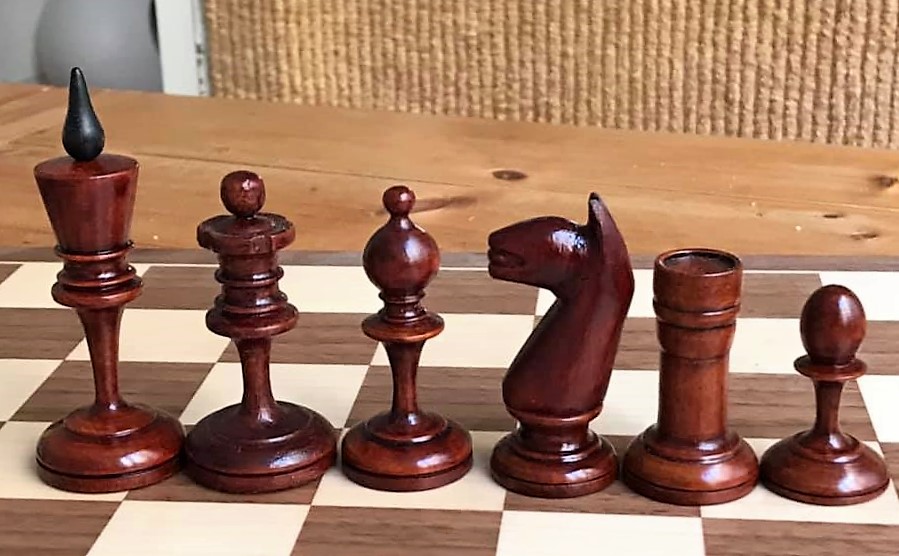
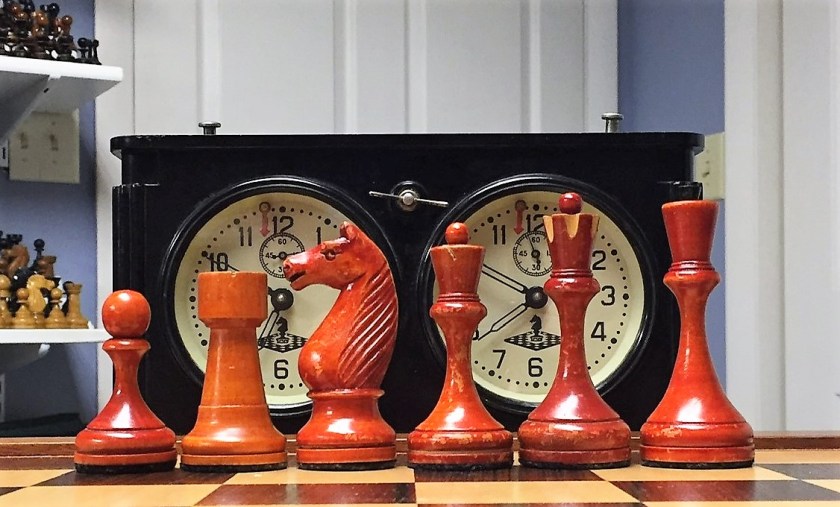
BFII pieces took center stage in the Krylenko’s efforts to gauge the strength of Soviet players against top level international competition, and to carry forward the “struggle at the chess board between the USSR and the capitalist countries.” Introduced at the 1934 Leningrad Tournament where future World Champion Max Euwe and Hans Kmoch, both Dutch, were brought in to compete against top Soviet players, they enjoyed the limelight at the 1935 and 1936 Moscow International Tournaments. The pieces shown as Set 1 are very similar, if not identical, to the sets used in the 1934 , 1935 , and 1936 tournaments.
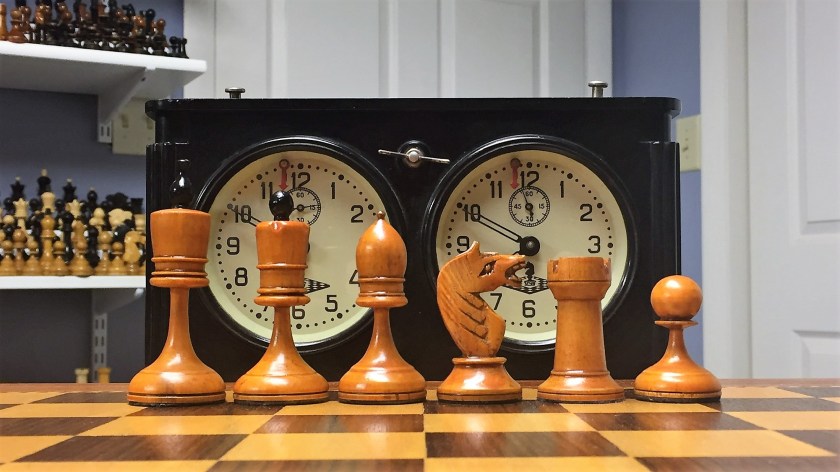
Set 1. Mid-1930s Botvinnik-Flohr II Pieces, Chuck Grau Collection, photo.
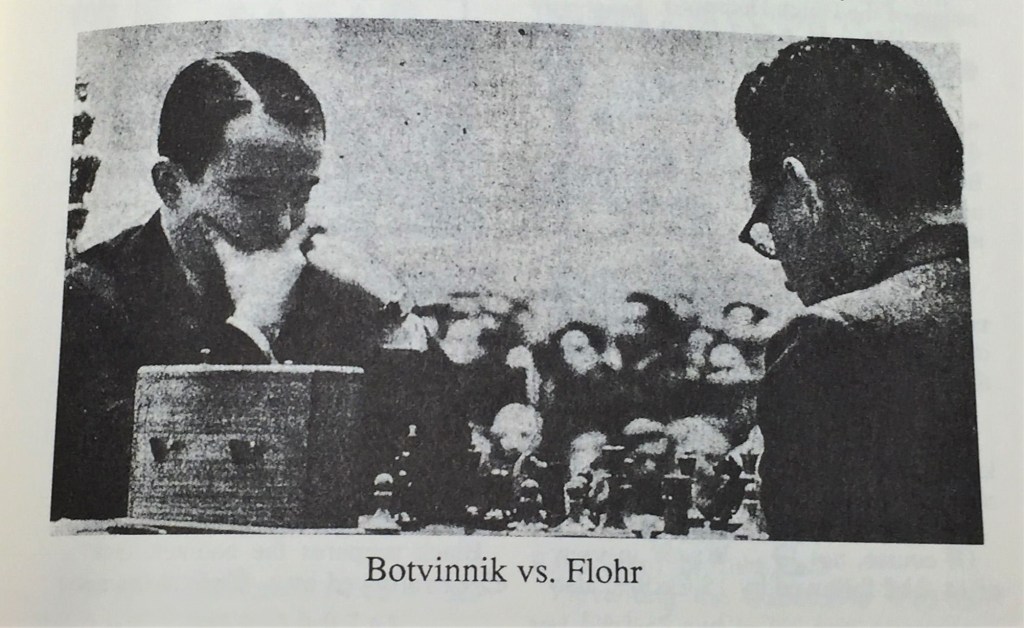
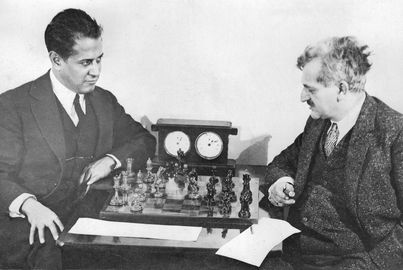
The set acquires its name from the two players who shared first place in the 1935 affair, Mikhail Botvinnik and Salo Flohr, ahead of former world champions Lasker (third) and Capablanca (fourth). It was with pieces like these that the famous Mop the Floor game was played between Botvinnik and Flohr in the 1936 tournament. The II designation distinguishes these pieces from those used in the Botvinnik-Flohr match of 1933 (BFI pieces). Until the differences between the pieces used in the 1933 match and the other events were rediscovered in 2017, collectors and manufacturers of reproductions had confounded them.
Flohr and Botvinnik, Moscow 1935. Source: Moscow 1935 International Chess Tournament 177 (N. Krylenko & I. Rabinovitch eds., Caissa Ed. 1998).
The pieces comprising Set 1 were turned and carved in Leningrad at the Prometheus Cultural Goods factory on Krestovsky Island, according to a stamp in the accompanying red-stained wood box. Given the pieces’ high level of craftsmanship for a Soviet set, the Prometheus Cultural Goods factory may well have been an artel. Artels were collectives of handicraft-producing artisans, recognized by Soviet law, who organized their own production efforts and shared costs and revenues.
Collectors in Russia and Ukraine might refer to the set colloquially as a Leningrad set, as they report that it is their practice to refer to sets by using the name of the city or town where they were produced. With very few exceptions, Soviet sets went nameless, and like other Soviet consumer goods were referred to by functional designations. Thus, sets intended for tournament play were all called Tournament Chess, those for youth Yunost (Youth) Chess, and so on.
While the pieces used in the 1935 and 1936 International tournaments were clearly black and natural in color, this specimen is bright red. Stalin, our colleagues in the former SSRs tell us, did not like white pieces, as they could be seen to symbolize the White Army that fought against the Bolsheviks in the Russian Civil War. Revolutionary red, often referred to as “Stalin Red,” was to be preferred for sets made for Apparatchiks and the public.
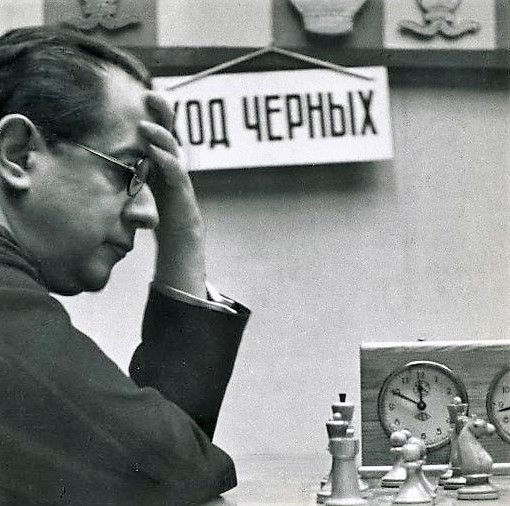
Capablanca, 1935 Moscow. Sergei Korshunov photo.
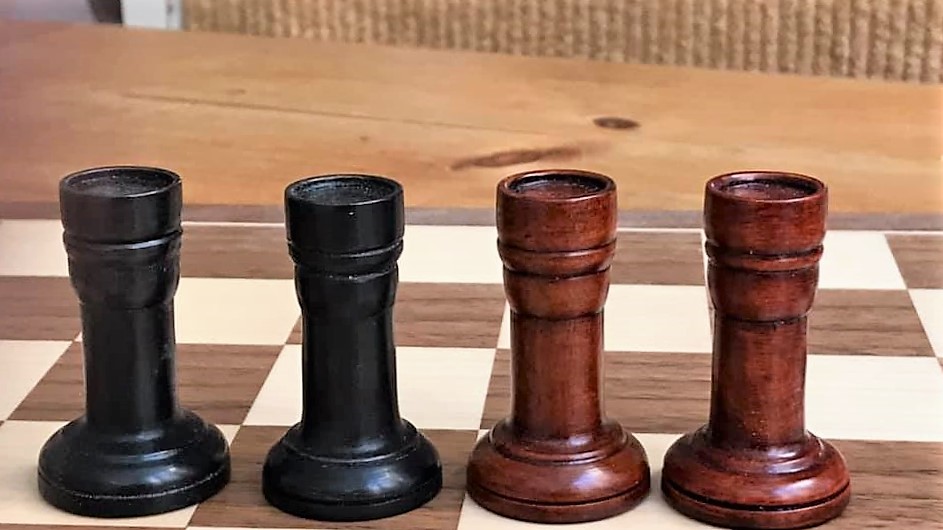
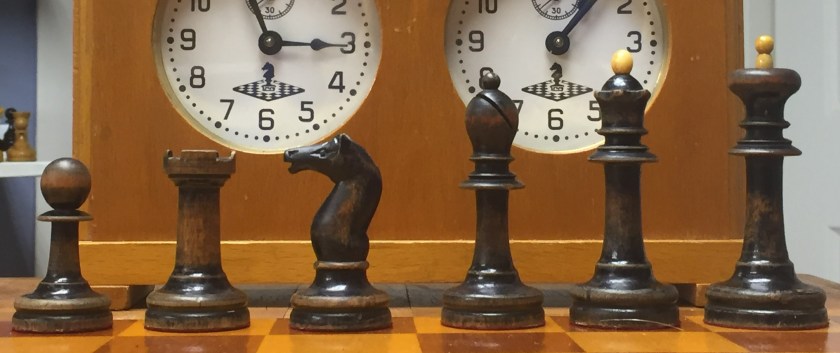
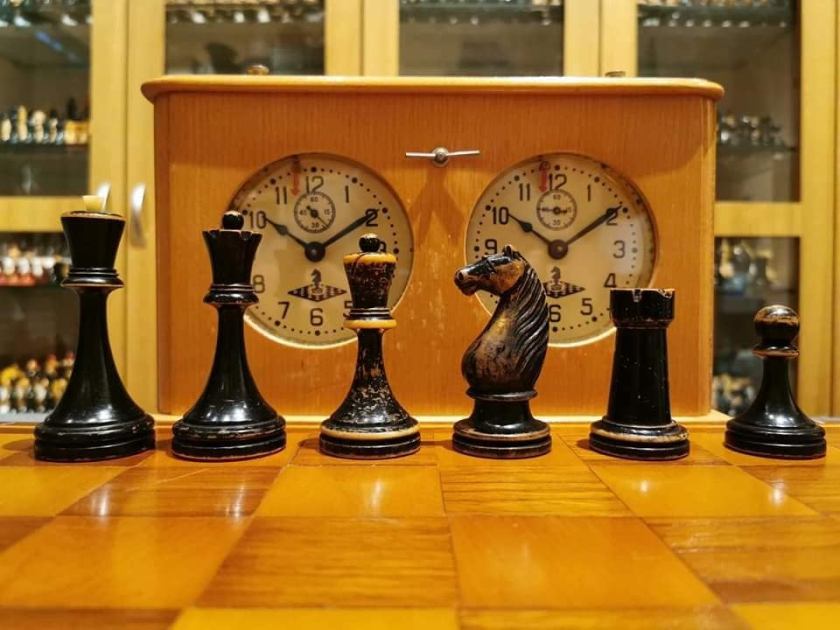
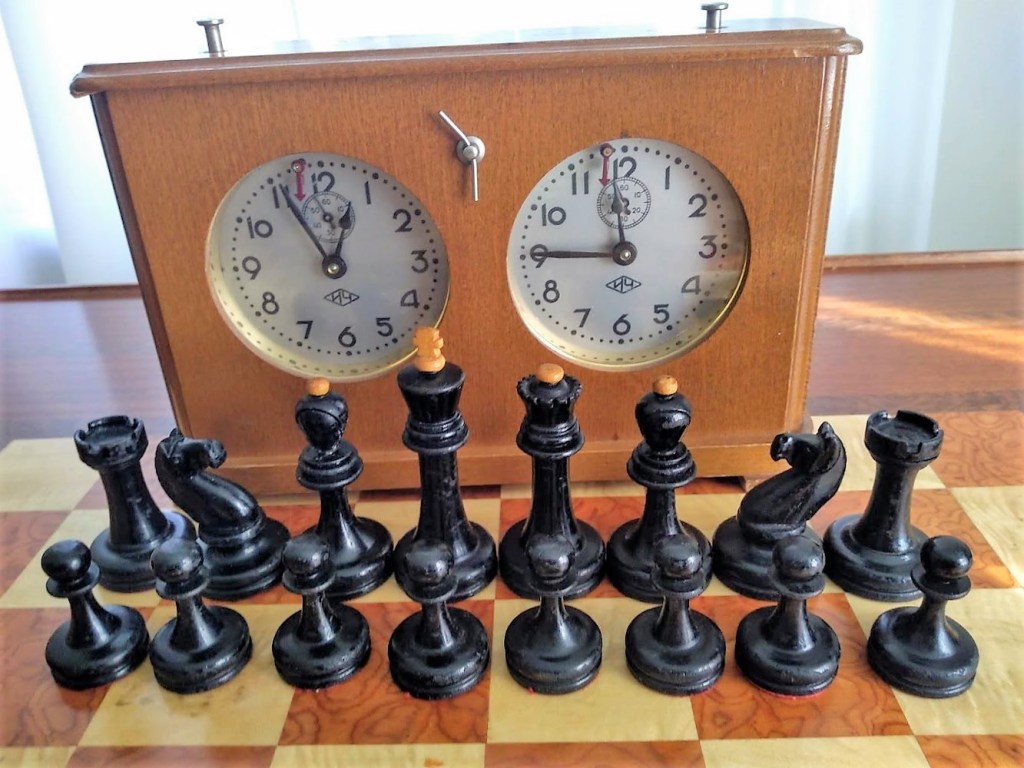
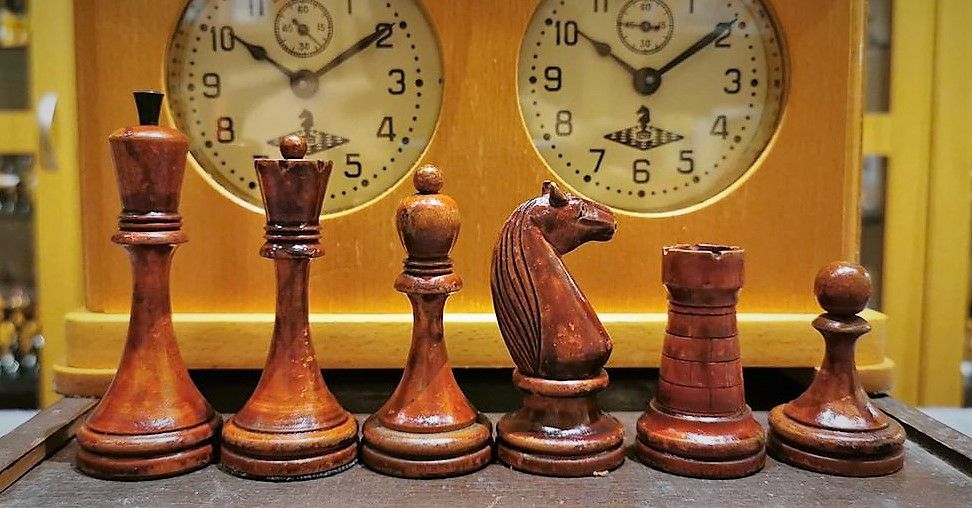
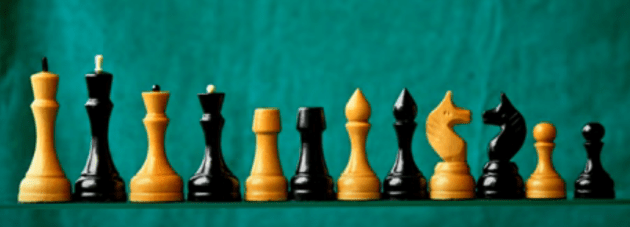
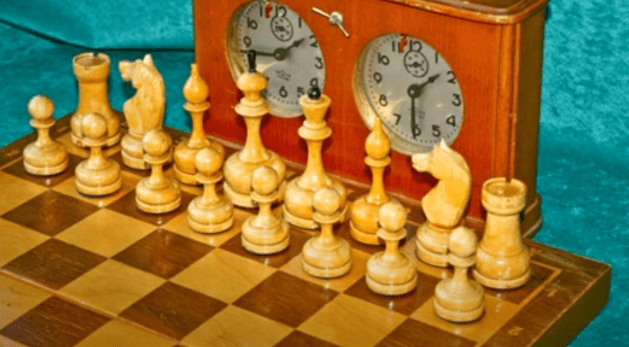
The style of these pieces differs noticeably from that of traditional English Staunton in several respects. First, the king is not topped with a same-color cross, but a secular, opposite-color finial. While the bishop’s miter at first included a cut, as we shall see it soon disappeared. The knight is simply cut and carved, echoing the lines of the 15th century Novgorod knight displayed in Linder’s works, rather than the Elgin Marbles. They lack the S-shaped back of English Staunton knights, and their ears face forward, rather than backwards, as in the English sets. The crenelations in the queen’s crown and the rook’s turret follow Staunton conventions, but soon disappeared. Unlike traditional Staunton pieces, which have an easily distinguishable base/stem/pedestal structure, these pieces flow up conically from the outside circumference of the base and ascend in a curve, which trumpets out to form the pedestal, upon which the piece signifiers and their connectors rest. This base to stem to pedestal curve was to become a basic element of Soviet style. The royals and clerics retain the double collars of the connector between piece signifier and pedestal familiar to traditional Staunton pieces. The pieces generally conform to the proportions of Staunton pieces.
Pieces of the Mid-1930s to 1940s
No sooner did the BFII design debut than it began to evolve and undergo permutations. Set 2 derives from the mid-to late 1930s. It appears in the black and natural colors characteristic of Soviet tournament sets. The bishops share the shape of the previous specimen, but the miters lack the cuts. Kings sport opposite-color bone finials. There are some variations in the carving of the knights from the previous specimen, most notably the ears, which do not extend the curve of the back but perk forward from the top of the head. Knights with this ear structure appear in many photos from the 1935 and 1936 Internationals, but to my eye the ear structure of the knights in those photos is mixed between those found in these first two specimens.
Set 2. Mid to Late 1930s BF2 Pieces. Chuck Grau Collection, photo.
Set 3 appears in a photo dated 1938 appearing in Igor Botvinnik’s Photo Chronicle (2012) tribute to his uncle. It is very similar to the original design, but the bishop’s miter has grown rounded and lost its cut. The black king’s finial is made of bone, and the set is substantially weighted.
Set 3. c. 1938 BFII Pieces. Chuck Grau Collection, photo.
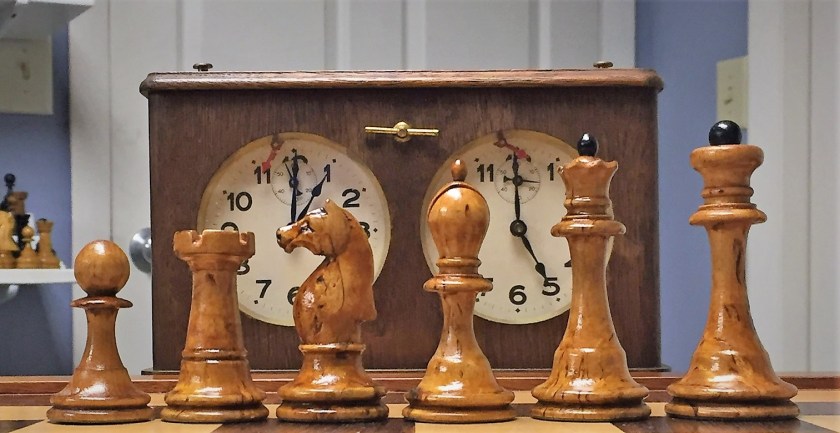
In Set 4, below, we begin to see significant modifications. The king’s crown and bishop’s miter have been noticeably rounded. The crenelations on the queen’s crown and the rook’s turret have disappeared, while the cut in the bishop’s miter remains absent. The queen’s finial has changed from same-color to opposite-color. The vertical portion of the stem has been shortened, while its conical portion has been commensurately lengthened, presenting an overall conical impression. And the torso of the knight, while retaining its neo-Novgorodian profile, has ballooned in girth, leading some collectors to dub it a Penguin Knight. A very similar set likely was produced by Artel Red Combine.
Set 4. c. 1940 BFII Pieces. Chuck Grau Collection, photo.
The Olympic Version of the 1950s
The final version of this iconic design (Set 5) appeared early in the 1950s, and was made in Valdai, Novgorod Oblast, according to an original box housing a pristine specimen of this version in the collection of Mike Ladzinski. Bobby Fischer played blitz against Tigran Petrosian with this version of the pieces, and they were the pieces used in the 1956 Moscow Olympiad and the 1957 USSR Championship.
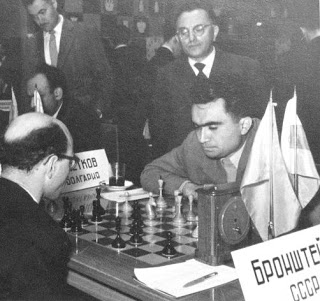
Bronstein and Minev, 1956 Moscow Olympiad. Photographer unknown.Bobby Fischer and Tigran Petrosian, Moscow 1958. Photographer unknown.
The design of this final version of the venerable BFII retreats from the radically conical version of the late thirties. The proportion of the conical lower to the vertical upper portion has diminished to that of the mid-thirties sets. While the tops of the kings and bishops remain rounded, there is a sharp joint demarking the boundary between top and side. The characteristic base/stem/pedestal curve remains. The size and girth of the knights are diminished, and the ears are pointed out to the sides for the first time. Unlike our first three specimens, the neck for the first time is not cut back from the front of the torso to the base. The height of the knight’s base is increased to compensate for the reduction in the height of the figural horse.
Set 5. 1950s Olympic BFII Pieces. Chuck Grau Collection, photo.
Set 5 is finished in natural and black, as were the sets used in the Olympiad and Soviet Championships.
Soviet Design and Political Chess
The simple style of the BFII pieces may be seen to carry forward the program of Political Chess in several ways. It facilitated cheaper mass production of chess equipment for use by the hundreds of thousands of players Political Chess would draw to the game. Beyond that, in relying on simplicity and incorporating industrial and geometric forms akin to Modernism and Constructivism, the Soviet design broke radically with the realism and neoclassical forms associated with the rise of industrial capitalism and “respectable Victorian society” expressed in the Staunton.
The design’s treatment of religious symbolism, a pillar of the Staunton design, merits elaboration. To be sure, the removal of crosses from kings and miter cuts from bishops expressed the Soviets’ underlying antipathy to religion and their efforts to repress it, but two other historical factors reinforced their aversion to the use of religious symbols in chess pieces. One is the Eastern roots of chess in Kievian Russia, where the first chess pieces bore a heavy Muslim influence in name and their geometric, abstract design, reflecting Islam’s prohibitions on the use of human forms. These Eastern influences persisted centuries longer than they did in the West, as the modernized game did not reach Russia until the rule of Peter the Great after 1760. The second is the hostility of Orthodox Christianity towards chess. Even many Tsarist designs avoided crosses and miter cuts, perhaps because more secular designs accommodated the Church and defused its opposition to the game.
Interestingly, however, early BFII pieces retained bishop miter cuts. Perhaps this reflected the pieces’ intended use in international tournaments, and an interest in keeping the pieces sufficiently familiar to foreign players participating in Soviet-sponsored international events. This may have been a factor in the Soviets’ retention of other elements of Staunton design as well, such as the relative proportions of the respective pieces. The BFII pieces—as other Soviet chess pieces we shall examine—ultimately incorporated some elements of the traditional Staunton design, while rejecting others, thereby forming what philosopher Walter Benjamin called a dialectical image in which now (modernist/simplified/geometrical/secular/socialist) confronts then (neoclassical/complex/realistic/religious/capitalist). In this way, these Soviet chess pieces embodied the “struggle at the chess board between the USSR and the capitalist countries” pursued by Krylenko’s program of Political Chess through the international and championship tournaments in which they were used.
Conclusion
The iconic Botvinnik-Flohr II design served the Soviet program of Political Chess as it scaled the ramparts of chess dominance. It is a preeminent example of how the Soviets put their mark not only on the style of chess play, but on the style of chess pieces as well.
An original version of this article appeared in the November 2021 edition of The Chess Collector Magazine, official publication of Chess Collectors International.
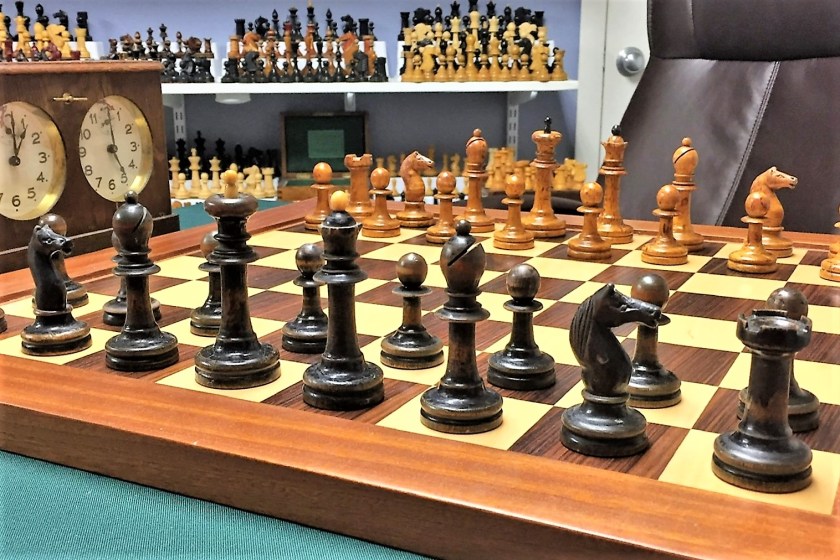
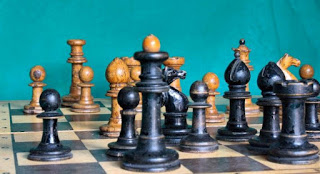
Karelian Birch Pieces, used in the 1909 & 1914 St. Petersburg Tournaments. Chuck Grau photo.
Having examined Arlindo Vieira’s groundbreaking work, I turn now to a survey of major tournament sets. I begin with an examination of sets used in significant events from 1914 to 1941. My goal is to provide a quick identification guide to the new collector or student of Soviet designs, and a bit of information about them to help further study or appreciation of these sets.
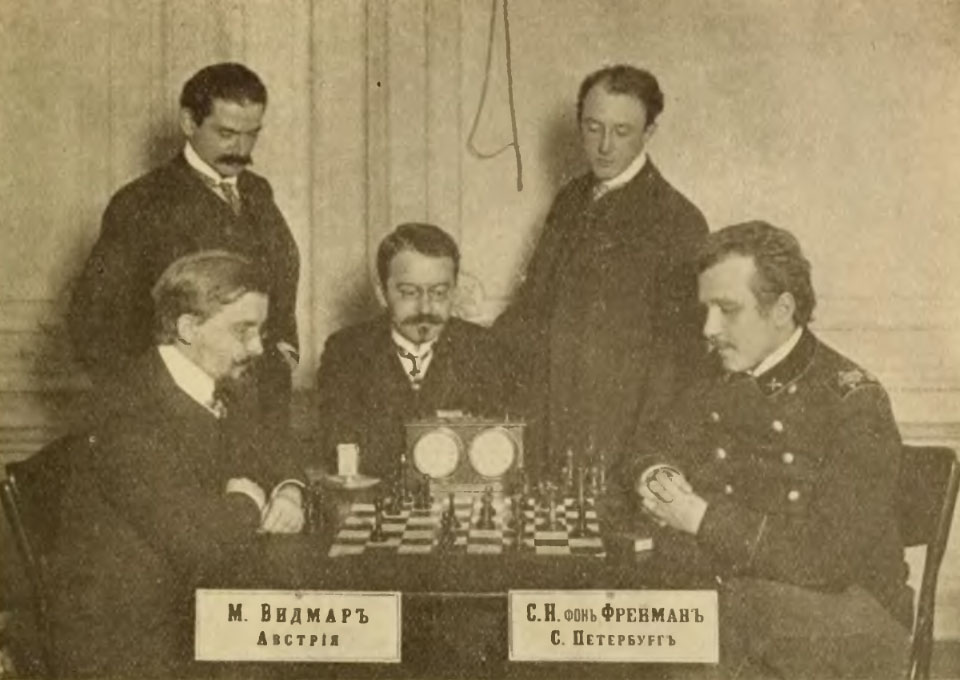
Pieces from the 1909 & 1914 St. Petersburg Tournaments: Late Tsarist Karelian Birch Chessmen
1909 St. Petersburg. Photographer unknown.
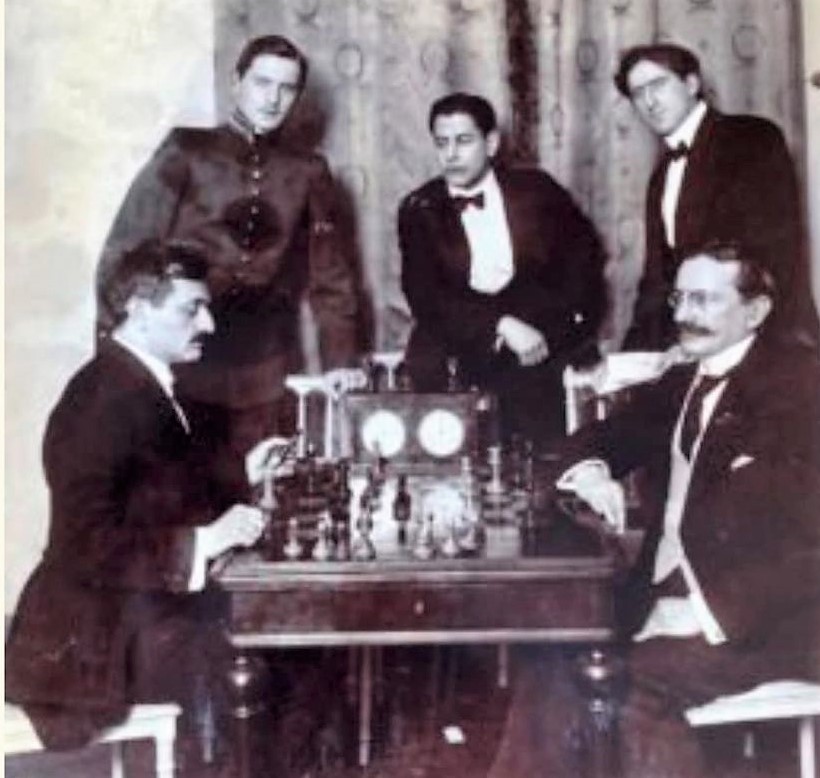
The last major tournament of the Tsarist era was played in St. Petersburg in 1914. Participants included World Champion Lasker, Capablanca (the winner), Alekhine, Tarrasch, Marshall, Nimzovich, Rubenstein, Janowski, Bernstein, Blackburne, and others. Here is a photo of the 1914 Tournament and some of its illustrious participants, together with two magnified and enhanced close-ups of the pieces used.
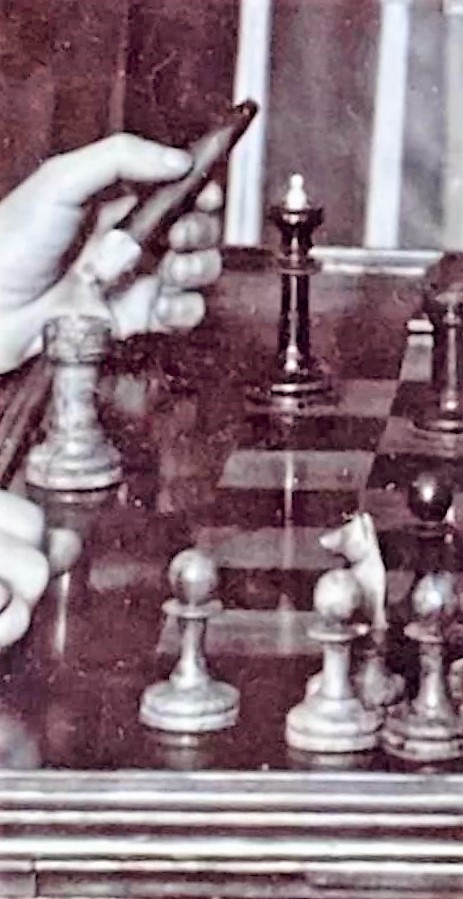
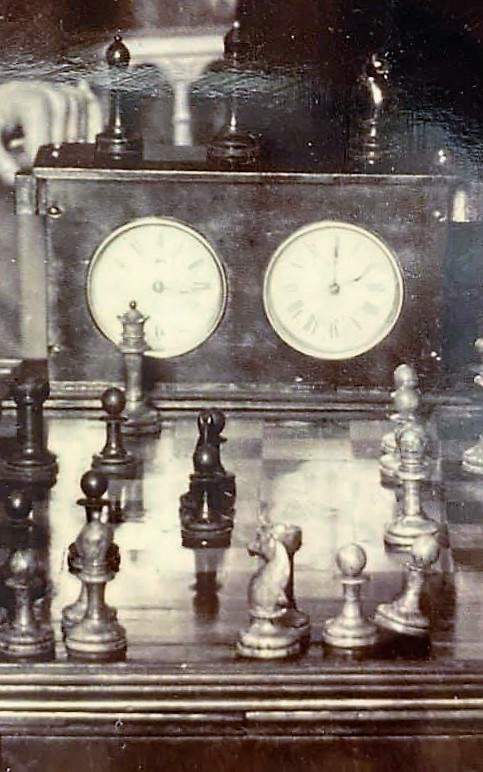
1914 St. Petersburg Tournament, photographer unknown. L to R: Emanuel Lasker, Alexander Alekhine, J.R. Capablanca, Frank Marshall, Siegbert Tarrasch.1914 St. Petersburg Pieces.1915 St. Petersburg Pieces.C. 1900 Karelian Birch Pieces, Antonio Fabiano Collection, Chuck Grau photo.
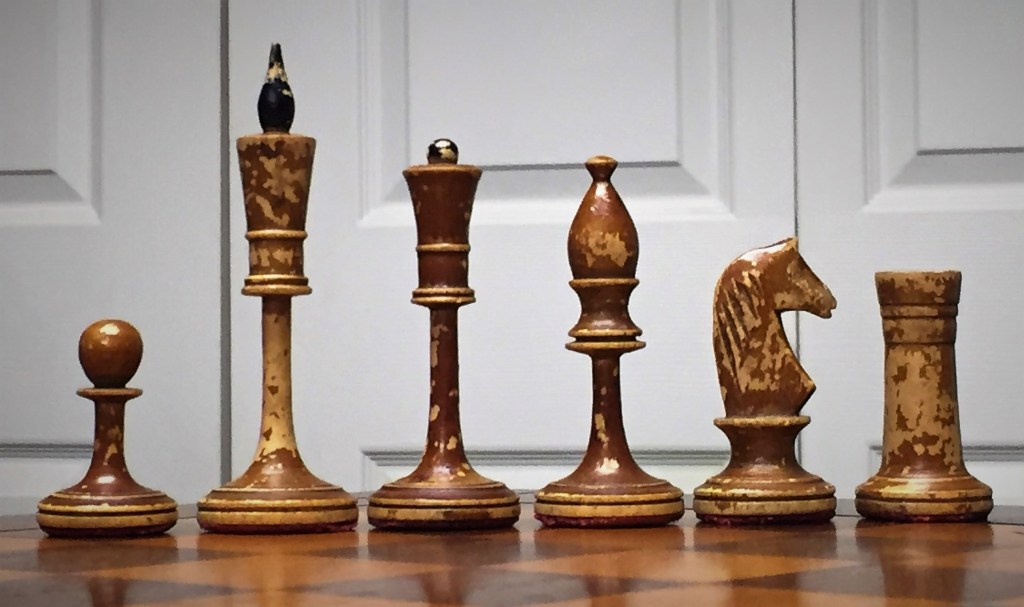
The photographic record above establishes that pieces like these were used in the famous 1914 St. Petersburg Tournament. Usually referred to as “Karelian Birch” pieces, the set is named for the wood from which they are turned, characterized by its uniquely bold figure and found only in the Karelian Peninsula north of St. Petersburg. Staunton features predominate, though an opposite colored finial replaces the king’s crown, and the queen’s orb is also changed to the opposite color. In some sets, the king’s finial is made of bone; in others, wood. In some sets the king’s finial is replaced with a demi-orb. The cuts in the bishop’s miter are usually asymmetrical, but those in the pictured set are symmetrical. The unusual crown of the king hearkens to those found in some Austrian sets. The sets came in various sizes. Known specimens include 3.75″, 4.00″, and 4.25″ kings. The pictured set’s kings are 3.75″.
Pieces from the 1925 First Moscow International Tournament
Once Soviet authorities decided chess was going to be an instrument of state policy intended both to raise the cultural level of the masses to define an area of cultural competition where they intended to “meet and exceed” the West, they decided to hold an international tournament in Moscow to measure where Soviet players stood in relation to those of the West. Scholar Michael Hudson terms this program “Political Chess.”
While there are a handful of photos, some taken from the film Chess Fever, which starred no less than Jose Raul Capablanca and other participants of the tournament, collectors have not identified a surviving example of the set. The photos themselves are somewhat unclear as to the set. Here is a well-known photo from the event and a close-up of the pieces in it.
Capablanca and Lasker, Source: Archivo General de la Nación, Buenos Aires, inventory #259945.Close-up of Capablanca-Lasker set by Eduardo Bauza.
The pieces are Staunton in style and proportion, with stepped-up bases, distinct pedestals, “triple collars,” a cross atop the king’s crown, a crenellated coronet, and distinct merlons in the rooks’ turrets. The pieces are probably from the late Tsarist period because during the preceding years, two revolutions and a civil war impeded both the development of Soviet style and the production of new chess sets.
1933 Botvinnik-Flohr I (“BFI”) Chess Pieces
Continuing to pursue their program of meeting and exceeding the West, Soviet chess officials arranged a 1933 match between their most promising player, Mikhail Botvinnik and Salo Flohr, who was then considered to be a world championship contender and perhaps the strongest player in the world. The match was played in Leningrad and Moscow and ended in a draw.
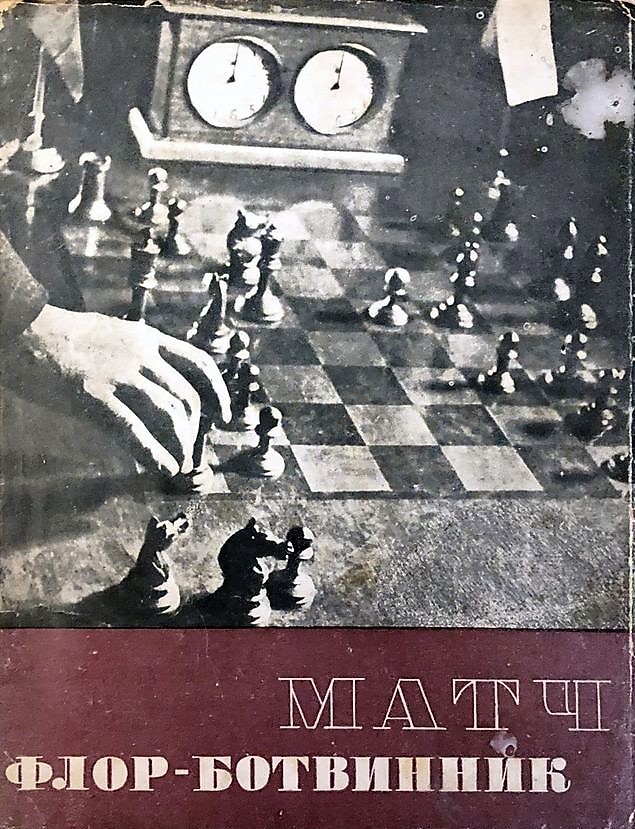
Here is a photo of the pieces used that appeared on the cover of the match book authored by Botvinnik.
Cover of M. Botvinnik’s 1933 Match Book
Although the available photos from the event are few in number, and somewhat ambiguous as to the size and style of the pieces, the pieces in the photo appear to bear many similarities to those in the photos from the 1925 First Moscow International. No surviving examples are known.
Unfortunately, the pieces pictured below were thought to be the same as the match pieces, and are commonly called “BFI” pieces. Ongoing review of the photos of the event have convinced me and other collectors that this name is mistaken for these pieces, even though they share some design features with the set actually used in the 1933 match.
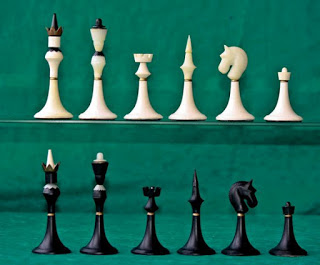
However, a set in the collection of Antonio Fabiano is very close in style to that of the 1933 match. Its main deviation from the match set are the concave walls of its rooks’ towers, which appear straight in photos of the match. Here is his set.
Antonio Fabiano Collection, photo.
In these pieces, we begin to see the development of a distinct Soviet style, despite the diminutive cross upon the king. The stepped-up base of the Staunton base has largely disappeared. The stems are noticeably concave, and mirror modernist dendriform columns rather than the neoclassical columns incorporated by Staunton sets. While the queen’s crown retains crenels on her coronet and the rook its merlons, the bishop’s miter has lost its cut. The knights make no attempt to copy the Elgin Marbles as Staunton knights do. Its snout is elongated, its mouth toothy, its eyes oversized, combining to form a very expressive visage.
Soldiers of International Competition 1934-36: Botvinnik-Flohr II (BFII”) Pieces
The next major events held in pursuit of the Soviets’ program of Political Chess were the 1934 Leningrad Masters Tournament, the 1935 Second Moscow International Tournament, and the 1936 Third Moscow International Tournament, all of which pitted the top Soviet players against fields of top Western players, including three then or future world champions Lasker, Capablanca, and Euwe.
A new set design appeared in these tournaments, perhaps the most iconic Soviet chess pieces of all, which we have come to call Botvinnik-Flohr II pieces, BFII for short. In evolving variations, they were used at the highest levels of Soviet chess from the 1930s to the 1960s, including the three mentioned events of 1934, 1935, and 1936, multiple Soviet Championships from 1937 to 1957, and the 1956 Moscow Olympiad. World Champions Lasker, Capablanca, Euwe, Botvinnik, Smyslov, Tal, Petrosian, Spassky, and Fischer all played with pieces of this style.
Flohr and Botvinnik, Tournament Book, Caissa Ed. (1998) at 177.Close-up of Capablanca’s Pieces, Moscow 1935, photographer unknown.
Pieces like these were used in the 1934 Leningrad and 1935 and 1936 Moscow International tournaments, and a number of USSR Championships in the late 1930s and 1940s. The following specimen is from the collection of Singapore collector Stephen Kong.
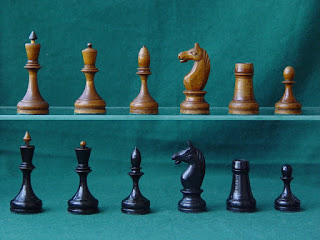
Mid-Thirties BFII Pieces, Steven Kong Collection, photo.
The set acquires its name from the two players who shared first place in the 1935 affair, Mikhail Botvinnik and Salo Flohr, ahead of former world champions Lasker (third) and Capablanca (fourth). It was with pieces like these that the famous Mop the Floor game was played between Botvinnik and Flohr in the 1936 tournament. The II designation distinguishes these pieces from those used in the Botvinnik-Flohr match of 1933 (BFI pieces). Until the differences between the pieces used in the 1933 match and the other events were rediscovered in 2017, collectors and manufacturers of reproductions had confounded them.
The pieces pictured above were turned and carved in Leningrad at the Prometheus Cultural Goods factory on Krestovsky Island, according to a stamp in the accompanying red-stained wood box. An identical set housed in an identical box with the same Prometheus stamp also bears a 1935 or 1936 date stamp, depending on how you interpret the smudged final digit of the stamp. The style of these pieces differs noticeably from that of traditional English Staunton in several respects. First, the king is not topped with a same-color cross, but a secular, opposite-color finial. While the bishop’s miter at first included a cut in the Staunton tradition, it soon disappeared in subsequent versions.
Tal Pieces of the 1940 Estonia-Lithuania Friendship Match
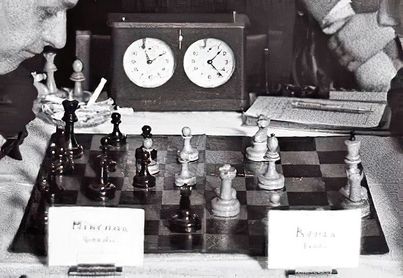
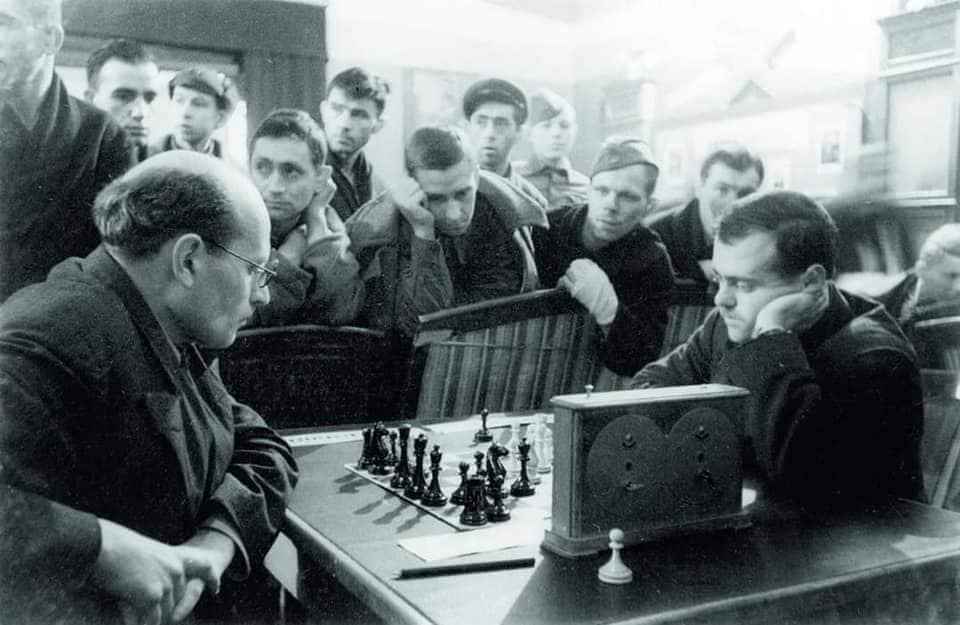
The earliest known example of the so-called Tal set is seen in photo of Paul Keres and Mikenas in a match between Estonia and Lithuania held in Tallinn, Estonia prior to the annexation of the Baltic states by the Soviet Union later in 1940. The set derives its name from a photo of Tal playing at the 1962 USSR Championship in Yerevan with a later version of the set. The photo appears on the cover of Tal’s autobiography, The Life and Games of Mikhail Tal.
Keres-Mikenas, Tallinn 1940, photographer unknown.
A specimen of this set resides in the collection of Mike Ladzinski.
1940 Tal Chessmen, Mike Ladzinski Collection, photo.
These chessmen adopt traditional elements of the English Staunton design, most notably the long stems narrower at the top than the bottom; the distinctly jointed pedestals, the three-ring collar system, the cross-crowned king, the bishop miter cuts, the merlons of the rook turrets, and the collective column-pediment. Unlike traditional Stauntons, the crosses and finials are opposite-colored. The unique, jaunty knights do not emulate the Elgin Marbles but are virtually identical to those of the 1962 Yerevan set. The pieces contain the wide, almost squared-off bases characteristic of the Tal, but not yet as tall as those of the Yerevan set. The cross is a true cross, not the vestigial cross of the 1962 version. While the rooks’ turrets incorporate merlons, their towers are noticeably narrower than their successor’s, and concave rather than straight, like the Yerevan tower. The pawns’ stems are longer than in later versions, making the pawns less squat.
1941 Leningrad Championship Pieces
The BFII design evolved through the late thirties, the forties, and the fifties, with multiple variants existing side-by-side over the years. One notable variant was used in the 1941 Leningrad Championship, which was begun during the Siege of Leningrad but was never completed.
1941 Leningrad Championship, photographer unknown.1941 Leningrad Championship BFII Pieces, Stephen Kong Collection, photo.
The pieces have retained their general shapes and proportions, as well as the crenellations on queens and rooks. The bishop’s miter, however, had grown rounded and lost its miter cut. This BFII variant is notable for the mortar work carved into the rooks’ walls.
Hopefully, the collector or student of Soviet chess sets now has some basic information to help identify these sets and when, where, and by whom they were used.
In 2012, Portuguese chess collector, history teacher, and photographer Arlindo Vieira published a YouTube video that has profoundly shaped the course of Soviet chess collecting. Simply titled “Russian-Soviet Chess Pieces,” the nearly twenty-seven-minute YouTube video presents Vieira’s “beloved collection” of Soviet chess pieces in a sophisticated and visually appealing slide show overlaid with a soundtrack of Prokofiev, Rachmaninoff, Shostakovich, and other Russian music. Vieira divides his presentation into ten sections. Eight of the sections exhibit individual chess sets. Two sections exhibit groups of sets. One group comprises four sets he collectively calls “Grandmaster” sets. The second, the subject of the concluding section, includes photos of chessmen Vieira longed to acquire. Vieira supplemented his video in a series of nine articles posted in his chess blog, Xadrez Memoria, elaborating his views on the sets of his video, and on the collection of Soviet chess pieces. Each blog article corresponds to a specific section of the video. Throughout both video and blog, Vieira’s beautifully staged photos and flamboyant prose, his careful choreography and well-chosen score, and his charisma and passion draw us like a magnet to Soviet and Russian chessmen.
St. Petersburg 1914 Chessmen?
Possibly 1914 St. Petersburg Chessmen, Vieira Collection, photo.
Set to the haunting refrains of the famous Russian ballad Zhuravli, or The Cranes, which ponders whether a flight of cranes overhead are the surviving souls of soldiers lost at war, Vieira opens with a pre-revolutionary set of particular significance. It is a heavily battle-scarred black- and natural-colored set of pieces he tells us are very similar in style to those used in the famous St. Petersburg tournament of 1914. We now describe pieces of this style to be “Karelian Birch” pieces, referring to the wood from which they are made.
In Xadrez Memoria, Vieira describes how he acquired the set:
I passed by them as a ‘dog in a harvested vineyard.’ I realized that they were Russian or Soviet, I caught a glimpse of their poor condition, and went on to the next image at Ebay’s chess auctions. After an hour I returned and decided to do a closer study of the pieces, because some strange reason made me not forget them. Bad state yes sir. But, an original ‘patina,’ an antiquity that did not deceive even by the excellent pictures that the seller of St. Petersburg put in the auction. ‘Very old,’ he said, but he didn’t venture how much. The bidding price was very low, around 30 dollars and there were two days to go. Nobody had bid so far, and I was sure that nobody would bid. For the state of the set, and for the fact that Russian –Soviet chess pieces are not part of the favors, the madness, the almost monetary ‘orgasms’ of the collectors of Jaques of London, British Chess Company, among others. I will say that they are poor relatives of international chess collecting, apart from one or the other rare case. That has no value, for the design, for the wood, for the conventional catalogs of the ‘sharks’ of the very ‘British’ collection.
Now fascinated by the old, battle-damaged pieces, he pressed the Russian dealer on their age. Although the dealer would not “guarantee the antiquity” of the set with certainty, his experience told him that the pieces were from the 1930s or 1940s. They exhibited a rich patina, they had suffered much damage over time, and their design was “so different” from characteristic Soviet pieces from the 1950s, 1960s, and 1970s:
That night, Vieira found it difficult to sleep. Visions of these pieces bearing the patina of antiquity filled his dreams. He began to think he had seen them before, but where? He rose from his bed and began to research his chess library for photographic evidence of their identity. Then, Eureka!
I removed two books: ‘Bernstein’s Schach – Umd Lebens Laufbahn’ by Savielly G. Tartakower – from Tschaturanga – Olms, and ‘Akiba Rubinstein – Uncrowned King’ by Donaldson and Minev from International Chess Enterprises. On their covers, confirmation. Both Bernstein and Rubinstein pose for the photo, with pieces, if not the same, at least very similar to those that were at auction. These photos are clearly from the 1st decade of the 20th century. Would they therefore be even older chess pieces, that is, from the 1st-2nd decade of the 20th century? That they were terribly used, lacerated, tired by so much fighting on the board, it was clear, or at least I wanted to believe it was. I am sure, I had: this model of pieces was the most common, at least in St. Petersburg before the Sovietization of chess.
This passage is significant not only for describing how Vieira established the likely identity of the pieces he sought to buy from St. Petersburg, but because they reflect his general methodology of scouring the photographic record to identify chess pieces. Furthermore, they presage the method of exposition he will employ throughout the video, juxtaposing photographs of his pieces with those of like pieces in actual play, usually with famous masters. These photos establish the identity and historical context of the sets. This is of particular importance because the types of evidence we have come to expect to establish a set’s provenance are by and large lacking in a land that endured two World Wars, three revolutions, a civil war, a Great Purge, massive population relocations and mass starvation in the intervening time. It is a method that collectors of Soviet and Russian sets continue to employ. To establish the identity and age of this set in his video, Vieira exhibits photos of Rubenstein, Bernstein, the young Alekhine, Capablanca, Lasker, Marshall, and Tarrasch playing with these chessmen, or seated next to them, all establishing their historical provenance and import.
Convinced of the set’s identity, Vieira placed his bid the next day, hopeful he would face no competition for this “dog in the vineyard.” He won, then awaited the set’s arrival. Finally, the postal service delivered it:
[T]he strongest emotion [I] felt when looking at some chess pieces. Even more beautiful than in the photos. The color, the incredible smell of worn varnish and stubble, a ‘patina’ of original time and not of ‘fresh paint,’ and above all the ailments of long board fights, to later rest for long years at someone else’s home, or attic of a St. Petersburg club.
Now Vieira faced the question posed to anyone acquiring an old set. Should it be restored? Or should it continue to bear the scars of its life, which give testament to past battles, past victories, and past defeats?
[Whether] to restore them? So, every time I looked at them, I saw an intense life in those flaws, in that worn varnish, board life, of joys, disappointments, of moves played with the anger of despair of defeat, or joy of victory, and I was going to restore them, for him. to inflate artificial life, to make them cute, to enhance them in the market? Their value, I had already internally attributed it to my passion as a collector.
Throughout his video and blog, Vieira presents many sets in his collection. Many of them are in good condition. Not one of them has been restored.
Some Elements of Soviet Design
In the second section of his video, Vieira introduces us to what he describes as a “Soviet Portable Chessboard” with pieces that are “nothing special.” Although we now know it to be Bulgarian in origin, Vieira’s observations of Soviet tendencies are worth noting: “stylized design,” kings without crosses, and opposite-colored finials that are the “brand image” of Eastern Bloc pieces and board squares too small to adequately accommodate the pieces. “I have hundreds and hundreds of photos of both Soviet players and tournaments,” he writes, “and, with the exception of the USSR Championships, in its final stage, it is extraordinary to see how the pieces do not seem to breathe on the boards, that is, they seem tight, close together, almost occupying every house they are in, giving poor general visibility.” He offers this criticism of Soviet sets repeatedly. “Perhaps,” he speculates, “the enormous massification of chess, the need to manufacture millions and millions of sets, required savings.”
Plastic Olympic Chessmen
Plastic Pieces from Minsk 1984, Vieira Collection, photo.
Vieira describes his next set as “Unusual Plastic/Metal Chess Pieces” that he acquired from a friend who knew only that they were Soviet. His video tells us little about the pieces, other than they were made in Minsk in 1984, according to a page from a Christies catalog he displays. In Xadrez Memoria, he describes them as “quite different” from traditional Soviet pieces, “almost say, aristocratic in their design.” Vieira was fascinated with their “Flowery… somewhat complex and turned shapes.” He tells us that his research determined that the pieces had been offered to certain personalities and sold to the public in commemoration of the 1980 Olympic games held in the USSR. In the video, he shows the set depicted on the cover of a chess book, from which in his blog he concludes the pieces had gained “some popularity.”
Vieira’s fourth section showcases “traditional” chessmen from the Borodino factory. Although he shares many beautiful slides of this rather simple and crude set, he tells us nothing more about it in either his video or his blog. We can glean from his introductory photo, however, that his knowledge of the pieces’ origins arises from the colorful cardboard box that houses it.
Vieira next presents “Medium Chess Sets,” which he describes as “very popular in schools and clubs.” In fact, we now recognize them as smaller versions of what he later describes as “Grandmaster 1” pieces, which we will examine below.
The next three sections are the real meat of Vieira’s video. The first of these he describes as the set of “Soviet Championships 50-60.” Photos of the set from his collection are interspersed with photos chess book covers and of many famous masters: Damsky, Botvinnik, Flohr, Petrosian, Tal, Korchnoi, Fischer, Boleslavsky, Taimanov, Kalman, Spassky, and Bronstein.
In his blog, Vieira relates that the eBay seller of his pieces had described them as “German.” Vieira, however “quickly realized” through the seller’s photos that the pieces in fact were “very common Soviet pieces” from the 1950s and 1960s. The shapes of the kings and queens, the large knights and pawns, the “slender style of the pieces” and their “elegance on the board” reminded him of the pieces he had seen in photos of Soviet events of those years in his “archive of interesting chess photos.” “A self-respecting ‘collector’ of chess pieces must be an archeologist of chess photographs,” he advises. “It is through them that you can often find the missing pieces in your collection, identify a Staunton, or other type of pieces, or even approximate the set you own.”
The board that accompanied his pieces afforded him the opportunity to repeat his concern that the Soviets generally played on boards too small for the pieces. He complains that the small size of the board’s squares piles the pieces “on top of one another,” that they “lose their freedom,” and become “asphyxiated,” thereby “making the visibility confusing.”
Vieira generated great interest in the sets depicted in these photos, but also sewed seeds of confusion. Later analysis of his and other historical photos has discerned not one but three different sets, and multiple variations of one of them, notwithstanding their stylistic similarities. Another unfortunate confusion was sown by a photo Vieira uses, which he tells us is an enlargement of one taken in the 1933 match between Flohr and Botvinnik, and infers from it that the style of his set originated in the thirties. While subsequent research largely substantiates Vieira’s claim that the style of his pieces arose in the 1930s, it also helped confuse the pieces used in the 1933 match with those used in their games in the Moscow International Tournaments of 1935 and 1936. As a result, collectors and vendors alike came to treat photos of the 1935 and 1936 events as though they depicted the pieces used in the 1933 match. While the 1933 match set remains an enigma, photographs known to be of the 1933 match make it clear that the set appearing in them it is significantly different from those used in the later tournaments.
“Latvian” Sets
“I called this set ‘Latvian’!” exudes Vieira at the outset of his next section, “So popular in the country of Tal, Vitolins, and so on!” The pieces are tall, slender, and simple: thin stems rising from wide bases and perpendicular pedestals, upon which rest unadorned crowns without connectors or collars, and topped with opposite-colored royal finials. Both the bishop’s miter and the king’s finial echo the onion-shaped domes of Orthodox churches. The knight is a simple slab, seemingly cut with a band saw and without any elaborate carving details. Netflix viewers might identify the pieces as the same style used in the Moscow Tournament climax to Queen’s Gambit.
“Latvian” Chessmen, Vieira Collection, photo.
Vieira admires the pieces’ simple, slim bodies and broad bases that affords them stability during play despite being unweighted. They are “elegant” and “aesthetically very pleasing” even though they are made from “poor” wood. In these ways, they reflect the “simplicity in manufacture, without great details in the pieces,” which results from “the need for serial manufacture” at “affordable prices” characteristic of Soviet pieces.
He refrains from concluding that these pieces reflect any kind of regional style, but observes that they have appeared in “dozens and dozens of pictures related to Latvian schools, tournaments, and players” and, at least at the time he wrote, 2012, most of the sellers offering them for sale on internet auction sites were from Latvia.
Vieira’s “Latvian” designation has stuck until recently. Most contemporary collectors of Soviet sets today would identify the pieces as “Latvian,” notwithstanding that over the course of six decades they apparently were manufactured from the Leningrad and Moscow regions to Mordovia. However, artist-collector Alan Power and others have begun to call the pieces “Mordovian-Latvian,” or simply “Mordovian,” reflecting our growing understanding of where the pieces were manufactured.
The Grandmaster Pieces
To the tune of Prokofiev’s Dance of the Knights, Vieira introduces the meatiest chapter of his video, “The GM Pieces—Four Versions/Styles.” In Xadrez Memoria, he describes these GM, or Grandmaster sets as:
Soviet pieces characteristic of many Clubs, competitions and even simple chess lovers that in a park, or Garden, anywhere in the former Soviet Union used to use them. Almost always these pieces were made with the respective folding board that also served as a box where they were kept (such “anemic” squares of 4.5 – 5cm square for pieces with a King base with 3.5-4 cm!)… All of these pieces are very reasonable in size, with the KINGS walking 10-11 cm high… [T]hey are very different sets from each other and have been used in different times…
Vieira designates each type of Grandmaster with a number, 1-4, and dedicates one sub-section of his video to each type. The dates he ascribes to each type do not really run chronologically. He dates the GM1 in the seventies and eighties; the GM2 in the sixties through the eighties; the GM3 goes undated in both the video and the blog; The GM4 is undated, but he describes it as “the last version of this competitive set,” and shows it in use in the mid-eighties.
Grandmaster 1 Chessmen, Vieira Collection, photo.
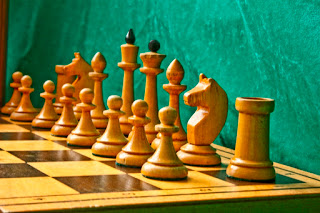
According to Vieira, the GM1 was “very popular in chess clubs.” Its lines are simple: cylindrical bases, slightly rounded at the tops, giving way to a stem, broad at its juncture with the base, and sweeping up in a concave arc to form a relatively narrow pedestal, upon which modest crowns, simple tear- miters, and orbs rest to signify the royals, clerics, and pawns. The knights are simple, more sawn than carved. Vieira shares photos of the specimen in his collection, and of the pieces in play with Spassky, Karpov, and Kasparov.
Grandmster 2 Chessmen, Vieira Collection, photo.
The GM2, he tells us, is “a very big set, but harmonious and pleasing to touch.” Indeed, the GM2 shares key design elements with the GM1, only they are more dramatic. The bases are larger, more bulbous. The stems also rise in a concave arc, but a larger one, forming a larger pedestal, upon which larger crowns, onion-shaped miters and orbs sit. The knights bear more and better carving. Well-staged photos of the GM2 in Vieira’s collection, of the set in play with Karpov, Gaprindashvili, Kasparov, and Vitonis, and of the set on the covers of books follow.
Grandmaster 3 Chessmen, Vieira Collection, photo.
Vieira labels the GM3 “the traditional set of Soviet Championship(s).” He intersperses photos of his set with those of Kasparov, Petrosian, Balashov, Bikova, Tal, Gaprindashvili, Spassky, and Chiburdanidze playing with these venerable pieces. Surprisingly, he offers little discussion or elaboration of his views of the set. He lets his photos speak for him.
We can see that the GM3s are a markedly different design from those of the GM1 and GM2, much more traditionally Staunton, down to the straight ascension of the stems, the triple collars, the bishops’ miter cuts, the merlons of the rooks’ towers, and the profiles of the knights, all matters we will examine in detail later.
Grandmaster 4 Chessmen, Vieira Collection, photo.
Recognizing them to be closely related to the GM3 pieces, he tells us that the GM4 pieces are “the last version of this competitive set.” He describes the set as “elegan(t) and playable,” but which “made players crazy” when used on boards with squares, again, far too small. Along with photos of his GM4 pieces, all displayed on squares large enough to allow them “to breathe,” we see photos of them with Karpov, Kamsky, Kramnik, and Kosteniuk.
In Xadrez Memoria, Vieira observes that the quality of the Grandmaster pieces degraded over time. The bishops, rooks, and knights all lost detail over time, though he does not discuss which details degraded or how.
The final set Vieira presents from his collection is one he describes as “the only set that is manufactured in Russia” today. In fact, Kadun, and perhaps others, were producing sets in Russia at the 2012 date of the video. He assesses the set as “Not bad… but little gracious and very clumsy.” In his view, it “works on a 6 cm. chessboard.” Most of the photos he shares portray his personal set and its pieces, but he does include several shots of the set being used in tournament play, as well as one of Korchnoi and Sveshnikov playing with it.
“Utopia”
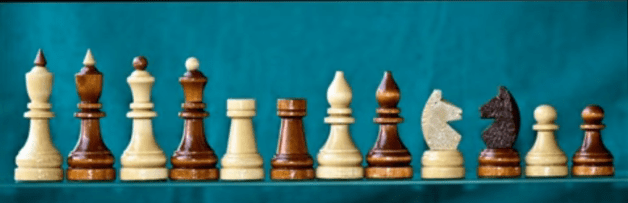
The final chapter of Vieira’s video reprises the children’s choir singing the poignant lines of Zhuravli with which he opened his work. His subject here is sets that are not part of his collection, “but I dream about them.” The sets are of particular significance because they have come to be most prized by serious collectors, some referring to them as Grail sets.
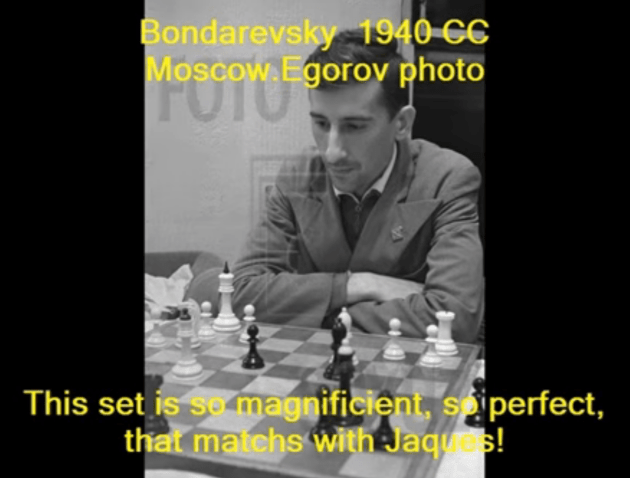
1940 Soviet Staunton Pieces, Vieira slide.
The first of them appears in four photos Vieira shares from the 1940 Soviet Championship in Moscow. The photos show Bondarevsky, Makoganev, Smyslov, and Keres playing with black and white pieces very much in the traditional Staunton style. “So magnificent, so perfect,” gushes Vieira, that the set “matches with Jaques.”
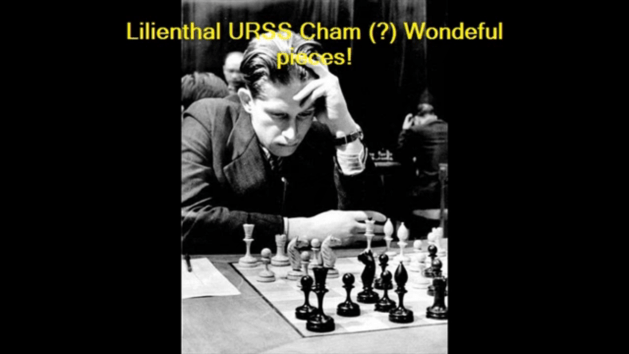
1949 Moscow Championship set with Averbakh, not Lilienthal, Vieira slide.
The second set appears in a photo of Averbach playing at what we have come to learn was the 1949 Moscow Championship. (Vieira misidentifies the player shown as Lilienthal, a mistake he corrects in comments to the video, and the event as the Soviet Championship.) “Wonderful pieces!” he exclaims. The set’s style is quite removed from the neoclassical style of traditional Staunton pieces, embodying instead quintessentially Soviet design elements, from the curved shape of its stems to the structure of its knights. Like the 1940 Moscow set, this one has fascinated collectors, who have named it after Averbakh because of this very photo.
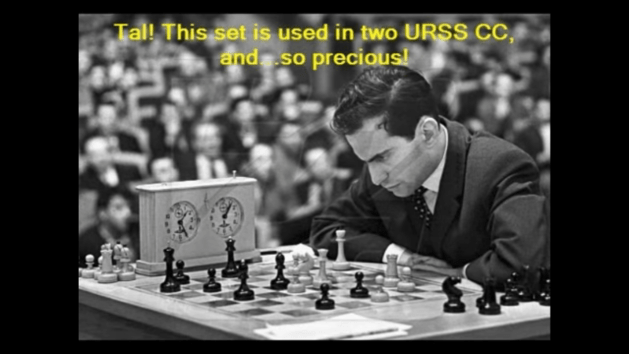
The final set Vieira pines for is in many ways the most famous, as it appears with Tal on the cover of his autobiography, The Life and Games of Mikhail Tal, a depiction of one of his games at the 1962 Soviet Championship in Yerevan. “So precious!” Vieira exudes. The pieces themselves, which have come to be known to collectors as the “Tal” set are more traditionally Staunton than Soviet in their design, and are defined in no small measure by their jaunty knight, the unique angle of its cocked head, and the serpentine curves of its torso. So enamored was I with this set that, unable to find an original, I undertook with my friend, chess partner, and historian Phil Pajakowski and Gregor Novak of NOJ Slovenia to reproduce it. We were humbled when no less than Arlindo Vieira himself described the fruits of our efforts to be “an ode to the reproduction of chess pieces.”
Arlindo Vieira’s Legacy
Arlindo Vieira’s works have excited collectors in Soviet chess sets and have increased our knowledge and understanding of them. Vieira employed a methodology that has served as an example to later collectors and has set an agenda for those interested in collecting Soviet sets.
Before Vieira’s 2012 works, the collection of Soviet chess sets was a stepchild to mainstream collecting. There were no books nor articles addressing them. Except for the odd figural, historical, or “propaganda” set, they were largely ignored by the chess collection literature and auction catalogs. Soviet sets occasionally appeared for auction on eBay, but they came without much information, explanation, or context. Interest in Soviet chess instead focused on its high level of play, its many masters and Grandmasters, and their domination of world chess for decades. While Linder’s two magnificent works, Chess in Ancient Russia and The Art of Chess, explored the evolution of chess pieces in ancient Russia, they offered precious little about late Tsarist and Soviet sets.
Of these the absence of information about Soviet chess pieces, Vieira wrote in the Chess.com Chess Books and Equipment forum:
Linder’s book has no value to the Russian Staunton pieces in their variants. Quite frankly only a Russian can do this book. Curious is the feeling that in Russia there has never been a real interest in the history of competition chess pieces. Even in the recent Chess Museum in Moscow, there are few competition sets of and even the match table Karpov-Kasparov (1984) has an unbelievable ‘German Knight’ or something like set because the original (unique chess set in the world, and very “Jaques”!) was stolen just after the end of the competition. Already they had one of those that was typical of Soviet competitions (GM pieces) but until this they took away. Funny that my blog in articles related to Soviet chess pieces have several visits from Russia! I, who even am Portuguese. Enigma, and mysteries. As you know, even among great collectors who all know… the Soviet chess pieces have always been poor relatives to the fortunes of Jaques, BCC, and so on! Perhaps the great impetus given to [Russian and Soviet] chess sets happened here in the Chess.com Forum.
The major contributors to the forum to which Vieira alludes now have largely migrated to Facebook collector groups.
Vieira (“BurnAmos”) belonged to the Chess.com Equipment forum in the mid-2010s, where his work became known to a group of collectors, Mike Ladzinski (“Goodknight Mike”), Ron Harrison (“Ronbo”), Lokahai Antonio (“UpCountryRain”) and me (“Cgrau”) among them, igniting a passion and a curiosity in Soviet sets in us. We began to seek out sets like those Vieira had shown us from his Russian and Soviet collection, as well as the “Utopia” sets for which he longed, on eBay, Etsy, and from dealers with whom we became acquainted. So did others who had become familiar with his YouTube video and blog. We posted photos and information about these sets in the Forum, which in turn sparked interest among others, notably Stephen Kong (“Chess Praxis”), especially when we moved our platform from the Chess.com forum to collectors’ groups on Facebook. After several years, I formed a Facebook group, Shakhmantynye Kollektsionery (“SK”), dedicated to Soviet and Russian chess collecting. As of June 2025, SK has grown to nearly 9,400 members worldwide.
To be sure, other notable collectors had sought out Soviet chessmen before Vieira’s 2012 work. As early as 2000, for example, Antonio Fabiano’s trip to Russia and the Tchigorin Chess Club of St. Petersburg had whetted his appetite, and he since has compiled a truly amazing collection of Soviet and late Tsarist sets, but Vieira’s work validated and enthused these collectors too.
Simplicity in manufacture, without great detail in the pieces, the result of the need for serial manufacture, and at affordable prices.
Arlindo Vieira, Xadrez Memoria
Vieira significantly increased our knowledge of and ability to think about Soviet chess sets. He found the pieces to be simple in design and manufacture, both to facilitate mass production and to keep them affordable for mass consumption. In that simplicity, he often found gracefulness in the combination of thin stems and wide bases, despite the generally poor quality of materials and too often workmanship, but also, at the high end, quality in design and manufacture the equal of Jaques of London. The kings did not bear crowns. The royals and bishops often bore opposite color finials, the knights and pawns characteristically stood proportionately large. Too often, the pieces were played on boards with squares so small that they were asphyxiated. Time and again he demonstrated that placing the same pieces on properly sized boards, giving them air to breathe, bringing them to life, and allowing their elegance to shine through. He also observed that the quality of the chessmen diminished over over time. Detail in design and workmanship declined. Wooden finals and knights came to be replaced by wooden ones, and graceful designs displaced by clumsy ones. Many of his observations later could be verified, others questioned and debated, but always they have offered a baseline and a framework for others on how to think and talk about Soviet chess pieces.
Vieira also gave us names for sets, making it easier for us to talk about them. He designated four sets “Grandmaster” sets and gave them numerical designations to distinguish them. And he began calling a set he saw frequently in photos of Latvian events “Latvian” pieces. Vieira’s names continue to be used today, though Soviet collector Mike Ladzinski has added the moniker “Bronstein” to the “GM2”, alluding to a photo of Bronstein and Tal playing with it, and other collectors, myself included, have begun renaming the “Latvian” pieces as “Mordovian-Latvian”, since so many of the sets are housed in boxes bearing stamps indicating they were made in Mordovia.
A self-respecting collector of chess pieces must be an archeologist of chess photographs…
Arlindo Vieira, Xadrez Memoria
An even more crucial part of the framework Vieira gave us was his core methodology: mining the photographic record to identify chess pieces by time, place, and event. This methodology enabled him to identify not only what he had, but what he didn’t have, thereby creating an agenda for future collecting efforts, his “Utopia.” But this methodology has another more basic, more subliminal effect. The photographic record not only ties pieces to times, events, and places, but it connects collectors to the great players who played with such pieces, to the rise and dominance of the Soviet School of Chess, to the tumultuous historical context in which it occurred, and to all the magnificent chess played with them. The photographic record connects the collector to that chess, those players, that history. The connection is palpable. It is powerful. And the feeling of connection continues to tie viewer and subject ever more as slide after slide fades in and out of Vieira’s video. This connection simply does not exist for figural sets, or even for playing sets before the ubiquity of photography. But it is the heart and soul of the collector of Soviet chess sets, and Vieira shows us that.
Vieira laid out a roadmap for what to collect. Collectors began to seek out sets like those from his collection shown from the ubiquitous “Latvian” and Grandmaster sets to the rare Tsarist set introducing his video. Even more desired have been the three “Utopia” sets showcased in his final section. Then there are those sets not shown at all in his work, but which the application of his method of culling the photographic record, or research inspired by his work would identify. We shall see many such sets as our exploration continues.
Finally, questions Vieira left unanswered begged for further inquiry. His section covering the “1940-1950s Championship Set,” presented photos of several different, if arguably stylistically related sets. Each of these needed to be researched and located in space and time, and their relationship with each other, if any, clarified. Then there are questions of style. Do Soviet chess pieces have a style or style? What are its elements? What do they share and how do they differ from chessmen that proceeded them? Are they at all related to changes in conceptions of art and design, and to the broader political, economic, and social objectives of the Soviet state? It is with Vieira’s observations and these broader considerations in mind that we begin our examination of Soviet chessmen.











 Soviet and Late Tsarist Chess Sets