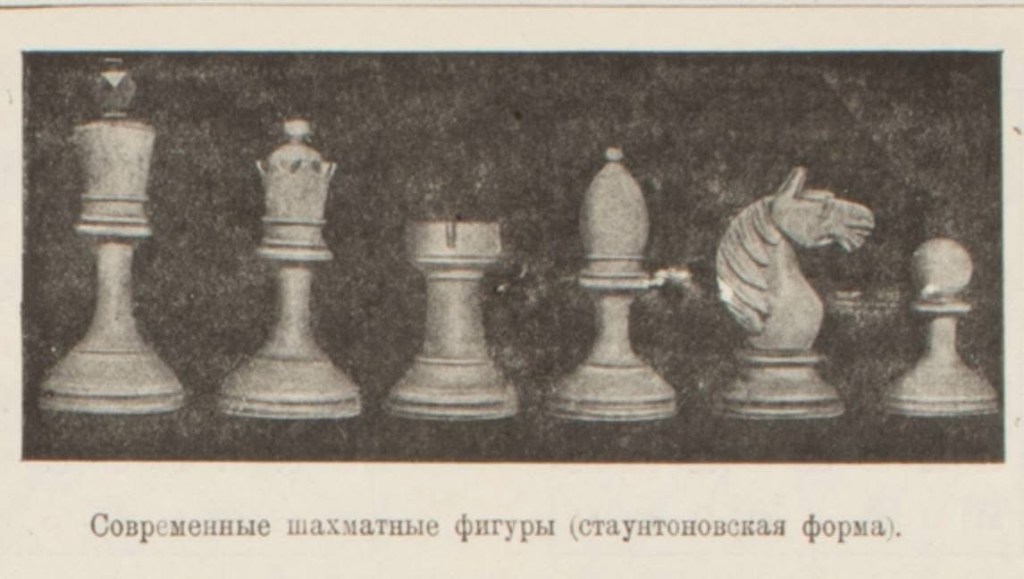
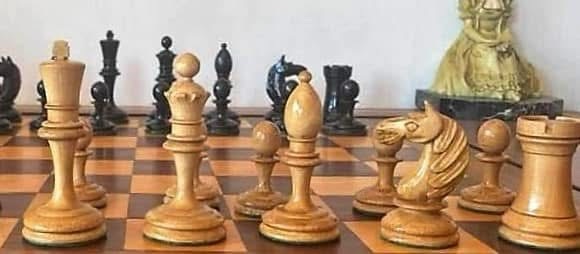
Soviet Master Ilyan Maizelis included a photo of the pictured set in his famous primer “Chess Beginnings” (1937). There he described it as “Modern Chess Figures (Staunton form).” At 9. So the set dates no later than 1937. For sake of convenience, I’ll refer to it as “Maizelis’s Set,” though I have no other evidence that he actually owned or played with one like it.
Photo courtesy of Sergey Kovalenko.Photo courtesy of Sergey Kovalenko.
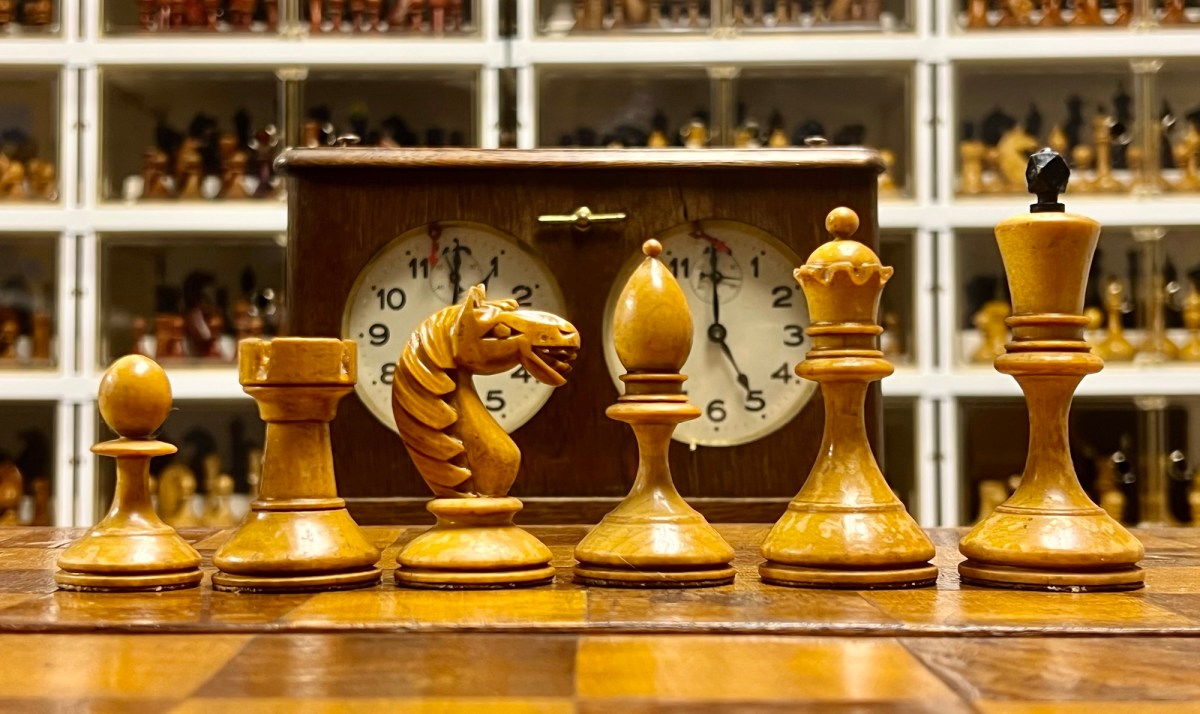
I recently added such a set to my Soviet and Tsarist collection.
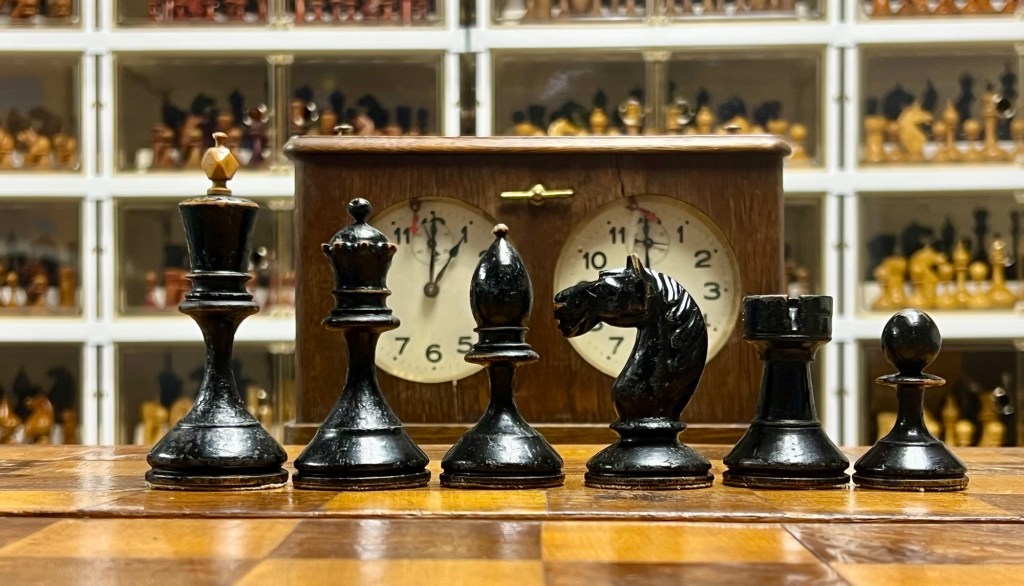
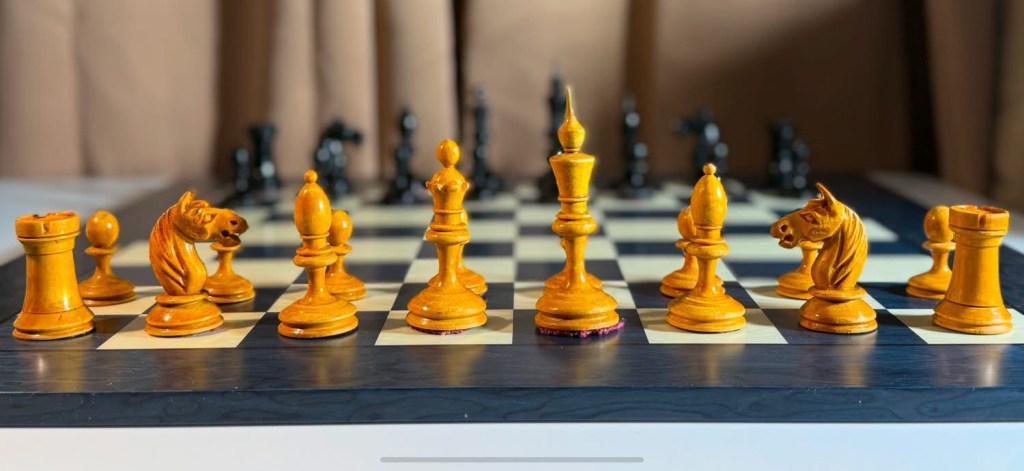
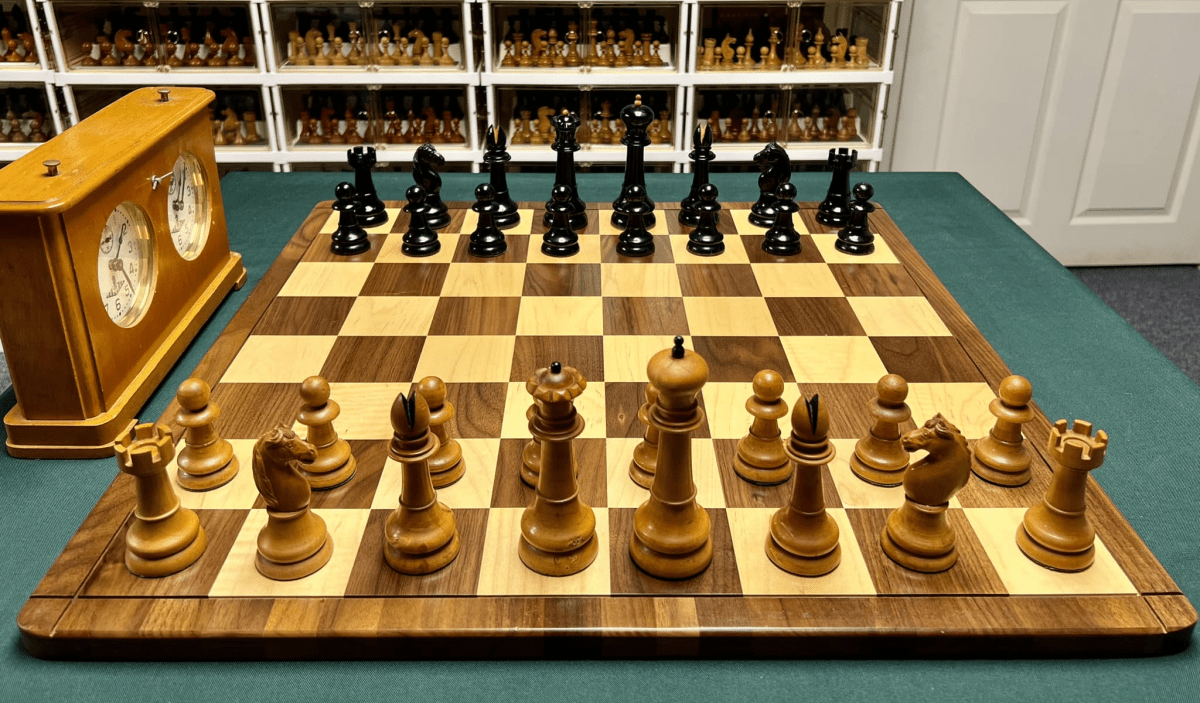
The set is magnificently turned, carved finished, and weighted, with several small defects, a couple chipped coronet tips, broken finials on a White Bishop, a partially broken off finial on the White King, a few cracks and worn finish for character.
Chuck Grau photos.
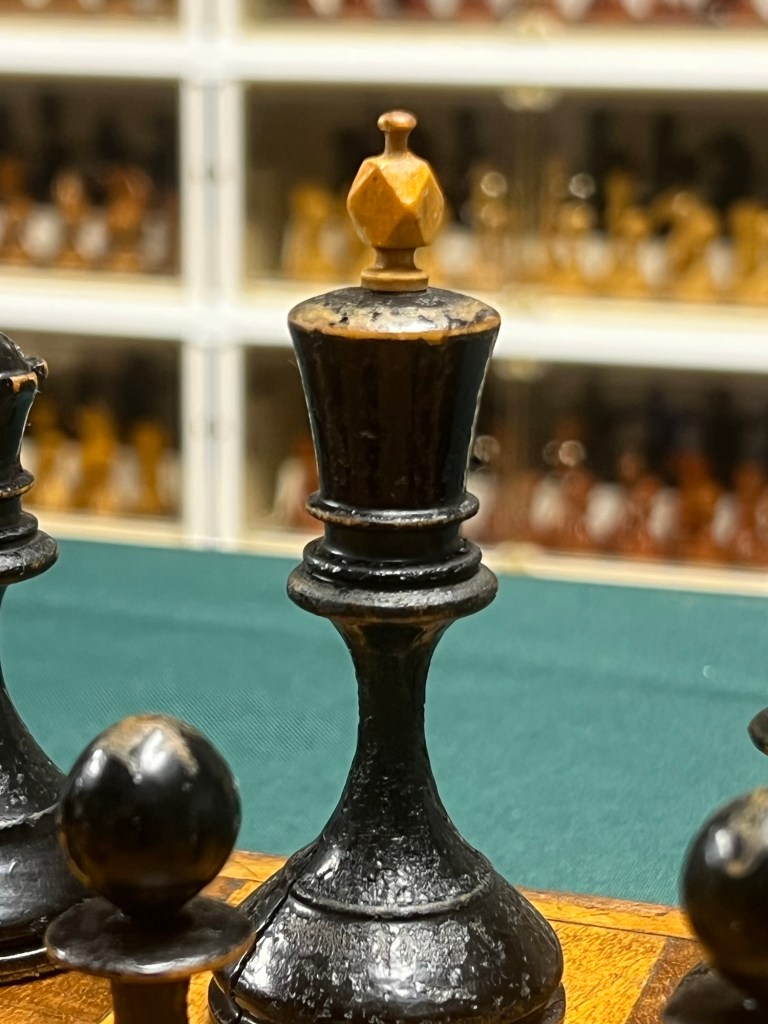
The Black King measures 97 mm with its fully intact finial. The Kings’s finials are carved in a unique diamond pattern. The Black pieces are painted with age-consistent wear and chipping, but the White pieces have a finish approximating French polish akin to two Tsarist sets that have matriculated through my collection. Beautiful patina.
Diamond-shaped finial. Chuck Grau photo.
The Knight carving is spectacular, the best of any of my Soviet sets and even better than my best Tsarist ones. Highly detailed mane carvings on both sides of the torso. Crisp mouth and eye details. Just spectacular.
Chuck Grau Photo.
The style is of the group of sets commonly but not unreasonably mistaken for the 1933 Botvinnik Flohr match. I included pictures of several of these sets in my article on the 1933 set.
Antonio Fabiano Collection, photo.Stephen Kong Collection, photo.Murat Dzhemakulov Collection.
Shane Chateauneuf recently acquired a beautiful, related set.
Shane Chateauneuf Collection, photo.
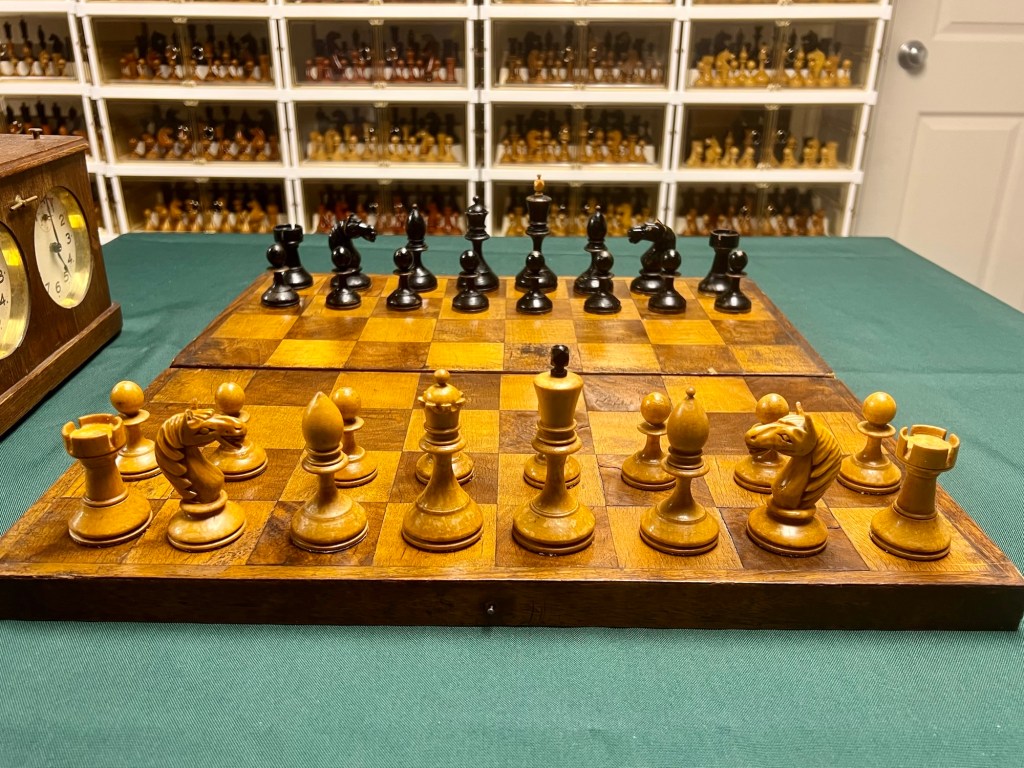
The board accompanying my set is wonderful in its own right. Beautiful veneer worn consistent with its age. Gorgeous patina. 53 mm squares are perfectly sized for the pieces, very un-Soviet. None of the asphyxiation that Arlindo Vieira repeatedly complained of. This is perhaps another factor hinting that the set may be much older than 1937.
Chuck Grau photo.
Simply a gem.
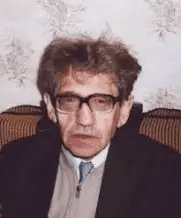
Ilyan Lvovich Maizelis
Ilya Lvovich Maizelis
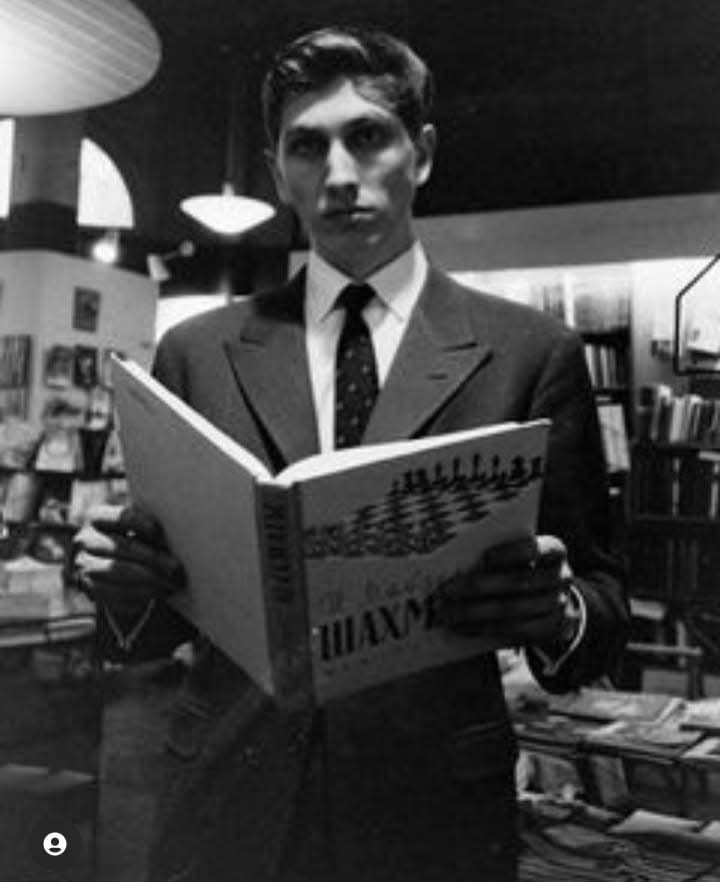
A close friend of Yuri Averbakh, Maizelis was a noted teacher and author, even outside the Soviet Union. No less than Bobby Fischer studied his work.
Courtesy of Jorge Njegovic Drndak
Soviet chess historian Jorge Njegovic Drndak has compiled this brief biography:
Ilya Lvovich Maizelis (1894-1978)
He was born on December 28, 1894 in Uman, a small village in the Cherkasy region. Having passed college in Ukraine, Ilya won the Union-wide Tournament of Cities in 1924 (a parallel tournament). Once in Moscow, Maizelis quickly joined the chess movement and became one of its most prominent figures.
Having started working as a chess journalist, Maizelis covered the Alekhine-Teichmann match (Berlin, 1921), at that time Alexander Alexandrovich’s name was not yet animated in his homeland. Ended with a score of 3:3.
Ilya Maizelis was close friends with Emanuel Lasker. It was he who during the Moscow International Tournament (1925) handed the great thinker a telegram saying that the work of the second world champion would be staged. The played Lasker ended up getting the foot of the “mill” in the match against Torre, but consoled the young man, who at first considered himself responsible for this defeat of the great chess player.
Maizelis was one of those who convinced Emanuel to move to the USSR, take Soviet citizenship and train for the national team. Shortly before leaving for America, Lasker handed the journalist the manuscript of his children’s book. Ilya’s friend Alexander Ilyin-Zhenevsky believed it was Maizelis’ duty to publish the book, but the work “How Victor Became a Chess Master” was only published in the 1970s.
Ilya Maizelis is a member of the editorial board of the magazine “64”. “Checkers and Chess in a Workers’ Club” (1925-1930), executive secretary of the publication “Soviet Chess Chronicle” (1943-1946), published in English in Moscow under the auspices of the Union Society for Cultural Relations (VOKS). He trained at the Pioneers House of the capital, but at the same time, until the late 1930s, he did not stop the practical performances, performed regularly at the finals of the Moscow championships. In 1932, Ilya Lvovich took fourth place in the championship of the capital and, of course, played in the strength of the master, but did not officially fulfill the title, opting for journalism.
Author of the books “Beginner Chess Player”, “Chess Yearbook 1937-1938”, “Fundamentals of Opening Strategy”, “For 4th Chess Players”. a and 3. “under category”, “Selected games of Soviet and International Tournaments of 1946”, “Chess Textbook Games”, “Tower vs Pawns”, “On the Theory of Tower End”, “Chess Finals. Pawns, Bishops, Horses” edited by Y. Averbakh, “chess. Fundamentals of Theory. Ilya Maizelis translated from German the books “Endgame Theory and Practice” by Johann Berger and “My System” by Aron Nimzowitsch.
With his article, he was the first in the USSR to draw attention to the 1603 painting “Ben Johnson and William Shakespeare,” attributed to Karel van Mander and depicts 17th-century English playwright playing chess. Ilya Lvovich studied the works of the poets Henry Longfellow and Heinrich Hein, translated their works into English and German.
Ilya Maizelis has compiled a chess library that is widely known not only in Moscow and the USSR, but also abroad.
“Everyone knows that Maizelis had the best chess library in Moscow and was often asked to clear up something from an old magazine or a rare book. There was a phone in the room and Ilya Lvovich used to dictate chess and variation games for a long time. Maizelis’ mother-in-law was always in the room, paralyzed and completely indifferent to everything that was going on. He sat like an idol and stared at one point.. And Maizelis, dictating movements, did not say “a-be”, like everyone else, but in a low voice – “a-be”. And then, one day, the mother-in-law, who was apparently tired of this hug to hell, said sadly, “Abe, abe… Fucking idiots! ” (J. Neishstadt).
Shortly before his death, Ilya Lvovich sold the library to good hands to preserve it for posterity. The master of Russian chess journalism passed away on December 23, 1978 in Moscow.
The history of checkers paralleled that of chess in the Soviet Union. Both games had been played for centuries, despite suffering the disapprobation of the Orthodox Church. Both were incorporated into the Soviet state’s political program to elevate and enrich the cultural level of the masses.
According to the Russian Checkers Federation, “games similar to modern Russian checkers were known to the Eastern Slavs as early as the 4th century, as indicated by numerous artifacts from archaeological excavations. References to checkers (or ‘tavleys,’ as this game was previously called in Rus) are found in some epics and other written evidence from that time.” https://shashki.ru/variations/draughts64/ During the reign of Peter I (1682-1725), checkers became popular. The first article about checkers appeared in 1803. https://www.sports.ru/others/blogs/2699763.html
Official rules were printed in 1884, and the first Russian championship was held a decade later, with the second, third, and fourth All-Russian championships played in 1895, 1898 and 1901 respectively. https://en.wikipedia.org/wiki/Russian_draughts A magazine dedicated to the game began publication in 1897. According to Russian author Maria Selenkova, by checkers had become popular, with skilled players emerging in various neighborhoods, playing in matches and and informal tournaments, and sharing their knowledge with the younger generation. https://www.sports.ru/others/blogs/2699763.html
1950s Soviet checkers set. The folding board is familiar to collectors of Soviet chess sets. Nikolai Filatov photo.
Like chess, the Russian game is played on a board with eight rows and eight ranks, the former designated by letters a-h and the latter numbers 1-8, the algebraic system familiar to modern chess players. The rules are similar to the game played in the United States, except that all pieces may capture forward or backward. Soviet players competed internationally, playing the 10 x 10 square version of draughts. Competitive games are timed, using chess clocks, and recorded using algebraic notation. Competitive players are rated using an Elo system. https://shashki.ru/federation/
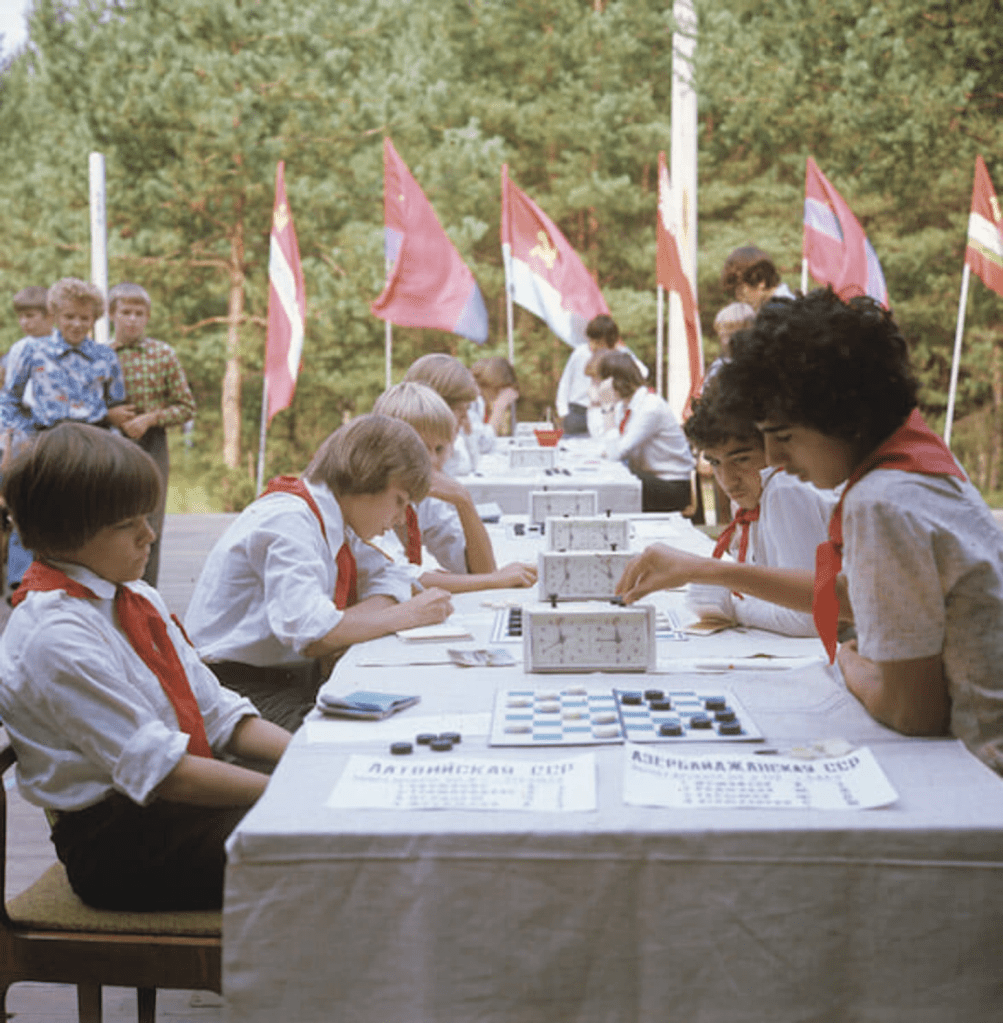
IX USSR Women’s Checkers Championship. Latvian Johanna Cine (right) congratulates Leningrader Iraida Spasskaya on her victory. Note the 8 x 8 board, the Jantar chess clock, and the scoresheets. https://www.sports.ru/others/blogs/2699763.html
During the early 20th century, checkers attracted a diverse demographic, including soldiers, workers, and traders. The game’s popularity continued to grow following the revolution, as the new government recognized the public’s interest in checkers, viewing it as a more dynamic and simpler alternative to chess.
Like chess, checkers was taken very seriously in the USSR was actively promoted by the Soviet state. In August 1924, the All-Union Chess and Checkers Section was established. Bolshevik and state prosecutor Nikolai Krylenko presided over the section. Under the section’s auspices the first USSR checkers championship was played the same year.
Krylenko spoke of the games jointly as the “chess and checkers movement.” He wrote:
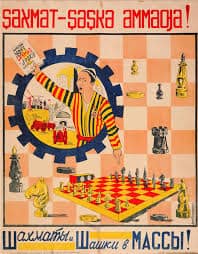
Ever since the conception of our organization, we have our slogan, Chess and Checkers into the Working Masses. We came up with this slogan to combat the theory that chess is pure art, the theory that chess is just art for art’s sake. The struggle for masses, the struggle for introduction of chess and checkers to the masses as a weapon of the cultural revolution – this is our first slogan, which we carry out ever since our organization was born.
“Chess and Checkers to the Masses!” Soviet Uzbek poster. Soviet Visuals photo.
The comrades who read our political literature, our specialized chess and checkers literature, knew clearly that if we wanted to make our movement, firstly, proletarian, and secondly, truly widespread, then the conclusion should have been obvious: a mass movement, a working-class movement is ought to be a political movement. It’s plainly impossible for the working masses, who every day take active part in the country’s political life, who every day, every hour are involved in their country’s international and internal policy – for those working masses, when they study chess and checkers in clubs, or at home, or wherever, to cease being what they are: being political activists and builders of their own state, arbiters of their country’s destiny.
In our epoch, the slogan “Chess and checkers to the masses as a weapon of cultural revolution” has been expanded: “Imbue chess and checkers with political content, make our chess and checkers players into political workers, conscientious fighters, conscientious participants of socialistic building.
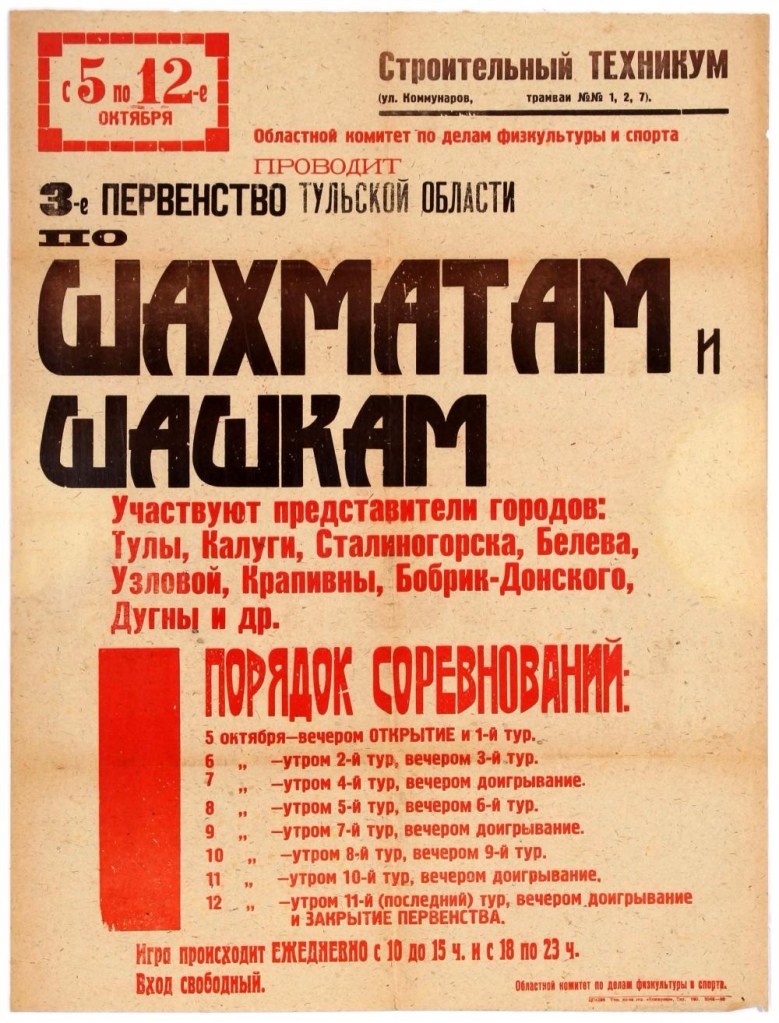
1938 Poster for Tula Chess and Checkers Competitions. Designer unknown. Antikbar Original Vintage Posters photo.
The issue of imbuing chess/checkers organizations with politics should be understood in this way: from some, we should demand that they, being organizers, being administrators, being responsible for political issues, pay much attention to political work; and we should get the others more involved in political life, make then conscientious participants of socialistic building.
I can cite a number of examples. Let’s look at the question of chess/checkers organizations’ participation in udarnik movement and socialistic competition. When you demand that the workers of this factory or that, in addition to being members of chess/checkers team, be udarniks and set high goals for themselves in socialistic competitions, as stevedores of the Lower Volga do – the checkers-playing and chess-playing stevedores – this is the way to couple cultural work with general political work, this is political work.
And there’s another form, which we can demand from more mature members of our organization – from administrators, from organizers. We measure the level of fitness for our chess/checkers work not just by purely chess/checkers talent and ability, but also by the ability to perform political and organizational work and the level of clear understanding of general political issues in our life and the imbuing of chess/checkers organizations’ work with political content.”
“In a Soviet factory lounge” 1930 [MAMM] Courtesy Sarah Beth Cohen
According to chess historian Terje Kristiansen, the above photo likely depicts “the so-called Lenin’s corner (aka Lenin’s room, Red Corner, the center of culture). Most factories and institutions had one, where pupils, students or workers met to read, chat, and play chess.” Kristiansen asked a Ukrainian-Russian friend and his Russian girlfriend about the photo. Both are now in their seventies, and are familiar with the history of chess in the Union. He shared their thoughts:
[The photo] captures the moment of the women’s chess and checkers circle. True, judging by the postures of women, by the expression of their faces and during the game on the checkerboards, the whole photo looks like a staged one (or women are just learning to play checkers and chess). You cannot see the enthusiasm and focus on the faces of the players. The two men in military uniform in the background are unlikely to be security guards. And what are they to protect here? This is clearly not a prison or a colony. Most likely, these are either the leaders of the circle, or the administrative workers of the institution (possibly the workers’ Club). In those years, many men, especially those who went through military operations, wore out military clothes (they simply did not have another). But, despite the staged plot of the photograph, I believe that it reflects the reality of that time.
A women’s championship was held in Leningrad in 1936. The next year, the section published a “Unified Checkers Code of the USSR,” providing a comprehensive set of rules for both Russian checkers (8 x 8 squares) and international checkers (10 x 10 squares).
Checkers tournaments were held all over the Union, often in conjunction with chess tournaments. Here are several posters advertising such events.
1930s poster for Tula chess and checkers competitions. Designer unknown. Poster Connections photo.
1930s ad for a Chess and Checkers tournament held by the Kaluga Regional Council of Physical Education. Match between Moscow and Kaluga. Designer unknown.
Promoted and funded by the state, the number of Soviet checkers players in the Soviet Union surpassed 100,000 by the time of the fascist invasion, rising to 1.2 million by 1960. In fact, Selenkova claims that checkers temporarily surpassed chess in popularity after the Great Patriotic War, only to fall behind again following Mikhail Botvinnik’s ascension to World Chess Champion in 1948. https://www.sports.ru/others/blogs/2699763.html
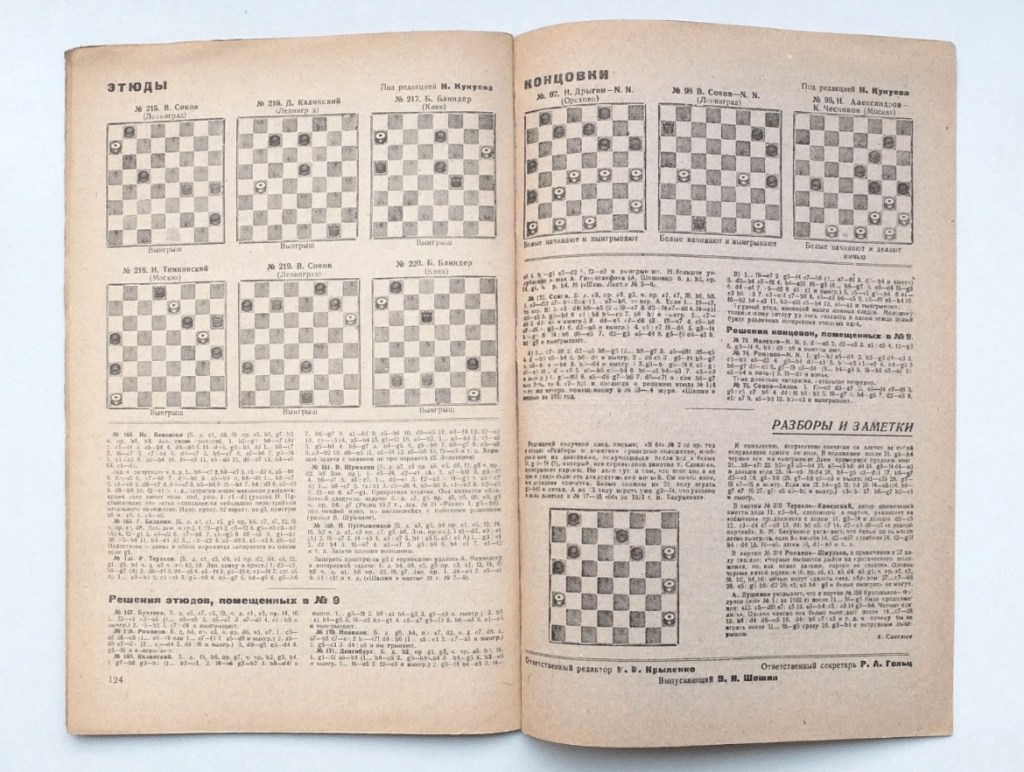
One way the Soviet state promoted chess and checkers was by publishing periodicals about them, reporting on events and presenting annotated games of instructional value. As important a chess publication as 64 carried a regular section for checkers. Here is an example:
64 No 8, 1933. “Chess and Checkers for the Masses.” Pixstock photo.
Pixstock photo.
Pixstock photo.
In the early 1950s, chess and checkers formed separate sections. By the end of the decade, checkers had developed its own federation. The USSR gained its first world champion in checkers, Iser Kuperman, in 1958. Of course, the 10 x 10 international version was played.
Iser Kuperman (R) (1922-2006). Somov/Sputnik photo (12 June 1963),
Checkers had several advantages over chess as a means of cultural enrichment. It was a much simpler game. It could be learned and played more quickly. Vodka consumption would not degrade the level of play to the same extent as in chess. While it was played on the same 8 x 8 boards as chess, the pieces were much simpler to produce, and therefore much cheaper and affordable.
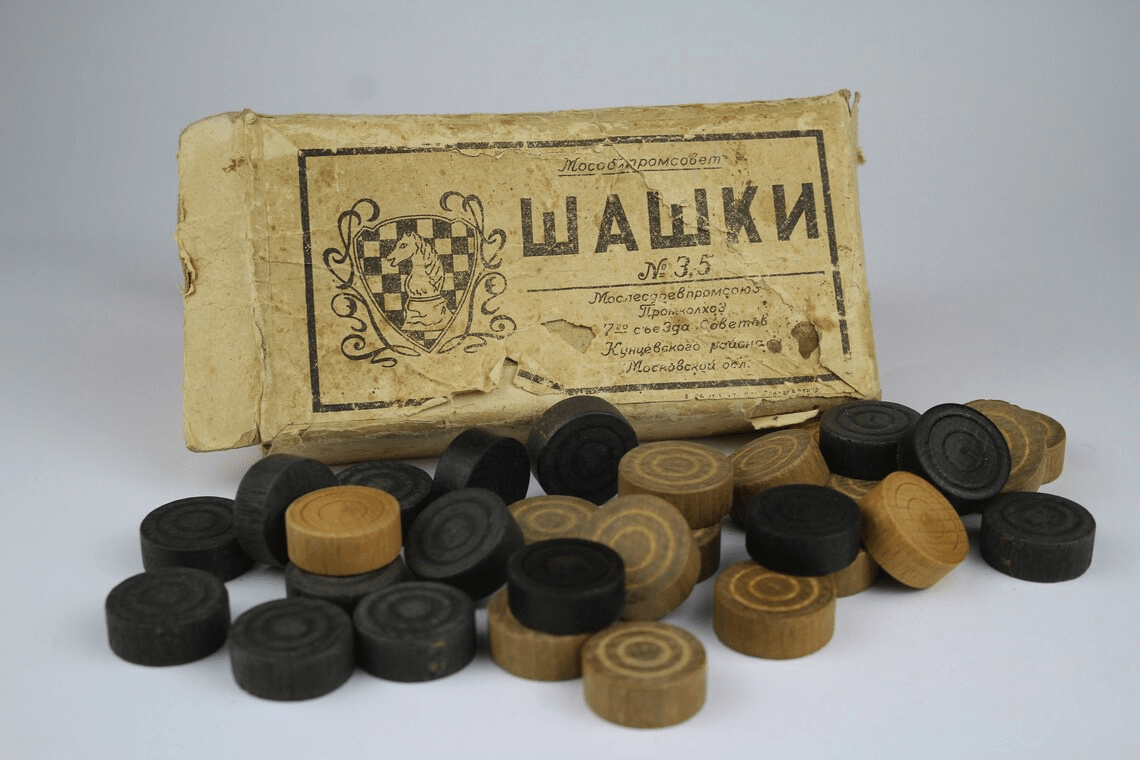
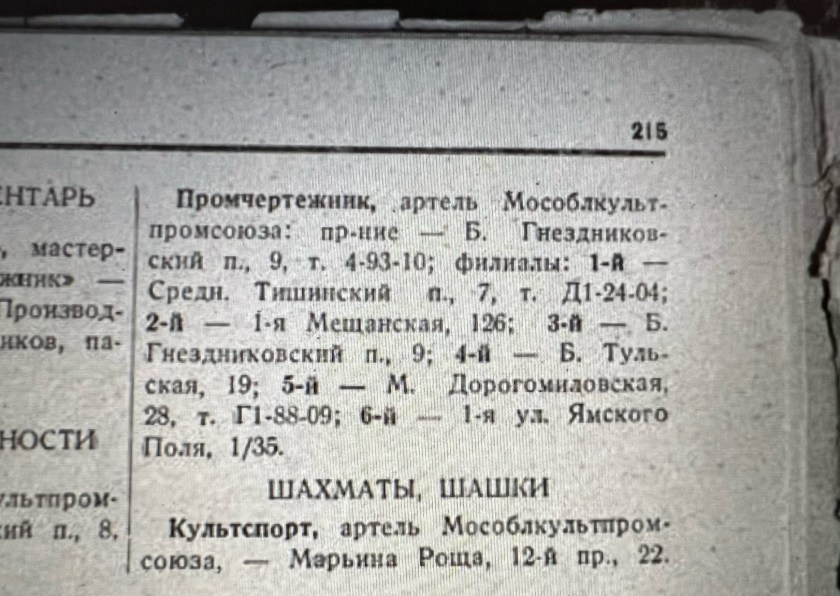
Makers of chess sets also manufactured checkers equipment. Here is a listing in the 1936 Moscow Directory for the well-known manufacturer of chess equipment, Artel Kultsport. Kultsport also advertised the sale of checkers (“шашки”) equipment.
Checkers are much simpler in design than chess pieces, and accordingly are simpler and cheaper to produce. Earlier checkers were made of wood. In the fifties, plastic pieces appeared, and soon became common.
Whereas chess pieces are not susceptible to over political messaging, checkers were not so limited. It was not uncommon for them to contain Agiprop messaging, thereby undertaking the political purpose Krylenko envisioned. A case in point is this set from the 1920s.
1920s Agitational Checkers. Russia Chess House photo.
According to Russia Chess House,
The figures depict a sickle and hammer, a star, and also a flag with the inscription “Proletarians of all countries unite”[They] are an example of agitational art of the pre-war Soviet period. There was a propaganda plan, according to which the symbols of the new government should be placed everywhere. Even matchboxes and plates had to tell the people about the accomplishments of the revolution. Utilitarian and decorative objects were to be accompanied by revolutionary slogans.”
Some checkers contained political symbols without political slogans. Here is an example from the 1940s, where the Soviet five-point star is embossed on the wooden checkers. In Soviet heraldry, the five-point star is the symbol of the Red Army. By one account, this came about through an exchange between Krylenko and Leon Trotsky.
Another claimed origin for the red star relates to an alleged encounter between Leon Trotsky and Nikolai Krylenko. Krylenko, an Esperantist, wore a green-star lapel badge; Trotsky inquired as to its meaning and received an explanation that each arm of the star represented one of the five traditional continents. On hearing that, Trotsky specified that soldiers of the Red Army should wear a similar red star.
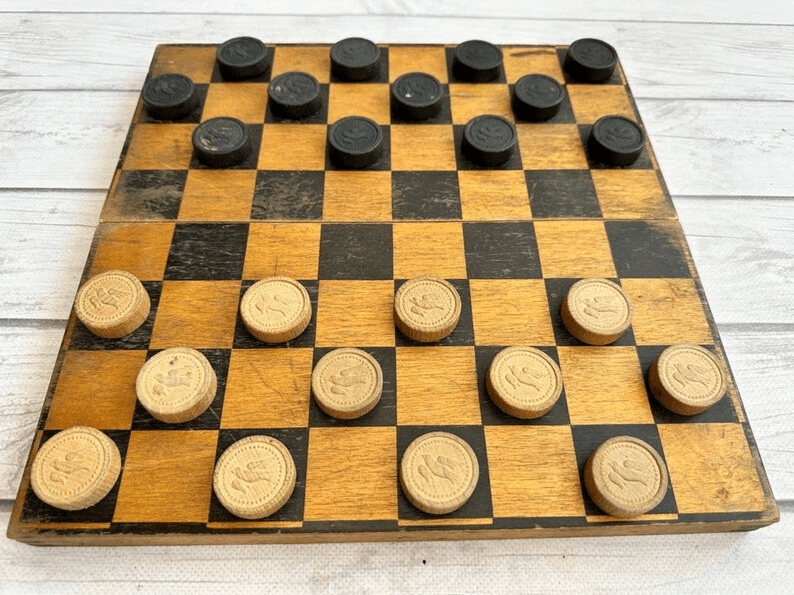
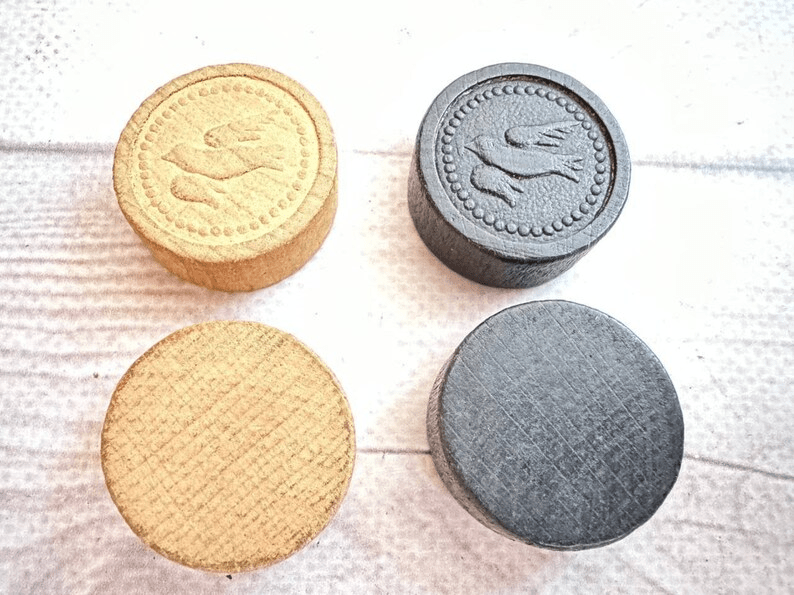
1950s Soviet checkers. Wood, with a dove of peace embossed on the front sides. Nikolai Filatov photo.
Not all the political icons carried by checkers were so bellicose. For example, these checkers (above) of the 1950s were embossed with the dove of peace. And the Bakelite checkers (below) celebrated the 1980 Moscow Olympics, which bore images of the different areas of competition.
AntiqueEmbassy photo.
Conclusion
As it did with chess, the Soviet state promoted checkers as part of its program to elevate the cultural level of the masses and to parlay the game into a means of political organizing.
Andrei Nikolaevich Hardin (1842-1910) was a Russian lawyer and chess player. He was born and lived in Samara.
According to Alexandr Yanushvesky:
Andrei Nikolaevich Hardin was passionately fond of chess. He subscribed to a great deal of foreign chess literature and could sit alone at the board for hours. According to him, he learned to play well because, having found himself somewhere in the wilderness and having a lot of free time, he would sit for days reading chess literature and studying the theory of this game. For about a year or a little more, he did not play with anyone, and after this sitting, having met Chigorin, he showed himself to be a first-class player.
Hardin came to play correspondence chess with one Vladimir Ilych Lenin, who became Hardin’s law clerk when Lenin moved to Samara. They continued playing chess, with Samara giving Lenin various odds.
Two photos of Hardin taken with a chess set are known.
While Hardin’s garb suggests that these photos were taken at different times, they most certainly appear to feature the same set and the same location. Perhaps it was Hardin’s apartment in Samara, where he played Lenin. Indeed, it well may have been the very set that he and Lenin played with.
Hardin’s set is a smaller version of what we have come to know as the “Alekhine Set,” a moniker attached to it by Singapore collector Steven Kong, who acquired it from a dealer in St. Petersburg, Russia. The set now resides in my collection.
The set is tall and heavy, finely turned, carved, and finished . The pieces have a large height to base width ratio, but their weight keeps them stable in play. The king is five inches tall with a bulging crown characteristic of Tsarist sets and reminiscent of Austrian onion top sets. The queen’s coronet eschews sharp points, protecting it from damage during the rigors of play. The bishop’s miter is unique, the cut splitting it into two equal halves. The knight’s mane flows with detail, and its features are carefully carved. The rook’s turret is exaggerated, its merlons tall and distinctly cut.
A magnificent set. A jewel. Of the finest craftsmanship a Tsarist workshop could be expected to provide.
















 Soviet and Late Tsarist Chess Sets