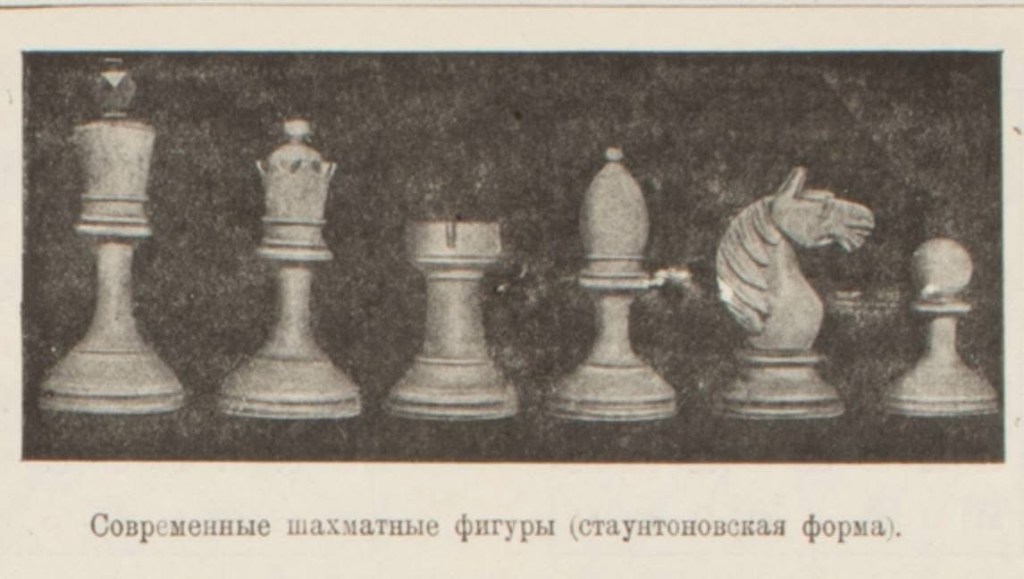
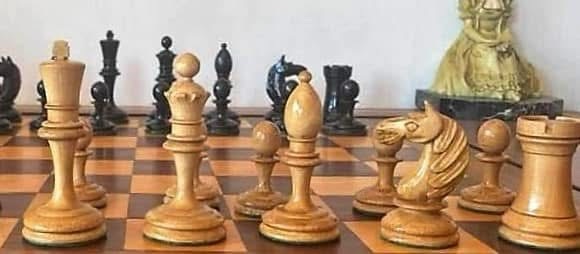
Soviet Master Ilyan Maizelis included a photo of the pictured set in his famous primer “Chess Beginnings” (1937). There he described it as “Modern Chess Figures (Staunton form).” At 9. So the set dates no later than 1937. For sake of convenience, I’ll refer to it as “Maizelis’s Set,” though I have no other evidence that he actually owned or played with one like it.
Photo courtesy of Sergey Kovalenko.Photo courtesy of Sergey Kovalenko.
I recently added such a set to my Soviet and Tsarist collection.
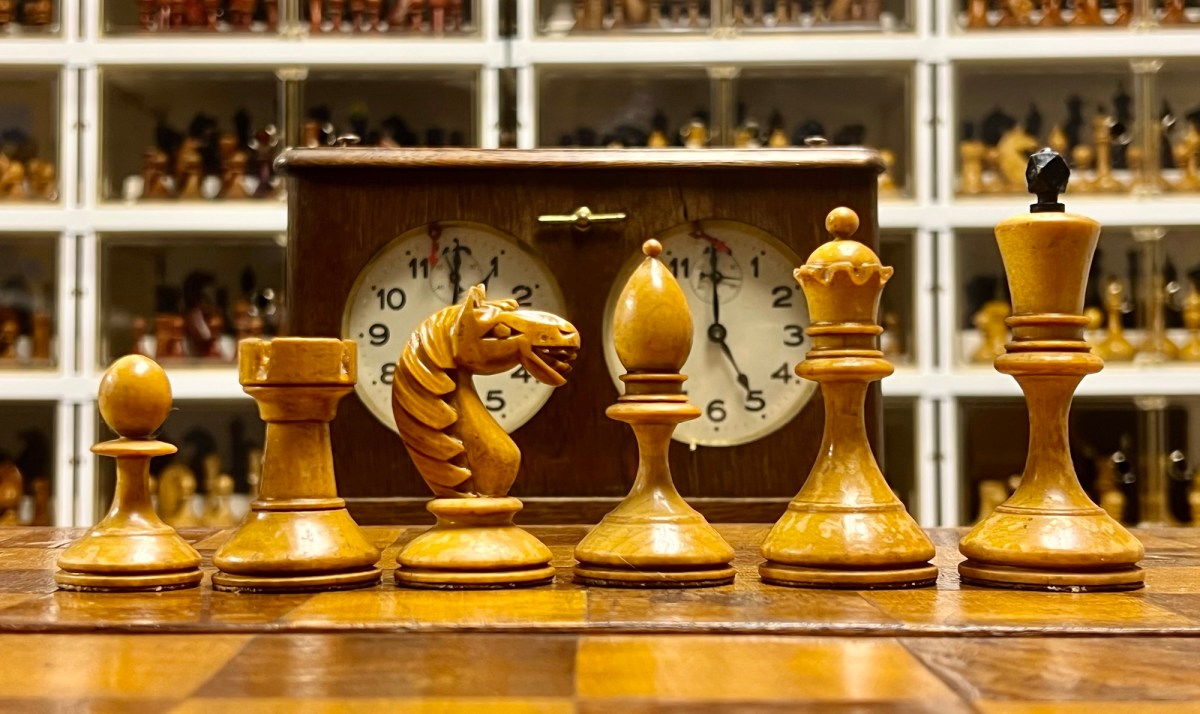
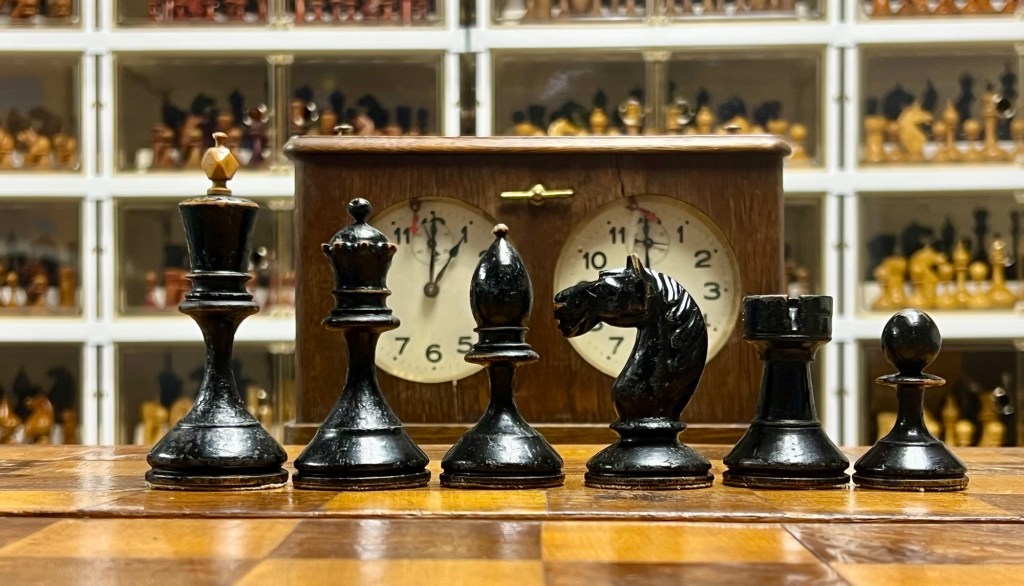
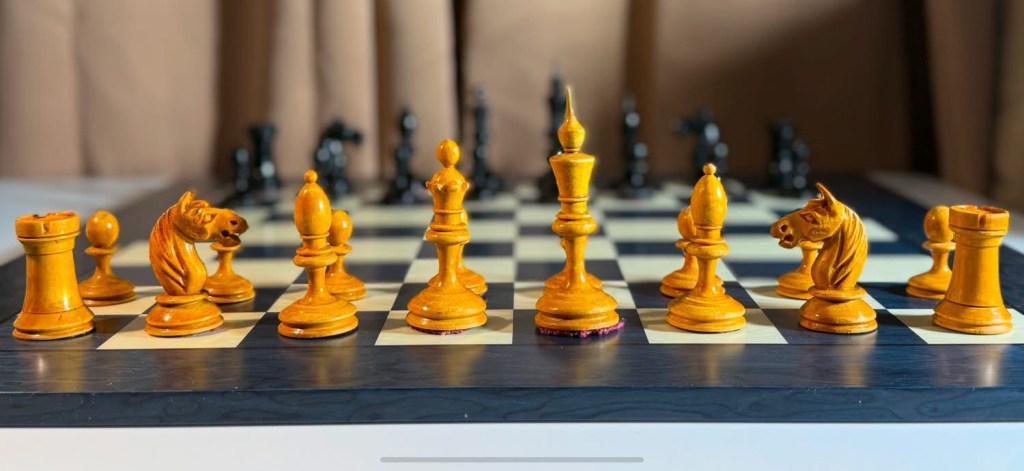
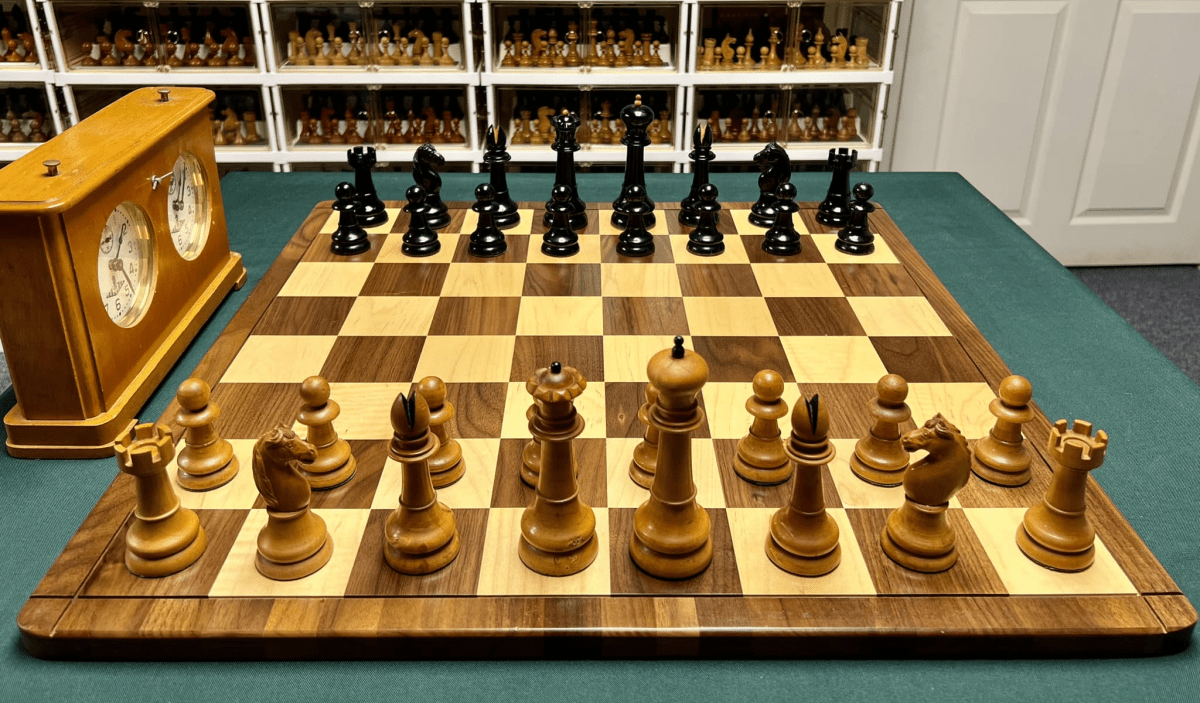
The set is magnificently turned, carved finished, and weighted, with several small defects, a couple chipped coronet tips, broken finials on a White Bishop, a partially broken off finial on the White King, a few cracks and worn finish for character.
Chuck Grau photos.
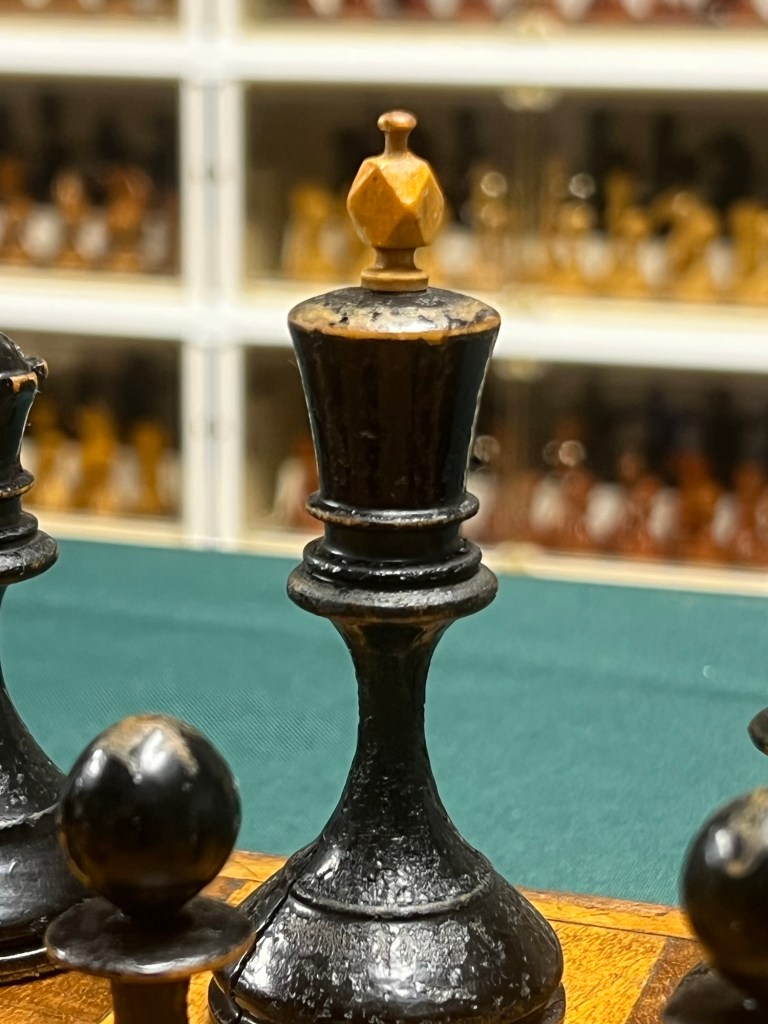
The Black King measures 97 mm with its fully intact finial. The Kings’s finials are carved in a unique diamond pattern. The Black pieces are painted with age-consistent wear and chipping, but the White pieces have a finish approximating French polish akin to two Tsarist sets that have matriculated through my collection. Beautiful patina.
Diamond-shaped finial. Chuck Grau photo.
The Knight carving is spectacular, the best of any of my Soviet sets and even better than my best Tsarist ones. Highly detailed mane carvings on both sides of the torso. Crisp mouth and eye details. Just spectacular.
Chuck Grau Photo.
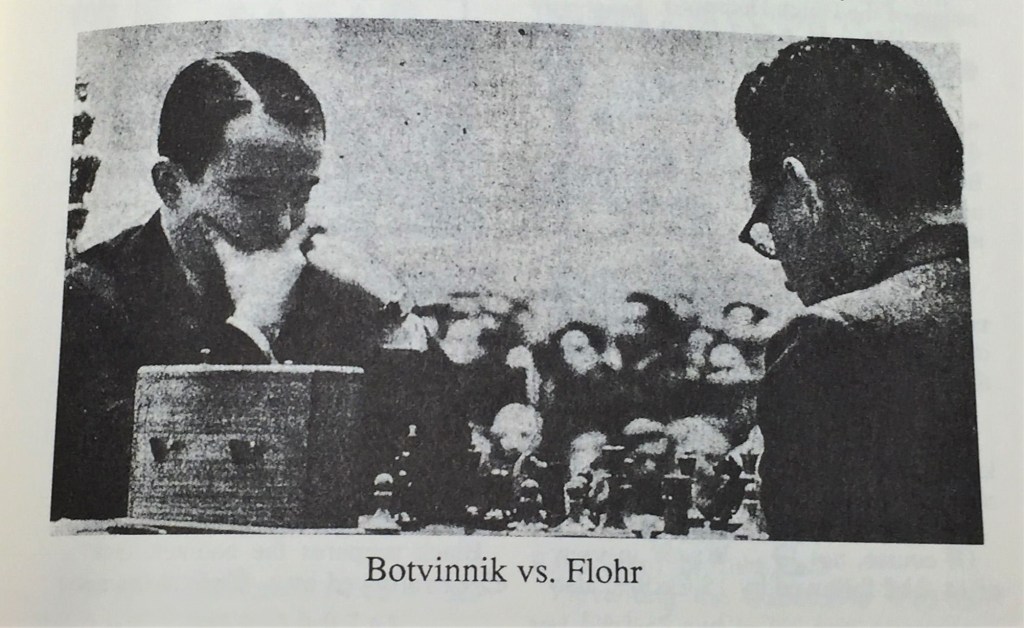
The style is of the group of sets commonly but not unreasonably mistaken for the 1933 Botvinnik Flohr match. I included pictures of several of these sets in my article on the 1933 set.
Antonio Fabiano Collection, photo.Stephen Kong Collection, photo.Murat Dzhemakulov Collection.
Shane Chateauneuf recently acquired a beautiful, related set.
Shane Chateauneuf Collection, photo.
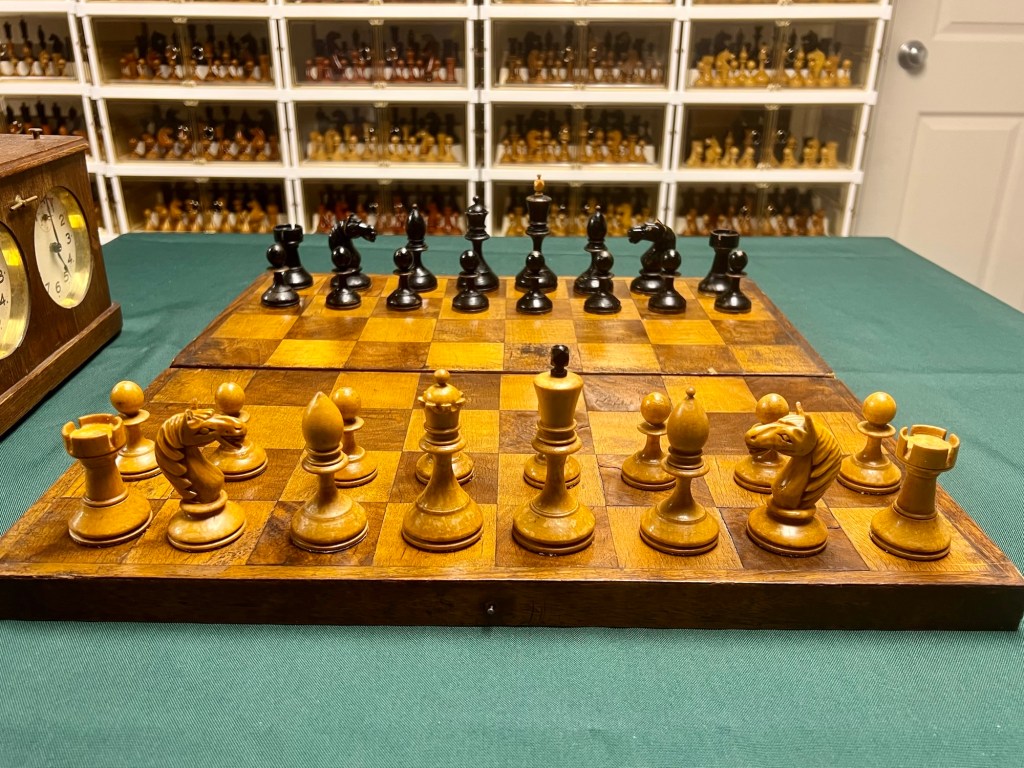
The board accompanying my set is wonderful in its own right. Beautiful veneer worn consistent with its age. Gorgeous patina. 53 mm squares are perfectly sized for the pieces, very un-Soviet. None of the asphyxiation that Arlindo Vieira repeatedly complained of. This is perhaps another factor hinting that the set may be much older than 1937.
Chuck Grau photo.
Simply a gem.
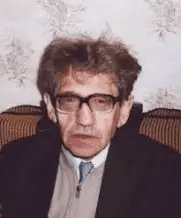
Ilyan Lvovich Maizelis
Ilya Lvovich Maizelis
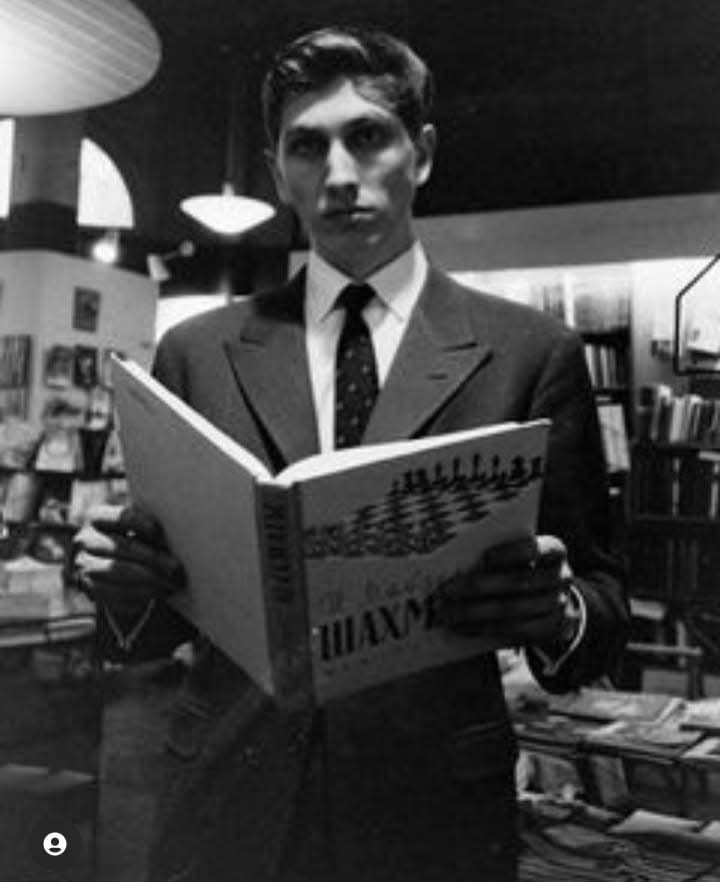
A close friend of Yuri Averbakh, Maizelis was a noted teacher and author, even outside the Soviet Union. No less than Bobby Fischer studied his work.
Courtesy of Jorge Njegovic Drndak
Soviet chess historian Jorge Njegovic Drndak has compiled this brief biography:
Ilya Lvovich Maizelis (1894-1978)
He was born on December 28, 1894 in Uman, a small village in the Cherkasy region. Having passed college in Ukraine, Ilya won the Union-wide Tournament of Cities in 1924 (a parallel tournament). Once in Moscow, Maizelis quickly joined the chess movement and became one of its most prominent figures.
Having started working as a chess journalist, Maizelis covered the Alekhine-Teichmann match (Berlin, 1921), at that time Alexander Alexandrovich’s name was not yet animated in his homeland. Ended with a score of 3:3.
Ilya Maizelis was close friends with Emanuel Lasker. It was he who during the Moscow International Tournament (1925) handed the great thinker a telegram saying that the work of the second world champion would be staged. The played Lasker ended up getting the foot of the “mill” in the match against Torre, but consoled the young man, who at first considered himself responsible for this defeat of the great chess player.
Maizelis was one of those who convinced Emanuel to move to the USSR, take Soviet citizenship and train for the national team. Shortly before leaving for America, Lasker handed the journalist the manuscript of his children’s book. Ilya’s friend Alexander Ilyin-Zhenevsky believed it was Maizelis’ duty to publish the book, but the work “How Victor Became a Chess Master” was only published in the 1970s.
Ilya Maizelis is a member of the editorial board of the magazine “64”. “Checkers and Chess in a Workers’ Club” (1925-1930), executive secretary of the publication “Soviet Chess Chronicle” (1943-1946), published in English in Moscow under the auspices of the Union Society for Cultural Relations (VOKS). He trained at the Pioneers House of the capital, but at the same time, until the late 1930s, he did not stop the practical performances, performed regularly at the finals of the Moscow championships. In 1932, Ilya Lvovich took fourth place in the championship of the capital and, of course, played in the strength of the master, but did not officially fulfill the title, opting for journalism.
Author of the books “Beginner Chess Player”, “Chess Yearbook 1937-1938”, “Fundamentals of Opening Strategy”, “For 4th Chess Players”. a and 3. “under category”, “Selected games of Soviet and International Tournaments of 1946”, “Chess Textbook Games”, “Tower vs Pawns”, “On the Theory of Tower End”, “Chess Finals. Pawns, Bishops, Horses” edited by Y. Averbakh, “chess. Fundamentals of Theory. Ilya Maizelis translated from German the books “Endgame Theory and Practice” by Johann Berger and “My System” by Aron Nimzowitsch.
With his article, he was the first in the USSR to draw attention to the 1603 painting “Ben Johnson and William Shakespeare,” attributed to Karel van Mander and depicts 17th-century English playwright playing chess. Ilya Lvovich studied the works of the poets Henry Longfellow and Heinrich Hein, translated their works into English and German.
Ilya Maizelis has compiled a chess library that is widely known not only in Moscow and the USSR, but also abroad.
“Everyone knows that Maizelis had the best chess library in Moscow and was often asked to clear up something from an old magazine or a rare book. There was a phone in the room and Ilya Lvovich used to dictate chess and variation games for a long time. Maizelis’ mother-in-law was always in the room, paralyzed and completely indifferent to everything that was going on. He sat like an idol and stared at one point.. And Maizelis, dictating movements, did not say “a-be”, like everyone else, but in a low voice – “a-be”. And then, one day, the mother-in-law, who was apparently tired of this hug to hell, said sadly, “Abe, abe… Fucking idiots! ” (J. Neishstadt).
Shortly before his death, Ilya Lvovich sold the library to good hands to preserve it for posterity. The master of Russian chess journalism passed away on December 23, 1978 in Moscow.
Andrei Nikolaevich Hardin (1842-1910) was a Russian lawyer and chess player. He was born and lived in Samara.
According to Alexandr Yanushvesky:
Andrei Nikolaevich Hardin was passionately fond of chess. He subscribed to a great deal of foreign chess literature and could sit alone at the board for hours. According to him, he learned to play well because, having found himself somewhere in the wilderness and having a lot of free time, he would sit for days reading chess literature and studying the theory of this game. For about a year or a little more, he did not play with anyone, and after this sitting, having met Chigorin, he showed himself to be a first-class player.
Hardin came to play correspondence chess with one Vladimir Ilych Lenin, who became Hardin’s law clerk when Lenin moved to Samara. They continued playing chess, with Samara giving Lenin various odds.
Two photos of Hardin taken with a chess set are known.
While Hardin’s garb suggests that these photos were taken at different times, they most certainly appear to feature the same set and the same location. Perhaps it was Hardin’s apartment in Samara, where he played Lenin. Indeed, it well may have been the very set that he and Lenin played with.
Hardin’s set is a smaller version of what we have come to know as the “Alekhine Set,” a moniker attached to it by Singapore collector Steven Kong, who acquired it from a dealer in St. Petersburg, Russia. The set now resides in my collection.
The set is tall and heavy, finely turned, carved, and finished . The pieces have a large height to base width ratio, but their weight keeps them stable in play. The king is five inches tall with a bulging crown characteristic of Tsarist sets and reminiscent of Austrian onion top sets. The queen’s coronet eschews sharp points, protecting it from damage during the rigors of play. The bishop’s miter is unique, the cut splitting it into two equal halves. The knight’s mane flows with detail, and its features are carefully carved. The rook’s turret is exaggerated, its merlons tall and distinctly cut.
A magnificent set. A jewel. Of the finest craftsmanship a Tsarist workshop could be expected to provide.
A wonderful essay authored by Alan Power, master of artistic chess set restoration and owner of the Chess Schach. Please click the link to read Alan’s highly informative article.
“For a reader living in the free world the word “thief” perhaps sounds like a reproach? But you misunderstand the term. In the underworld of the …
Mid-1930s Botvinnik-Flohr II Pieces, Chuck Grau Collection, photo.
Perhaps the most iconic Soviet chess pieces of all are what we have come to call Botvinnik-Flohr II pieces, BFII for short. In evolving variations, they were used at the highest levels of Soviet chess from the 1930s to the 1960s, including the 1934 Leningrad Masters Tournament, the 1935 Second Moscow International Tournament, the 1936 Third Moscow International Tournament, multiple Soviet Championships, and the 1956 Moscow Olympiad. World Champions Lasker, Capablanca, Euwe, Botvinnik, Smyslov, Tal, Petrosian, Spassky, and Fischer all played with pieces of this style.
For decades, BFII chess pieces served as soldiers in the front lines of the Soviet state’s program of Political Chess first pioneered by Alexander Ilyin-Genevsky in the 1920s and firmly established by Nikolai Krylenko in the thirties.
Alexander Ilyin-Genevsky, photographer unknown. Genevsky died during the Siege of Leningrad.
Genevsky served as a Red Army Commissar during the Revolution and was a master-level player and chess organizer. He believed chess was a way to teach soldiers initiative and strategic thinking. Chess, he wrote, “sometimes to an even greater degree than sport, does develop boldness, inventiveness, willpower, and something more that sport cannot do, develop strategical ability in a person.” Genevsky believed chess could do the same for the working masses, arguing that “In this country where the workers have gained victory, chess cannot be apolitical as in capitalist countries.” Krylenko had served as Commander in Chief of the Red Army during the Revolution, and later became Chief Prosecutor of the Soviet Union as well as Chairman of the All-Union Chess Section of the Supreme Council for Physical Culture. “We must finish once and for all with the neutrality of chess,” wrote Krylenko, “We must condemn once and for all the formula ‘chess for the sake of chess,’ like the formula ‘art for art’s sake.’ We must organize shock-brigades of chess-players, and begin immediate realization of a Five-Year Plan for chess.”
Nikolai Krylenko, photographer unknown. He was shot in 1938, a victim of the Purges and guilt-by-confession trials he had helped perpetrate. Ironically, one of the counts in the indictment against him alleged that he had practiced “Chess for Chess’s sake.”
Political Chess advanced on two fronts. First, it sought to increase the cultural level of the masses by teaching them chess and expanding clubs in workplaces, unions, youth organizations, and the armed forces, thereby drawing them into the political and social life of the Soviet Union. “In our country,” wrote Krylenko, “where the cultural level is comparatively low, where up to now a typical pastime of the masses has been brewing liquor, drunkenness and brawling, chess is a powerful means of raising the general cultural level.” This expansion would also improve the quality of chess play by identifying, nurturing, and advancing talent, which would thereby help the Soviets to compete with and defeat chess in the West, the second front of Political Chess. Political Chess catapulted Botvinnik to the world championship in 1948 and created a cadre of world class players who dominated chess for decades, thereby achieving Stalin’s goal of “meeting and exceeding the West.” This is an introduction to these historic pieces, which were present at every step along the Soviets’ road to world domination.
Pieces of the Mid-1930s
BFII pieces took center stage in the Krylenko’s efforts to gauge the strength of Soviet players against top level international competition, and to carry forward the “struggle at the chess board between the USSR and the capitalist countries.” Introduced at the 1934 Leningrad Tournament where future World Champion Max Euwe and Hans Kmoch, both Dutch, were brought in to compete against top Soviet players, they enjoyed the limelight at the 1935 and 1936 Moscow International Tournaments. The pieces shown as Set 1 are very similar, if not identical, to the sets used in the 1934 , 1935 , and 1936 tournaments.
Set 1. Mid-1930s Botvinnik-Flohr II Pieces, Chuck Grau Collection, photo.
The set acquires its name from the two players who shared first place in the 1935 affair, Mikhail Botvinnik and Salo Flohr, ahead of former world champions Lasker (third) and Capablanca (fourth). It was with pieces like these that the famous Mop the Floor game was played between Botvinnik and Flohr in the 1936 tournament. The II designation distinguishes these pieces from those used in the Botvinnik-Flohr match of 1933 (BFI pieces). Until the differences between the pieces used in the 1933 match and the other events were rediscovered in 2017, collectors and manufacturers of reproductions had confounded them.
Flohr and Botvinnik, Moscow 1935. Source: Moscow 1935 International Chess Tournament 177 (N. Krylenko & I. Rabinovitch eds., Caissa Ed. 1998).
The pieces comprising Set 1 were turned and carved in Leningrad at the Prometheus Cultural Goods factory on Krestovsky Island, according to a stamp in the accompanying red-stained wood box. Given the pieces’ high level of craftsmanship for a Soviet set, the Prometheus Cultural Goods factory may well have been an artel. Artels were collectives of handicraft-producing artisans, recognized by Soviet law, who organized their own production efforts and shared costs and revenues.
Collectors in Russia and Ukraine might refer to the set colloquially as a Leningrad set, as they report that it is their practice to refer to sets by using the name of the city or town where they were produced. With very few exceptions, Soviet sets went nameless, and like other Soviet consumer goods were referred to by functional designations. Thus, sets intended for tournament play were all called Tournament Chess, those for youth Yunost (Youth) Chess, and so on.
While the pieces used in the 1935 and 1936 International tournaments were clearly black and natural in color, this specimen is bright red. Stalin, our colleagues in the former SSRs tell us, did not like white pieces, as they could be seen to symbolize the White Army that fought against the Bolsheviks in the Russian Civil War. Revolutionary red, often referred to as “Stalin Red,” was to be preferred for sets made for Apparatchiks and the public.
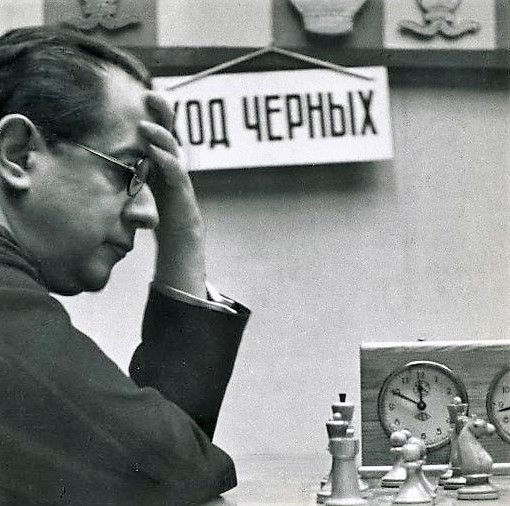
Capablanca, 1935 Moscow. Sergei Korshunov photo.
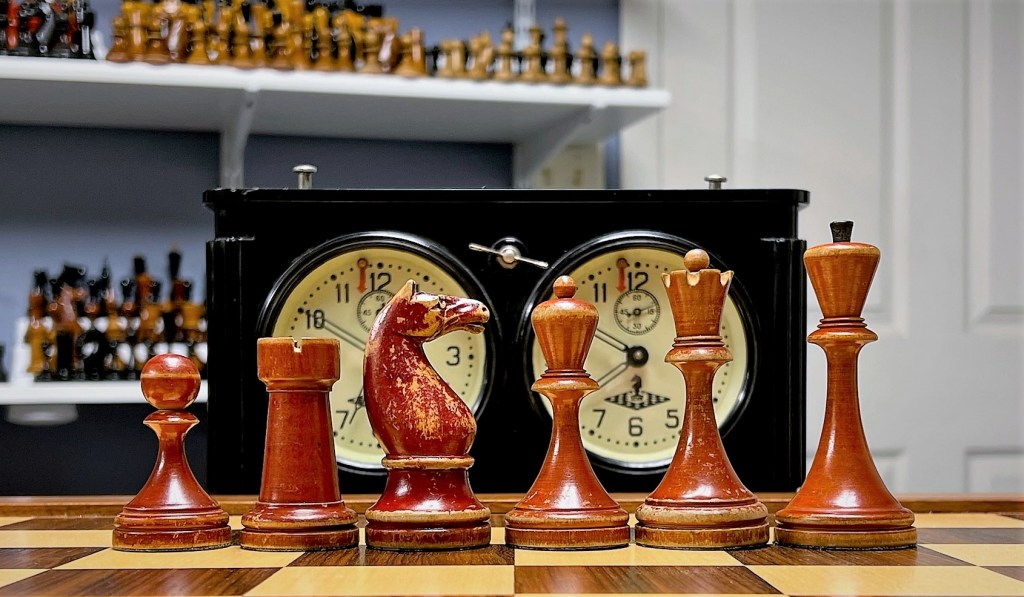
The style of these pieces differs noticeably from that of traditional English Staunton in several respects. First, the king is not topped with a same-color cross, but a secular, opposite-color finial. While the bishop’s miter at first included a cut, as we shall see it soon disappeared. The knight is simply cut and carved, echoing the lines of the 15th century Novgorod knight displayed in Linder’s works, rather than the Elgin Marbles. They lack the S-shaped back of English Staunton knights, and their ears face forward, rather than backwards, as in the English sets. The crenelations in the queen’s crown and the rook’s turret follow Staunton conventions, but soon disappeared. Unlike traditional Staunton pieces, which have an easily distinguishable base/stem/pedestal structure, these pieces flow up conically from the outside circumference of the base and ascend in a curve, which trumpets out to form the pedestal, upon which the piece signifiers and their connectors rest. This base to stem to pedestal curve was to become a basic element of Soviet style. The royals and clerics retain the double collars of the connector between piece signifier and pedestal familiar to traditional Staunton pieces. The pieces generally conform to the proportions of Staunton pieces.
Pieces of the Mid-1930s to 1940s
No sooner did the BFII design debut than it began to evolve and undergo permutations. Set 2 derives from the mid-to late 1930s. It appears in the black and natural colors characteristic of Soviet tournament sets. The bishops share the shape of the previous specimen, but the miters lack the cuts. Kings sport opposite-color bone finials. There are some variations in the carving of the knights from the previous specimen, most notably the ears, which do not extend the curve of the back but perk forward from the top of the head. Knights with this ear structure appear in many photos from the 1935 and 1936 Internationals, but to my eye the ear structure of the knights in those photos is mixed between those found in these first two specimens.
Set 2. Mid to Late 1930s BF2 Pieces. Chuck Grau Collection, photo.
Set 3 appears in a photo dated 1938 appearing in Igor Botvinnik’s Photo Chronicle (2012) tribute to his uncle. It is very similar to the original design, but the bishop’s miter has grown rounded and lost its cut. The black king’s finial is made of bone, and the set is substantially weighted.
Set 3. c. 1938 BFII Pieces. Chuck Grau Collection, photo.
In Set 4, below, we begin to see significant modifications. The king’s crown and bishop’s miter have been noticeably rounded. The crenelations on the queen’s crown and the rook’s turret have disappeared, while the cut in the bishop’s miter remains absent. The queen’s finial has changed from same-color to opposite-color. The vertical portion of the stem has been shortened, while its conical portion has been commensurately lengthened, presenting an overall conical impression. And the torso of the knight, while retaining its neo-Novgorodian profile, has ballooned in girth, leading some collectors to dub it a Penguin Knight. A very similar set likely was produced by Artel Red Combine.
Set 4. c. 1940 BFII Pieces. Chuck Grau Collection, photo.
The Olympic Version of the 1950s
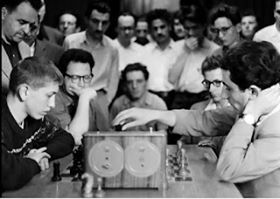
The final version of this iconic design (Set 5) appeared early in the 1950s, and was made in Valdai, Novgorod Oblast, according to an original box housing a pristine specimen of this version in the collection of Mike Ladzinski. Bobby Fischer played blitz against Tigran Petrosian with this version of the pieces, and they were the pieces used in the 1956 Moscow Olympiad and the 1957 USSR Championship.
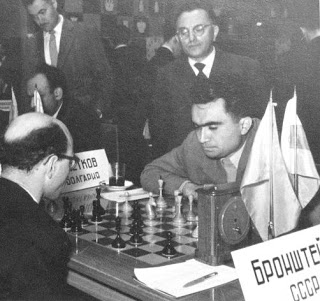
Bronstein and Minev, 1956 Moscow Olympiad. Photographer unknown.Bobby Fischer and Tigran Petrosian, Moscow 1958. Photographer unknown.
The design of this final version of the venerable BFII retreats from the radically conical version of the late thirties. The proportion of the conical lower to the vertical upper portion has diminished to that of the mid-thirties sets. While the tops of the kings and bishops remain rounded, there is a sharp joint demarking the boundary between top and side. The characteristic base/stem/pedestal curve remains. The size and girth of the knights are diminished, and the ears are pointed out to the sides for the first time. Unlike our first three specimens, the neck for the first time is not cut back from the front of the torso to the base. The height of the knight’s base is increased to compensate for the reduction in the height of the figural horse.
Set 5. 1950s Olympic BFII Pieces. Chuck Grau Collection, photo.
Set 5 is finished in natural and black, as were the sets used in the Olympiad and Soviet Championships.
Soviet Design and Political Chess
The simple style of the BFII pieces may be seen to carry forward the program of Political Chess in several ways. It facilitated cheaper mass production of chess equipment for use by the hundreds of thousands of players Political Chess would draw to the game. Beyond that, in relying on simplicity and incorporating industrial and geometric forms akin to Modernism and Constructivism, the Soviet design broke radically with the realism and neoclassical forms associated with the rise of industrial capitalism and “respectable Victorian society” expressed in the Staunton.
The design’s treatment of religious symbolism, a pillar of the Staunton design, merits elaboration. To be sure, the removal of crosses from kings and miter cuts from bishops expressed the Soviets’ underlying antipathy to religion and their efforts to repress it, but two other historical factors reinforced their aversion to the use of religious symbols in chess pieces. One is the Eastern roots of chess in Kievian Russia, where the first chess pieces bore a heavy Muslim influence in name and their geometric, abstract design, reflecting Islam’s prohibitions on the use of human forms. These Eastern influences persisted centuries longer than they did in the West, as the modernized game did not reach Russia until the rule of Peter the Great after 1760. The second is the hostility of Orthodox Christianity towards chess. Even many Tsarist designs avoided crosses and miter cuts, perhaps because more secular designs accommodated the Church and defused its opposition to the game.
Interestingly, however, early BFII pieces retained bishop miter cuts. Perhaps this reflected the pieces’ intended use in international tournaments, and an interest in keeping the pieces sufficiently familiar to foreign players participating in Soviet-sponsored international events. This may have been a factor in the Soviets’ retention of other elements of Staunton design as well, such as the relative proportions of the respective pieces. The BFII pieces—as other Soviet chess pieces we shall examine—ultimately incorporated some elements of the traditional Staunton design, while rejecting others, thereby forming what philosopher Walter Benjamin called a dialectical image in which now (modernist/simplified/geometrical/secular/socialist) confronts then (neoclassical/complex/realistic/religious/capitalist). In this way, these Soviet chess pieces embodied the “struggle at the chess board between the USSR and the capitalist countries” pursued by Krylenko’s program of Political Chess through the international and championship tournaments in which they were used.
Conclusion
The iconic Botvinnik-Flohr II design served the Soviet program of Political Chess as it scaled the ramparts of chess dominance. It is a preeminent example of how the Soviets put their mark not only on the style of chess play, but on the style of chess pieces as well.
An original version of this article appeared in the November 2021 edition of The Chess Collector Magazine, official publication of Chess Collectors International.














 Soviet and Late Tsarist Chess Sets